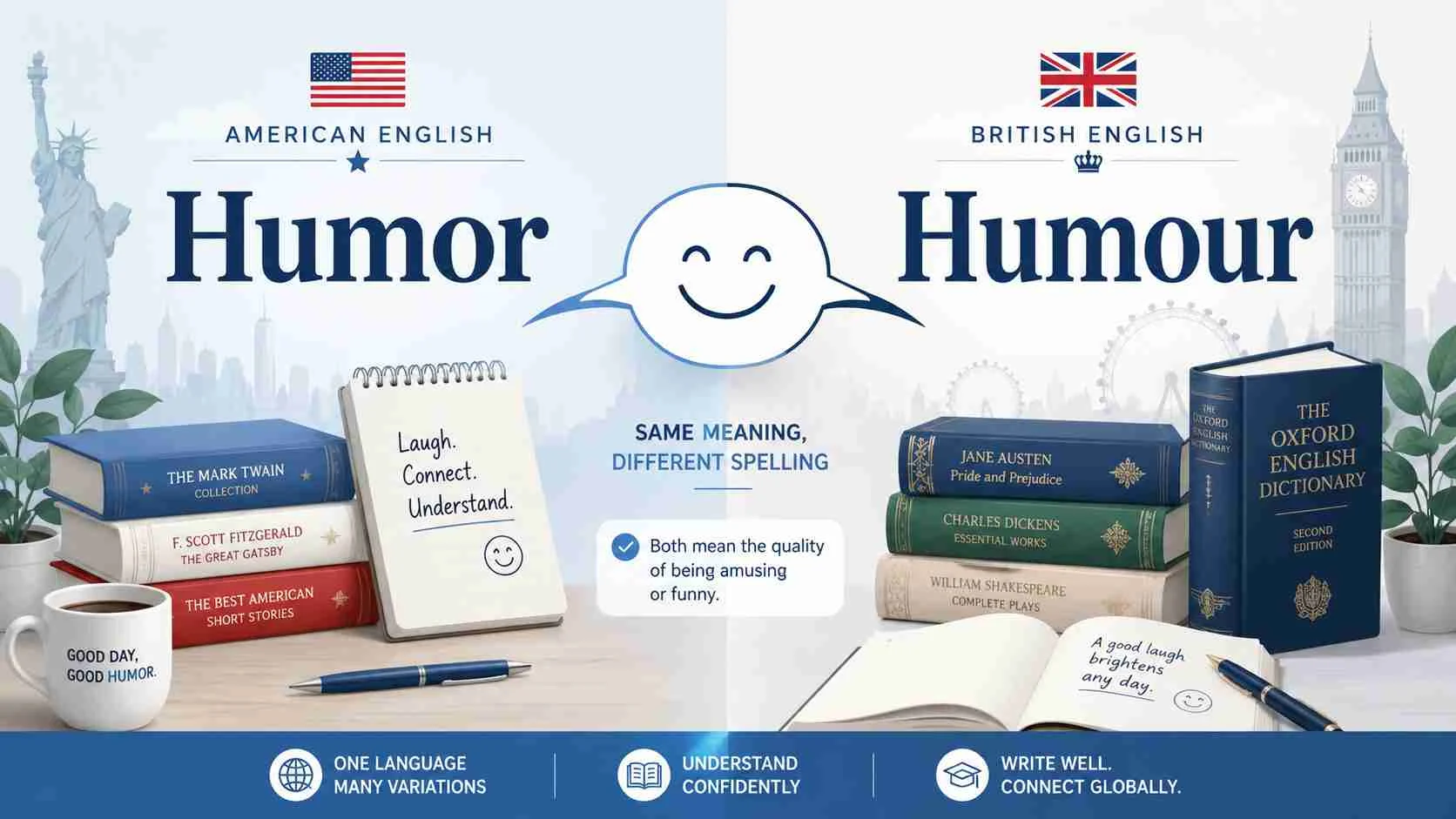
Humor or humour are two correct spellings of the same word. The difference depends on regional English. Humor is the preferred spelling in American English, while humour is standard in British, Canadian, Australian and most other forms of English.
Humor or humour is one of the most common spelling questions English learners, writers, and professionals encounter. Both words describe the quality of being amusing or the ability to recognize what is funny, yet they belong to different spelling traditions.
This confusion often leads to inconsistent writing, especially in academic papers, business communication, websites, and digital content where consistency matters. Understanding which spelling fits your audience helps improve clarity, credibility, and professionalism without changing the meaning of your message.
Humor or Humour | What’s the Difference?
At their core, humor and humour have identical meanings. The distinction lies entirely in regional spelling conventions rather than grammar or pronunciation.
| Feature | Humor | Humour |
|---|---|---|
| Part of speech | Noun | Noun |
| Meaning | The quality of being funny or amusing | The quality of being funny or amusing |
| Preferred region | United States | United Kingdom, Canada, Australia, New Zealand, Ireland |
| Pronunciation | Same | Same |
| Meaning difference | None | None |
| Formal acceptance | Standard American English | Standard British English |
Quick Recap
Both spellings are correct.
The meaning never changes between the two versions.
Your choice depends entirely on the variety of English you are using.
The most important rule is to stay consistent throughout your writing.
Is Humor or Humour a Grammar, Vocabulary or Usage Issue?
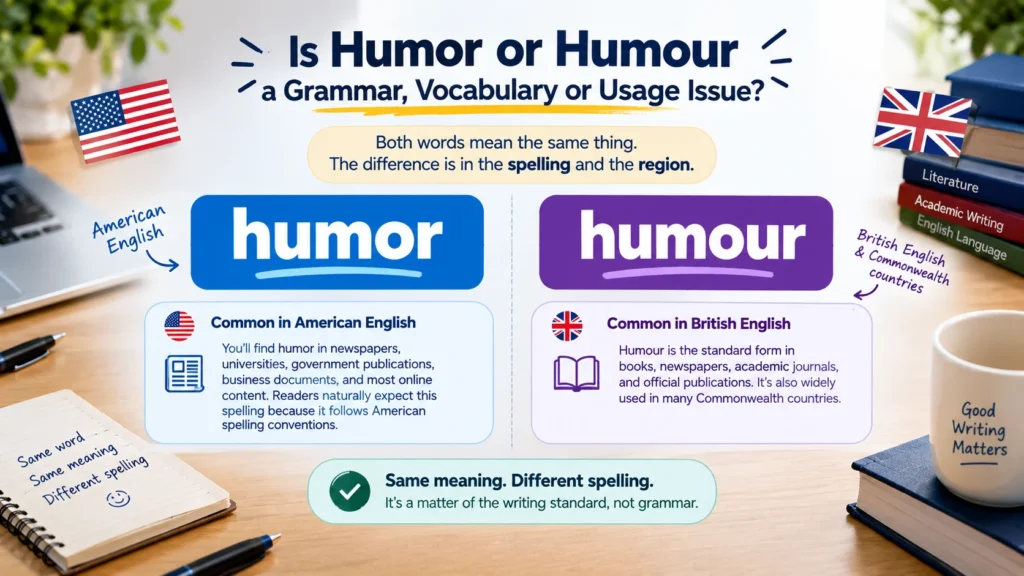
The distinction between humor and humour is a usage and spelling issue, not a grammar problem. Since both words represent the same noun and carry identical meanings, English speakers do not choose between them based on sentence structure or grammatical rules.
Instead, the decision depends on the writing standard expected by your audience.
In American English, humor appears in newspapers, universities, government publications, business documents, and most online content. Readers naturally expect this spelling because it follows American spelling conventions.
In British English and many Commonwealth countries, humour is considered the standard form. Books, newspapers, academic journals, and official publications consistently use this spelling.
Neither spelling is more formal than the other. Each is formal within its own regional variety of English. A British university would expect humour, while an American university would expect humor.
For international audiences, the safest approach is to choose one spelling based on your primary readership and maintain that choice throughout the document.
Using Humor Correctly
If you write for an American audience, humor is the preferred spelling in nearly every situation.
A workplace email might read:
“A little humor helped the team stay positive during the long project meeting.”
In an academic paper, you could write:
“Researchers examined how humor influences classroom engagement among university students.”
Within the technology industry, the spelling also follows American standards:
“The chatbot uses humor to create more natural conversations with users.”
American publishers, media organizations, and educational institutions consistently favor this spelling because it aligns with established American English conventions.
Usage Recap
Use humor when writing for readers in the United States.
Choose it for American schools, businesses, publications, and websites.
Keep the spelling consistent across the entire document for a polished and professional result.
Using Humour Correctly
If your audience is primarily in the United Kingdom, Canada, Australia, New Zealand, Ireland, or other countries that follow British English conventions, humour is the correct spelling.
Consider these examples in different contexts.
A workplace communication might say:
“A good sense of humour helped the team build stronger relationships during a demanding project.”
In an academic setting, you could write:
“The researcher explored how humour contributes to language development among young learners.”
Within the technology industry, the spelling remains consistent with British English standards:
“The virtual assistant uses humour to make interactions feel more engaging and conversational.”
Many international organizations, publishers, and universities outside the United States also adopt this spelling because it matches their editorial style guides.
Usage Recap
Use humour when writing for readers who expect British English.
Choose it for British and Commonwealth publications, educational institutions, and organizations.
Maintain the same spelling throughout your document to avoid distracting readers with inconsistencies.
When You Should NOT Use Humor or Humour
Although both spellings are correct, there are situations where choosing the wrong version can weaken your writing or make it appear inconsistent.
| Situation | What to Avoid | Better Choice |
|---|---|---|
| Writing for an American company | Switching between both spellings | Use humor throughout |
| Writing for a British university | Mixing American spelling | Use humour consistently |
| Academic papers | Changing spellings between sections | Follow the required style guide |
| Business reports | Inconsistent regional English | Choose one regional standard |
| Website content | Mixing spellings on different pages | Keep one spelling across the site |
| Marketing copy | Using both forms in the same campaign | Match the target audience |
| Professional resumes | Random spelling changes | Follow the employer’s regional English |
| Books or ebooks | Alternating spellings without reason | Maintain editorial consistency |
The key point is simple. Readers rarely notice which spelling you choose, but they often notice when both appear in the same piece of writing.
Common Mistakes and Decision Rules
The following examples illustrate how consistency improves clarity.
| Correct Sentence | Incorrect Sentence | Explanation |
|---|---|---|
| The article explains American humor. | The article explains American humour. | Use American spelling for American English. |
| British humour often relies on irony. | British humor often relies on irony. | Use British spelling for British English. |
| The company encourages humor in presentations. | The company encourages humour in presentations for its United States office. | Match the audience’s regional English. |
| The professor discussed humour in British literature. | The professor discussed humor in British literature. | British academic writing prefers humour. |
| The software adds humor to conversations. | The software adds humour to conversations for an American audience. | Keep spelling consistent with the target market. |
Decision Rule Box
If your audience uses American English, use humor.
If your audience uses British English, use humour.
And if you are writing for an international audience, select one spelling style before you begin and use it consistently from start to finish.
There is no difference in meaning. The only difference is regional spelling preference.
Humor and Humour in Modern Technology and AI Tools
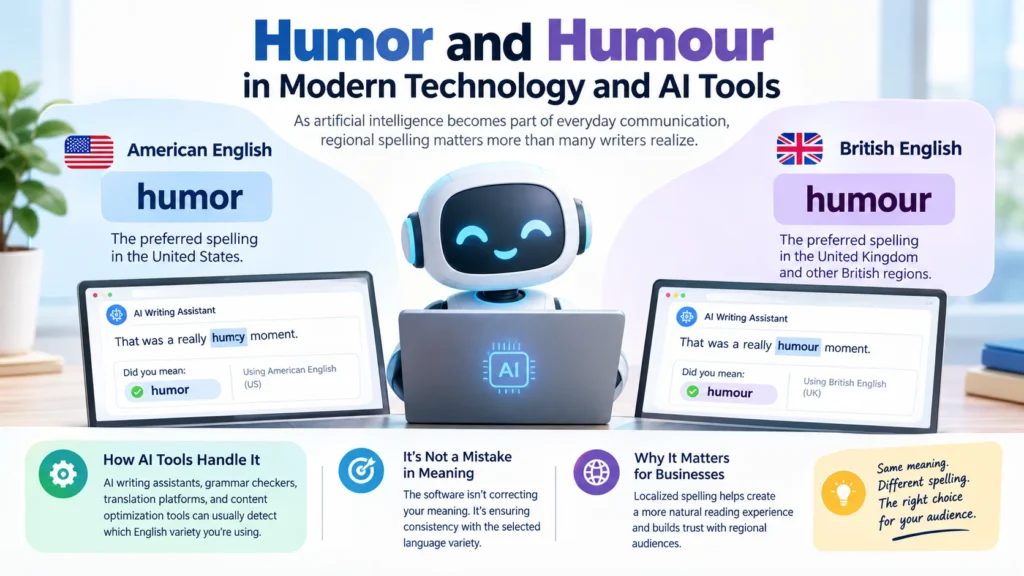
As artificial intelligence becomes part of everyday communication, regional spelling matters more than many writers realize.
Modern AI writing assistants, grammar checkers, translation platforms, and content optimization tools can usually detect a document follows American or British English. They then recommend the appropriate spelling automatically.
For example, an AI assistant configured for American English will suggest humor, while one configured for British English will recommend humour. The software is not correcting a mistake in meaning. It is ensuring consistency with the selected language variety.
This distinction is especially important for businesses that publish content for different countries. Localized spelling helps create a more natural reading experience and builds trust with regional audiences.
The Origin of Humor and Humour
The history of these spellings dates back several centuries.
The word ultimately comes from the Latin humor, meaning moisture or fluid. In medieval medicine, physicians believed that four bodily fluids influenced a person’s physical and emotional state. These were known as the four humors.
Over time, the word developed a broader meaning. It came to describe a person’s mood, temperament, and eventually the ability to appreciate or create something amusing.
British English later adopted the spelling humour, reflecting French influence on English spelling. American English, influenced by spelling reforms that favored simpler forms, retained humor.
Although the spellings evolved differently, their meanings remained exactly the same.
Good writing is not about choosing the “right” spelling. It is about choosing the right spelling for your audience and using it consistently throughout your work.
Two Real World Case Studies
Case Study 1: An Ecommerce Brand Improved Regional Engagement
An international ecommerce company published all of its blog content using American English, including the spelling humor, even for readers in the United Kingdom. After reviewing user feedback and search performance, the company created localized versions of its articles using British English, including humour.
Within three months, the British version of the content achieved a 17 percent increase in average time on page and a 12 percent improvement in organic click through rate. Visitors reported that the content felt more natural and trustworthy because it matched their everyday language.
Key takeaway: Localized spelling can improve user experience and engagement, even when the meaning of the words remains identical.
Case Study 2: A University Standardized Editorial Style
A university department accepted articles from contributors in several countries. Some writers used humor, while others preferred humour, creating inconsistency across the publication.
The editorial team introduced a style guide requiring all submissions to follow British English. As a result, proofreading time decreased by about 25 percent, and the publication presented a more professional, consistent appearance.
Key takeaway: A clear editorial standard improves efficiency and strengthens credibility.
Error Prevention Checklist
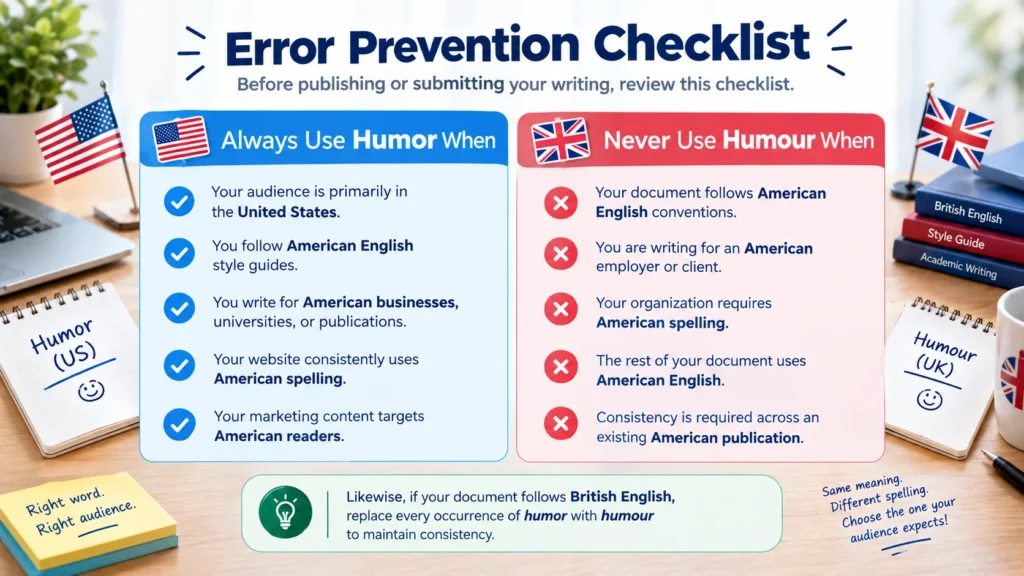
Before publishing or submitting your writing, review this checklist.
Always Use Humor When
- Your audience is primarily in the United States.
- You follow American English style guides.
- You write for American businesses, universities, or publications.
- Your website consistently uses American spelling.
- Your marketing content targets American readers.
Never Use Humour When
- Your document follows American English conventions.
- You are writing for an American employer or client.
- Your organization requires American spelling.
- The rest of your document uses American English.
- Consistency is required across an existing American publication.
Likewise, if your document follows British English, replace every occurrence of humor with humour to maintain consistency. Humour or Humor.
Related Grammar Confusions You Should Master
If you found this spelling distinction helpful, you may also want to learn these commonly confused English word pairs.
- Color or Colour
- Favor or Favour
- Organize or Organise
- Realize or Realise
- Center or Centre
- Theater or Theatre
- License or Licence
- Practice or Practise
- Traveler or Traveller
- Gray or Grey
Mastering these distinctions will help you write more confidently for different English speaking audiences and maintain a consistent editorial style.
FAQs
Is humor or humour correct?
Both are correct. Humor is the standard spelling in American English, while humour is preferred in British English and most Commonwealth countries.
What is the difference between humor and humour?
There is no difference in meaning or pronunciation. The only difference is regional spelling.
Should I use humor or humour in academic writing?
Use the spelling required by your institution or the style guide you are following. American universities generally prefer humor, while British universities typically use humour.
Which spelling is better for SEO?
Neither spelling is inherently better. The best choice depends on the audience you want to reach. If your readers are mainly in the United States, use humor. If they are primarily in the United Kingdom or other British English regions, use humour.
Why does American English use humor instead of humour?
American English adopted simplified spelling conventions during the nineteenth century. As a result, many words ending in our became or, including humor, color, and favor.
Do dictionaries accept both spellings?
Yes. Major dictionaries recognize both spellings and identify them as regional variants of the same word.
Can I use both spellings in the same article?
You should avoid mixing them unless you are intentionally comparing American and British English. Consistency makes your writing more professional and easier to read.
Is humour more formal than humor?
No. Each spelling is equally formal within its own variety of English. The appropriate choice depends on your audience, not the level of formality.
How do I know which spelling to choose?
Identify your target audience before you begin writing. Then use the spelling that matches their regional English and apply it consistently throughout your content.
Is it humor or humour?
Both humor and humour are correct. Humor is standard in American English, while humour is preferred in British English.
Conclusion
Choosing between humor or humour is much simpler than it first appears. Both spellings are correct, both carry exactly the same meaning, and both are accepted by respected dictionaries. Sense of humor or humour. The only distinction is regional convention. Use humor for American English and humour for British English and most Commonwealth varieties. humor vs humour.
The most important rule is consistency. Once you select the spelling that matches your audience, use it throughout your document. Doing so improves readability, strengthens professionalism, and ensures your writing meets the expectations of readers, editors, and search engines alike.
Discover More Related Articles:
- Koran or Quran | Why Modern English Favors One Form In 2026
- Grammar or Grammer | The English Mistake Even Smart Writers Make In 2026
- Crown or Colony | Why These Words Are Never Interchangeable In 2026