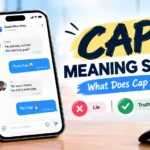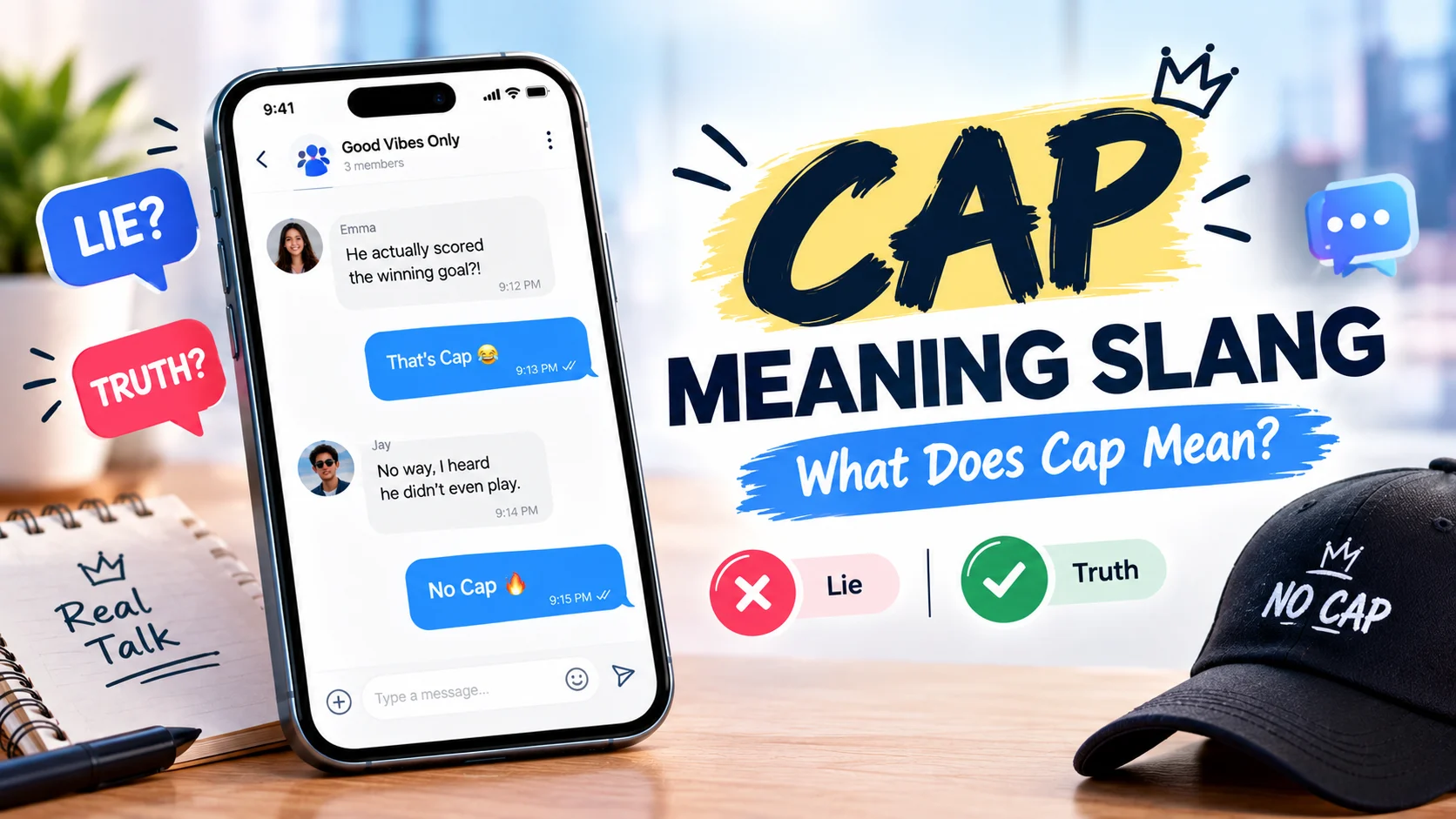
Cap meaning slang refers to a lie, false statement, exaggeration, or something that is not true. When someone says “That’s cap,” they mean “That’s not true” or “You’re lying.” In contrast, “no cap” means someone is being completely honest or serious. These expressions are especially common in texting, social media, and informal online conversations.
Cap meaning slang is commonly used in texting, social media, and everyday online conversations to describe a lie, false claim, or exaggeration. If someone says “That’s cap,” they are usually saying that they do not believe what another person has said. The opposite expression, “no cap,” is used to emphasize that someone is being honest or serious.
Because cap has several other meanings, understanding the context is important. It can refer to a type of hat, a limit, or other specialized terms, while its slang meaning is mainly associated with informal communication. This guide explains what cap means in slang, where the expression comes from, how “no cap” and “capping” are used, and how related phrases differ.
What Does Cap Mean in Slang?
In modern slang, cap means a lie or an untrue statement. If someone makes a claim that another person does not believe, they might respond with “Cap!” or “That’s cap.”
For example:
“I finished the entire project in ten minutes.”
Someone might reply:
“That’s cap.”
Here, the speaker is saying that the claim is probably untrue or exaggerated.
The word is generally used in casual communication rather than formal writing. It is common in online conversations, social media posts, text messages, and spoken informal English.
Simple Definition of Cap
Cap = a lie, false claim, or exaggeration.
No cap = honestly, seriously, or without lying.
The exact meaning can depend on context. Sometimes “cap” refers to an outright lie, while in other situations it can describe exaggeration or an unbelievable claim.
What Does “No Cap” Mean in Slang?
No cap means “I am telling the truth,” “I am not lying,” or “I am being completely serious.”
For example:
“No cap, that was the best concert I’ve ever attended.”
The speaker is emphasizing that the statement is sincere.
Another example is:
“No cap, I waited three hours for that food.”
Here, “no cap” signals that the speaker wants the listener to understand that the statement is genuine.
Because of this, no cap meaning slang is essentially the opposite of “cap.”
| Expression | Meaning |
|---|---|
| Cap | A lie or false claim |
| No cap | Truthfully or seriously |
| Capping | Lying or exaggerating |
| That’s cap | That is not true |
| Stop the cap | Stop lying or exaggerating |
What Does “That’s Cap” Mean?
That’s cap means “That is a lie,” “That is not true,” or “That sounds exaggerated.”
For example:
“He says he owns five sports cars.”
“That’s cap.”
The second speaker is expressing disbelief in the first person’s claim.
The phrase is highly informal and is usually associated with casual speech and internet communication.
What Does “All Cap” Mean in Slang?
All cap can have more than one interpretation depending on context.
When used as slang, it can mean that something is entirely false or made up. For example:
“Everything he said was all cap.”
This means the speaker believes everything being said was a lie or exaggeration.
However, all caps is also a completely different expression in writing. It means that text is written entirely in uppercase letters, such as:
THIS IS AN EXAMPLE.
Therefore, context is important.
What Does “Stop the Cap” Mean?
Stop the cap means “stop lying,” “stop exaggerating,” or “stop making false claims.”
For example:
“You said you met three celebrities yesterday. Stop the cap!”
The speaker is challenging the truthfulness of the claim.
This phrase is generally playful or confrontational depending on the conversation.
What Does “Capping” Mean?
Capping is the verb form associated with the slang use of cap.
If someone is capping, they are lying, exaggerating, or making an unbelievable claim.
For example:
“Are you capping right now?”
This means:
“Are you lying or exaggerating?”
Another example:
“She’s capping about knowing the singer.”
This means the speaker believes she is not telling the truth.
Cap Meaning Slang Origin
The modern slang use of cap has roots in African American English and earlier American slang expressions involving the word “cap.” Its development is connected with ideas of exaggeration, boasting, and false claims.
The expression became especially widespread through hip hop culture, social media, memes, texting, and internet communities.
The exact history of the slang is more complicated than simply saying that “cap” means “lie.” Earlier expressions involving “capping” and “busting a cap,” for example, had different meanings.
As a result, the modern expression no cap should be understood as a contemporary slang expression rather than assuming every historical use of the word “cap” had the same meaning.
Cap Meaning Slang in 2026
The expression cap remains recognizable in contemporary internet slang in 2026. It is particularly associated with casual online communication, youth slang, memes, texting, and social media.
However, slang changes quickly. Different online communities may use expressions differently, and some terms can become less common over time.
For formal writing, professional communication, academic work, or business correspondence, it is usually clearer to use standard expressions such as:
- That is not true.
- That is incorrect.
- I don’t believe that claim.
- That appears to be exaggerated.
- I am being honest.
Cap Meaning Slang Urban Dictionary
People sometimes search for cap meaning slang Urban Dictionary because Urban Dictionary contains user submitted definitions of contemporary slang.
Such websites can be useful for seeing how internet users use informal expressions, but user submitted slang definitions should not automatically be treated as authoritative dictionary definitions.
For a reliable explanation, it is better to compare slang usage with established dictionary sources and examples from actual contemporary communication.
Cambridge Dictionary No Cap Meaning Slang
The Cambridge Dictionary is another source people may search when researching Cambridge Dictionary no cap meaning slang.
Dictionary coverage of slang can change as language becomes more established. When checking a slang term, pay attention to the dictionary’s definition, usage label, examples, and publication or update information.
The important distinction is that no cap is an informal expression meaning that the speaker is being truthful or serious.
Merriam Webster No Cap Meaning Slang
Searches for Merriam Webster no cap meaning slang are also common because Merriam Webster regularly covers contemporary vocabulary and slang.
When researching internet slang, dictionary entries are useful for understanding recognized usage, but context remains important. A slang expression can have different meanings from the ordinary dictionary meanings of the individual words.
In modern informal usage:
No cap = no lie, honestly, seriously, or truthfully.
What Is Cap Meaning Slang?
If you are asking what is cap meaning slang, the simplest explanation is:
Cap is slang for a lie, false statement, or exaggeration.
For example:
“That story is cap.”
This means:
“That story is not true.”
Similarly:
“No cap.”
means:
“I’m telling the truth.”
Big Cap Meaning Slang
Big cap is an intensified version of “cap.” It can refer to a major lie, obvious exaggeration, or an unbelievable claim.
For example:
“He said he won a million dollars. That’s big cap.”
The expression is informal and often used humorously.
The exact intensity depends on the speaker and context. It does not necessarily refer to a specific measurable amount of dishonesty.
Cap Meaning Slang Drug
The search phrase cap meaning slang drug can be confusing because “cap” has several unrelated uses in discussions about drugs and substances.
In some contexts, “cap” can refer to a capsule or a measured container of a substance. In other contexts, people may use “cap” as part of a product or street term.
That meaning is different from the internet slang “cap,” meaning a lie.
Therefore:
Cap = lie in common modern internet slang.
But:
Cap can have other meanings in specific drug related or substance related contexts.
The surrounding words are necessary to determine which meaning is intended.
Peel Your Cap Meaning Slang
The phrase “peel your cap” is not a standard modern slang expression with one universally accepted meaning.
The word cap has appeared in different historical, regional, and cultural expressions, so unusual phrases should be interpreted according to their context rather than automatically assigning them the modern meaning “lie.”
If you encountered “peel your cap” in a song, video, post, or conversation, the surrounding sentence can provide important clues about its intended meaning.
Colonies Cap Meaning Slang
The search phrase “colonies cap meaning slang” does not correspond to a widely recognized modern slang definition of cap.
If “cap” appears alongside colonies, it may refer to a historical, geographical, organizational, or context specific use rather than the modern slang meaning of “lie.”
For accurate interpretation, the complete sentence or source should be considered.
Flat Cap Meaning Slang
A flat cap is not the same as the slang word “cap” meaning a lie.
A flat cap is a type of traditional soft brimmed hat. The word cap here refers to headwear.
For example:
“He wore a flat cap.”
This has nothing to do with lying or exaggerating.
This distinction demonstrates why context is important when interpreting the word cap.
Red Cap Meaning Slang
Red cap can have several meanings depending on context.
It may simply describe a red colored cap or hat:
“She was wearing a red cap.”
In other contexts, “red cap” can be part of a specific cultural, historical, organizational, or internet reference.
Therefore, red cap should not automatically be interpreted as the slang meaning “lie.”
Cap vs. No Cap
The easiest way to understand these expressions is to compare them directly.
| Expression | Meaning | Example |
|---|---|---|
| Cap | Lie or exaggeration | “That’s cap.” |
| No cap | Truthfully or seriously | “No cap, I loved it.” |
| Capping | Lying or exaggerating | “You’re capping.” |
| Stop the cap | Stop lying | “Stop the cap!” |
| Big cap | A major or obvious lie | “That’s big cap.” |
Examples of Cap in Slang
Here are some natural examples of how cap appears in informal communication:
Example 1
“You said you finished it already? Cap.”
Meaning: The speaker does not believe the claim.
Example 2
“No cap, this is the best pizza I’ve had.”
Meaning: The speaker is being completely serious.
Example 3
“Stop capping. I saw what happened.”
Meaning: Stop lying or exaggerating.
Example 4
“That sounds like cap.”
Meaning: That sounds untrue or exaggerated.
Example 5
“Big cap. There’s no way that happened.”
Meaning: The speaker strongly doubts the claim.
Is “Cap” a Bad Word?
Cap is generally not considered a profanity. It is informal slang used to describe lying, exaggerating, or making an untrue claim.
However, saying “you’re capping” can sound confrontational because it directly accuses someone of being dishonest.
In professional or formal situations, clearer standard language is usually preferable.
Is “No Cap” the Opposite of “Cap”?
Yes. In contemporary slang, no cap is generally used as the opposite of cap.
Compare:
“That’s cap.”
This means:
“That’s not true.”
With:
“No cap, I really enjoyed it.”
This means:
“I am telling the truth.”
The expressions therefore create a simple contrast between calling something false and emphasizing that something is true.
How to Use Cap Correctly
Use cap when you are talking casually about a statement that you believe is false, exaggerated, or unbelievable.
Use no cap when you want to emphasize that you are telling the truth or speaking seriously.
Casual:
“That’s cap.”
More emphatic:
“Stop the cap.”
Honest or serious:
“No cap.”
Avoid these expressions in formal documents unless you are intentionally discussing slang or quoting informal speech.
FAQs
What does cap mean in slang?
In modern slang, cap means a lie, false statement, or exaggeration. “That’s cap” means “That’s not true.”
What does no cap mean?
No cap means “I’m telling the truth,” “I’m not lying,” or “I’m being serious.”
What does capping mean?
Capping means lying, exaggerating, or making an unbelievable claim.
What does “that’s cap” mean?
“That’s cap” means “That’s a lie,” “That’s false,” or “I don’t believe that.”
What does “stop the cap” mean?
“Stop the cap” means “Stop lying,” “Stop exaggerating,” or “Stop making false claims.”
Is cap Gen Z slang?
Cap is strongly associated with modern internet and youth slang, including social media and texting. However, its linguistic history extends beyond current Gen Z usage.
Is cap the same as lying?
In many modern slang contexts, yes. Cap commonly refers to lying, although it can also imply exaggeration or an unbelievable claim.
Does cap mean a hat?
Yes, but that is a completely different meaning. A cap can be a type of hat, while slang cap can mean a lie.
Conclusion
The modern cap meaning slang is a lie, false claim, or exaggeration. The expression “that’s cap” is used when someone believes a statement is untrue, while “no cap” emphasizes honesty or seriousness. “Capping” means lying or exaggerating, and “stop the cap” means to stop doing so.
Because cap also has ordinary meanings involving hats, limits, containers, and other specialized uses, context is essential. In casual online communication, however, cap = lie and no cap = truthfully or seriously are the key meanings to remember.
Discover More Related Articles:
- Opp Meaning Slang | What Does Opp Mean in Texting & Social Media In 2026
- POS Meaning Slang | What Does POS Mean in Texting & Chat In 2026
- BTA Meaning Slang | What Does BTA Mean in Text, Sports, TikTok & More In 2026