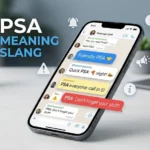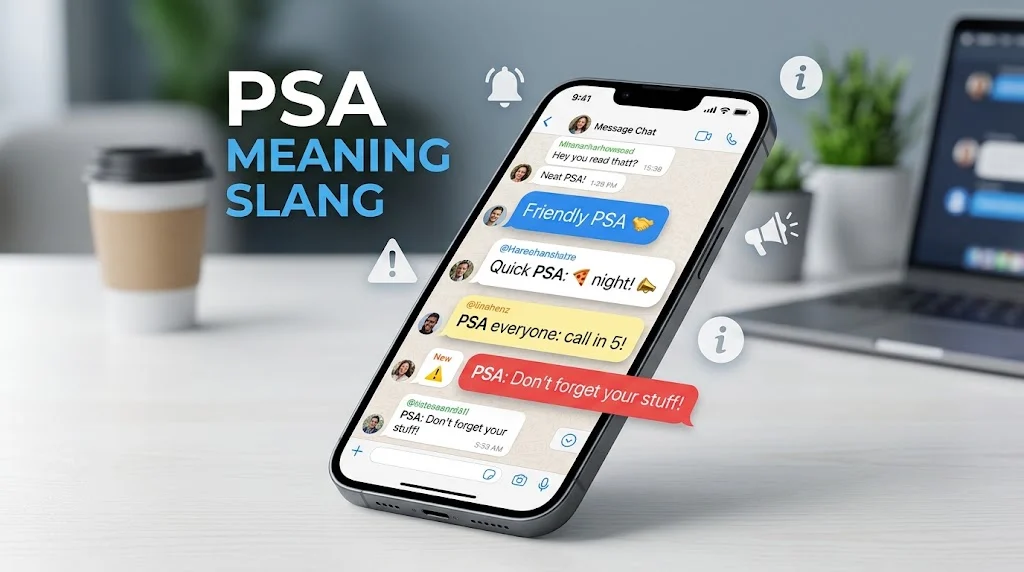
PSA usually means “Public Service Announcement” in slang, texting, and social media. People use it to introduce information they want others to notice, such as a reminder, warning, useful tip, announcement, or piece of advice. In casual online communication, “PSA” often sounds less formal than an actual public announcement and simply means, “Here’s something you should know.”
Seeing “PSA:” at the beginning of a text or social media post can feel a little dramatic. Sometimes the message is genuinely important. Other times, someone might use it before sharing a tiny life hack or a funny observation.
That flexible use explains why PSA meaning slang appears so often in searches about texting and social media.
The abbreviation itself isn’t new. PSA stands for “Public Service Announcement,” a term used for messages designed to give the public important information, often through television, radio, or the internet. Cambridge Dictionary defines a PSA as an announcement intended to give the public an important message.
Online communication has made the expression much more casual. Today, you might see “PSA: The store closes early today,” “Quick PSA,” or “Friendly PSA” in a group chat, caption, comment, or post.
So, what does PSA mean in slang? Let’s break it down.
What Does PSA Mean in Slang?
In everyday internet communication, PSA means “Public Service Announcement.”
However, people don’t always use it in the formal sense associated with television, radio, government information, or public awareness campaigns. Instead, they often borrow the phrase as a playful way to introduce something they want other people to notice.
For example:
PSA: Bring a jacket tonight. It’s going to get cold.
The writer isn’t necessarily making an official public announcement. They’re simply highlighting information that may help other people.
That’s the key to understanding the PSA slang meaning.
When someone writes “PSA:”, you can usually read it as:
- “Here’s something you should know.”
- “Quick announcement.”
- “Pay attention to this.”
- “Here’s an important reminder.”
- “I want everyone to know this.”
- “This information might help you.”
- “Heads up about something.”
The exact tone depends on the message that follows.
A serious safety warning can begin with PSA. So can a funny observation about coffee, shopping, food, or everyday life. The abbreviation stays the same while the tone changes.
Simple PSA Example
PSA: Don’t leave your phone in the car on a hot day.
Here, PSA introduces a practical warning.
Now compare that with:
PSA: Cold pizza tastes better than expected.
The second example is casual and humorous. The writer uses the structure of a public announcement for an everyday observation.
That playful contrast is one reason PSA meaning in text can feel different from the formal definition.
What Does PSA Stand For?
PSA stands for “Public Service Announcement.”
A public service announcement traditionally communicates information intended to benefit or inform the public. These announcements can cover topics such as health, safety, education, awareness, community information, or civic issues.
Dictionary.com similarly defines a PSA as an audio or video message designed to educate people or promote awareness about subjects such as health, safety, or civics.
The original concept is fairly straightforward:
Public Service Announcement = information presented for public awareness or benefit.
Internet users have simply shortened the phrase to PSA and expanded its everyday use.
Formal vs. Casual PSA Usage
| Type | Example | Purpose |
|---|---|---|
| Formal PSA | A safety announcement about seat belts | Public education |
| Community PSA | Information about a local event or service | Community awareness |
| Social media PSA | “PSA: Check your appointment time.” | Informal reminder |
| Texting PSA | “PSA: The meeting moved to 10.” | Quick announcement |
| Humorous PSA | “PSA: Never grocery shop when you’re hungry.” | Funny observation or advice |
The common thread is attention plus information.
The message appears on television or in a group chat, the writer uses PSA to signal that the next statement deserves some attention.
PSA Meaning in Texting
The PSA meaning in texting is usually Public Service Announcement, but the phrase has a relaxed, conversational feel.
Someone may put PSA at the beginning of a text when they want to make sure another person or group notices something.
For example:
PSA: The appointment starts at 8 instead of 9.
Or:
Quick PSA: Don’t forget your charger.
Or:
PSA everyone, the deadline changed.
In each case, PSA works as an attention signal.
It tells the reader that the following information isn’t just random conversation. The sender considers it useful, timely, or worth noticing.
Why People Use PSA in Texts
A text message moves quickly. People often skim messages rather than reading every word carefully.
Putting PSA at the front gives the message a little visual punch.
Instead of writing:
“I wanted to let everyone know that the schedule changed.”
Someone might write:
PSA: The schedule changed.
The second version gets to the point immediately.
It also creates a recognizable tone. The abbreviation feels familiar, informal, and slightly attention grabbing.
Common PSA Text Messages
Here are natural examples:
- PSA: The office closes at 4 today.
- Quick PSA: Bring cash because they don’t take cards.
- PSA everyone: The class has moved to Room 204.
- Friendly PSA: Back up your files before updating your laptop.
- Just a PSA: The event starts at 7, not 8.
- PSA guys: Don’t forget the tickets.
None of these uses requires an actual government or organizational announcement.
That’s the important shift between the original meaning and modern casual usage.
PSA Meaning in Chat
In online chat, PSA often functions as a mini announcement.
You might see it in:
- Group chats
- Community chats
- Gaming chats
- Workplace messaging
- Class groups
- Family conversations
- Online forums
- Social media comments
For example:
PSA everyone: The server will be down tonight.
Or:
PSA: The assignment deadline is tomorrow.
The abbreviation helps the writer address multiple people without writing a long introduction.
PSA in Group Chats
Group chats are especially suited to PSA because one person often needs to communicate the same information to several people.
Instead of individually telling five people that plans have changed, someone can write:
PSA: Dinner is at 7:30 now.
The message is short. The audience is clear. The purpose is obvious.
PSA in Private Chats
PSA can also appear in a one-to-one conversation.
For example:
PSA: Your favorite restaurant is offering free delivery today.
That doesn’t make the message less valid. The writer is using PSA for its attention grabbing effect rather than its literal public audience.
This is why PSA meaning in chat depends more on usage than on the size of the audience.
PSA Meaning on Social Media
The PSA meaning on social media is generally the same: Public Service Announcement.
What changes is the way people use it.
Social media gives users a public space where they can share information with friends, followers, communities, or strangers. PSA fits naturally into that environment because the abbreviation frames a post as something worth noticing.
A social media post might say:
PSA: Read the return policy before buying anything online.
Another might say:
PSA: Save your work before installing the update.
Someone else might use it humorously:
PSA: Eating one cookie somehow turns into eating six.
The subject changes. The basic function doesn’t.
PSA Meaning on TikTok
When people search for PSA meaning on TikTok, they’re usually encountering the abbreviation in captions, videos, comments, or spoken content.
TikTok doesn’t give PSA a separate slang definition. In ordinary usage, it still refers to Public Service Announcement.
Creators may use PSA before:
- A warning
- A useful tip
- A product reminder
- An observation
- A recommendation
- An awareness message
- A humorous statement
- A piece of advice
For example:
PSA: Check the ingredients before trying a new product.
Or:
PSA: Always screenshot your confirmation number.
The format works well on short-form platforms because viewers understand the purpose immediately.
PSA Meaning on Instagram
The PSA meaning on Instagram is also generally “Public Service Announcement.”
You may see PSA in:
- Captions
- Instagram Stories
- Comments
- Reels
- Direct messages
- Community posts
For example:
PSA: Our opening hours are different this weekend.
A creator might also write:
Friendly PSA: Drink some water before your next workout.
Again, the phrase doesn’t need to represent an official announcement.
PSA on Facebook, Reddit, and Other Platforms
The same basic usage appears across other online communities.
A Reddit user might post a PSA about a useful feature. A Facebook user might share a community reminder. Someone on another platform might use it before a funny observation.
The platform doesn’t fundamentally change the definition.
PSA is an abbreviation whose meaning comes from the phrase “Public Service Announcement.”
The surrounding text determines how seriously the writer intends it.
How Is PSA Used in Slang?
Although people often search for PSA slang meaning, PSA isn’t really a slang word in the traditional sense.
It’s better described as an abbreviation or initialism that people use informally.
In casual online communication, though, people may call it internet slang because it functions like other familiar online shorthand.
The most common structure is simple:
PSA: + information
For example:
PSA: The deadline is Friday.
You can also add a descriptive word before PSA:
Quick PSA: The store closes at 6.
Friendly PSA: Don’t forget your appointment.
Important PSA: The schedule has changed.
Just a PSA: Bring your ID.
These additions influence the tone.
“Quick PSA”
This suggests that the information will be short.
Quick PSA: The meeting starts in ten minutes.
“Friendly PSA”
This makes the announcement sound helpful rather than forceful.
Friendly PSA: Check your spam folder before requesting another email.
“Just a PSA”
This sounds especially casual.
Just a PSA: You can save that document as a PDF.
“Important PSA”
This creates a stronger sense of urgency.
Important PSA: The road will be closed tomorrow.
The abbreviation itself hasn’t changed. The modifier changes the emotional weight of the message.
Common PSA Phrases on the Internet
Certain patterns appear repeatedly in online communication.
| Phrase | Typical tone | Example |
|---|---|---|
| PSA: | Direct | PSA: The deadline is Friday. |
| Quick PSA: | Casual and brief | Quick PSA: Bring your charger. |
| Friendly PSA: | Helpful | Friendly PSA: Check your receipt. |
| Just a PSA: | Relaxed | Just a PSA: The store closes early. |
| Important PSA: | More serious | Important PSA: The schedule changed. |
| PSA everyone: | Group focused | PSA everyone: Dinner starts at 7. |
| PSA guys: | Very casual | PSA guys: Don’t forget the tickets. |
| Here’s your PSA: | Playful | Here’s your PSA: Drink some water. |
These expressions are useful because they let the writer establish the purpose of a message before delivering the actual information.
PSA Examples in a Sentence
The easiest way to understand an abbreviation is to see it in context.
Here are several examples of PSA in a sentence.
Reminder
PSA: Don’t forget to submit the form today.
The writer uses PSA to introduce a reminder.
Warning
PSA: That road gets extremely slippery after heavy rain.
Here, PSA introduces a warning.
Useful tip
PSA: Save your confirmation email before closing the page.
The abbreviation highlights practical advice.
Schedule change
PSA everyone: Tomorrow’s meeting starts at 10 instead of 9.
This example works well in a group conversation.
Community information
PSA: The library will close early this Saturday.
The information affects a broader group.
Casual observation
PSA: Frozen grapes make a surprisingly good snack.
The subject isn’t serious. The writer uses PSA playfully.
Humorous statement
PSA: Never go grocery shopping while you’re starving.
The message sounds like an official warning while discussing an everyday problem.
That’s a common feature of online PSA usage: the serious announcement format can make ordinary advice sound funnier or more noticeable.
Is PSA Always Serious?
No. PSA can be serious, practical, casual, or humorous.
The surrounding message usually reveals the intended tone.
A serious example might say:
PSA: Keep emergency contacts updated on your phone.
A casual example might say:
PSA: Bring snacks for the road trip.
A humorous example might say:
PSA: One episode is never actually one episode.
The same abbreviation works in all three.
Serious PSA Usage
Serious messages often involve:
- Health information
- Safety reminders
- Community notices
- Emergency information
- Important deadlines
- Public awareness
Casual PSA Usage
Casual messages often involve:
- Personal tips
- Recommendations
- Reminders
- Everyday advice
- Shopping information
- Social plans
Humorous PSA Usage
Humorous PSAs often imitate the formal tone of public announcements.
For example:
PSA: If you open the refrigerator three times, the fourth visit won’t magically reveal new food.
The joke comes partly from treating an ordinary observation like a formal public warning.
PSA Meaning From a Girl
If someone searches PSA meaning from a girl, the important point is simple: PSA doesn’t have a special female-specific meaning.
A girl using PSA will generally mean Public Service Announcement, just as anyone else would.
The context matters more than the sender’s gender.
For example:
PSA: Bring a sweater tomorrow.
That is simply a reminder.
Likewise:
Quick PSA: The tickets are almost sold out.
That’s an announcement.
There isn’t a hidden romantic, emotional, or gender-specific meaning built into the abbreviation itself.
If someone is trying to understand a particular message, the words surrounding PSA provide much more information than the sender’s gender.
PSA Meaning From a Guy
The same principle applies to PSA meaning from a guy.
A guy who writes:
PSA everyone: Don’t forget tomorrow’s meeting.
is using PSA as an informal announcement.
A message such as:
PSA: Bring your ID tonight.
is simply a reminder or warning.
The abbreviation doesn’t automatically communicate attraction, sarcasm, friendship, anger, or any other personal feeling.
Those meanings can come from the larger conversation, but PSA itself doesn’t create them.
PSA vs. FYI: What’s the Difference?
PSA and FYI overlap, but they aren’t identical in tone or function.
FYI means “For Your Information.”
People usually use it when passing information to someone without necessarily framing it as an announcement.
PSA means “Public Service Announcement.”
People often use it when they want to highlight information that they believe people should notice.
| Term | Full form | Common purpose | Typical tone |
|---|---|---|---|
| PSA | Public Service Announcement | Highlights information, reminders, warnings, or announcements | Attention grabbing |
| FYI | For Your Information | Passes along information | Neutral |
| Heads up | Phrase rather than abbreviation | Alerts someone to something | Direct and conversational |
Consider these examples:
FYI: The meeting moved to 3 PM.
This simply passes along information.
PSA: The meeting moved to 3 PM.
This makes the schedule change feel more like an announcement.
Neither expression is automatically more formal or more correct. The choice depends on the writer’s intended tone.
PSA vs. “Heads Up”
“Heads up” and PSA both attract attention, but they work differently.
A heads-up usually feels more direct and personal.
Heads up, the store closes at 5.
PSA can sound broader:
PSA: The store closes at 5 today.
The first feels like one person alerting another.
The second sounds like a mini announcement.
That distinction becomes less important in casual social media posts because people often use the terms loosely.
Is PSA Considered Slang?
Technically, PSA is better described as an abbreviation or initialism than as a slang word.
The expression comes from the established phrase “Public Service Announcement.”
However, internet users often use it in casual, playful ways that aren’t limited to formal public information.
That’s why searches for PSA abbreviation slang, PSA internet slang, and PSA slang meaning are common.
The most accurate explanation is:
PSA is an abbreviation that has developed a very common informal use in online communication.
Calling it “slang” isn’t unusual in everyday conversation, but the underlying expression itself isn’t a secret slang term.
Why the Distinction Matters
Compare PSA with a word that exists mainly because of internet culture.
PSA is different. It has a standard expanded form and established meaning outside social media.
Online communication simply gave it a broader everyday role.
That’s why you can encounter PSA in:
- A television announcement
- A radio message
- A newspaper article
- A social media post
- A group chat
- A text message
- An online community
The context changes. The abbreviation remains recognizable.
Is PSA an Acronym or an Abbreviation?
People often use acronym and abbreviation interchangeably, although there is a technical distinction.
An abbreviation is a shortened form of a word or phrase.
An acronym is commonly formed from the initial letters of a phrase and is typically pronounced as a word, such as “NASA.”
PSA is generally pronounced by saying its individual letters, so it is more precisely described as an initialism.
For everyday writing, however, calling PSA an abbreviation is completely understandable.
The important point for readers is its expanded form:
PSA = Public Service Announcement
You don’t need specialized terminology to understand or use it correctly.
How to Use PSA in Texting
Using PSA in a text is easy.
The most common pattern is:
PSA: [important information]
For example:
PSA: The parking lot closes at 8.
You can also use a softer variation:
Friendly PSA: Bring a jacket.
Or a more casual one:
Quick PSA: Don’t forget your keys.
Use PSA When You Want to:
- Get someone’s attention
- Share a useful reminder
- Alert a group
- Give practical advice
- Highlight a warning
- Announce a change
- Share information that affects others
PSA Works Especially Well When:
The information benefits other people.
For example:
PSA: The website is down right now, so don’t keep refreshing it.
The information is easy to miss.
PSA: Tomorrow’s class starts one hour earlier.
You want to make an ordinary message stand out.
PSA: Check the expiration date before opening that old bottle.
When PSA May Not Be Necessary
You don’t need PSA before every piece of information.
For example:
“PSA: I ate lunch.”
That doesn’t really function as an announcement unless you’re deliberately being humorous.
A good PSA usually contains information that another person might actually find useful, interesting, timely, or amusing.
PSA Meaning in Messages: What Does It Add?
A message can contain the same factual information with or without PSA.
Compare:
The event starts at 6.
with:
PSA: The event starts at 6.
The facts haven’t changed.
What changes is the framing.
The second version tells the reader:
“Pay attention. This is something I think you should know.”
That makes PSA a pragmatic tool in communication.
It doesn’t add a new factual meaning to the sentence. Instead, it signals how the writer wants the reader to interpret what follows.
This is one reason PSA meaning in messages is best understood through context.
PSA Meaning in Social Media Posts
On social media, PSA often serves as a headline-like opener.
People have limited attention when scrolling. A short phrase such as “PSA:” can make the following statement feel more noticeable.
For example:
PSA: Always check the ingredients before trying a new recipe.
The phrase creates a small pause before the advice.
It also makes the post feel more public.
That effect works especially well when the message is directed toward a community:
PSA for everyone attending the event: Parking is available behind the building.
The writer isn’t necessarily making an official announcement. They’re using the language of one.
PSA as a Friendly Reminder
One of the most common casual uses of PSA is to introduce a reminder.
For example:
Friendly PSA: Back up your important photos.
Or:
PSA: Don’t forget your appointment tomorrow.
This use is often softer than saying:
“You forgot this.”
The PSA framing can make the reminder feel less personal and more general.
Instead of directly blaming someone, the writer presents the information as something everyone should remember.
PSA as a Warning
PSA can also introduce a warning.
For example:
PSA: That shortcut gets flooded after heavy rain.
Or:
PSA: Don’t click suspicious links in unexpected messages.
The writer wants the reader to stop and pay attention.
In this context, PSA functions almost like a verbal warning label.
What Makes a Good PSA Warning?
A useful warning should be:
- Clear
- Specific
- Relevant
- Easy to understand
- Actionable when possible
For example:
PSA: Save your confirmation number before closing the booking page.
is more useful than:
PSA: Be careful online.
Specific information gives the reader something they can actually do.
PSA as an Announcement
PSA can also introduce a straightforward announcement.
Examples include:
PSA: The office will close at noon Friday.
PSA everyone: The event has moved indoors.
Quick PSA: Tomorrow’s class is online.
This is probably the closest casual internet usage gets to the traditional idea of a public service announcement.
The difference is scale.
A traditional PSA may target a large public audience. A casual social media PSA might target only a handful of friends.
PSA as Advice
People also use PSA before sharing advice.
For example:
PSA: Read the instructions before assembling the furniture.
Or:
PSA: Keep a copy of important documents somewhere safe.
The writer isn’t necessarily claiming authority.
Instead, PSA makes the advice sound like information worth passing along.
Sometimes that creates a humorous effect:
PSA: Don’t start cleaning your room at midnight unless you’re prepared to reorganize your entire life.
The formal announcement style contrasts with the ordinary subject.
PSA and Humor
Humor is one of the most interesting parts of modern PSA usage.
A formal PSA sounds authoritative. When people apply that format to something trivial, the mismatch can create a joke.
For example:
PSA: Never open a bag of chips if you aren’t prepared to finish the investigation.
The writer isn’t actually making a public safety announcement.
They’re borrowing the serious structure of one to make an everyday observation sound dramatic.
This style has a long history in popular culture. Public service announcements have also inspired parody and meme formats. Dictionary.com notes the influence of NBC’s “The More You Know” PSA campaign on later humorous online usage and memes.
That background helps explain why PSA can carry a slightly playful tone online even when the information itself isn’t serious.
Common Mistakes About PSA Meaning
Because PSA appears in many settings, several misunderstandings can occur.
Assuming PSA Always Means an Official Announcement
It doesn’t.
A social media user can write:
PSA: Wear sunscreen.
That doesn’t make the post an official public service campaign.
The user is simply borrowing the announcement format.
Assuming PSA Is Exclusive to Social Media
It isn’t.
The term predates modern social platforms and has long been used for public information messages.
Social media simply made the abbreviation easy to use in casual communication.
Assuming PSA Has a Different Meaning on TikTok
Generally, it doesn’t.
PSA meaning on TikTok is normally still Public Service Announcement.
The platform can influence style and tone, but it doesn’t create a separate definition.
Assuming PSA Has a Different Meaning From a Girl or Guy
There is no standard gender-specific meaning.
The surrounding message provides the relevant context.
Assuming Every PSA Has the Same Tone
Not at all.
PSA can sound:
- Serious
- Helpful
- Neutral
- Urgent
- Friendly
- Sarcastic
- Playful
- Humorous
The words after PSA determine much of the tone.
Does PSA Mean Something Different in Other Contexts?
Yes.
This point matters because PSA is not exclusively an internet expression.
Cambridge Dictionary lists prostate specific antigen as another meaning of PSA in medical contexts. Dictionary.com also lists both prostate specific antigen and public service announcement among its meanings.
That means you shouldn’t automatically interpret every PSA as internet slang.
Context is essential.
PSA in Everyday Communication
PSA: The meeting starts at 10.
Here, PSA means Public Service Announcement.
PSA in a Medical Context
The doctor ordered a PSA test.
Here, PSA refers to prostate specific antigen, not public service announcement.
Why Context Matters
Abbreviations are compact. The same three letters can represent completely different phrases.
A useful rule is:
Look at the words around the abbreviation before deciding what it means.
If PSA appears before a reminder or announcement, the public service meaning is likely.
If it appears alongside terms such as test, blood level, prostate, screening, or antigen, the medical meaning may be intended.
PSA Meaning Slang vs. Medical PSA
| Context | PSA Meaning | Example |
|---|---|---|
| Texting | Public Service Announcement | PSA: Don’t forget your appointment. |
| Social media | Public Service Announcement | PSA: Check the deadline. |
| Group chat | Public Service Announcement | PSA everyone: Plans changed. |
| Community post | Public Service Announcement | PSA: The road closes Friday. |
| Medical discussion | Prostate specific antigen | The doctor discussed the PSA result. |
The abbreviation stays identical. The context does the heavy lifting.
PSA Meaning in Text vs. P.S. Meaning
Another common source of confusion is PSA vs. P.S.
They aren’t the same.
PSA usually means Public Service Announcement.
P.S. traditionally means postscript, which is an additional remark added to a letter or message. Cambridge Dictionary defines P.S. as an abbreviation for postscript and notes that it is used to add extra information after the main message.
Compare:
PSA: The store closes at 6 today.
with:
P.S. Don’t forget to call me.
The first introduces an announcement.
The second adds a postscript.
Quick Comparison
| Term | Meaning | Common position |
|---|---|---|
| PSA | Public Service Announcement | Usually before the information |
| P.S. | Postscript | Usually after the main message |
This distinction is especially useful when you’re reading older correspondence or formal writing.
PSA vs. FYI vs. Heads Up
These expressions overlap enough to cause confusion, but each has a slightly different conversational flavor.
| Expression | Basic meaning | Typical use |
|---|---|---|
| PSA | Public Service Announcement | Highlighting an announcement or useful information |
| FYI | For Your Information | Passing along information |
| Heads up | Warning or alert | Calling attention to something |
| Reminder | A prompt to remember something | Repeating important information |
| Note | Something worth noticing | Introducing a relevant detail |
Consider a simple situation where a store closes early.
PSA
PSA: The store closes at 5 today.
This sounds like an announcement.
FYI
FYI, the store closes at 5 today.
This sounds like information being passed along.
Heads up
Heads up, the store closes at 5 today.
This sounds like a direct alert.
Reminder
Reminder: The store closes at 5 today.
This suggests that the reader may already know but needs to remember.
These aren’t rigid rules. Natural language is flexible. Still, the differences help explain why someone might choose PSA instead of another expression.
How to Write a Good PSA
A casual PSA works best when the information is immediately clear.
A simple structure is:
PSA + key information + optional explanation
For example:
PSA: The parking lot closes at 8, so move your car before then.
This works because the reader immediately understands:
- There is something worth noticing.
- The parking lot closes at 8.
- They need to take action before then.
Keep the Main Point Near the Beginning
Don’t hide the important information under a long introduction.
Instead of:
“Hey everyone, I just wanted to mention something because I know some people might not have heard about it yet…”
Use:
PSA: The schedule changed.
Then explain the details.
Use PSA When It Adds a Useful Tone
If the message is already clear without it, PSA isn’t mandatory.
For example:
The meeting starts at 10.
is perfectly fine.
But:
PSA: The meeting starts at 10.
adds an announcement-like tone.
The choice depends on what you want the reader to feel.
When Should You Use PSA in Texting?
Use PSA when you want to draw attention to information that affects or benefits other people.
Good situations include:
- A schedule change
- A deadline
- A reminder
- A safety warning
- A helpful tip
- A community update
- A practical recommendation
- A useful discovery
- A playful announcement
Examples
PSA: The deadline moved to Friday.
PSA: Bring your student ID tomorrow.
PSA: The parking entrance has changed.
PSA: Save the confirmation email.
PSA: Check your spam folder if you don’t see the message.
Each example provides information with a clear reason for using an attention-grabbing opener.
When Should You Avoid PSA?
PSA can become repetitive if you put it before every statement.
For example:
PSA: I woke up.
PSA: I ate breakfast.
PSA: I opened my laptop.
That sequence might work as a deliberate joke, but it isn’t normal informational usage.
A PSA works better when the message has some value beyond simply reporting what you’re doing.
Ask:
Would another person benefit from noticing this information?
If the answer is yes, PSA may fit naturally.
If not, a regular sentence will usually sound better.
Is “PSA” Formal or Informal?
The phrase Public Service Announcement can appear in formal contexts.
The abbreviation PSA can also appear in professional or institutional communication.
However, using PSA: before an ordinary personal reminder is usually informal.
Compare:
The organization released a public service announcement about road safety.
This sounds formal and descriptive.
Now:
PSA: Wear your seat belt.
This sounds casual and direct.
The difference isn’t the abbreviation alone. It’s the surrounding context and purpose.
PSA in Professional Communication
PSA can occasionally work in professional settings when the audience and subject make it appropriate.
For example:
PSA: The building will undergo maintenance from 6 PM to 8 PM.
This could work in an internal team channel.
However, a formal business notice might use:
Notice: The building will undergo maintenance from 6 PM to 8 PM.
The second version is more conventional for formal notices.
This illustrates an important principle:
Correct usage depends on audience, purpose, and tone.
PSA isn’t automatically wrong in professional writing. It simply creates a more conversational or announcement-like feel.
Why Does PSA Work So Well Online?
The strength of PSA comes from its ability to frame information in just three letters.
Online readers often scan rather than read every word carefully.
A familiar marker like PSA gives them an immediate signal:
Something important or useful is coming next.
It acts almost like a tiny headline.
That makes the abbreviation especially effective in:
- Captions
- Group messages
- Short posts
- Comments
- Community updates
- Quick announcements
It also carries a recognizable cultural tone. People understand the serious origin of “public service announcement,” which allows writers to use the format humorously.
PSA and Attention-Grabbing Messages
A PSA is often an attention-grabbing message, but attention isn’t the only purpose.
A strong PSA usually combines three elements:
| Element | Function |
|---|---|
| Attention | Gets the reader to stop and notice |
| Information | Provides something useful or relevant |
| Context | Explains why the information matters |
For example:
PSA: The parking entrance moved to the east side because construction starts today.
The opener gets attention.
The next phrase provides the change.
The final phrase explains why.
That’s more useful than simply saying:
PSA: Parking changed.
Good communication doesn’t just grab attention. It gives the reader something they can understand or act on.
PSA as a Public Awareness Message
The original concept of a PSA is closely connected to public awareness.
Traditional public service announcements can educate people about issues affecting communities.
The internet version is usually smaller in scale, but the basic idea survives.
Someone might write:
PSA: Check on elderly neighbors during extreme weather.
Or:
PSA: Keep emergency numbers somewhere accessible.
The writer is sharing information with the hope that others will notice and perhaps act on it.
That’s why the term remains a natural fit for awareness-oriented posts.
PSA Meaning Slang: Quick Reference Table
| Question | Answer |
|---|---|
| What does PSA mean in slang? | Usually “Public Service Announcement.” |
| What does PSA stand for? | Public Service Announcement. |
| What does PSA mean in texting? | An informal way to introduce an announcement, reminder, warning, or useful message. |
| What does PSA mean on social media? | A way to highlight information people should notice. |
| What does PSA mean on TikTok? | Usually Public Service Announcement, often used casually before tips, warnings, or announcements. |
| What does PSA mean on Instagram? | Usually Public Service Announcement in captions, Stories, comments, or messages. |
| Is PSA slang? | It’s more accurately an abbreviation or initialism used informally. |
| Does PSA have a gender-specific meaning? | No standard gender-specific meaning exists. |
| Is PSA the same as FYI? | They overlap, but PSA often has a stronger announcement or attention-grabbing tone. |
| Can PSA have other meanings? | Yes. Medical and professional contexts can use PSA differently. |
Common PSA Examples for Texting and Social Media
Here are practical examples you can use to recognize the expression in real conversations.
Group reminder
PSA everyone: Please bring your ID tomorrow.
Schedule change
PSA: The meeting starts at 2 instead of 3.
Helpful tip
Quick PSA: Save your work before restarting your computer.
Safety reminder
PSA: Don’t leave valuables visible in your car.
Community notice
PSA: The community center closes early today.
Shopping advice
PSA: Check the return policy before ordering.
Travel reminder
PSA: Download your boarding pass before heading to the airport.
Casual advice
Friendly PSA: Drink some water before you reach for another coffee.
Funny observation
PSA: “I’ll just watch one episode” is a dangerous promise.
Playful announcement
Here’s your PSA: The weekend is too short.
The last few examples show why the expression feels so natural online. It can carry real information without sounding stiff.
PSA Meaning in Chat: A Realistic Conversation
Seeing an abbreviation in a conversation can make its meaning clearer.
Alex:
PSA everyone: Tomorrow’s meeting is online.
Jordan:
Thanks for the heads up.
Sam:
Does that mean we don’t need to come in?
Alex:
Correct. It’s fully remote.
Here, PSA functions exactly like a quick group announcement.
Now consider a playful conversation:
Mia:
PSA: Never shop for groceries when you’re hungry.
Lena:
Too late.
Mia:
How bad?
Lena:
Three bags of snacks.
Here, PSA is humorous rather than official.
The abbreviation creates the setup for the joke.
PSA Meaning From a Girl or Guy: Why Context Matters More
Searches such as “PSA meaning from a girl” or “PSA meaning from a guy” can make an ordinary abbreviation seem more mysterious than it is.
In reality, PSA doesn’t contain a standard gender-based message.
If someone writes:
PSA: Don’t forget your jacket.
the key information is the reminder.
If someone writes:
PSA: You need to see this.
the phrase creates anticipation.
If someone writes:
PSA: This restaurant is amazing.
the writer is sharing a recommendation.
The sender’s gender doesn’t alter the standard meaning of PSA.
To interpret the emotional tone of a particular message, look at:
- The words after PSA
- Previous messages
- Punctuation
- Emojis
- The relationship between the people
- The overall topic
- the message is serious or joking
The abbreviation alone isn’t enough to determine personal intent.
FAQs
What does PSA mean in slang?
PSA usually means “Public Service Announcement.” In casual internet communication, people use it before a reminder, warning, tip, announcement, or useful piece of information.
What does PSA stand for in slang?
PSA stands for Public Service Announcement. Online users often use the abbreviation casually rather than referring to an official public information campaign.
What does PSA mean in texting?
In texting, PSA usually introduces something the sender wants the recipient or group to notice. For example, “PSA: The meeting starts at 10” turns a simple schedule update into a quick announcement.
What does PSA mean on social media?
On social media, PSA generally means Public Service Announcement. Users often place it before advice, warnings, reminders, recommendations, awareness messages, or announcements.
What does PSA mean on TikTok?
PSA on TikTok usually means “Public Service Announcement.” Creators may use it before sharing a tip, warning, recommendation, observation, or humorous statement.
What does PSA mean on Instagram?
On Instagram, PSA usually means Public Service Announcement. It can appear in captions, Stories, comments, Reels, or direct messages.
What does PSA mean in chat?
In chat, PSA usually introduces information that someone wants a group or individual to notice. It often functions like a quick announcement.
What does PSA mean in messages?
PSA in messages usually means Public Service Announcement. The sender may use it before a reminder, warning, update, or useful tip.
What does PSA mean from a girl?
PSA doesn’t have a standard girl-specific meaning. A girl using PSA generally means Public Service Announcement, and the surrounding message determines the tone.
What does PSA mean from a guy?
A guy using PSA generally uses it in the same way. There isn’t a standard male-specific slang definition for PSA.
Is PSA the same as FYI?
Not exactly. FYI means “For Your Information,” while PSA means “Public Service Announcement.” Both can introduce information, but PSA often feels more like an announcement or attention-grabbing message.
Is PSA considered slang?
PSA is more accurately an abbreviation or initialism than a slang word. However, people frequently use it informally in texting and social media, which is why it often appears in searches about slang.
Conclusion
The PSA meaning slang is usually “Public Service Announcement.” In texting, chats, and social media, people use PSA as a quick way to introduce information they want others to notice. It can introduce a reminder, warning, helpful tip, announcement, or even a funny observation. Someone writes “PSA: Don’t forget your keys” or “Quick PSA: Check your email,” the goal is usually the same: grab attention and share something useful.
Although PSA started as a term for public information messages, online communication has given it a more relaxed and playful feel. Its meaning generally stays the same on TikTok, Instagram, group chats, and other social platforms. However, context still matters because PSA can have different meanings in specialized fields. In everyday online conversations, though, PSA is most commonly a simple way to say, “Here’s something you should know.”
Discover More Related Articles:
- Opp Meaning Slang | What Does Opp Mean in Texting & Social Media In 2026
- POS Meaning Slang | What Does POS Mean in Texting & Chat In 2026
- BTA Meaning Slang | What Does BTA Mean in Text, Sports, TikTok & More In 2026