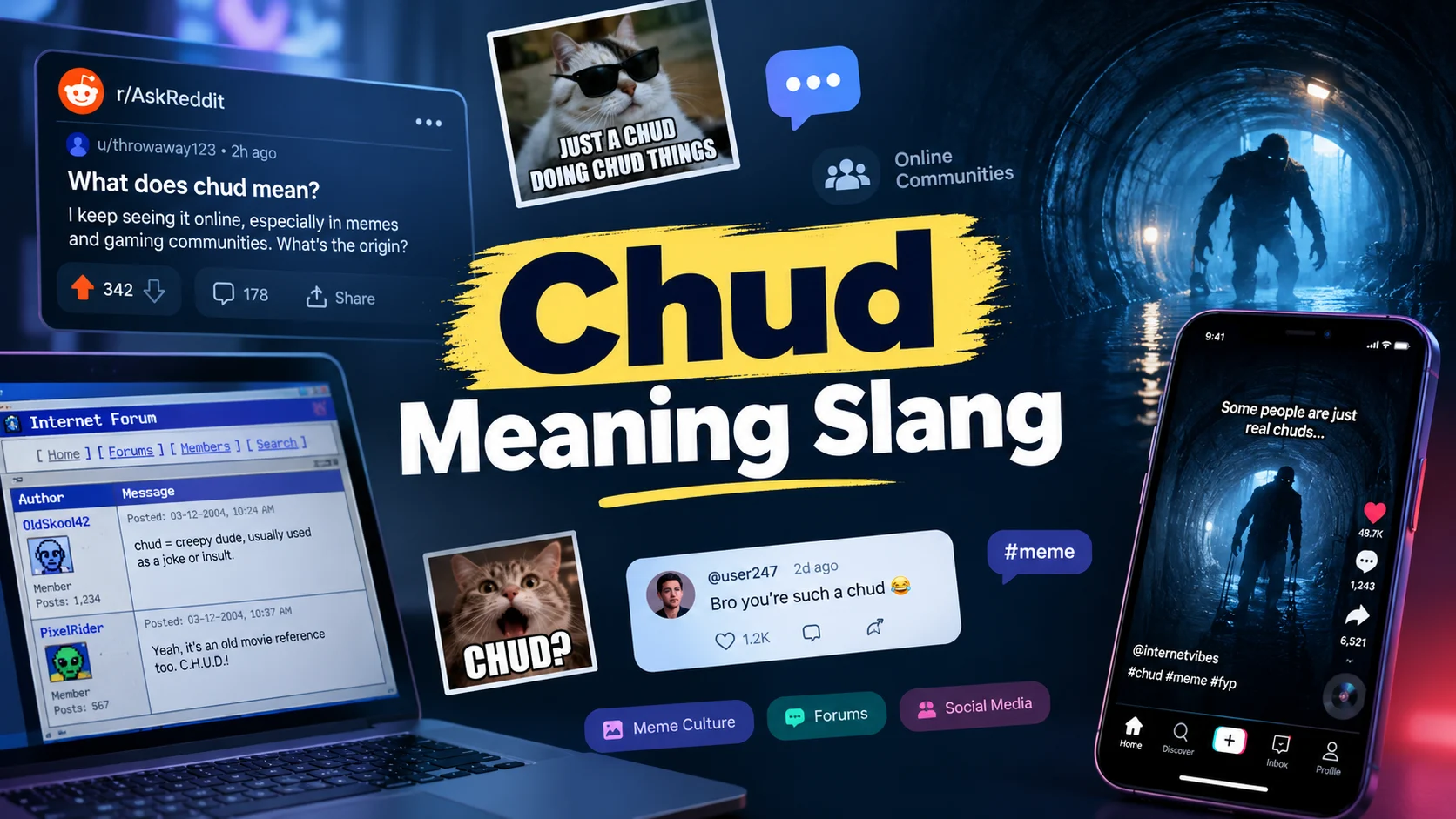
Chud meaning slang usually refers to an insulting internet term for a person portrayed as ignorant, reactionary, obnoxious, or aggressively opinionated. It is generally used as an insult and can be dismissive or mocking depending on the context.
If you searched for chud meaning slang, you probably saw the word in a social media post, comment, meme, or online argument and wondered what it actually means. Unlike ordinary vocabulary, slang can change meaning depending on the community using it, so a short word can carry more context than its dictionary definition suggests.
Chud is mainly used online as a derogatory label for a person who is presented as crude, ignorant, unpleasant, or strongly reactionary. The term also has an older pop culture connection that helped shape its internet use. This guide explains the meaning of chud, its background, common contexts, examples, tone, related expressions, and mistakes to avoid.
What Does Chud Mean in Slang?
In modern internet slang, chud is usually an insulting term for someone described by the speaker as ignorant, obnoxious, crude, or reactionary.
The exact meaning can shift between online communities. In one conversation, someone may use it to criticize a person’s political or social opinions. In another, it may simply describe someone the speaker considers unpleasant, uncultured, or aggressive.
| Context | Common meaning |
|---|---|
| Internet comments | An insulting label for someone considered ignorant or obnoxious |
| Political discussions | A derogatory label for someone viewed as strongly reactionary |
| Memes | A mocking stereotype or character type |
| Casual online arguments | A general insult directed at someone’s behavior or opinions |
| Pop culture | A reference connected to the fictional creatures called C.H.U.D.s |
The word is therefore not normally a neutral description. If someone calls another person a chud, the speaker is usually expressing criticism or ridicule.
Is Chud a Bad Word?
Chud is generally considered offensive or insulting slang. It is not normally appropriate when you need to speak respectfully about someone.
The seriousness of the insult depends on the conversation. Among people who regularly use internet slang, it may appear as a joking insult. In a heated argument, however, it can be deliberately hostile.
For example:
“That guy is such a chud.”
The speaker is not simply describing the person’s personality. They are using a negative label to mock or criticize that person.
Where Did the Word Chud Come From?
The word chud has a pop culture origin that is separate from its newer internet slang usage.
It is strongly associated with the 1984 horror film C.H.U.D., whose title stands for Cannibalistic Humanoid Underground Dwellers. The movie depicts underground creatures who attack people in New York City.
Over time, chud developed additional uses outside the film. Online communities began using the word as an insult for a stereotypical person perceived as crude, aggressive, ignorant, or reactionary.
The modern slang meaning should therefore not be treated as though it came directly from the movie’s literal definition. The pop culture reference provided an existing word and image, while internet culture gave it a broader insulting meaning.
Because slang develops informally, there is not always one exact moment when a particular modern meaning becomes established. Its use has varied across online communities.
How Chud Is Used in Different Contexts
The meaning of chud becomes clearer when you look at the situation in which someone uses it.
Chud in Text Messages
In private messages, someone might use chud as a quick insult when talking about another person.
For example:
“Ignore him. He’s being a chud.”
Here, the speaker is criticizing the person’s behavior. The word does not provide a precise description of what the person did. Instead, it expresses a broad negative judgment.
Chud on Social Media
Social media users may use the term when responding to an opinion, video, photograph, or comment.
For example:
“The replies are full of chuds today.”
In this sentence, the speaker is using chuds as a plural noun to describe people they believe are behaving badly or expressing views they strongly dislike.
Chud on TikTok
On TikTok, the word can appear in comments, captions, memes, or discussions about controversial behavior.
Its meaning still depends on the surrounding content. A creator may use it seriously as an insult, while another person may use it humorously as part of an exaggerated meme.
The platform itself does not give the word a separate official meaning.
Chud on Reddit
Reddit discussions can contain the term when users criticize another commenter or describe a particular stereotype.
For example:
“The comments turned into a bunch of chuds arguing.”
The intended meaning comes from the speaker’s description of the commenters, not from Reddit itself.
Chud in Online Arguments
This is one of the contexts where the word appears most naturally.
Someone might write:
“I’m not arguing with a chud about this.”
The speaker is using the word as a dismissive label. It suggests that they see the other person’s position or behavior as unreasonable, crude, or reactionary.
However, calling someone a chud does not prove anything about that person’s actual beliefs or personality. It is the speaker’s characterization.
Chud Meaning From a Guy or Girl
People sometimes search for slang terms with questions about what they mean when used by a guy or a girl.
With chud, the gender of the person using the word usually does not create a fixed separate definition. A guy calling someone a chud and a girl calling someone a chud can both be using the term as an insult.
The better way to interpret the message is to examine the surrounding conversation.
For example:
“You’re such a chud 😂”
The laughing emoji may make the message sound more playful or teasing.
Compare that with:
“You’re a chud. Stop commenting here.”
The second version sounds much more hostile and dismissive.
A single use of the word cannot reliably tell you exactly what someone feels or intends. Look at the previous messages, the relationship between the people, and the conversation is serious or humorous.
Tone and Emotional Meaning of Chud
The word chud usually has a negative tone, but its exact emotional force can vary.
Several details can affect how it sounds.
Context
A meme may use chud as exaggerated humor, while an argument may use it as a serious insult.
Punctuation
Compare:
“What a chud.”
with:
“What a chud!”
The second can sound more emphatic.
Emojis
An emoji can soften or exaggerate the intended tone.
“You’re such a chud 😂”
may be teasing, while:
“You’re a chud.”
can sound more direct.
Previous Messages
If two friends regularly tease each other, the term may be less serious. In a conversation between strangers, the same word may be more confrontational.
Relationship
Friends may use insults jokingly. However, that does not mean the term is universally harmless. Its meaning depends on the people involved.
Follow Up
A person’s follow-up message can provide useful context. If they explain that they are joking, the meaning may be different from a message followed by further insults.
Real Life Examples of Chud
Here are several examples showing how chud can appear in everyday online conversations.
Example One: Comment Section
Person A: “Did you see his comment?”
Person B: “Yeah, what a chud.”
Here, chud is a general insult aimed at the commenter.
Example Two: Friendly Teasing
Person A: “You spent three hours arguing about a video game.”
Person B: “I know. I’m becoming a chud.”
In this example, the speaker is applying the insult to themselves humorously. The tone is self-deprecating rather than directly hostile.
Example Three: Online Argument
Person A: “I’m done responding to this guy.”
Person B: “Probably for the best. He’s acting like a chud.”
The word describes how the speaker views the person’s behavior.
Example Four: Social Media
Person A: “Why are there so many chuds in the replies?”
Person B: “The post got shared outside the usual community.”
Here, chuds refers broadly to people the speaker considers unpleasant or reactionary.
Example Five: Meme
Person A: “Me turning into a chud because someone changed my favorite game.”
Person B: “That’s actually hilarious.”
The term is being used humorously and does not necessarily represent a literal judgment about the person.
Example Six: Direct Insult
Person A: “You don’t know anything about the topic.”
Person B: “Whatever, chud.”
This is a direct insult and sounds dismissive.
How to Use Chud Correctly
If you encounter the word online, understanding its grammatical role can make its use easier to recognize.
Chud is commonly used as a noun.
For example:
“He’s a chud.”
It can also appear in plural form:
“The comments are full of chuds.”
It may also appear in compound or descriptive internet expressions, depending on the community.
Because the term is insulting, use it carefully. If you simply want to describe someone’s behavior, a more specific word may communicate your point better.
Instead of:
“He’s a chud.”
you could say:
“He’s being rude.”
Or:
“That comment was unnecessarily aggressive.”
Specific language is often clearer than a broad insult.
Formal or Informal Usage
Chud is informal slang and should generally be treated as a derogatory internet expression.
It is most likely to appear in:
- Social media comments
- Memes
- Online forums
- Group chats
- Gaming communities
- Casual conversations
- Internet arguments
It generally does not belong in:
- Business emails
- Academic assignments
- Resumes
- Formal reports
- Customer service communication
- Professional presentations
For professional writing, describe the specific behavior instead.
For example, instead of calling someone a chud, you could write:
“The commenter used an aggressive and dismissive tone.”
That statement explains the behavior without relying on slang.
Common Mistakes People Make With Chud Meaning Slang
Understanding the word is easier when you know what not to assume.
Mistake: Treating Chud as a Neutral Word
Chud is generally negative. Calling someone a chud usually communicates criticism, mockery, or contempt.
Mistake: Assuming Everyone Uses It the Same Way
Internet slang varies between communities. One group may use the term frequently, while another may rarely use it.
Always examine the surrounding conversation.
Mistake: Assuming It Always Refers to Politics
Political discussions are one common setting for the word, but chud can also be used as a general insult.
It does not automatically identify someone’s political beliefs.
Mistake: Confusing the Slang Meaning With the Movie Reference
The original pop culture reference is connected to C.H.U.D., while modern internet slang uses the word differently.
The two meanings are related historically but are not identical.
Mistake: Assuming the Word Proves Someone’s Character
Calling a person a chud is a judgment made by the speaker. It does not independently establish that the person is ignorant, reactionary, or unpleasant.
Related Words and Expressions
Several words can appear in similar online conversations, although they are not exact synonyms.
Troll
A troll is someone who deliberately provokes others online, often to get a reaction.
Unlike chud, troll focuses more on provocative online behavior.
Edgelord
An edgelord is a person who deliberately uses shocking, offensive, or extreme statements to appear provocative.
The emphasis is usually on provocative behavior.
Normie
Normie is internet slang for someone perceived as having mainstream tastes or being unfamiliar with a particular online subculture.
It can be dismissive, but it does not have exactly the same meaning as chud.
Reactionary
Reactionary is a more established political term. In political discussion, it can describe a person or position associated with opposition to certain social or political changes.
Chud is much more informal and insulting.
Jerk
Jerk is a common everyday insult for someone behaving badly. It is broader and usually less tied to internet culture than chud.
Chud Compared With Similar Internet Insults
There is no perfect one-to-one replacement for chud because the term combines insult, internet culture, and a particular stereotype.
| Term | Typical meaning | Tone |
|---|---|---|
| Chud | A person portrayed as crude, ignorant, obnoxious, or reactionary | Insulting |
| Troll | Someone who deliberately provokes people online | Negative |
| Edgelord | Someone who tries to appear shocking or extreme | Mocking |
| Normie | Someone viewed as mainstream or outside an online subculture | Dismissive |
| Jerk | Someone behaving badly | Insulting |
| Reactionary | A person associated with opposition to certain forms of change | Political or descriptive |
The key difference is context. Someone can be a troll without being called a chud, and someone can be called a chud without deliberately trying to provoke people.
Social Media Usage of Chud
The term can appear across several online communities.
On Instagram, chud may appear in comments or discussions when users criticize someone’s behavior or opinions.
For example:
“Why did this chud show up in the comments?”
The meaning is generally insulting and depends on the post.
TikTok
TikTok comments may use the word as part of memes or arguments.
The platform does not create a unique definition. Users bring their own community meanings to the term.
Reddit users may use chud when describing another commenter or a perceived stereotype within a discussion.
Because Reddit contains many different communities, the exact tone can vary significantly.
Discord
On Discord, the word may appear in casual conversations, gaming communities, or debates. Friends may use it jokingly, while strangers may use it aggressively.
X
On X, the term can appear during heated public discussions, particularly when people criticize opinions they strongly disagree with.
Again, the word expresses the speaker’s characterization rather than providing an objective description.
Professional Usage
Using chud in professional communication is usually a poor choice.
Avoid it in:
- Workplace emails
- Business reports
- Resumes
- Cover letters
- Client messages
- Academic papers
- Formal complaints
A professional alternative should explain the actual issue.
Instead of:
“That employee is a chud.”
write:
“The employee’s response was dismissive and unprofessional.”
Instead of:
“The customer is a chud.”
write:
“The customer used an aggressive tone during the conversation.”
Specific wording makes the message more useful and less inflammatory.
Regional and Generational Usage
The modern slang meaning of chud is strongly associated with internet culture and English-language online communities.
However, not every English speaker will recognize it immediately. Its frequency can vary by age, online community, interests, and exposure to internet slang.
American internet users may encounter the term in memes, forums, political discussions, and social media. British, Canadian, and other English-speaking users may also recognize it, especially if they participate in online communities where American internet slang is common.
There is no need to assume that every person from a particular country uses the term in exactly the same way.
The safest approach is to consider the surrounding text and community.
Why Context Matters With Chud
Slang words often communicate attitude as much as literal meaning.
Consider these two examples:
“He’s a chud.”
“I’m being a chud today.”
The first sentence attacks another person. The second can be a humorous description of the speaker’s own behavior.
Likewise, this sentence:
“The comments are full of chuds.”
uses the plural form to describe a group.
The word remains negative in all three examples, but the speaker’s intention and target change.
Context helps you understand the person is making a serious insult, joking with friends, exaggerating for a meme, or criticizing an online group.
Practice Questions
Test yourself with these short questions.
Question One
What does chud usually mean in modern internet slang?
Answer: It is generally an insulting term for someone portrayed as crude, ignorant, obnoxious, or reactionary.
Question Two
Is chud normally formal English?
Answer: No. It is informal internet slang and is generally derogatory.
Question Three
Can chud be used humorously?
Answer: Yes. People sometimes use it jokingly or self-deprecatingly, especially among friends or in memes.
Question Four
Does calling someone a chud prove that person is reactionary?
Answer: No. The word expresses the speaker’s judgment or characterization. It does not independently establish someone’s beliefs.
Question Five
Where is chud most likely to appear?
Answer: It commonly appears in social media, online forums, group chats, memes, and internet arguments.
FAQs
What does chud mean in slang?
Chud is usually an insulting internet slang term for a person portrayed as crude, ignorant, obnoxious, or reactionary. Its exact meaning depends on the online community and context.
Is chud an insult?
Yes. Chud is generally used as a derogatory label. It can sometimes appear jokingly among friends, but its basic tone is negative.
Where did the word chud come from?
The word is strongly associated with the 1984 horror film C.H.U.D., whose title refers to fictional underground creatures. Internet culture later developed broader slang uses for chud.
What does chud mean on TikTok?
On TikTok, chud generally carries the same insulting internet slang meaning. It can describe someone the commenter considers crude, obnoxious, ignorant, or reactionary.
Can I use chud in a professional email?
It is best to avoid it in professional communication. Chud is informal and insulting, so a specific description of the person’s behavior will usually be clearer and more appropriate.
Conclusion
Understanding chud meaning slang requires more than memorizing a single definition. The word is generally a derogatory internet label for someone portrayed as crude, ignorant, obnoxious, or reactionary, but the exact implication depends on the community and conversation.
The term also has a pop culture background connected to the film C.H.U.D. Modern online usage has expanded beyond that original reference. If you see chud in a message or comment, pay attention to the surrounding words, tone, relationship between the speakers, and subject of the conversation before deciding exactly what the writer means.