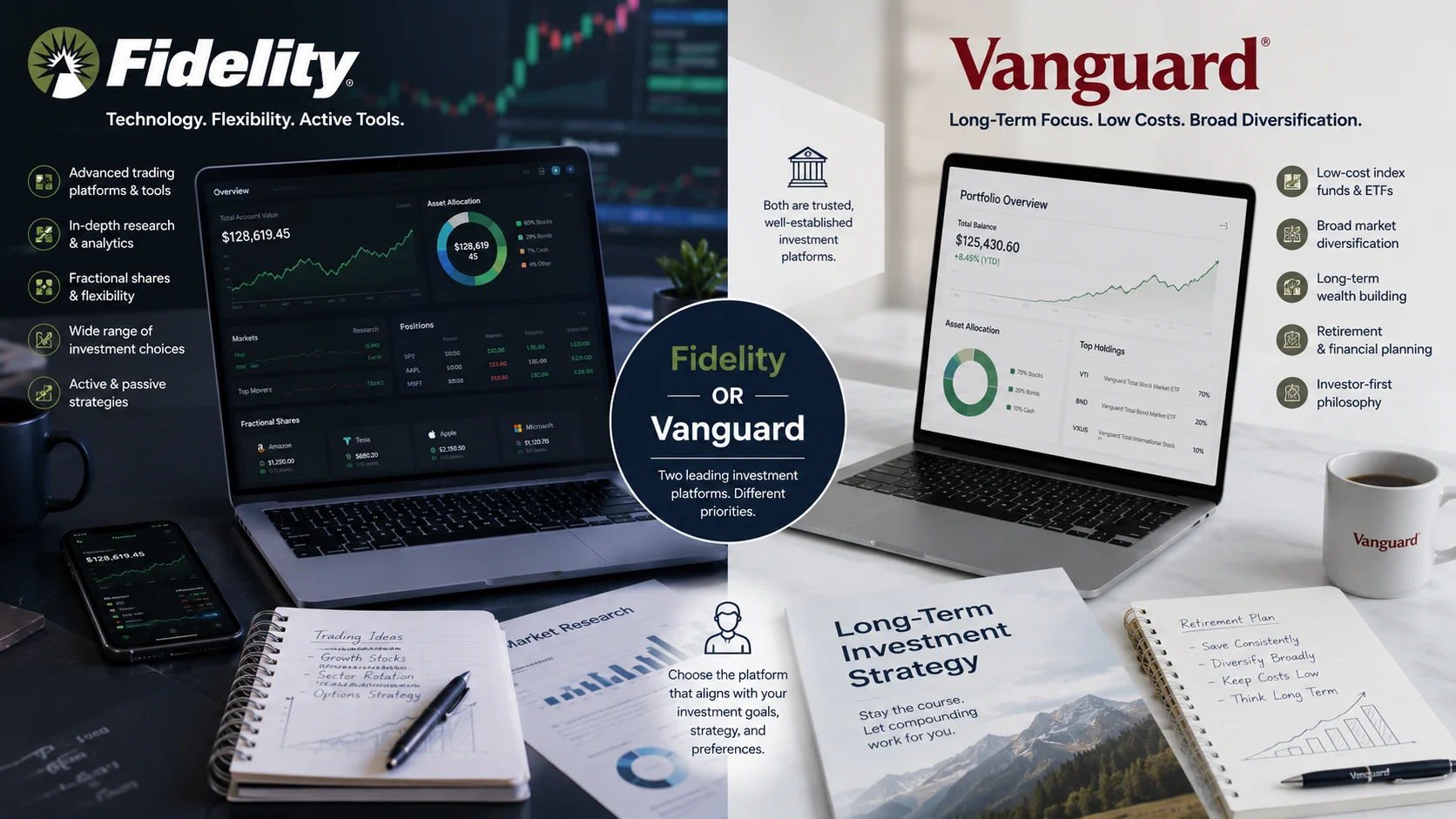
Fidelity and Vanguard are two major US investment firms, but they serve investors somewhat differently. Fidelity emphasizes broad investment choice, research, trading technology, fractional shares, and flexible account options, while Vanguard is especially known for low cost index investing and its investor owned structure. The better choice depends on your goals, investment style, and preferred tools.
Fidelity or Vanguard: What’s the Difference?
The main difference between Fidelity and Vanguard is not simply which company has lower fees. Both offer commission free online trading for many investments, retirement accounts, mutual funds, ETFs, financial guidance, and digital investing services. The real distinction is the overall investing experience.
Fidelity Investments is a financial services company offering brokerage accounts, retirement plans, mutual funds, ETFs, stocks, bonds, options, cash management, research, and advisory services. Fidelity has also built a strong reputation around trading technology and investor education. Its current brokerage offering has no minimum to open an account, while online US stock and ETF trades carry a zero commission.
Vanguard is an investment management company founded in 1975 and structured differently from most financial firms. Vanguard is owned by its funds, which are owned by fund shareholders. The company is particularly associated with low cost index funds and ETFs and a long term investment philosophy.
| Feature | Fidelity | Vanguard |
|---|---|---|
| Company focus | Brokerage, investing, retirement, advice, research | Investment management, index investing, retirement, advice |
| Online US stock commissions | $0 | $0 |
| Online ETF commissions | $0 | $0 |
| Brokerage account minimum | $0 | No fee to open, with investment minimums depending on the fund |
| Fractional shares | Available for eligible stocks and ETFs | Vanguard ETFs can be purchased for as little as $1 |
| Zero expense ratio index funds | Yes | No |
| Mutual fund strength | Very broad fund selection | Strong proprietary low cost fund lineup |
| Trading technology | Strong | More focused on long term investing |
| Research tools | Extensive | More streamlined |
| Investor owned structure | No | Yes |
| Best known for | Choice, research, trading flexibility | Low costs and index investing |
The practical takeaway is straightforward. Fidelity tends to appeal to investors who want more flexibility, research, and trading functionality. Vanguard tends to appeal to investors who prioritize simple, low cost, long term investing.
Neither is automatically better for every investor.
Is Fidelity Versus Vanguard a Grammar, Vocabulary or Usage Issue?
This comparison is neither a grammar problem nor a vocabulary problem. Fidelity and Vanguard are proper names of financial companies, so the issue is primarily one of investment usage and suitability.
They are not interchangeable in every situation. An investor choosing between the two is selecting a brokerage and investment provider, not two different names for the same service.
For casual investors, both companies can provide a straightforward way to buy stocks, ETFs, mutual funds, and retirement investments. For more advanced investors, however, the differences in research, trading platforms, fund structure, fractional investing, and account features can become important.
In academic or financial writing, it is better to explain what is actually being compared. Saying that one company is simply cheaper can be misleading because costs depend on the specific fund, account, transaction, advisory service, and investment strategy.
For example, Vanguard reports an asset weighted average expense ratio of 0.07 percent for its US mutual fund and ETF offerings based on 2025 average net assets. Fidelity, meanwhile, offers several Fidelity ZERO index mutual funds with a zero expense ratio.
That distinction matters because a brokerage fee and a fund expense ratio are different costs.
Fidelity: When Does It Make More Sense?
Fidelity is particularly attractive when an investor wants a broad financial platform rather than a company centered primarily on index funds.
A major advantage is flexibility. Fidelity provides access to stocks, ETFs, mutual funds, options, bonds, CDs, retirement accounts, cash management, and other investment products. Its brokerage account can be opened without an account minimum, and Fidelity states that investors can begin investing with as little as $1 through fractional investing where available.
Workplace example
Imagine an employee who has a workplace retirement plan but also wants an IRA, taxable brokerage account, and cash management account. A broad platform can make it easier to manage several financial objectives in one ecosystem.
Fidelity also has extensive experience with workplace retirement plans. Its history shows that the company began offering 401(k) workplace savings plans and retail investor centers during the early 1980s.
Academic example
A finance student researching individual stocks, ETFs, mutual funds, and portfolio construction may benefit from Fidelity’s research environment. Fidelity says its platform includes research from more than 20 independent providers along with education and trading tools.
Technology example
Technology is one of Fidelity’s clearest differentiators. Fidelity Trader Plus provides advanced charting, technical indicators, customizable layouts, real time market information, alerts, and trading functionality across desktop, web, and mobile experiences.
Usage recap: Choose Fidelity when flexibility, research, fractional investing, account variety, and trading technology are major priorities.
Vanguard: When Does It Make More Sense?
Vanguard is particularly compelling for investors who want to build a diversified portfolio around low cost funds and hold those investments for many years.
Its reputation comes from a simple philosophy: keep costs low, diversify broadly, and avoid unnecessary trading. Vanguard’s structure reinforces this approach because the company is owned through its funds by their shareholders.
Workplace example
Consider an employee who contributes regularly toward retirement and does not want to research individual stocks every week. A diversified portfolio of low cost index funds can provide a relatively simple framework for long term investing.
Academic example
Vanguard is especially relevant when studying index investing. Its historical role in popularizing index funds makes it an important case study in modern portfolio management. Vanguard explains that index funds seek to track a benchmark rather than depend on analysts attempting to select securities that will outperform.
Technology example
Vanguard is also investing heavily in technology. The company describes artificial intelligence, advanced analytics, and digital systems as important components of its modern investor experience.
The key difference is emphasis. Vanguard uses technology primarily to improve the investor experience and support its investment approach, while Fidelity has developed especially extensive tools for investors who actively research and trade securities.
Usage recap: Choose Vanguard when low cost diversified investing, index funds, and a long term philosophy matter more than sophisticated trading tools.
Fidelity or Vanguard: Which Is Better for Beginners?
For many beginners, either company can work well. The more important question is what the beginner actually wants to do.
Someone who wants to purchase broad market ETFs and contribute regularly may find Vanguard’s philosophy attractive. Someone who wants to explore stocks, fractional shares, research tools, retirement accounts, and different investment products may find Fidelity more flexible.
Fidelity’s lack of a minimum to open a retail brokerage account can also be useful for a new investor with a small starting balance.
Vanguard ETFs can also be purchased for as little as $1, while many Vanguard mutual funds have specific minimum investment requirements. Most Vanguard index mutual funds have a $3,000 minimum for Admiral Shares.
The beginner friendly choice therefore depends less on the brand and more on the investment product being purchased.
Fidelity or Vanguard: Which Has Lower Fees?
This is one of the most misunderstood parts of the comparison.
Both companies offer $0 online commissions for many stock and ETF transactions. Fidelity states that online US stock and ETF trades have a $0 commission. Vanguard also states that online stock and ETF trades have a $0 commission.
The more important comparison is often the expense ratio of the specific fund.
Fidelity offers several ZERO index mutual funds with a 0.00 percent expense ratio. Its Fidelity ZERO Total Market Index Fund and Fidelity ZERO International Index Fund are examples.
Vanguard is also extremely cost conscious. Vanguard reports that its average mutual fund expense ratio was 0.08 percent as of December 31, 2025, compared with an industry average of 0.50 percent. Its average ETF expense ratio was 0.04 percent.
Therefore, there is no responsible answer that simply says one company is always cheaper.
The correct approach is to compare the exact fund, expense ratio, transaction costs, minimum investment, tax considerations, and services you actually need.
When You Should NOT Use Fidelity or Vanguard
There are several situations in which choosing either provider without further research can create problems.
- Do not choose based only on brand reputation. A famous investment company does not automatically make every fund or strategy suitable for you.
- Do not assume $0 commission means investing is completely free. Fund expense ratios, spreads, advisory costs, and other charges can still matter.
- Do not choose Vanguard simply because you want the lowest possible cost. Fidelity has zero expense ratio index mutual funds, so the specific investment must be compared.
- Do not choose Fidelity simply because it has more trading tools. More tools are not necessarily better for someone who wants a simple retirement strategy.
- Do not compare a mutual fund directly with an ETF without examining the differences. They can track similar markets but operate differently.
- Do not ignore investment minimums. Vanguard mutual funds can require $3,000 or more, while its ETFs can be purchased for as little as $1.
- Do not select a platform because of historical performance alone. Past returns do not guarantee future results.
- Do not overlook taxes and account type. A taxable brokerage account and a retirement account can have very different consequences.
Common Mistakes and Decision Rules
| Correct sentence | Incorrect sentence | Explanation |
|---|---|---|
| Fidelity offers a broad range of research and trading tools. | Fidelity is always better for active investors. | The first statement describes a feature. The second makes an unsupported universal conclusion. |
| Vanguard is known for low cost index investing. | Vanguard has no fees. | Vanguard has low costs, but some account and investment related fees can apply. |
| Fidelity offers zero expense ratio index funds. | All Fidelity funds have zero expenses. | Only specific Fidelity funds have a zero expense ratio. |
| Vanguard ETFs can be purchased with as little as $1. | All Vanguard mutual funds require $1. | Mutual fund minimums vary by fund. |
| Both firms offer $0 online stock and ETF commissions. | Both firms are identical. | Similar commissions do not make the entire platforms identical. |
Decision Rule Box
If your priority is trading flexibility, research, fractional investing, and a broad financial platform, Fidelity is often the stronger fit.
If your priority is low cost diversified investing and a long term index focused approach, Vanguard is often the stronger fit.
This is a suitability rule, not a guarantee of investment performance.
Fidelity and Vanguard in Modern Technology and AI Tools
Modern investing is increasingly influenced by artificial intelligence, automated analysis, digital advice, real time data, and personalized financial planning.
Fidelity has continued expanding digital capabilities and trading technology. Its 2026 business update reported 5.7 million daily average trades in the second quarter, up 31 percent year over year, alongside continued development of its ETF lineup and digital services.
Vanguard is also incorporating artificial intelligence and advanced analytics into its technology strategy. Its technology team describes AI and advanced analytics as tools intended to improve efficiency and the investor experience rather than simply encourage more trading.
The distinction is useful. Technology can help investors analyze information, but it cannot remove market risk. A sophisticated platform does not guarantee better returns.
Authority and Trust: What Separates the Two Firms?
Both companies have substantial histories.
Fidelity was founded in 1946 and remains privately held. The company reports more than $19 trillion in assets under administration and $7.8 trillion in managed assets for the second quarter of 2026.
Vanguard began operations in 1975. As of June 30, 2026, it reported 487 funds worldwide and more than 50 million investors as of December 31, 2025. Its investor owned structure remains one of its defining characteristics.
These figures demonstrate scale, but scale alone should not determine an investor’s decision. What matters is the firm’s products, costs, tools, and investment philosophy fit the investor’s needs.
Etymology and Investment Philosophy
The word Fidelity carries the broader English meaning of loyalty, trust, or faithfulness. Vanguard traditionally refers to the leading position or group at the front of a movement.
The company names therefore have different historical identities, but their investment philosophies have evolved substantially over decades.
Vanguard’s identity is particularly connected to John C. Bogle and the development of low cost index investing. Vanguard’s own educational material attributes the famous principle to Bogle:
“Don’t look for the needle in the haystack. Just buy the haystack!”
The quotation captures the central idea behind broad market indexing: investors do not necessarily need to identify the next winning stock when they can own a diversified collection of investments.
Case Study 1: Fidelity ZERO International Index Fund
Fidelity’s ZERO International Index Fund provides a useful example of how its low cost philosophy works in practice.
As of December 30, 2025, the fund reported a 0.00 percent gross expense ratio. Its five year average annual return was 9.38 percent through June 30, 2026, while its primary benchmark recorded 9.31 percent over the same period.
This does not prove that Fidelity will outperform Vanguard in the future. It demonstrates something more specific: Fidelity offers a broad international index product with no stated fund expense ratio and measurable historical results.
Case Study 2: Vanguard Total Stock Market Index Fund
Vanguard’s Total Stock Market Index Fund provides a useful comparison.
As of April 28, 2026, VTSAX reported a 0.04 percent expense ratio and a $3,000 minimum investment. The fund is designed to provide broad exposure to the US stock market across large, mid, and small companies.
The lesson is not that 0.04 percent is expensive. It is extremely low. The lesson is that investors should examine the exact fund rather than assume every Vanguard product or every Fidelity product has identical costs.
Error Prevention Checklist
Always use Fidelity when
- You value extensive research and trading tools.
- You want fractional investing in eligible securities.
- You want a broad selection of account types.
- You expect to research stocks, options, ETFs, and other securities actively.
- You prefer a highly flexible brokerage environment.
Never use Vanguard when
- You specifically require sophisticated active trading tools.
- You want every investment product to have a zero minimum.
- You assume every Vanguard fund has the same fee structure.
- You are choosing solely because of historical brand reputation.
- You have not compared the specific Vanguard fund with available alternatives.
These are practical guidelines, not universal investment rules.
Related Grammar Confusions You Should Master
Although this topic is financial rather than grammatical, readers researching comparison terminology often encounter other commonly confused terms. Understanding these distinctions can make financial and educational content more precise.
Related topics include Fidelity versus Charles Schwab, Vanguard versus Schwab, ETF versus mutual fund, index fund versus actively managed fund, brokerage account versus retirement account, expense ratio versus management fee, traditional IRA versus Roth IRA, 401(k) versus IRA, stocks versus ETFs, and investing versus trading.
These comparisons should always be evaluated according to the exact context rather than treated as interchangeable terms.
FAQs
Is Fidelity or Vanguard better for beginners?
Both can work well, but Fidelity may be more flexible for beginners who want fractional investing and extensive research tools, while Vanguard can suit beginners focused on simple index investing.
Is Fidelity cheaper than Vanguard?
Neither company is universally cheaper. Fidelity offers zero expense ratio index funds, while Vanguard is known for extremely low average fund costs, so compare the exact investment.
Does Vanguard have better index funds than Fidelity?
Not automatically. Vanguard has a long history of index investing, while Fidelity also offers broad low cost index funds, including several with a 0.00 percent expense ratio.
Is Fidelity or Vanguard better for long term investing?
Both can support long term investing. Vanguard has a particularly strong index investing identity, while Fidelity offers more flexibility for investors who want additional tools and products.
Is Fidelity or Vanguard better for active trading?
Fidelity is generally the stronger fit for active traders because of its research and trading technology, including Fidelity Trader Plus and related tools.
Does Fidelity have lower fees than Vanguard?
Sometimes, depending on the fund. Fidelity has zero expense ratio index mutual funds, while Vanguard offers very low cost mutual funds and ETFs.
Can I buy Vanguard funds through Fidelity?
Many Vanguard ETFs and mutual funds can be accessed through brokerage platforms, although transaction rules and fund availability can differ. Check the current brokerage schedule before investing.
Can I buy Fidelity funds through Vanguard?
Availability depends on the specific Fidelity fund and Vanguard’s current brokerage policies. Investors should verify the exact fund before assuming it can be purchased.
Should I choose Fidelity or Vanguard for retirement?
Either can be suitable. The better choice depends on your retirement account options, investment selection, costs, tax situation, and preferred level of investment control.
Conclusion
The best choice is not determined by which company has the bigger name. Fidelity is generally the more versatile choice for investors who want research, fractional investing, advanced trading technology, and a broad range of financial services. Vanguard remains exceptionally attractive for investors who prioritize low cost index investing, diversification, and a disciplined long term approach.
For a hands on investor, Fidelity may provide the more complete experience. For a buy and hold investor building a portfolio around low cost index funds, Vanguard may feel more natural. The strongest decision comes from comparing the exact funds, expenses, account features, investment minimums, and services you actually plan to use.
In other words, the smarter question is not simply which company wins. It is which platform gives you the right combination of cost, simplicity, flexibility, and investment tools for your own strategy.
Discover More Related Articles:
- Alter or Altar | Spelling, Usage & Easy Ways to Remember the Difference In 2026
- Tase or Taze | Which Spelling Is Correct & When to Use Each In 2026
- Cue or Que | Meaning, Usage & the Correct Spelling In 2026