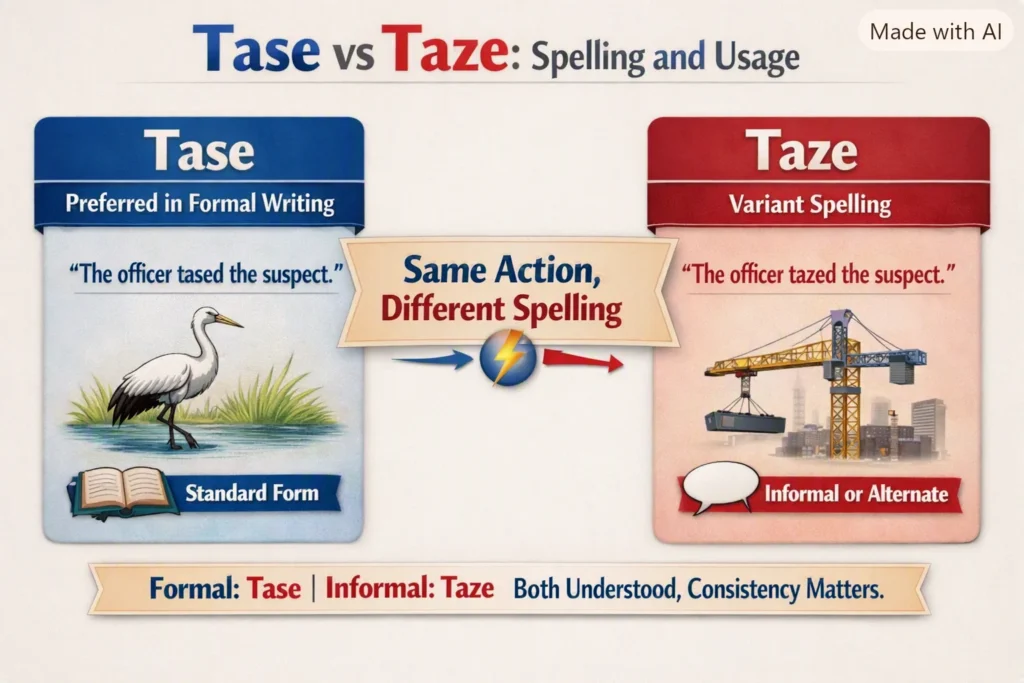
Tase is the standard spelling for the verb meaning to stun someone with a Taser or similar device, while taze is a recognized variant spelling. In edited American English, tase is generally the better choice because it follows the spelling most closely associated with Taser. The noun is usually Taser or stun device, depending on context.
The difference between tase and taze may seem like a simple spelling mistake, but choosing the right word matters when you want your writing to sound clear and professional. Although these words look similar, their meanings and usage can differ depending on the context. If you have ever wondered tase or taze is the correct spelling, understanding how dictionaries and standard English usage treat these terms can help you avoid confusion. Both spellings are associated with the act of using a conducted electrical weapon, but one is more widely recognized in standard usage.
In this guide, you’ll learn the meaning of tase vs. taze, explore their differences, and discover which spelling is more appropriate for formal writing, everyday communication, and professional content. With clear definitions and practical examples, this comparison will help you choose the right form confidently. you are writing an article, preparing a report, or improving your vocabulary, knowing the distinction can make your writing more accurate and reader-friendly.
Tase or Taze | What’s the Difference?
The confusion between tase and taze is mainly a spelling and usage issue. Both forms are used as verbs, and both refer to the act of electrically stunning a person or living target with a Taser or a similar device. However, tase is the more established spelling in standard dictionary usage, while taze is treated as a variant.
Dictionary.com defines tase as a verb meaning to electrically stun a living target using a Taser or similar stun device. It also records taze as an alternative spelling. The dictionary traces tase to the word Taser and identifies it as a back formation from the brand name.
The distinction becomes especially interesting because Taser itself began as a trademark rather than as an ordinary English verb. Axon, the company associated with the Taser brand, continues to identify TASER as a trademark and specifically advises that the trademark should not be used as a verb.
Here is the practical comparison:
| Word | Part of Speech | Meaning | Typical Status | Example |
|---|---|---|---|---|
| tase | Verb | To electrically stun someone or a living target | Preferred and more common spelling | The officer decided to tase the suspect. |
| taze | Verb | To electrically stun someone or a living target | Recognized spelling variant | The officer decided to taze the suspect. |
The easiest way to remember the distinction is simple. Tase is the spelling you should normally choose in polished writing. Taze is not meaningless or necessarily an error, but it is less conventional.
If you are writing an academic paper, professional report, news article, or educational resource, tase is usually the safer spelling.
If you are discussing the brand itself, be more careful. TASER is a trademark, and the brand owner recommends using the trademark as an adjective rather than treating it as a generic verb.
Is Tase or Taze a Grammar, Vocabulary or Usage Issue?
The question is primarily a spelling and usage issue, rather than a fundamental grammar problem.
Both tase and taze function as verbs. Their meanings are essentially the same, so changing one spelling to the other normally does not change the grammatical structure of a sentence.
For example:
The officer tased the suspect.
The verb is tased, which is the past tense and past participle form of tase.
With taze, the corresponding form is tazed:
The officer tazed the suspect.
Both sentences can be understood. The difference lies in spelling preference and convention rather than in the underlying action.
For formal writing, however, tase is generally preferable. It has stronger dictionary recognition as the principal spelling, while taze is presented as a variant.
Academic writers should also consider the word is necessary at all. In highly formal contexts, phrases such as “used an electrical weapon” or “deployed a conducted energy weapon” may be more precise, depending on the subject being discussed.
Casual writing is different. Everyday speakers may use tase, tazed, Taser, or even tazed with little concern for trademark distinctions. That does not mean every casual usage is ideal for professional publication.
How to Use Tase Correctly
Tase is the preferred spelling when you need the verb describing the act of electrically stunning a person or another living target.
The word commonly appears in news reporting, fictional dialogue, police related discussions, informal conversation, and descriptions of incidents involving conducted energy weapons.
Workplace Example
A workplace safety report might say:
Security personnel were instructed to report any incident involving an attempt to tase an individual.
Here, tase works as a verb after the phrase “attempt to.” The construction follows a normal English infinitive pattern.
For a more formal corporate document, an organization might avoid the word entirely and use terminology such as “deploy an electrical weapon.” The best choice depends on the document is describing ordinary language or using technical terminology.
Academic Example
An academic discussion might say:
The study examined public perceptions of officers who tase suspects during high stress situations.
The verb is grammatically straightforward, but academic writers should make sure that the term accurately reflects the source material.
If the study itself uses a specific technical term, reproducing that terminology can be preferable to substituting a casual verb.
Technology Example
Technology writing may use the verb when discussing body cameras, evidence systems, or automated records:
The video system recorded the moment an officer tased the suspect.
In technical writing, however, the device and action should be distinguished carefully. A Taser is a particular brand, while conducted energy weapon is a broader technical category. Axon itself identifies TASER as a trademark for energy weapons and related products.
Usage recap: Choose tase when you need the familiar verb and want the more established spelling. In highly technical writing, consider a more precise term such as “deploy an electrical weapon” is appropriate.
How to Use Taze Correctly
Taze is a recognized spelling variant of tase. It carries essentially the same meaning and can appear in informal or general writing.
Dictionary.com specifically lists taze as a variation of tase, which means that treating every occurrence of taze as an outright spelling error would be inaccurate.
Workplace Example
An informal workplace message could say:
The security guard was prepared to taze the attacker if the situation became dangerous.
The sentence is understandable and grammatically sound. Nevertheless, if this sentence appears in an official report, tase would generally be the more conventional choice.
Academic Example
A paper discussing language variation could legitimately write:
Some speakers prefer the spelling taze because its pronunciation is immediately apparent from the spelling.
In this situation, taze is the object of linguistic analysis rather than merely an alternative spelling selected at random.
Technology Example
A technology article might say:
The software automatically labels footage in which an officer tazed a subject.
The sentence is grammatically possible, although professional terminology may favor a more neutral description of the event.
Usage recap: Taze is a legitimate variant, but it is usually not the first choice for polished standard English. Use it when discussing spelling variation, quoting a source, preserving a particular style, or when the surrounding context specifically calls for it.
When You Should NOT Use Tase or Taze
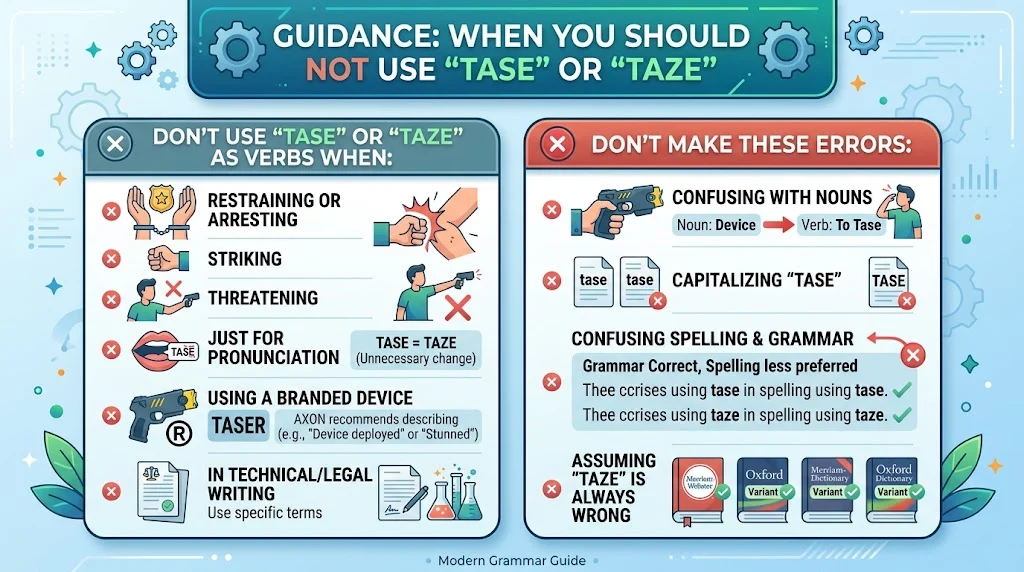
There are several situations where neither spelling is the best choice.
- Do not use tase when you actually mean a different action, such as restraining, arresting, striking, or threatening someone.
- Do not use taze simply because it looks more closely related to the pronunciation. Tase is already pronounced like “taze,” so changing the spelling is unnecessary.
- Do not use either word when the subject is a branded device and your writing requires strict trademark accuracy. In that situation, describe the device according to the relevant brand or technical terminology. Axon advises against using TASER as a verb.
- Do not automatically replace technical terminology with casual language in scientific or legal writing.
- Do not assume that taze is always incorrect. Major dictionary sources recognize it as a spelling variant.
- Do not use tase when the sentence actually requires the noun form.
- Do not capitalize tase simply because it comes from the trademark TASER. The ordinary verb is treated as a lexicalized English word in general usage.
- Do not confuse spelling preference with grammatical correctness. A sentence can be grammatically correct while still using the less preferred spelling.
Common Mistakes and Decision Rules
| Correct Sentence | Incorrect Sentence | Explanation |
|---|---|---|
| The officer decided to tase the suspect. | The officer decided to taser the suspect. | Tase is the ordinary verb form. TASER is a trademark, and the brand owner advises against using it as a verb. |
| The officer tased the suspect. | The officer taseed the suspect. | The past tense of tase is tased, not taseed. |
| The officer tazed the suspect. | The officer tazeeed the suspect. | Taze forms its past tense as tazed. |
| Tase is the preferred spelling in this article. | Taze is the only correct spelling. | Taze is recognized as a variant, so calling it the only possible spelling is too absolute. |
| The report describes a conducted energy weapon. | The report describes a TASER as a verb. | Technical writing may require a generic device description rather than using a trademark as a verb. |
Decision Rule: If you mean the action of electrically stunning someone, use tase in most standard writing. If you are referring to the spelling variant, taze is acceptable. If you mean the branded product, use TASER according to appropriate trademark conventions.
Tase or Taze in Modern Technology and AI Tools
Modern technology has made language surrounding electrical weapons more complicated because digital systems increasingly process police reports, body camera footage, transcripts, and incident records.
An AI writing assistant, transcription system, or search engine may encounter both tased and tazed because both forms occur in real world language. A language model should not automatically classify tazed as a spelling mistake without considering context.
This is an important distinction between language correction and language standardization. A system designed to proofread formal English may recommend tased when it sees tazed, while a system designed to preserve a quotation should retain the original wording.
Technology can also distinguish between the generic noun and the trademark. Axon states that TASER is a trademark and recommends that the brand be treated appropriately rather than turned into a generic verb.
For content creators, the practical lesson is straightforward. AI tools can identify common usage patterns, but writers still need to make the final editorial decision.
The Etymology of Tase and Taze
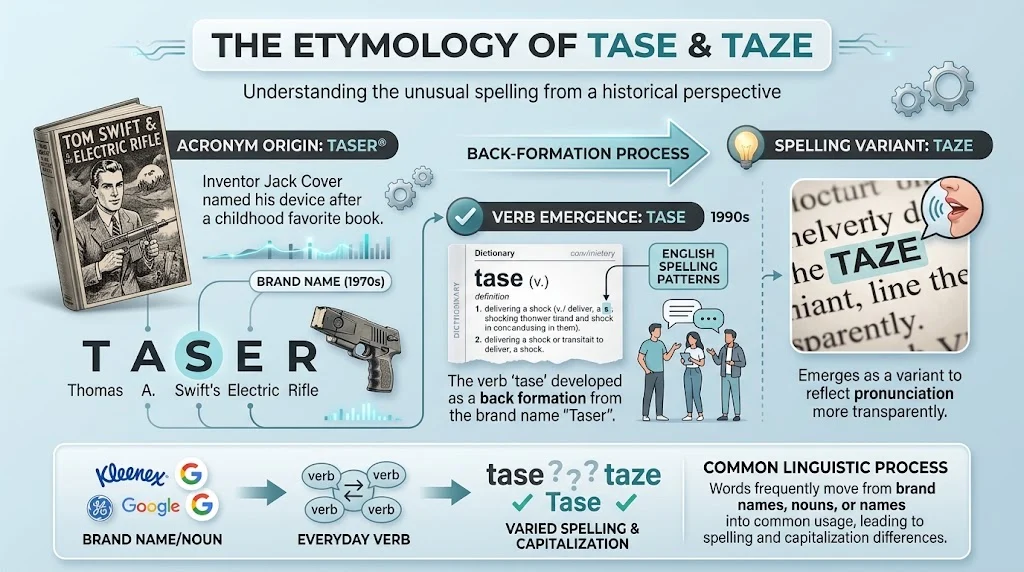
The history of these words explains why the spelling feels unusual.
Taser originated as an acronym connected to the fictional character Thomas A. Swift and the phrase “electric rifle.” Axon explains that inventor Jack Cover named the device after the title of a favorite book and that TASER is therefore an acronym.
The verb tase developed later as a back formation from Taser. Dictionary.com dates the origin of tase to the 1990s.
Once speakers began treating the brand name as the source of an ordinary action word, English spelling patterns produced tase. The alternative taze then emerged as a variant that reflects the pronunciation more transparently.
This is a familiar process in English. Words often move from brand names, nouns, or names into everyday verbs. Once that happens, spelling and capitalization can become subjects of disagreement.
What Language Experts Would Recommend
A useful editorial principle is to choose the established form when two variants communicate the same meaning and one has stronger recognition in standard references.
In this case, that principle favors tase for most edited English.
A concise expert style recommendation would be:
Choose the established spelling for formal prose, and preserve a variant when the context specifically requires it.
That approach avoids declaring taze “wrong” when reputable dictionaries recognize it as a variant, while still giving readers a clear recommendation.
Two Practical Case Studies
Case Study One: Editing a News Report
Imagine an editor receives this sentence:
The officer tazed the suspect during the confrontation.
The sentence is understandable, but the editor wants consistent standard usage throughout the publication. The editor changes it to:
The officer tased the suspect during the confrontation.
The meaning remains exactly the same. The editorial result is greater consistency because tase is the more established spelling.
The concrete result is a one letter spelling change while preserving the entire grammatical structure and meaning.
Case Study Two: Editing a Language Article
Suppose a grammar website receives the sentence:
Taze is always wrong.
An editor checking dictionary evidence finds that taze is listed as a variation of tase.
The editor revises the claim:
Taze is a recognized variant, but tase is generally the better choice for standard edited English.
The concrete result is greater factual accuracy. The article no longer presents a legitimate variant as an absolute error.
These examples demonstrate why good editing requires more than a simple spell checker. The goal is not merely to identify differences. It is to explain which form is preferable and why.
Error Prevention Checklist
Always use tase when
Use tase when you are writing ordinary formal or professional English and need the verb meaning to electrically stun someone.
Use tase when you want the spelling most closely aligned with mainstream dictionary treatment.
Use tased for the ordinary past tense.
Never use taze when
Do not use taze if your publication has a house style that specifically requires tase.
Do not call taze the only incorrect form because dictionaries recognize it as a variant.
Do not use either spelling as a substitute for precise technical terminology when accuracy requires a broader or more specific term.
Related Grammar Confusions You Should Master
Learning tase versus taze can also help you understand a broader group of English spelling and usage questions.
- Fazed or phased: one describes emotional disturbance, while the other relates to phases or stages.
- Faze or phase: pronunciation can cause confusion even though the meanings differ.
- Taser or TASER: capitalization and trademark treatment matter.
- License or licence: American and British conventions differ.
- Practice or practise: noun and verb distinctions vary by variety of English.
- Toward or towards: both are established, but regional preferences differ.
- Canceled or cancelled: spelling conventions differ between American and British English.
- Judgment or judgement: both forms occur, with judgment especially common in American English.
- Traveler or traveller: regional spelling conventions determine the preferred form.
- Neighbor or neighbour: American and British spelling conventions produce different standard forms.
These examples show why a spelling difference should not automatically be treated as a grammar error. English contains many legitimate variants.
FAQs
Is tase or taze correct?
Tase is generally the preferred spelling in standard edited English, while taze is a recognized variant.
Is taze a real word?
Yes. Dictionary.com identifies taze as a variation of tase, so it should not automatically be classified as an invented or meaningless spelling.
Is tase a verb or a noun?
Tase is a verb meaning to electrically stun someone or a living target using a Taser or similar device.
What is the past tense of tase?
The standard past tense is tased. For example, “The officer tased the suspect” uses the regular past tense form.
What is the past tense of taze?
The past tense of taze is tazed. It follows the regular spelling pattern for verbs ending in a silent e.
Should I write Taser or TASER?
TASER is the trademark form identified by Axon. The company states that TASER is a trademark and recommends that it not be used as a verb.
Is tase acceptable in formal writing?
Yes. Tase is appropriate when the context requires the ordinary verb, although highly technical or legal writing may prefer a more precise description of the device or action.
Why do people spell tase as taze?
Taze developed as a spelling variant that reflects the pronunciation more directly. Dictionary.com recognizes it as a variation of tase.
Does tase mean the same thing as taze?
In ordinary usage, yes. Both forms describe the same action, although tase is generally the stronger editorial choice.
Conclusion
When choosing between tase or taze, the safest rule is to use tase in standard edited English. It is the more established spelling and is the form most likely to fit professional, educational, and general purpose writing. Taze is not simply meaningless, however. It is recognized as a spelling variant of tase.
The distinction becomes even more important when trademark accuracy matters. TASER is a trademark, and its owner recommends that writers avoid using the trademark as a verb.
So, if you are unsure, choose tase for the verb, tased for the past tense, and reserve TASER for the branded product when trademark usage is relevant.
Discover More Related Articles:
- Excited or Exited | The Difference Every English Learner Should Know In 2026
- Suppose or Supposed | Which Word Is Correct & When Should You Use Each In 2026
- Misspelled or Misspelt | Why British & American English Differ In 2026