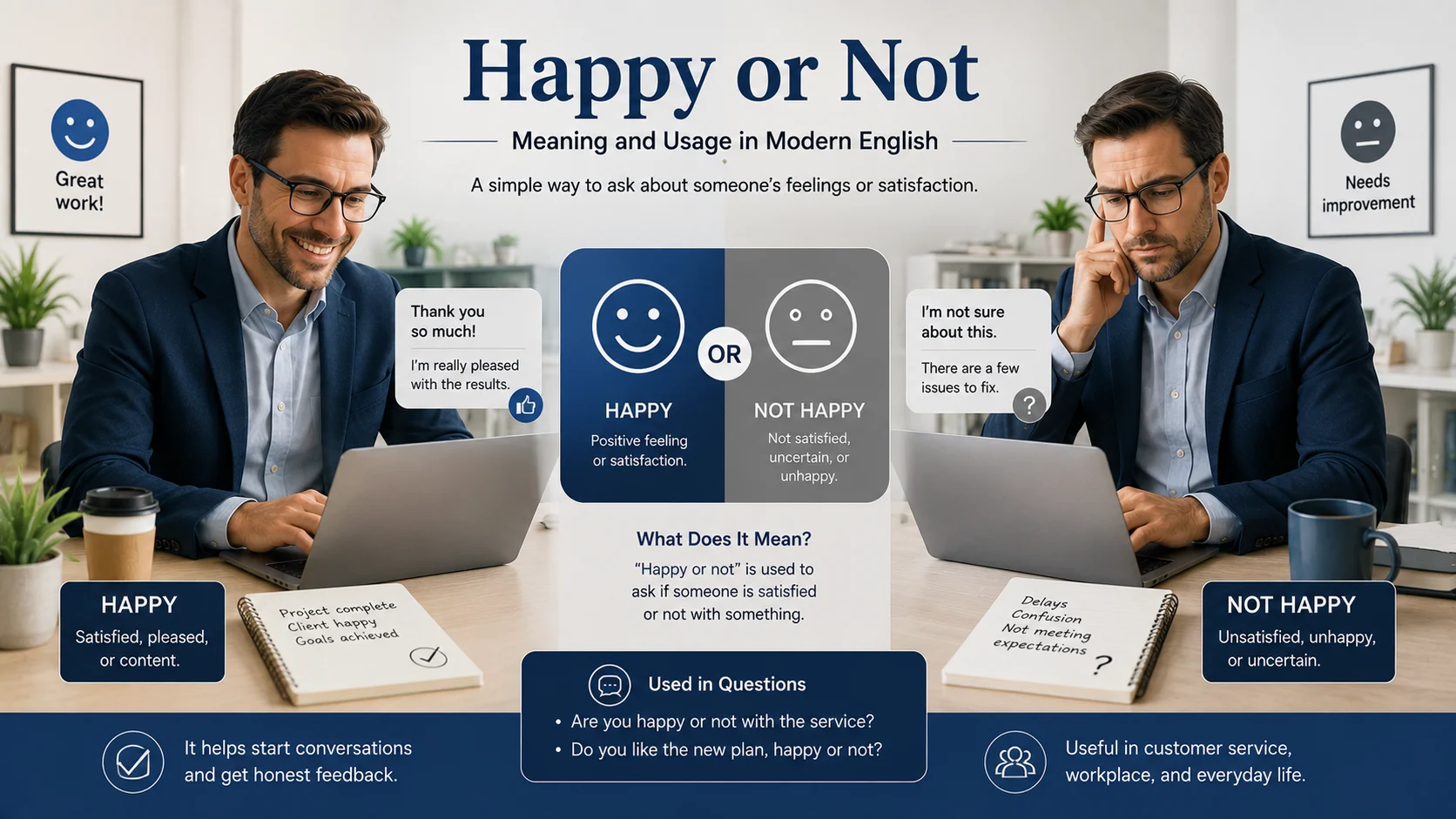
The expression happy or not asks someone is satisfied, pleased, or emotionally content, often regardless of circumstances. It can describe a direct question, a condition, or an acknowledgment that a person’s feelings may differ from what others expect. The phrase is grammatically natural, but its meaning depends on context and tone.
The phrase happy or not appears frequently in everyday English, workplace conversations, personal messages, literature, and online communication. It usually presents two possibilities: a person is happy, or the person isn’t happy. The expression can be used when asking about someone’s feelings, recognizing uncertainty, or emphasizing that a particular outcome exists regardless of emotional reaction.
For example, someone might ask, “Are you happy or not?” when they want a clear answer about another person’s feelings. A manager might say, “Whether you’re happy or not, the decision has been made.” Here, the phrase doesn’t simply ask about happiness. It can also communicate contrast, acceptance, or even firmness.
Understanding this distinction matters because changing the wording can change the tone considerably. “Are you happy?” sounds neutral, while “Are you happy or not?” can sound more direct or impatient. Similarly, “happy whether or not” introduces a different grammatical structure and meaning.
This guide explains the expression from a linguistic, grammatical, and practical perspective, with examples designed to make the usage easy to understand.
Happy or Not: What’s the Difference?
There isn’t a grammatical competition between two different words in this expression. Instead, the phrase combines the adjective happy with the conjunction or and the negative adverb not.
Happy is an adjective that describes a positive emotional state, satisfaction, pleasure, or contentment.
Not is an adverb used here to create the negative alternative to being happy.
The expression therefore presents a contrast between two states: being happy and not being happy.
| Feature | Happy | Not happy |
|---|---|---|
| Part of speech | Adjective | Adverb plus adjective |
| Basic meaning | Feeling pleased or satisfied | Feeling dissatisfied or lacking happiness |
| Positive meaning | Yes | No |
| Typical question | Are you happy? | Are you not happy? |
| Combined expression | Happy or not | Happy or not |
| Common context | Feelings, satisfaction, approval | Contrast, uncertainty, disagreement |
The important point is that happy or not doesn’t create a new adjective.
It functions as a compact way of presenting two possible emotional states.
The expression can sound neutral when used as a genuine question.
It can sound stronger when used to emphasize that something remains true regardless of feelings.
Is Happy or Not a Grammar, Vocabulary, or Usage Issue?
The main issue is usage, rather than vocabulary.
There is nothing grammatically incorrect about combining happy, or, and not. The construction follows a common English pattern in which an adjective is presented alongside its negative alternative.
Consider these examples:
“Are you happy or not?”
“She’ll attend, happy or not.”
“Whether you’re happy or not, we need to continue.”
The first example is a direct question. The second uses the expression as a shortened contrast. The third uses a more complete grammatical construction with whether.
The expression is generally interchangeable with longer constructions in casual English, but the alternatives aren’t always identical in tone.
| Expression | Tone | Typical meaning |
|---|---|---|
| Are you happy? | Neutral | Asking about feelings |
| Are you happy or not? | Direct | Demanding a clear choice |
| Whether you’re happy or not | Formal or neutral | Regardless of feelings |
| Happy or unhappy | Explicit | Clearly identifying both states |
| Whether you’re satisfied | Professional | Asking about satisfaction |
In academic writing, “happy or not” can sound conversational. A more precise expression such as “whether the participants were satisfied” is usually preferable.
In casual speech, however, the shorter phrase is completely natural.
How to Use Happy or Not in Everyday English
The expression is particularly useful when the speaker wants to highlight a person’s emotional response without spending several words explaining both possibilities.
Workplace Example
Imagine an employee has been assigned a new responsibility.
A colleague might say:
“You can accept the new schedule, happy or not.”
Here, the speaker isn’t necessarily asking whether the employee feels happy. The meaning is closer to “whether you like the schedule or not.”
For a direct workplace question, a softer version would be:
“Are you happy with the new schedule?”
That wording is often more professional because it avoids sounding confrontational.
Academic Example
Academic writing usually favors precision.
Instead of writing:
“Students were asked whether they were happy or not.”
A researcher could write:
“Students were asked whether they were satisfied with the course.”
The second sentence is more specific because satisfied directly identifies the subject being evaluated.
Technology Example
Technology discussions can also use the expression in ordinary conversational language.
For example:
“Whether you’re happy or not with the update, the application now requires the latest version.”
In technical documentation, however, clarity usually matters more than conversational style:
“Users must install the latest version regardless of whether they approve of the update.”
Usage Recap
Use the expression naturally in conversation when you want to discuss someone’s emotional reaction.
For professional or academic writing, consider a more precise term such as satisfied, content, pleased, or dissatisfied, depending on the intended meaning.
How “Whether You Are Happy or Not” Works
One of the most useful structures is:
Whether you are happy or not, + statement
This construction means that the statement remains true regardless of the person’s feelings.
For example:
“Whether you are happy or not, you must follow the rules.”
The speaker isn’t necessarily interested in discovering the person’s emotional state. The main message is that the rules apply in either situation.
Compare:
“Are you happy or not?”
This asks a question.
“Whether you are happy or not, you need to leave.”
This expresses a condition that does not depend on happiness.
That distinction is important for understanding English sentence structure.
When You Should NOT Use Happy or Not
Although the expression is correct, there are situations where another wording is more appropriate.
1. When you need a polite question
“Are you happy or not?” can sound impatient.
Use:
“Are you happy with the result?”
2. When writing academic research
Academic language generally benefits from precision.
Use:
“Were the participants satisfied with the outcome?”
3. When discussing measurable satisfaction
If the subject is customer satisfaction, satisfied is usually more precise than happy.
Use:
“Customers were satisfied with the service.”
4. When discussing formal approval
If you’re asking about agreement with a proposal, use approve or agree.
Use:
“Do you agree with the proposal?”
5. When the emotional meaning is unclear
The word happy can mean cheerful, pleased, satisfied, or fortunate.
If you need one specific meaning, choose a more exact word.
6. When speaking to someone in a sensitive situation
A direct “happy or not” question may sound dismissive.
A gentler question can be:
“How do you feel about the situation?”
7. When writing formal business communication
Professional communication often benefits from neutral language.
Use:
“Please let us know whether you are satisfied with the proposed arrangement.”
8. When the issue is preference rather than emotion
Use prefer, like, or approve when those words better express the intended meaning.
Common Mistakes and Decision Rules
| Correct sentence | Incorrect or less suitable sentence | Explanation |
|---|---|---|
| Are you happy with the decision? | Are you happy from the decision? | Use with when describing satisfaction with something |
| Whether you are happy or not, the rule applies. | Whether you happy or not, the rule applies. | The verb are is required |
| She wasn’t happy with the result. | She wasn’t happy on the result. | With is the natural preposition |
| Are they happy with the changes? | Are they happy about the changes? | Both can work, but with often focuses on satisfaction |
| He stayed, happy or not. | He stayed, happily or not. | Happy describes his state in this construction |
| I don’t know whether she is happy. | I don’t know whether she happy. | A linking verb is required |
Decision Rule
If you mean a person’s emotional state, use “happy.” If you mean satisfaction with a specific result, consider “satisfied” or “pleased.”
This rule prevents many awkward sentences because English often requires a more precise adjective than happy.
Happy and Not Happy in Modern Technology and AI Tools
Modern communication has made emotional language more flexible.
People now discuss whether they are happy with an application, an artificial intelligence system, a software update, an online purchase, or an automated response.
For example:
“I’m not happy with the latest update.”
This doesn’t necessarily mean the person is emotionally unhappy in a broad sense. It usually means they are dissatisfied with a specific change.
Artificial intelligence tools also need to interpret context rather than simply match words. The phrase “I’m happy with the result” usually expresses approval, while “I’m happy” may describe general emotional wellbeing.
This illustrates an important principle in natural language processing: meaning depends on context, grammar, and surrounding words.
Etymology and Linguistic Background
The adjective happy has an interesting history. It developed from the Middle English word hap, which referred to luck, chance, or fortune. Over time, the word became associated with favorable circumstances and eventually developed its modern meaning of feeling pleased or content.
The word not has much older Germanic roots and has long served as a central English marker of negation.
The construction or not is also deeply established in English. Similar patterns appear in expressions such as:
“Ready or not.”
“Like it or not.”
“Believe it or not.”
“Whether we agree or not.”
These constructions demonstrate that English commonly places an affirmative expression beside its negative alternative for emphasis or contrast.
Expert Style Explanation
A useful linguistic principle is that context determines whether an expression communicates a genuine question, contrast, or concession. In other words, the same words can perform different functions depending on their position in the sentence and the speaker’s intention.
Two Practical Language Case Studies
Case Study One: Workplace Communication
Consider a manager saying:
“Are you happy or not with the new arrangement?”
The grammatical structure is correct, but the tone may feel demanding.
Changing it to:
“Are you satisfied with the new arrangement?”
makes the question more professional and specific.
The improvement comes not from correcting grammar, but from selecting vocabulary that better fits the workplace context.
Case Study Two: Everyday Conversation
Imagine a friend has received a gift.
“You’ve got the gift now, happy or not.”
Here, the phrase can communicate playful teasing or mild criticism.
A more neutral statement would be:
“I hope you’re happy with it.”
The grammatical difference is small, but the pragmatic difference is significant. Tone is therefore just as important as grammar when choosing between expressions.
Error Prevention Checklist
Always use “happy” when
You are describing a positive emotional state.
You are asking about someone’s general feelings.
You are describing pleasure or contentment.
You are using a natural conversational expression.
You are contrasting happiness with its opposite.
Avoid “happy” when
You need to describe formal approval.
You are measuring customer satisfaction.
You need a precise academic term.
You are discussing agreement rather than emotion.
You need to distinguish satisfaction from general happiness.
Related Grammar Confusions You Should Master
Learning this expression becomes easier when you understand other common English contrasts.
- Whether or if
- Affect or effect
- Then or than
- Your or you’re
- Its or it’s
- Who or whom
- Fewer or less
- Good or well
- Lay or lie
- Further or farther
These pairs and structures cause confusion because English meaning often depends on grammatical function rather than spelling alone.
FAQs
What does happy or not mean in English?
It means being happy or not being happy, and it can describe either a direct question about feelings or a situation that remains true regardless of someone’s feelings.
Is happy or not grammatically correct?
Yes, it is grammatically acceptable when used appropriately, especially in questions and constructions expressing contrast or indifference to someone’s emotional response.
Is it better to say happy or not or you are happy or not?
Both can be correct, but “you are happy or not” is generally clearer when it introduces a complete dependent clause.
Can I use happy or not in formal writing?
You can, but formal writing often benefits from more precise words such as satisfied, pleased, dissatisfied, or content.
Does happy or not sound rude?
It can sound blunt when used as a direct question, particularly with a frustrated tone, so a softer expression may be better in sensitive conversations.
What is the difference between happy and satisfied?
Happy usually describes an emotional state, while satisfied more specifically describes contentment with a particular result, service, decision, or situation.
Can happy or not mean regardless of happiness?
Yes. In expressions such as “You’re happy or not, the decision stands,” it means that the outcome does not depend on the person’s feelings.
Is happy or not the same as happy or unhappy?
They can communicate a similar contrast, but “happy or unhappy” explicitly names both emotional states, while “happy or not” is shorter and more conversational.
Conclusion
Understanding the expression requires more than checking the words are grammatically correct. The real issue is context, tone, precision, and communicative purpose.
Use happy when you’re describing someone’s emotional state. Use satisfied when you specifically mean contentment with a result, service, decision, or experience. Use you are happy or not when you want to show that something remains true regardless of how someone feels.
The expression is natural in everyday English, but it isn’t always the best choice for formal or academic communication. A strong writer considers not only grammatical correctness but also tone and intended meaning.
When you encounter happy or not, ask one simple question: Is the speaker asking about happiness, or emphasizing that happiness doesn’t change the situation? That distinction will usually reveal the correct interpretation.
Discover More Related Articles:
- Offerred or Offered | Which Spelling Is Correct & Why In 2026
- Honda or Toyota | Which Is Better for Reliability, Value & Everyday Driving In 2026
- Draws or Drawers | Meaning, Grammar, Usage & Common Mistakes In 2026