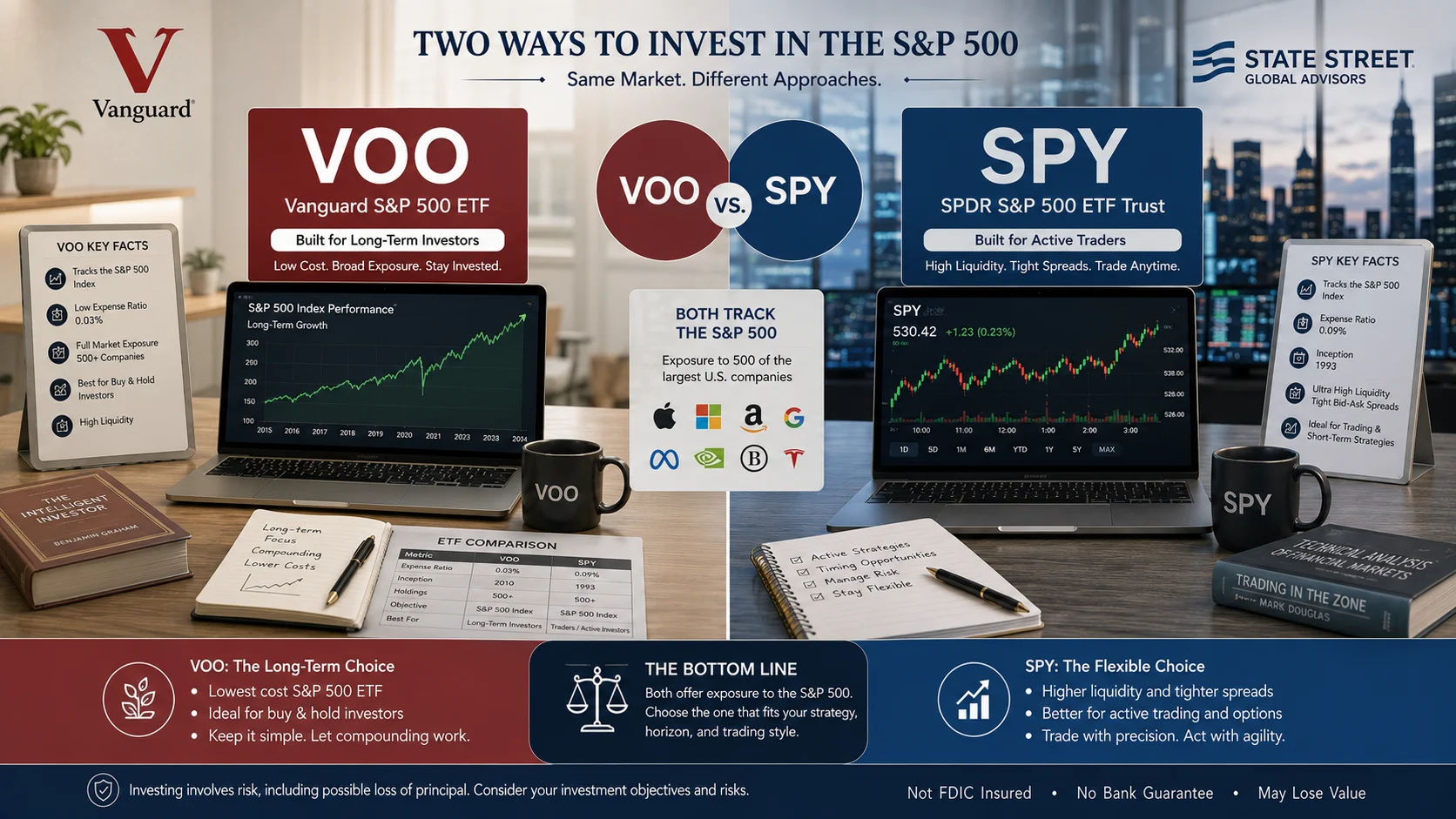
VOO or SPY compares two major exchange traded funds that track the S&P 500 Index. VOO is Vanguard’s S&P 500 ETF, while SPY is State Street’s SPDR S&P 500 ETF Trust. Their portfolios are extremely similar, but fees, fund structure, trading liquidity, and investor goals can make one more suitable than the other.
When investors begin comparing S&P 500 ETFs, two tickers appear repeatedly: VOO and SPY. Both provide exposure to large American companies through a single exchange traded fund, making them popular choices for investors who want broad exposure to the US stock market without selecting individual companies.
The confusion is understandable because the two funds pursue essentially the same investment objective. Both seek to track the S&P 500 Index, a float adjusted, market capitalization weighted index representing large US companies across eleven economic sectors.
Yet identical market exposure does not mean identical investment characteristics. VOO currently has a considerably lower expense ratio, while SPY has an exceptionally long operating history and remains one of the most heavily traded ETFs in the market. SPY began trading in 1993, making it the first exchange traded fund listed in the United States. VOO launched in 2010.
For a long term investor, a small difference in annual costs can compound over decades. For an active trader, liquidity and trading mechanics may matter more. Understanding that distinction is the key to making an informed comparison.
VOO vs SPY | What’s the Difference?
VOO and SPY are both designed to provide exposure to the S&P 500, so their underlying investments are remarkably similar. The most important differences involve cost, structure, trading characteristics, assets, and the type of investor each fund may suit.
| Feature | VOO | SPY |
|---|---|---|
| Full name | Vanguard S&P 500 ETF | State Street SPDR S&P 500 ETF Trust |
| Issuer | Vanguard | State Street Global Advisors |
| Benchmark | S&P 500 Index | S&P 500 Index |
| Expense ratio | 0.03% | 0.0945% |
| Inception | September 7, 2010 | January 22, 1993 |
| Investment style | Passive large cap US equity | Passive large cap US equity |
| Structure | Open ended ETF | Unit Investment Trust |
| Options | Available | Available |
| Dividend frequency | Quarterly | Quarterly |
| Primary strength | Low cost for long term investing | Trading liquidity and established market presence |
| Best suited to | Buy and hold investors | Active traders and investors prioritizing liquidity |
Vanguard currently reports an expense ratio of 0.03% for VOO, while State Street reports a gross expense ratio of 0.0945% for SPY.
Quick recap
VOO and SPY both follow the S&P 500.
VOO has the lower annual expense ratio.
SPY has a much longer history and exceptional trading activity.
The better choice depends largely on how you intend to use the ETF.
Is VOO vs SPY a Grammar, Vocabulary or Usage Issue?
This comparison isn’t a language question in the traditional sense. VOO and SPY are financial ticker symbols, so the distinction is primarily an investment and usage issue.
They are not interchangeable names for the same security. Each ticker represents a separate ETF issued and operated by a different financial institution. However, they are highly comparable because both seek to track the same S&P 500 benchmark.
In casual investing conversations, someone might refer to either one simply as an S&P 500 fund. In professional investment analysis, however, identifying the exact ticker matters because fees, structure, trading characteristics, distributions, and tax considerations can differ.
For academic writing, financial research, workplace investment discussions, and portfolio documentation, it is better to identify the fund by its ticker and full name the first time it appears.
What Is VOO?
VOO is the Vanguard S&P 500 ETF. Its investment objective is to track the performance of a benchmark measuring large capitalization US stocks. Vanguard describes the fund as using a passive, full replication strategy.
As of July 31, 2026, Vanguard reported 505 holdings and approximately $1.69 trillion in total net assets for the fund. Its expense ratio was 0.03%.
That low cost is one of VOO’s biggest attractions.
Workplace example
An employee building a retirement portfolio through a brokerage account may prefer VOO because the fund provides broad S&P 500 exposure while charging a very low annual expense ratio.
Academic example
A finance student comparing passive investment strategies could use VOO as an example of a low cost index tracking ETF and analyze how expense ratios influence long term compound returns.
Technology example
An investor using a modern portfolio application can purchase VOO like a stock during market hours, monitor its price, reinvest distributions, and combine it with other asset classes.
VOO usage recap
VOO is particularly attractive for investors who emphasize low costs and long term ownership. Its purpose is straightforward: provide broad exposure to large US companies while closely following the S&P 500.
What Is SPY?
SPY is the State Street SPDR S&P 500 ETF Trust. It seeks to provide investment results that generally correspond to the price and yield performance of the S&P 500 Index.
SPY has a distinctive place in ETF history. It launched on January 22, 1993 and was the first exchange traded fund listed in the United States. State Street reported assets under management of approximately $811.94 billion as of August 31, 2026.
SPY’s expense ratio is higher than VOO’s, but its trading ecosystem remains extremely important. The fund also has options available, which can make it particularly useful for investors and institutions using more sophisticated trading strategies.
Workplace example
A portfolio manager who regularly adjusts market exposure may use SPY because it is a highly established vehicle for trading S&P 500 exposure.
Academic example
A university finance course might examine SPY when discussing the development of exchange traded funds because of its historical significance as the first US listed ETF.
Technology example
An advanced trading platform can use SPY for strategies involving options, hedging, short term positioning, or other market exposure techniques.
SPY usage recap
SPY can be especially relevant when trading characteristics matter. Its higher expense ratio does not automatically make it inferior. Different investors value different characteristics.
VOO and SPY Cost Comparison
Expense ratio is one of the clearest differences between the two funds.
| Investment amount | VOO at 0.03% | SPY at 0.0945% | Approximate annual difference |
|---|---|---|---|
| $10,000 | $3.00 | $9.45 | $6.45 |
| $50,000 | $15.00 | $47.25 | $32.25 |
| $100,000 | $30.00 | $94.50 | $64.50 |
| $500,000 | $150.00 | $472.50 | $322.50 |
| $1,000,000 | $300.00 | $945.00 | $645.00 |
These figures illustrate the annual operating expense based solely on the stated expense ratios. They do not represent total investment costs because trading spreads, commissions where applicable, taxes, and other factors can affect an investor’s actual result.
Vanguard has also published a detailed comparison showing that the lower expense ratio of VOO can materially reduce total ownership costs over longer holding periods.
VOO vs SPY Performance: Are They Different?
Because both funds track the same benchmark, their long term performance tends to be extremely close before costs.
Their actual returns can differ slightly because of expenses, portfolio implementation, cash holdings, trading costs, distributions, and other fund mechanics.
Recent comparisons have shown only small differences in total returns. For example, a June 2026 comparison reported five year growth of $1,828 for SPY versus $1,835 for VOO on a hypothetical $1,000 investment, illustrating how closely the funds can track each other while still producing slightly different results.
Investors should therefore avoid choosing between these ETFs solely by looking at a short period of historical performance. The benchmark, costs, investment horizon, taxes, and intended use all deserve attention.
When You Should NOT Use VOO or SPY
Neither ETF should automatically be treated as the perfect investment for every objective.
| Situation | Why caution is appropriate |
|---|---|
| You need guaranteed returns | Neither ETF guarantees principal or returns |
| You need international diversification | Both focus on US large capitalization stocks |
| You want small company exposure | The S&P 500 does not provide dedicated small cap exposure |
| You need fixed income | Neither fund is a bond ETF |
| You need a highly customized portfolio | A single index ETF may not meet specialized allocation needs |
| You are choosing based only on recent returns | Short term performance can be misleading |
| You need money very soon | Stock market prices can fluctuate significantly |
| You are trading without understanding market orders | ETF prices can move during market hours |
State Street specifically warns that ETF investments are subject to market fluctuations and may trade above or below net asset value.
Common Mistakes and Decision Rules
| Correct sentence | Incorrect sentence | Explanation |
|---|---|---|
| VOO has a lower expense ratio than SPY. | VOO has no investment costs. | VOO still has an expense ratio and other possible transaction costs. |
| SPY tracks the S&P 500. | SPY tracks a completely different index. | Both funds seek to track the S&P 500. |
| SPY can be useful for active trading. | SPY is only for retirement investors. | Its liquidity and trading ecosystem can suit active strategies. |
| VOO may suit long term investors focused on cost. | VOO is guaranteed to outperform SPY. | Lower fees do not guarantee future outperformance. |
| Both funds carry equity market risk. | Neither fund can lose value. | Both are exposed to stock market movements. |
Decision Rule: If your priority is minimizing ongoing fund expenses for long term S&P 500 exposure, VOO deserves serious consideration. If your priority is trading flexibility and the established SPY trading ecosystem, SPY may be more appropriate.
VOO and SPY in Modern Technology and AI Tools
Modern investing platforms have made both ETFs accessible to individual investors through desktop and mobile applications.
AI powered financial tools can also compare expense ratios, historical returns, holdings, volatility, distributions, and portfolio allocations. However, investors should distinguish between data analysis and financial advice. An AI system can organize information, but it cannot remove market risk or predict future returns with certainty.
Both ETFs also provide exposure to companies involved in artificial intelligence, cloud computing, semiconductors, software, consumer technology, financial services, health care, and other major industries because the S&P 500 spans eleven sectors.
VOO vs SPY Holdings and Diversification
Although fund holdings can change over time, the portfolios of VOO and SPY are closely tied to the same benchmark.
Vanguard reported 505 holdings for VOO as of July 31, 2026. Its largest positions included NVIDIA, Apple, Microsoft, Amazon, Alphabet, Broadcom, Meta, Micron, and Tesla.
This illustrates an important point about S&P 500 diversification. Owning an index fund provides exposure to hundreds of companies, but the portfolio remains weighted according to company market capitalization. Consequently, the largest companies can represent substantial portions of the fund.
The S&P 500 is therefore diversified, but it isn’t equally weighted.
Authority and Trust: Why Fund Structure Matters
The history of SPY and the scale of VOO demonstrate two different approaches to the same broad investment objective.
SPY’s unit investment trust structure is part of its historical design, while VOO operates as an ETF using Vanguard’s passive full replication approach.
A useful principle in ETF analysis is:
“The cheapest fund isn’t automatically the best fund for every investor.”
The important question is the fund’s characteristics match the investor’s objective.
Case study 1: Long term cost
Consider an investor with $100,000 seeking S&P 500 exposure. Based purely on current expense ratios, VOO would have an annual fund expense of approximately $30, compared with approximately $94.50 for SPY. Over many years, differences in costs can compound because money spent on expenses is money that cannot remain invested. The actual outcome will vary with portfolio value and market performance.
Case study 2: Trading requirements
Consider an investor who frequently trades S&P 500 exposure and uses options. SPY’s long history, extensive trading ecosystem, and available options can make it particularly relevant to this type of strategy. That does not mean SPY is inherently better for every trader, but it demonstrates why expense ratio should not be the only decision factor.
Author expertise: This analysis is written from an SEO and financial content perspective, with emphasis on clear terminology, source based comparisons, search intent, and practical investor education.
Error Prevention Checklist
Always use VOO when
You prioritize a very low expense ratio.
You are seeking straightforward S&P 500 exposure.
You expect to hold the investment for many years.
You want a simple passive investment approach.
Never use SPY when
You assume a higher expense ratio automatically means better returns.
You believe ETF investing eliminates market risk.
You need guaranteed principal protection.
You are selecting the fund solely because of its ticker popularity.
Related Grammar Confusions You Should Master
Although VOO and SPY are financial tickers rather than grammar terms, investors often encounter similar terminology distinctions when reading financial content.
- ETF vs mutual fund
- Index vs benchmark
- Market price vs net asset value
- Expense ratio vs trading cost
- Dividend vs capital gain
- Total return vs price return
- Market capitalization vs equal weighting
- Liquidity vs trading volume
- Volatility vs risk
- Yield vs total return
Understanding these distinctions makes investment research much easier because many apparent disagreements are actually differences in terminology or measurement.
FAQs
Is VOO better than SPY for long term investing?
VOO may be more attractive for long term investors because its current expense ratio is substantially lower, although suitability depends on the investor’s objectives and circumstances.
Why is VOO cheaper than SPY?
VOO currently charges 0.03%, while SPY reports a gross expense ratio of 0.0945%, so VOO has the lower ongoing fund cost.
Do VOO and SPY track the same index?
Yes. Both seek to track the S&P 500 Index, so their underlying market exposure is highly similar.
Is SPY better for active traders?
SPY can be attractive to active traders because of its long market history, trading ecosystem, and available options, although trading suitability depends on the strategy.
Does VOO have more stocks than SPY?
The exact number of holdings can change, and the two funds may report slightly different holding counts at a particular date even though both track the same benchmark.
Are VOO and SPY safe investments?
Neither is risk free. Both are equity ETFs whose values can fall when the stock market declines.
Which has the better dividend yield, VOO or SPY?
Dividend yields can change with market prices and distributions, so investors should compare current official fund data rather than relying on an old yield figure.
Can I own both VOO and SPY?
Yes, but doing so generally creates substantial overlap because both funds provide exposure to the same S&P 500 companies.
Does VOO always outperform SPY?
No. Its lower expense ratio gives it a cost advantage, but future investment performance is not guaranteed and small differences can arise from several fund characteristics.
Conclusion
For most investors seeking simple, long term S&P 500 exposure, VOO stands out because its current 0.03% expense ratio is significantly below SPY’s 0.0945%. That cost difference can become meaningful as an investment grows and remains invested for many years.
SPY remains highly relevant because of its history, scale, trading ecosystem, and role in active investment strategies. It was the first US listed ETF and continues to be a major vehicle for obtaining S&P 500 exposure.
The simplest conclusion is therefore not that one fund is universally superior. VOO is generally compelling for cost conscious long term investors, while SPY can be compelling when trading characteristics matter more.
When evaluating VOO or SPY, look beyond the ticker. Compare expense ratios, investment structure, liquidity, taxes, portfolio objectives, trading frequency, and time horizon. Both funds provide powerful access to the same broad US equity benchmark, but the better choice depends on what you need the ETF to accomplish.
Discover More Related Articles:
- Offerred or Offered | Which Spelling Is Correct & Why In 2026
- Honda or Toyota | Which Is Better for Reliability, Value & Everyday Driving In 2026
- Draws or Drawers | Meaning, Grammar, Usage & Common Mistakes In 2026