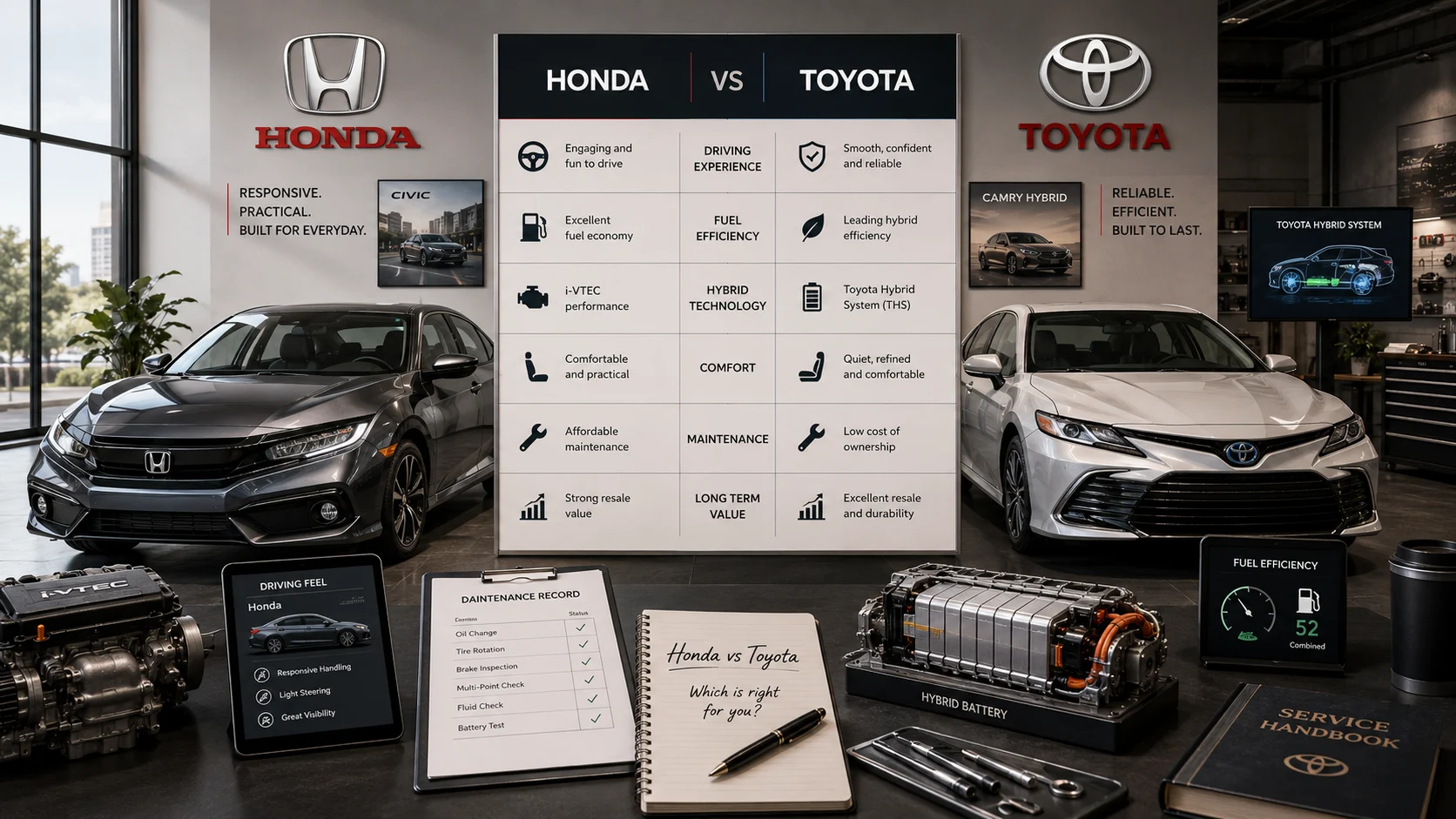
Honda and Toyota are two of the best known Japanese automobile brands, but they emphasize slightly different strengths. Honda is often associated with responsive driving, practical interiors, and strong all round value, while Toyota has a particularly strong reputation for reliability, hybrid technology, and long term ownership. The better choice depends on your priorities, budget, vehicle type, and driving needs.
Choosing between Honda and Toyota can be challenging because both automakers are known for reliability, fuel efficiency, and long-lasting vehicles. But which brand is the better choice for your needs? you are buying your first car, upgrading your family vehicle, or looking for a dependable used car, understanding the differences between Honda and Toyota can help you make a more informed decision. Although both brands offer competitive models, they differ in driving experience, interior design, maintenance considerations, and the features available across their lineups.
In this guide, we’ll compare Honda vs. Toyota across key factors, including reliability, fuel economy, performance, comfort, resale value, and overall ownership costs. Rather than declaring one brand the universal winner, we’ll explore where each manufacturer stands out and what buyers should consider before making a purchase. By examining these practical differences, you can identify which brand better matches your budget, driving habits, and long-term expectations.
Honda or Toyota | What’s the Difference?
Honda and Toyota are both proper nouns because they are names of automobile companies and brands. They aren’t interchangeable terms for the same thing. Each represents a separate manufacturer with its own vehicles, engineering choices, design philosophy, technology, warranty policies, and ownership experience.
Honda Motor Co. began in Japan as a manufacturer founded by Soichiro Honda and Takeo Fujisawa. Toyota Motor Corporation is another Japanese manufacturer with a much longer industrial history. Both companies have become global automobile leaders, offering cars, SUVs, hybrids, and other mobility products.
The easiest way to understand the difference is to stop thinking of the question as a simple contest. A Honda Civic and a Toyota Corolla may compete directly, but the best choice between them can change depending on fuel economy, driving feel, cabin design, resale value, safety equipment, repair costs, and the specific model year.
| Comparison | Honda | Toyota |
|---|---|---|
| Brand origin | Japan | Japan |
| Main reputation | Practicality, driving feel, efficient powertrains | Reliability, hybrids, long term ownership |
| Common passenger cars | Civic, Accord | Corolla, Camry |
| Popular compact SUVs | CR V, HR V | RAV4, Corolla Cross |
| Hybrid presence | Strong and expanding | Especially extensive |
| Driving character | Often responsive and composed | Often comfort focused and predictable |
| Reliability reputation | Excellent | Excellent |
| Long term ownership | Strong | Strong |
| Best known strength | Balanced practicality and driving experience | Reliability and hybrid expertise |
| Ideal buyer | Driver wanting practicality with engaging road manners | Buyer prioritizing dependable long term ownership |
Consumer Reports has consistently placed both manufacturers among strong performers for reliability. Its latest brand reliability reporting placed Toyota at the top of its reliability rankings, with Honda also in the top group. Consumer Reports also stresses that individual model reliability can vary significantly within the same brand.
Quick recap
Honda and Toyota are competing automobile manufacturers, not alternative spellings or interchangeable words.
Honda frequently appeals to buyers who value practicality and driving characteristics.
Toyota has a particularly strong reputation for reliability and hybrid technology.
The specific vehicle and model year matter more than the badge alone.
Is Honda or Toyota a Brand, Vocabulary or Usage Issue?
This isn’t a grammar problem in the traditional sense. It’s primarily a comparison and consumer decision issue.
When someone searches for Honda or Toyota, they usually want to know which manufacturer produces the better vehicle for a particular purpose. The two names cannot normally be substituted for one another.
For example, saying, “I bought a Honda” identifies the manufacturer. Saying, “I bought a Toyota” identifies a different manufacturer. Replacing one with the other changes the factual meaning of the sentence.
The confusion usually develops because both companies compete in similar categories. A Civic competes with vehicles such as the Corolla, while the CR V and RAV4 occupy closely related SUV territory. This creates an understandable temptation to ask which brand is universally better.
There is no universal winner.
A buyer interested in handling might prefer one model. A buyer focused on hybrid efficiency might prefer another. Someone purchasing a used vehicle may care more about service history and condition than the manufacturer’s reputation.
Formal versus casual usage
In formal writing, use the complete brand name when precision matters.
Example:
“Honda and Toyota have different approaches to vehicle design.”
In casual conversation, people often use the brand name as shorthand for a vehicle.
Example:
“I drive a Toyota.”
Both are normal forms of English usage.
Academic and professional usage
In academic or professional writing, avoid making unsupported claims such as “Toyota cars never break down” or “Honda is always better.
A stronger statement would be:
“Both Honda and Toyota have established strong reliability reputations, although reliability varies by model and model year.”
That wording is more precise and defensible.
Honda | When It Makes More Sense
Honda has built its reputation around practical vehicles that are generally easy to live with while retaining a relatively engaging driving character.
Models such as the Civic and Accord have traditionally appealed to drivers who want efficient transportation without feeling disconnected from the road. Honda’s SUV range also gives buyers choices for family transportation, urban driving, and longer trips.
Consumer Reports currently describes Honda vehicles as generally inexpensive, reliable, and fuel efficient, while noting that its sedans and SUVs often perform strongly in road tests and predicted reliability.
Workplace example
Imagine an employee who commutes long distances every week and needs a comfortable vehicle that is economical enough for regular travel.
A Honda Civic or Accord may make sense because the buyer can combine fuel efficiency, practicality, comfortable road manners, and a driving experience that feels relatively responsive.
Academic example
Suppose you’re writing a research project about automobile engineering.
A useful sentence would be:
“Honda has historically emphasized efficient engines and practical vehicle packaging across several segments.”
This is more informative than simply saying Honda makes good cars.
Technology example
Modern Honda vehicles increasingly combine driver assistance systems, connected features, hybrid powertrains, digital displays, and smartphone integration.
Honda’s current product strategy also demonstrates that the company is moving toward broader electrification. Its 2026 Digital FactBook shows substantial production of hybrid versions of models including the CR V and Accord.
Honda usage recap
Choose Honda when driving feel, practical packaging, efficient transportation, and balanced everyday usability are high priorities.
That doesn’t mean every Honda is automatically better. Vehicle condition, model year, powertrain, maintenance history, and intended use still matter.
Toyota | When It Makes More Sense
Toyota’s greatest advantage is arguably the depth of its reputation for dependable ownership.
The company has also spent decades developing and refining hybrid technology. That experience gives Toyota an unusually broad hybrid lineup and makes the brand especially relevant to buyers who want lower fuel consumption without moving completely to an electric vehicle.
Toyota’s reliability reputation remains exceptionally strong. Consumer Reports’ latest reliability survey ranked Toyota first among brands for predicted reliability.
Workplace example
Consider someone who uses a vehicle for frequent commuting, client visits, or business travel.
Toyota may be attractive because long term dependability and fuel efficiency can become important when a vehicle accumulates substantial mileage.
Academic example
In an academic discussion of automotive technology, Toyota provides a useful case study in hybrid vehicle development and mass market adoption.
Toyota’s official historical information shows that its hybrid passenger vehicle sales reached major cumulative milestones years ago, demonstrating how early and extensively the company committed to hybrid technology.
Technology example
Toyota’s modern technology strategy extends beyond traditional gasoline engines. Its vehicles include hybrid, plug in hybrid, battery electric, connected, and driver assistance technologies.
For buyers who want hybrid choices across several vehicle categories, Toyota can therefore provide an unusually broad selection.
Toyota usage recap
Choose Toyota when reliability reputation, hybrid availability, predictable ownership, and long term value are major priorities.
The same warning applies here: a Toyota badge does not guarantee that every model or every model year will outperform every Honda.
When You Should NOT Choose Honda or Toyota
The biggest mistake is assuming that brand reputation eliminates the need to research the actual vehicle.
Here are several situations where choosing purely by brand name can lead to a poor decision.
- Do not choose Honda simply because you believe every Honda is more fun to drive.
Driving characteristics differ considerably between models, engines, transmissions, tires, and generations.
- Do not choose Toyota solely because someone says Toyota cars never have problems.
No automobile manufacturer can guarantee a completely trouble free ownership experience.
- Do not choose either brand without checking the specific model year.
A redesigned vehicle can have a different reliability history from the generation it replaces. Consumer Reports specifically warns that newly introduced or newly redesigned vehicles can experience more problems during their initial model year.
- Do not ignore maintenance records when buying used.
A well maintained used Honda can be a better purchase than a neglected Toyota.
- Do not choose a hybrid solely because it has a hybrid badge.
Your annual mileage, driving conditions, fuel prices, and ownership period determine the additional technology is worthwhile.
- Do not ignore safety equipment.
Compare the exact trim level rather than assuming every version of a model has identical equipment.
- Do not buy based only on resale value.
A vehicle that retains value well can still be the wrong choice if it doesn’t fit your space, comfort, driving, or technology requirements.
- Do not treat brand rankings as a substitute for a test drive.
A reliability ranking cannot tell you the seating position, steering, visibility, ride quality, or controls feel right for you.
Common Mistakes and Decision Rules
| Correct sentence | Incorrect sentence | Explanation |
|---|---|---|
| Honda and Toyota are separate automobile manufacturers. | Honda and Toyota are different names for the same company. | They are independent Japanese automobile companies. |
| Toyota has a particularly strong hybrid reputation. | Every Toyota is automatically more fuel efficient than every Honda. | Fuel economy depends on the specific vehicle and powertrain. |
| Honda has a strong reliability reputation. | Every Honda is guaranteed to be trouble free. | Reliability is never guaranteed for every individual vehicle. |
| Compare the exact model and year before buying. | The brand badge tells you everything you need to know. | Vehicle level differences can be substantial. |
| Check the service history of a used vehicle. | Buy any old Honda or Toyota without inspection. | Condition and maintenance history strongly influence ownership costs. |
| Consider your driving needs first. | Always choose Toyota because it is Japanese. | National origin alone doesn’t determine a vehicle fits your needs. |
Decision Rule Box
If reliability and hybrid availability are your primary concerns, Toyota deserves close consideration. If driving feel and practical everyday usability are especially important, Honda deserves close consideration. For either brand, compare the exact model, generation, powertrain, trim, price, and maintenance history before deciding.
Honda or Toyota in Modern Technology and AI Tools
Modern automobile comparison is increasingly influenced by software, connected services, driver assistance, hybrid control systems, and artificial intelligence.
AI tools can help shoppers compare specifications, fuel economy estimates, dimensions, safety equipment, ownership costs, and model histories. However, AI generated recommendations should be treated as a starting point rather than a final buying decision.
An AI system may summarize thousands of reviews, but it cannot know a particular used vehicle has been properly maintained unless reliable records are provided.
The same principle applies to reliability rankings. Consumer Reports uses large scale owner survey data and analyzes multiple trouble areas, including engines, transmissions, electrical systems, brakes, and in car electronics.
Technology makes comparison easier, but careful human judgment remains essential.
Etymology and Brand History
The name Honda comes from the family name of founder Soichiro Honda. Toyota developed from the Toyoda family name, with the company adopting Toyota as its corporate identity.
Both brands emerged from Japan and eventually expanded into international automobile markets.
Their histories also help explain some of their modern reputations. Honda developed a strong identity around engineering, engines, motorcycles, and automobiles. Toyota became famous for manufacturing discipline, production efficiency, and eventually its extensive hybrid strategy.
The result is two brands that share a reputation for Japanese engineering quality while maintaining noticeably different corporate histories and product philosophies.
Expert style perspective
“For reliability conscious buyers, the most useful comparison is not simply brand against brand, but model against model and year against year.”
That principle aligns with Consumer Reports’ warning that significant reliability differences can exist among vehicles from the same manufacturer.
Case Study 1: Long term reliability
Consumer Reports analyzed vehicles that had demonstrated an ability to reach 200,000 miles or more. Its findings showed a clear pattern: Honda and Toyota models appeared prominently among the vehicles most likely to reach that milestone with relatively few problems.
The practical result is important for buyers considering long ownership periods. Both brands have evidence supporting their reputations for durability, so the decision should focus on which specific vehicle best meets the buyer’s needs.
Case Study 2: Reliability rankings
Consumer Reports’ latest reliability reporting provides another useful comparison. Toyota took the top position in the brand reliability ranking, while Honda remained among the strongest mainstream brands.
The concrete lesson is not that Honda is unreliable. Instead, it shows that Toyota currently holds a measurable advantage in one major reliability ranking while Honda remains a highly competitive choice.
Error Prevention Checklist
Always use Honda when
- The specific Honda model has the features and driving characteristics you want.
- Its price fits your budget.
- Its fuel economy suits your normal driving.
- Its maintenance history is strong if buying used.
- You prefer its seating, controls, ride, and handling after a test drive.
Never use Toyota when
- You are choosing it only because someone says it can never break.
- The specific Toyota model does not fit your space requirements.
- Its price is substantially higher than a comparable alternative without meaningful benefits.
- You have ignored the vehicle’s maintenance history.
- You have not compared the exact model year and trim.
Related Grammar Confusions You Should Master
Although Honda and Toyota are brand names rather than grammar alternatives, readers who frequently research language and usage may also encounter confusing pairs such as:
- Affect or effect
- Advice or advise
- Practice or practise
- License or licence
- Compliment or complement
- Principal or principle
- Then or than
- Its or it’s
- Further or farther
- Fewer or less
The important lesson is that not every search query containing “or” represents a spelling problem. Sometimes the terms refer to completely different entities, concepts, products, or brands.
FAQs
Is Honda or Toyota more reliable?
Toyota currently has the stronger position in Consumer Reports’ latest brand reliability ranking, while Honda also ranks among the strongest brands. The specific model and year remain important.
Is Honda or Toyota better for long term ownership?
Both can be excellent long term choices. Consumer Reports has found that models from both manufacturers are strongly represented among vehicles capable of reaching 200,000 miles or more.
Is Honda or Toyota better for fuel economy?
Neither brand wins every comparison because fuel economy depends on the exact model, engine, transmission, hybrid system, vehicle size, and driving conditions.
Is Honda or Toyota better for a family SUV?
Both offer strong family SUV options. Compare seating, cargo capacity, safety equipment, fuel economy, price, and the exact model year before choosing.
Is Honda or Toyota better for hybrid cars?
Toyota has an especially deep history and broad selection of hybrid vehicles, while Honda also offers competitive hybrid models. Toyota’s hybrid experience is one of its major strengths.
Is Honda or Toyota cheaper to maintain?
Maintenance costs vary by model, age, mileage, location, parts prices, and service requirements, so a blanket brand level answer can be misleading.
Should I buy a Honda or Toyota used?
Either can be a strong used vehicle choice, but condition, service history, accident history, mileage, inspection results, and model specific reliability matter more than the badge alone.
Which lasts longer, Honda or Toyota?
Both brands have many models with strong durability records. Consumer Reports’ long term analysis found Honda and Toyota models prominently represented among vehicles reaching 200,000 miles or more.
Conclusion
The best answer to Honda or Toyota isn’t that one brand wins every category. Toyota currently has an especially strong reliability reputation and an extensive hybrid portfolio, while Honda remains highly competitive with practical vehicles, strong reliability, efficient powertrains, and appealing driving characteristics.
If long term reliability and hybrid choice are your highest priorities, Toyota deserves serious consideration. If you value practicality, driving feel, and balanced everyday performance, Honda may be the better fit. Most importantly, compare the exact vehicle rather than relying on the badge.
A smart buyer asks a more useful question than simply “Honda or Toyota?” The better question is, “Which Honda or Toyota model best fits my needs, budget, driving habits, and expected ownership period?”
Discover More Related Articles:
- Friend or Foe | Meaning, Pronunciation, Spelling & How to Use It Correctly In 2026
- Nails or Never | Meaning, Correct Wording & Usage Guide In 2026
- Arial or Aerial | Two Similar Words, Two Different Meanings In 2026