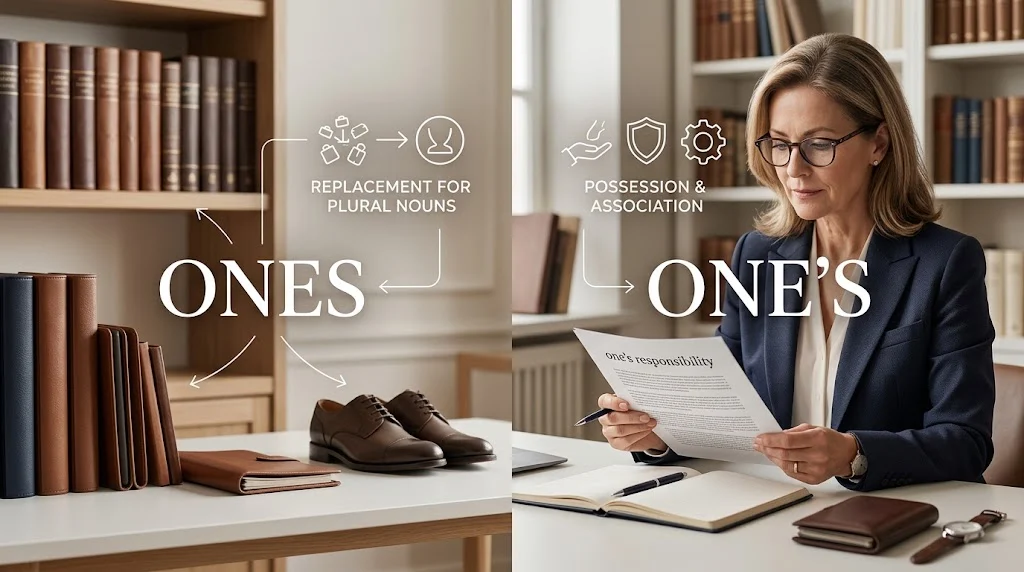
“Ones” is the plural form of “one” and refers to multiple people or things, while “one’s” is the possessive form of “one” and means something belonging to a person. They are not interchangeable, so choosing the wrong form can change the meaning of a sentence.
Understanding the difference between ones or one’s is important because the two forms sound similar but perform completely different grammatical jobs. Ones is normally a plural pronoun used to avoid repeating a noun, while one’s is a possessive determiner or possessive pronoun referring to something associated with a person. This small apostrophe can therefore change an entire sentence from a reference to multiple items into an expression of possession.
Ones vs One’s: What’s the Difference?
The simplest way to distinguish these forms is to ask what the sentence is trying to express.
Ones is the plural form of one when one represents people or things. It is commonly used after a determiner or adjective when the original noun has already been mentioned.
For example:
I prefer the blue shoes to the black ones.
Here, ones replaces the repeated noun shoes. It means multiple shoes.
One’s, on the other hand, contains an apostrophe because it expresses possession. It generally means belonging to one or belonging to a person.
For example:
One should respect one’s parents.
In this sentence, one’s indicates that the parents belong to or are associated with the person represented by one.
| Form | Part of speech | Meaning | Main function | Example |
|---|---|---|---|---|
| Ones | Plural pronoun | Multiple people or things | Replaces a repeated plural noun | I like the red ones. |
| One’s | Possessive determiner | Belonging to one or a person | Shows possession or association | One should protect one’s privacy. |
| One | Pronoun | A person or thing | Refers to a single person or thing | One should be careful. |
| Oneself | Reflexive pronoun | One personally | Refers back to one | One should trust oneself. |
The distinction becomes much easier when you remember the role of the apostrophe.
Ones means more than one.
One’s expresses possession.
Ones usually replaces a plural noun.
One’s normally comes before a noun when it means belonging to one.
A Simple Example
Compare these two sentences:
I don’t like the expensive ones.
One should consider one’s budget.
The first sentence talks about multiple things. The second sentence expresses possession. The apostrophe in one’s is therefore meaningful, not decorative.
Is Ones vs One’s a Grammar, Vocabulary or Usage Issue?
The distinction is primarily a grammar and usage issue, rather than a simple vocabulary difference. Both forms originate from the word one, but the apostrophe changes the grammatical function.
Ones is plural. It commonly appears when a writer wants to avoid repeating a noun.
These books are better than the old ones.
The word ones stands in for books.
One’s is possessive. It indicates that something belongs to, concerns, or is associated with one.
One must accept one’s responsibilities.
Here, one’s responsibilities means the responsibilities of the person represented by one.
The forms aren’t interchangeable in formal writing. In academic writing, professional communication, essays, reports, and carefully edited publications, using the correct form matters because the apostrophe communicates grammatical information.
In casual digital communication, people sometimes omit apostrophes or use them incorrectly. Autocorrect can also create confusion. However, informal habits don’t change the underlying grammar.
How to Use Ones Correctly
Ones is useful when a noun has already been identified and you want to avoid repeating it.
Consider:
Which jacket do you want, the black jacket or the brown jacket?
This is grammatically correct, but repetitive. A more natural version is:
Which jacket do you want, the black one or the brown one?
When the noun is plural, ones can perform the same function:
Which jackets do you want, the black ones or the brown ones?
The word ones is especially common after adjectives and demonstratives.
I prefer fresh ones.
These ones are cheaper.
The larger ones are more practical.
The damaged ones were removed.
Workplace Example
Please send me the updated documents, not the old ones.
Here, ones refers to documents. It prevents unnecessary repetition and makes the instruction more concise.
Academic Example
Modern theories often replace older ones when new evidence becomes available.
Here, ones refers to theories.
Technology Example
Some devices work better with newer ones.
A clearer version might specify the noun depending on context, but ones can correctly replace a previously established plural noun.
Usage Recap
Use ones when you are referring to multiple people or things and the noun is understood from context. Think of it as a replacement word for a plural noun.
How to Use One’s Correctly
One’s is the possessive form associated with the pronoun one. It is particularly common in formal, general, or philosophical statements.
For example:
One should always consider one’s options.
The phrase one’s options means the options available to the person represented by one.
Another example is:
One must take responsibility for one’s actions.
The first one represents a person in general. The second form, one’s, expresses possession or association.
Workplace Example
Every employee should protect one’s personal information.
This sentence is grammatically possible in certain formal constructions, although modern professional writing often sounds more natural with their:
Every employee should protect their personal information.
Academic Example
A researcher should acknowledge one’s limitations.
This construction can sound awkward because a researcher and one’s do not match naturally. A better sentence is:
A researcher should acknowledge their limitations.
Or:
One should acknowledge one’s limitations.
The second version maintains consistent use of one and one’s.
Technology Example
One should regularly update one’s software to reduce security risks.
Here, one’s software means the software belonging to or used by that person.
Usage Recap
Use one’s when you need to show possession or association with one. The apostrophe is essential because removing it changes the grammatical function.
When You Should NOT Use Ones or One’s
Several common situations cause writers to choose the wrong form.
| Situation | Correct choice | Example |
|---|---|---|
| Referring to multiple previously mentioned items | Ones | I prefer the newer ones. |
| Showing possession | One’s | One should protect one’s reputation. |
| Referring to one item | One | I want the blue one. |
| Referring to several objects | Ones | The expensive ones are imported. |
| Saying something belongs to a person represented by one | One’s | One should know one’s limits. |
| Writing a plural possessive | Usually not one’s | The students’ books were on the desk. |
| Referring to a single person generally | One | One should remain calm. |
| Referring back to an established plural noun | Ones | The older ones were replaced. |
Six Common Misuse Scenarios
1. Using one’s when you mean multiple things
Incorrect:
I prefer the expensive one’s.
Correct:
I prefer the expensive ones.
The apostrophe is unnecessary because the sentence isn’t expressing possession.
2. Using ones when possession is intended
Incorrect:
One should respect ones privacy.
Correct:
One should respect one’s privacy.
3. Confusing one’s with the plural noun
Apostrophes don’t normally create plurals. Ones is plural without an apostrophe.
4. Adding an apostrophe simply because a word ends in s
The presence of an s does not automatically require an apostrophe. The apostrophe has a grammatical purpose.
5. Using one’s after a noun phrase that doesn’t refer to one
Every student should submit one’s assignment.
This is awkward because every student does not naturally match one’s. Consistency is important.
6. Assuming one’s always means “one is”
In some contexts, one’s can theoretically be interpreted as a contraction of one is, although that construction is uncommon. In ordinary grammar questions, one’s is generally encountered as the possessive form of one.
Common Mistakes and Decision Rules
| Correct sentence | Incorrect sentence | Explanation |
|---|---|---|
| I chose the blue ones. | I chose the blue one’s. | Ones replaces a plural noun and does not need an apostrophe. |
| One should know one’s responsibilities. | One should know ones responsibilities. | One’s expresses possession. |
| The older ones were removed. | The older one’s were removed. | Ones refers to multiple objects. |
| One should consider one’s health. | One should consider ones health. | The possessive form requires an apostrophe. |
| These ones are suitable. | These one’s are suitable. | Ones is plural here. |
| One must protect one’s belongings. | One must protect ones belongings. | One’s shows association or possession. |
Decision Rule
If you mean multiple people or things that have already been identified, use “ones.”
If you mean something belonging to or associated with a person represented by “one,” use “one’s.”
This rule is more accurate for this pair than a generic action versus person rule because the central distinction is plural reference versus possession.
Ones and One’s in Modern Technology and AI Tools
Digital writing has made apostrophe errors particularly noticeable. Search engines, grammar checkers, word processors, and AI writing tools can usually identify obvious grammatical differences, but context still matters.
For example:
Choose the ones that meet the requirements.
The system needs to understand that ones refers to multiple items.
Compare:
One should protect one’s account credentials.
Here, one’s communicates possession or association.
AI tools can suggest a correction, but writers should still understand why the correction is appropriate. Automated grammar checking is most reliable when the surrounding sentence provides enough context.
This distinction also matters in natural language processing because apostrophes can signal different grammatical relationships. A strong language model or editing system needs to distinguish plural forms from possessive forms rather than treating the apostrophe as a simple spelling variation.
The Etymology Behind One, Ones and One’s
The word one has a long history in English and is related to forms found in other Germanic languages. Originally associated with the numerical concept of a single unit, one developed additional grammatical functions over time.
English eventually came to use one not only as a number but also as a pronoun referring to a person in a general sense.
From this foundation, ones naturally developed as a plural form when one functions as a pronoun referring to multiple items.
The possessive one’s developed through the normal English system of marking possession with an apostrophe and s.
The history explains why the forms look so similar today while performing different grammatical roles.
What Grammar Experts Would Emphasize
A useful editorial principle is:
An apostrophe should communicate grammatical meaning, not simply make a word look plural.
That principle is especially helpful with words ending in s. Writers sometimes add an apostrophe because they hear an s sound, but punctuation should follow grammatical function.
If the sentence means multiple items, use ones.
If the sentence means belonging to one, use one’s.
Two Practical Case Studies
Case Study 1: Professional Editing
Consider a product comparison page containing this sentence:
Customers preferred the premium one’s over the standard models.
An editor identifies the problem immediately. The writer is discussing several premium products, not ownership. The corrected sentence becomes:
Customers preferred the premium ones over the standard models.
The correction removes the unnecessary apostrophe and makes the plural meaning explicit.
Case Study 2: Academic Editing
Consider:
One should evaluate ones assumptions before accepting a conclusion.
The missing apostrophe changes the possessive construction. The edited version is:
One should evaluate one’s assumptions before accepting a conclusion.
The correction restores the possessive relationship between one and assumptions.
These examples demonstrate why a single punctuation mark can affect grammatical interpretation.
Error Prevention Checklist
Always use Ones when:
☑ You mean multiple people or things.
☑ You are replacing a previously mentioned plural noun.
☑ You are using a word such as new, old, large, or expensive to describe several items.
☑ You are contrasting several items without repeating the noun.
Never use One’s when:
☑ You simply mean a plural noun.
☑ You are using an adjective to describe multiple items.
☑ You are replacing a plural noun with a pronoun.
Always use One’s when:
☑ You mean something belonging to one.
☑ You mean something associated with the person represented by one.
☑ You are using the formal general pronoun construction one’s.
Related Grammar Confusions You Should Master
Learning this distinction becomes easier when you understand other commonly confused forms. These include:
- Its and it’s
- Your and you’re
- Their and they’re
- Whose and who’s
- Who and whom
- Then and than
- There, their, and they’re
- Affect and effect
- Persons and people
- Everyone and every one
The last pair is particularly relevant because everyone and every one demonstrate how spacing can also change meaning.
FAQs
Are ones and one’s the same word?
No. Ones is generally plural, while one’s is possessive. The apostrophe changes the grammatical function and therefore the meaning.
When should I use ones instead of one’s?
Use ones when referring to multiple people or things, especially when it replaces a plural noun already understood from context.
Is one’s always possessive?
In normal modern usage, one’s is most commonly the possessive form of one, as in “one’s responsibility.” Context can theoretically allow a contraction, but that use is uncommon.
Is ones a plural pronoun?
Yes. When one is used as a pronoun to represent an item, ones can refer to multiple items, as in “the red ones.”
Why does one’s have an apostrophe?
The apostrophe helps mark possession. In “one’s decision,” the decision is associated with the person represented by one.
Can I write one’s when I mean more than one?
No. If you mean multiple people or things, ones is normally the correct form. An apostrophe should not be added merely to create a plural.
Which is correct, the blue ones or the blue one’s?
“The blue ones” is correct when you mean several blue items. “The blue one’s” would suggest possession and does not fit that meaning.
Is one’s formal English?
Yes. The construction one’s is especially common in formal, academic, philosophical, and carefully edited English, although alternatives such as your or their may sound more natural depending on context.
Can AI grammar tools distinguish ones and one’s?
Usually, yes, when sufficient context is available. However, writers should understand the distinction because automated systems can sometimes make context dependent suggestions.
Conclusion
The difference between ones or one’s becomes straightforward once you identify the grammatical purpose of the word. Ones refers to multiple people or things and commonly replaces a repeated plural noun. One’s expresses possession or association with the general pronoun one.
A useful memory trick is simple: ones means plural, while one’s means possession. If you’re talking about several items, don’t add an apostrophe. If you’re describing something belonging to or associated with one, the apostrophe matters.
Mastering this small distinction improves grammar accuracy, punctuation, academic writing, professional communication, and everyday English. It also helps prevent the kind of tiny errors that can make otherwise polished writing look careless.
Discover More Related Articles:
- Indexes or Indices | Which Plural Form Is Correct In 2026
- Curtsy or Curtsey | Which Spelling Is Correct & When Should You Use Each In 2026
- License or Licence | Which Spelling Is Correct & When Should You Use Each In 2026