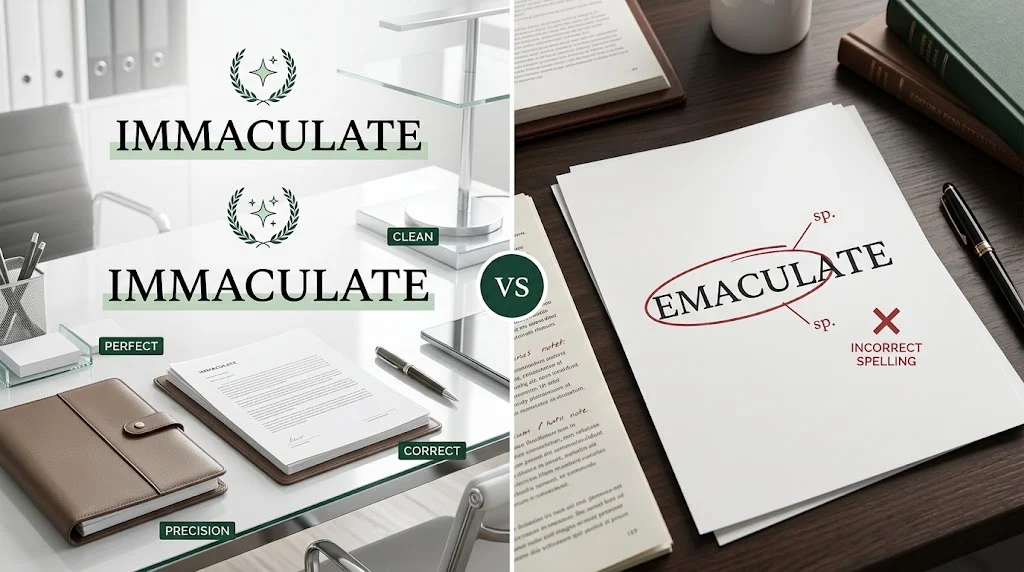
Immaculate is the correct spelling, while emaculate is an incorrect spelling in standard English. Immaculate means completely clean, flawless, pure, or free from imperfections, and it is the word you should use in formal, academic, professional, and everyday writing.
If you have ever wondered the correct spelling is immaculate or emaculate, the answer is straightforward: immaculate is the standard English word. It is an adjective used to describe something perfectly clean, spotless, flawless, or free from mistakes. Emaculate is not the accepted spelling of this word. The confusion often happens because the pronunciation can make the first part of the word sound less obvious when spoken quickly.
Using the wrong spelling can create problems in professional emails, academic assignments, essays, product descriptions, website content, and other forms of formal communication. Learning the meaning, pronunciation, spelling, and correct usage makes it much easier to choose the right form confidently.
Immaculate vs Emaculate: What’s the Difference?
The difference is simple but important. Immaculate is a correctly spelled English adjective. Emaculate is a misspelling and should not be used when you intend to describe something as perfectly clean, flawless, or without fault.
| Word | Part of Speech | Meaning | Standard English? | Example |
|---|---|---|---|---|
| Immaculate | Adjective | Perfectly clean, flawless, pure, or free from imperfections | Yes | Her office was immaculate. |
| Emaculate | Incorrect spelling | No established standard meaning in this context | No | Emaculate is not the correct spelling. |
The word immaculate can describe physical cleanliness, appearance, behavior, performance, organization, or quality. For example, you can have an immaculate kitchen, an immaculate record, an immaculate presentation, or an immaculate reputation.
Emaculate, by contrast, is generally the result of a spelling error. It can appear when someone relies on pronunciation rather than remembering the established spelling.
Quick Recap
Immaculate is the correct adjective.
It means perfectly clean, flawless, or without imperfections.
Emaculate is a spelling mistake in standard English.
Use immaculate in academic, professional, formal, and everyday writing.
What Does Immaculate Mean?
Immaculate is an adjective that describes something exceptionally clean, perfect, pure, or free from faults. The exact meaning depends on the context.
When used for physical cleanliness, immaculate means completely spotless. Consider the sentence, “The hotel room was immaculate.” This tells the reader that the room was exceptionally clean and well maintained.
The word can also describe quality or performance. If someone delivers an immaculate presentation, the presentation may be extremely polished and free from noticeable errors.
In another context, immaculate can describe a person’s reputation or record. An athlete with an immaculate record has no defeats or serious blemishes in the record being discussed.
The word therefore has a broader meaning than simply “clean.” It can communicate an unusually high degree of perfection.
| Context | Meaning of Immaculate | Example |
|---|---|---|
| Cleanliness | Completely spotless | The laboratory was immaculate. |
| Appearance | Perfectly neat | She arrived in an immaculate outfit. |
| Performance | Excellent and error free | He gave an immaculate performance. |
| Reputation | Free from wrongdoing or criticism | She has an immaculate professional record. |
| Organization | Extremely neat and orderly | His files are immaculate and carefully arranged. |
| Quality | Extremely refined or flawless | The craftsmanship was immaculate. |
Why Is Immaculate So Often Misspelled?
The spelling can seem difficult because the pronunciation does not always make every letter obvious. English contains many words whose spelling cannot be reliably predicted from pronunciation alone.
The beginning of immaculate is particularly important. The word starts with imma, not ema. Once the correct spelling becomes familiar, recognizing it becomes much easier.
Another reason for confusion is that people sometimes create spellings based on how a word sounds. This is common with words that contain unstressed vowels. When spoken naturally, the initial sound in immaculate may not strongly emphasize the difference between the written forms.
There is also a useful visual pattern to remember:
immaculate = im + maculate
The spelling contains im at the beginning and has two m letters after the initial i.
A useful memory technique is to associate immaculate with the idea of something being completely perfect. When you see the word in books, newspapers, professional writing, and edited publications, its standard form becomes easier to remember.
Is Immaculate vs Emaculate a Grammar, Vocabulary or Usage Issue?
This is primarily a spelling and vocabulary issue, not a grammatical distinction between two interchangeable words.
Immaculate is an established adjective in English. It can function naturally before a noun or after a linking verb.
For example:
“The room is immaculate.”
“She maintains an immaculate workspace.”
“The company has an immaculate safety record.”
Emaculate does not provide an alternative grammatical form. In ordinary standard English, replacing immaculate with emaculate is simply a spelling error.
The distinction remains important in formal writing because spelling contributes to clarity and credibility. A misspelled word can distract readers even when the intended meaning is obvious.
Formal and Academic Usage
Immaculate is completely appropriate in formal English. It can be used in academic writing when the context genuinely calls for its meaning.
For example:
“The researcher maintained an immaculate laboratory environment.”
“The manuscript was presented in an immaculate format.”
However, academic writers should avoid using the word merely to sound sophisticated. Precise language is more valuable than unnecessarily elaborate vocabulary.
Casual Usage
Immaculate is also common in everyday conversation.
“You keep your car immaculate.”
“Her apartment is always immaculate.”
“He looked immaculate for the event.”
The word therefore works across different levels of communication.
How to Use Immaculate Correctly
Immaculate is most useful when you want to emphasize an unusually high level of cleanliness, perfection, neatness, or freedom from faults.
Workplace Example
“The manager keeps the conference room immaculate before every client meeting.”
Here, immaculate emphasizes cleanliness and professional presentation.
A workplace can also have an immaculate record:
“The company has maintained an immaculate safety record for several years.”
In this example, the meaning shifts from physical cleanliness to an absence of negative incidents.
Academic Example
“The laboratory must remain immaculate to prevent contamination.”
This is a natural academic and scientific use because cleanliness can be essential to reliable research.
Another example is:
“The student submitted an immaculate final presentation.”
Here, immaculate suggests exceptional polish and freedom from obvious errors.
Technology Example
“The developer maintained an immaculate interface throughout the application.”
In technology related writing, immaculate can describe an exceptionally clean design or highly polished user experience. However, technical writers should use it carefully because terms such as precise, consistent, optimized, or error free may sometimes communicate the intended idea more directly.
Usage Recap
Use immaculate when you want to communicate exceptional cleanliness, perfection, neatness, or freedom from faults.
The word can describe physical objects, personal appearance, professional records, performances, designs, and other things that can reasonably be evaluated for quality or condition.
Why You Should Not Use Emaculate
The main problem with emaculate is that it is not the standard spelling of the adjective you are trying to use. Choosing it in edited writing can make a sentence look careless even when the rest of the sentence is grammatically correct.
Here are common situations where you should avoid it:
| Situation | Correct Choice | Why |
|---|---|---|
| Formal email | Immaculate | Standard spelling |
| Academic essay | Immaculate | Accepted English vocabulary |
| Website content | Immaculate | Clear and recognizable |
| Business report | Immaculate | Professional spelling |
| Product description | Immaculate | Correct descriptive adjective |
| School assignment | Immaculate | Standard dictionary form |
| Resume or professional profile | Immaculate | Avoids an obvious spelling error |
| Published article | Immaculate | Suitable for edited English |
The issue is not that readers will always misunderstand emaculate. Many will probably infer what the writer intended. The problem is that a visible spelling mistake can weaken the perceived quality of otherwise strong writing.
Common Mistakes and Decision Rules
The easiest way to avoid the error is to remember that immaculate is the established spelling.
| Correct sentence | Incorrect sentence | Explanation |
|---|---|---|
| Her room is immaculate. | Her room is emaculate. | Immaculate is the correct spelling. |
| He keeps his car immaculate. | He keeps his car emaculate. | The adjective describing exceptional cleanliness is immaculate. |
| The hotel was immaculate. | The hotel was emaculate. | Immaculate is the standard English form. |
| She has an immaculate record. | She has an emaculate record. | Immaculate can describe a record without faults or blemishes. |
| The presentation looked immaculate. | The presentation looked emaculate. | The correct adjective is immaculate. |
| The laboratory must remain immaculate. | The laboratory must remain emaculate. | Immaculate is appropriate for exceptionally clean environments. |
Decision Rule Box
If you mean completely clean, flawless, pure, exceptionally neat, or free from imperfections, use immaculate.
If you see emaculate in your draft, treat it as a spelling error and replace it with immaculate.
Immaculate and Modern Technology and AI Tools
Modern writing tools frequently identify spelling errors automatically, but automated correction should not replace vocabulary knowledge.
Spell checkers, grammar assistants, word processors, search engines, and AI writing tools can often recognize immaculate as the correct form. They may flag emaculate because it does not match the expected standard spelling.
AI tools are particularly useful for checking a sentence in context. For example, if a writer enters a sentence containing emaculate, an AI assistant can usually infer that immaculate was intended.
However, writers should still understand the underlying distinction. Automated tools can suggest corrections, but knowing why a word is correct helps prevent the same error from appearing repeatedly.
This is especially important for content creators, students, editors, marketers, and professionals who produce large amounts of written material.
The Etymology of Immaculate
Immaculate has a long history in English and ultimately comes from Latin. It is related to the Latin word immaculatus, meaning spotless or undefiled.
The word entered English through French and developed its modern associations with cleanliness, purity, and freedom from blemish.
Its historical connection with the idea of being without a stain helps explain why immaculate can be used in both literal and figurative contexts.
For example, an immaculate surface is literally free from dirt or marks. An immaculate reputation is figuratively free from blemish.
That connection gives the word considerable expressive range.
What Does an Expert Linguistic Explanation Suggest?
A useful way to understand the distinction is to focus on established usage rather than pronunciation alone:
“Standard spelling is determined by accepted usage, not simply by the way a word sounds.”
This principle explains why a plausible sounding spelling can still be incorrect. English spelling reflects historical development, borrowed vocabulary, pronunciation changes, and established written conventions.
For writers, the practical lesson is simple: when a word has a recognized standard spelling, that form should be preferred in edited English.
Two Practical Case Studies
Case Study 1: Professional Communication
Imagine a company preparing a presentation about its cleaning standards. A sentence reads:
“Our facilities are maintained to an emaculate standard.”
The intended meaning is clear, but the spelling error immediately creates a problem. Replacing emaculate with immaculate produces:
“Our facilities are maintained to an immaculate standard.”
The second version is professionally credible because it uses the established English adjective.
The concrete result is improved spelling accuracy and a more polished impression without changing the underlying message.
Case Study 2: Academic Writing
Consider a student writing about laboratory conditions:
“The research team worked in an emaculate environment.”
The intended meaning is again obvious. Nevertheless, academic writing is expected to follow standard spelling conventions.
Changing emaculate to immaculate produces:
“The research team worked in an immaculate environment.”
The result is a sentence that communicates the intended meaning while avoiding an unnecessary spelling error.
These examples demonstrate why vocabulary accuracy matters even when readers can understand the original sentence.
Author Expertise
This article follows established English spelling, vocabulary, usage, semantic distinctions, and search focused educational writing principles to provide a clear reference for students, professionals, editors, and English learners.
Error Prevention Checklist
Always Use Immaculate When
☑ You mean completely clean.
☑ You mean spotless or without marks.
☑ You mean flawless or without imperfections.
☑ You are describing an exceptionally neat appearance.
☑ You are describing a reputation or record without blemishes.
☑ You are writing an academic, professional, or formal document.
☑ You want the standard English spelling.
Never Use Emaculate When
☒ You mean the standard adjective immaculate.
☒ You are writing a formal email.
☒ You are submitting academic work.
☒ You are publishing website content.
☒ You are preparing professional documentation.
☒ You are writing a resume or professional profile.
Related Grammar Confusions You Should Master
Learning one spelling distinction often reveals other common English problems. Writers who want stronger command of English should also understand these frequently confused forms:
| Confusion | Correct Form | Main Issue |
|---|---|---|
| Definitely or Definately | Definitely | Spelling |
| Separate or Seperate | Separate | Spelling |
| Occurrence or Occurence | Occurrence | Spelling |
| Necessary or Neccessary | Necessary | Spelling |
| Receive or Recieve | Receive | Spelling |
| Privilege or Priviledge | Privilege | Spelling |
| Recommend or Reccomend | Recommend | Spelling |
| Maintenance or Maintainance | Maintenance | Spelling |
| Embarrass or Embarass | Embarrass | Spelling |
| Accommodation or Accomodation | Accommodation | Spelling |
These examples show a broader pattern in English: pronunciation alone cannot always tell you how a word should be written. Familiarity, reading, dictionary use, and careful proofreading all help develop reliable spelling habits.
FAQs
Is immaculate the correct spelling?
Yes. Immaculate is the standard English spelling for an adjective meaning completely clean, flawless, pure, or free from imperfections.
Is emaculate a word?
Emaculate is not the standard spelling of the adjective immaculate and should generally be treated as a spelling error in standard English writing.
What does immaculate mean in simple English?
Immaculate means extremely clean, perfectly neat, or completely free from faults or imperfections.
How do you spell immaculate correctly?
The correct spelling is immaculate, with an initial im and two m letters near the beginning.
Can immaculate describe a person?
Yes. Immaculate can describe a person’s appearance, clothing, reputation, record, or other qualities when the context suggests exceptional neatness or freedom from flaws.
Can immaculate be used in academic writing?
Yes. Immaculate is appropriate in academic writing when its meaning is precise and relevant to the subject.
Why do people spell immaculate as emaculate?
The error usually comes from pronunciation, unfamiliarity with the word, or attempting to spell the word according to how it sounds.
What is a synonym for immaculate?
Depending on context, synonyms include spotless, flawless, pristine, perfect, clean, pristine, faultless, and unblemished.
Is immaculate formal or informal?
Immaculate works in both formal and informal English. Its suitability depends mainly on its meaning fits the context.
Conclusion
The correct spelling is immaculate, not emaculate. Immaculate is an adjective meaning completely clean, spotless, flawless, pure, or free from imperfections. It can describe physical cleanliness, personal appearance, professional records, performances, designs, and reputations.
The easiest way to remember the spelling is to associate the word with its standard form: immaculate begins with im and contains the characteristic double m spelling. Once you recognize this pattern, the common misspelling becomes much easier to avoid.
You’re writing an academic essay, professional email, website article, business report, or everyday message, choosing the correct spelling improves clarity and credibility. When the intended meaning is exceptional cleanliness or freedom from flaws, choose immaculate every time.
Discover More Related Articles:
- Indexes or Indices | Which Plural Form Is Correct In 2026
- Curtsy or Curtsey | Which Spelling Is Correct & When Should You Use Each In 2026
- License or Licence | Which Spelling Is Correct & When Should You Use Each In 2026