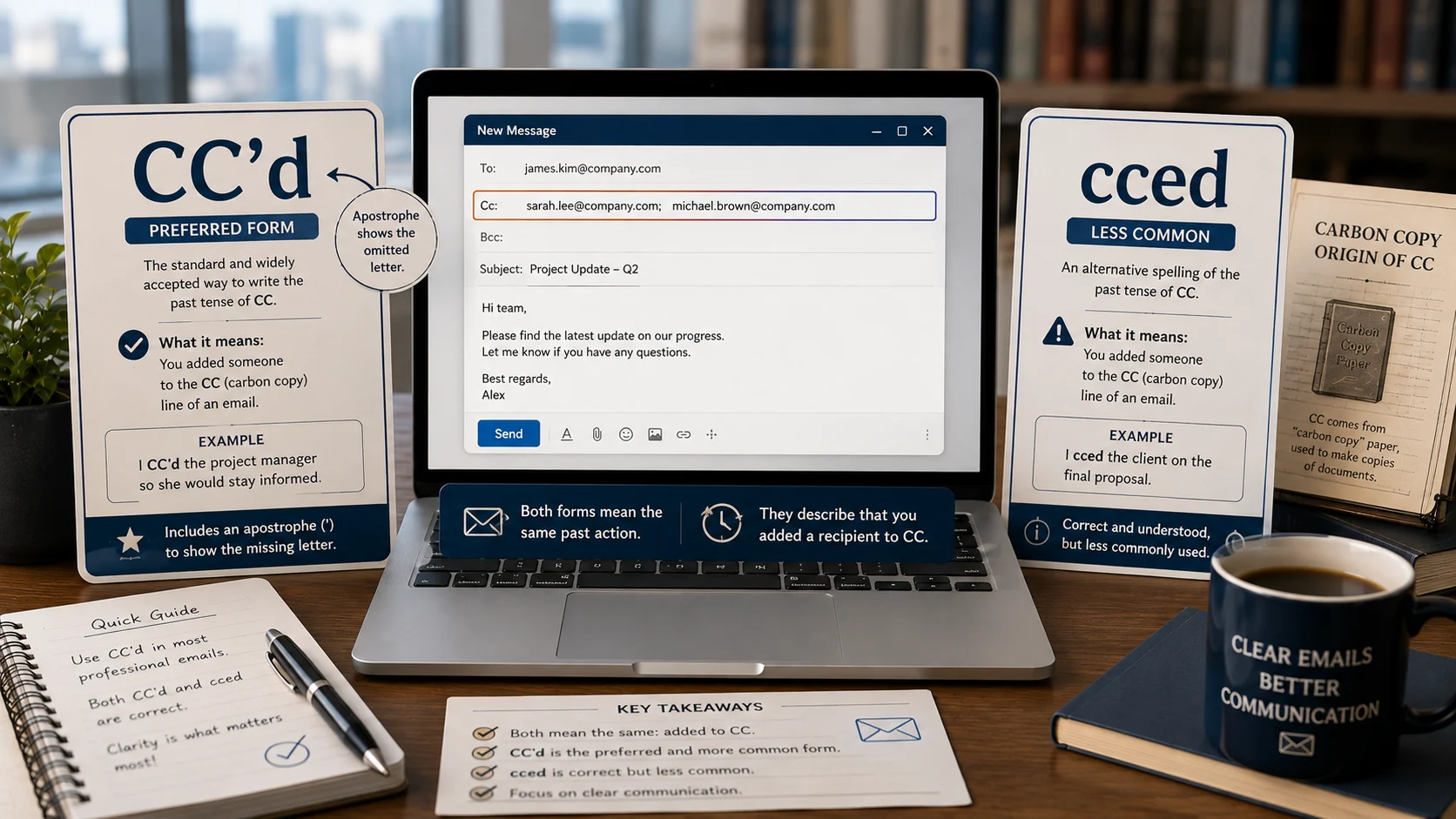
Cced or CC’d are two forms used to describe the past action of adding someone to the carbon copy field of an email. Both forms are found in real English usage, but CC’d is a widely accepted and especially clear choice in professional email writing. The spelling cced also appears in dictionaries and established usage, so it is not simply a spelling mistake.
Have you ever hesitated while writing an email because you were unsure to use CCed or CC’d? You are not alone. These two spellings appear in professional emails, workplace communication, and everyday digital conversations, making it easy to wonder which form is correct. The abbreviation CC stands for “carbon copy,” a feature that allows you to send a copy of an email to additional recipients. However, when describing this action in the past tense, choosing the right spelling can make your writing clearer and more polished.
In this guide, we’ll explore the difference between CCed and CC’d, explain which form is preferred in modern English, and provide practical examples to help you use each form confidently. Drawing on standard English usage and common email-writing conventions, you’ll learn how to avoid spelling inconsistencies and communicate more professionally. you’re writing a business email, an academic message, or a casual note, this guide will help you make the right choice.
Cced vs CC’d| What’s the Difference?
The two forms perform the same grammatical function. They are past tense forms of the verb CC, meaning to send someone a copy of an email.
The main difference is visual and stylistic rather than meaning. CC’d uses an apostrophe to separate the abbreviation CC from the past tense ending. Cced attaches the ending directly to the abbreviation.
Quick recap
CC’d and cced can both function as past tense forms of CC.
CC’d is visually clear because the apostrophe separates the abbreviation from the ending.
Cced is also an established form and should not automatically be treated as a spelling error.
For maximum clarity in ordinary professional emails, CC’d is a strong practical choice.
Is Cced vs CC’d a Grammar, Vocabulary or Usage Issue?
The question is primarily a usage and style issue, rather than a question of completely different meanings.
Both forms describe the same basic action. If you write, “I CC’d my manager,” you mean that you sent your manager a copy of the email. If you write, “I cced my manager,” the intended meaning is normally identical.
The difference becomes important because abbreviations can behave differently when they become verbs. English speakers often add grammatical endings directly to abbreviations, but punctuation can make the resulting form easier to read.
For example, English contains forms such as “OK’d” and “OKed,” and dictionaries have historically recorded variation in how abbreviated forms receive grammatical endings. The same general problem occurs with CC.
Is CC’d more formal than cced?
Not necessarily. It would be inaccurate to claim that one form is always formal and the other is always informal. Both occur in real writing.
However, CC’d can look more immediately recognizable to readers because the apostrophe makes the grammatical ending visually distinct. That can be useful in business communication, academic correspondence, and other situations where clarity matters.
What about academic writing?
In academic correspondence, either form may be understood, but the best choice depends on the publication or institution’s style preferences.
If you are writing a formal academic document rather than an email, copied may sometimes be clearer.
For example:
“I copied Professor Ahmed on the email.”
This avoids any uncertainty about how to punctuate the abbreviation.
How to Use CC’d Correctly
CC’d is used when you are describing an email that has already been sent with an additional recipient included.
The verb can appear with different subjects and tenses.
Workplace example
“I CC’d the project manager so she could review the latest update.”
This sentence is natural because the speaker is describing an action that has already happened.
Academic example
“I CC’d my supervisor when I sent the revised proposal.”
Here, CC’d indicates that the supervisor received a copy of the email.
Technology example
“I CC’d the support team when I submitted the request.”
This is useful when describing email activity involving customer support, software teams, or automated service systems.
Usage recap
Use CC’d when describing the completed action of adding someone to the CC field.
It can be used in active sentences such as “I CC’d her” and passive sentences such as “She was CC’d.”
How to Use Cced Correctly
Cced follows the same basic grammatical pattern as CC’d. The difference is simply that the past tense ending is written without an apostrophe.
For example:
“I cced my supervisor on the message.”
“She was cced on the email.”
“We cced the legal department for reference.”
These sentences communicate the same basic idea as sentences using CC’d.
Workplace example
“I cced the department head on the final report.”
The sentence tells the reader that the department head received a copy.
Academic example
“I cced my instructor when I submitted the assignment.”
The meaning is clear even though some readers may find the form visually unusual.
Technology example
“The administrator was cced on the notification email.”
Again, the intended meaning is that the administrator received a copy.
Usage recap
Cced is an established past tense form of CC. It has the same basic meaning as CC’d.
If your priority is immediate visual clarity, however, CC’d may be easier for many readers to recognize.
When You Should NOT Use Cced or CC’d
There are several situations where neither form is the best choice.
1. When you mean the CC field itself
Do not write:
“I put him in the CC’d.”
Instead, write:
“I put him in the CC field.”
Here, CC is functioning as the name of an email feature.
2. When you are talking about the present action
Do not use a past tense form when the action is happening now.
Use:
“I am CC’ing the manager.”
3. When you are describing a future action
Use the base verb:
“I will CC the finance team.”
4. When you mean a direct recipient
Being CC’d is not exactly the same communicative role as being the primary recipient. A person in the To field is generally the direct recipient, while someone in CC is included for information or awareness.
5. When the reader may not understand the abbreviation
In highly formal documents, “copied” can sometimes be clearer.
For example:
“I copied the department manager on the correspondence.”
6. When you mean BCC
Do not confuse CC with BCC.
CC recipients are normally visible to the other recipients. BCC recipients are hidden from the other recipients.
7. When you are writing a document that prohibits abbreviations
Some academic, legal, or organizational style guides may prefer full wording. Follow the relevant style guide when one exists.
8. When the sentence becomes awkward
If “CC’d” or “cced” makes the sentence difficult to understand, simply use “copied.”
Clarity is more important than forcing an abbreviation into every sentence.
Common Mistakes and Decision Rules
Decision Rule
If you mean the completed action of sending someone a copy, use CC’d or cced.
If you mean the email feature or recipient field, use CC.
The commonly suggested rule that says “use one form for the action and another for the person or tool” does not apply to this pair. CC’d and cced are both forms of the same verb, while CC can function as the name of the email feature.
Cced and CC’d in Modern Technology and AI Tools
CC remains an important part of digital communication even as workplace communication moves beyond traditional email.
Modern email platforms automatically display CC as a recipient field. Business systems can also generate messages in which users are copied for visibility, approval, documentation, or compliance.
AI writing assistants may encounter both CC’d and cced in email drafts. A good writing assistant should recognize that the forms have the same basic meaning rather than automatically treating every occurrence of cced as a spelling error.
LanguageTool, for example, currently identifies “cced” as a form to correct and suggests “cc’d,” illustrating that automated grammar tools can apply a particular usage preference even when broader English usage contains variation.
This is an important lesson for English learners: grammar software recommendations are useful, but they should be interpreted alongside dictionaries, style guides, and established usage.
The Etymology of CC
CC comes from carbon copy, a term associated with older methods of producing duplicate documents.
Before modern email, carbon paper was placed between sheets of paper so that writing or typing on the top sheet created a copy on the sheet underneath. A copy could then be sent to another person for information.
Email adopted the abbreviation because the function was similar. A sender could provide an additional recipient with a copy of the communication.
Over time, CC became more than an abbreviation used in a technical field. It developed into an ordinary verb.
That is why modern writers can say:
“I will CC you.”
“I CC’d you.”
“She was CC’d.”
The development shows how technology can turn an abbreviation into a productive English verb.
What Do Language Authorities Suggest?
The most important point is that CC’d and cced are not two words with different meanings. Historical dictionary evidence records both as past tense forms of the verb cc.
A useful expert style principle is:
When an abbreviated verb looks unfamiliar, choose the form that makes its grammatical structure easiest for the reader to recognize.
That principle explains why CC’d is often a practical choice. The apostrophe visually signals that the final letter represents the past tense ending.
Case Study One: Workplace Email
Consider an employee writing:
“I cced the director on the report.”
The sentence is understandable, but some readers may pause because cced looks unusual.
Changing it to:
“I CC’d the director on the report.”
makes the grammatical structure immediately visible. The meaning has not changed, but the visual presentation is clearer.
Result: The revised sentence reduces the chance that a reader will mistake the abbreviation for an ordinary word or typing error.
Case Study Two: Academic Correspondence
Imagine a student writing to a professor:
“I CC’d my supervisor on the revised proposal.”
The reader immediately understands that the supervisor received a copy.
If the student wants to avoid abbreviation entirely, the alternative is:
“I copied my supervisor on the revised proposal.”
Result: Both versions communicate the same action, while “copied” provides the clearest option for readers who may not be familiar with email shorthand.
These examples demonstrate an important writing principle: correctness is not only about choosing a grammatical form. It is also about choosing wording that your intended reader can process easily.
Error Prevention Checklist
Always use CC’d when
You are describing a completed email action.
You want the abbreviation to be visually easy to recognize.
You are writing a normal workplace or personal email.
You are using the verb in a passive construction, such as “She was CC’d.”
Never use CC’d when
You are describing a future action.
You are naming the CC field itself.
You are describing an action happening right now.
Your organization has a style guide requiring a different form.
In those cases, use the appropriate form such as CC, CC’ing, will CC, or copied.
Related Grammar Confusions You Should Master
English learners who are interested in CC’d and cced should also understand several other confusing forms.
- Email or e mail: Learn how modern English normally writes the word.
- Setup or set up: Understand the difference between a noun and a verb phrase.
- Login or log in: Learn when the word functions as a noun and when it functions as a verb.
- Backup or back up: Distinguish the noun from the verb.
- Followup or follow up: Recognize the difference between a noun and a verb phrase.
- OK’d or OKed: Learn how abbreviations can receive past tense endings.
- Sign in or signin: Understand standard digital terminology.
- Copied or CC’d: Know when an abbreviation is useful and when the full verb is clearer.
- CC or BCC: Understand the difference between visible and hidden copy recipients.
- To or CC: Learn the difference between a primary recipient and someone included for information.
FAQs
Is CC’d or cced correct?
Both forms are established past tense forms of CC, but CC’d is a particularly clear and widely used choice in professional email writing.
Is cced a real word?
Yes. Cced is recorded as a past tense form of the verb CC, although many writers prefer the visually clearer form CC’d.
What does CC’d mean in an email?
CC’d means that someone was included as a carbon copy recipient of an email, usually so they can be informed about the communication.
Should I write CC’d or CCed?
CC’d is often the clearest choice because the apostrophe separates the abbreviation from the past tense ending.
Can I use cced in professional emails?
Yes. Cced is an established form, but CC’d may look more immediately familiar to many professional readers.
What is the past tense of CC?
Both CC’d and cced are established past tense forms of the verb CC.
Is CC’d formal English?
CC’d is acceptable in ordinary professional communication, although “copied” can be preferable when a more traditional or fully spelled out style is required.
What is the difference between CC and CC’d?
CC is the base form and can also name the email field, while CC’d describes the completed action of adding someone to that field.
Is CC’d the same as BCC’d?
No. A CC recipient is normally visible to other recipients, while a BCC recipient is hidden from the other recipients.
Conclusion
Cced or CC’d can both refer to the past tense of the email verb CC. However, CC’d is a clear and practical choice for professional email writing because its apostrophe makes the grammatical ending easy to recognize. Cced is also an established form, so it should not automatically be treated as an error.
When clarity is your priority, write “I CC’d Sarah on the email.” When you want to avoid abbreviation entirely, write “I copied Sarah on the email.” Both communicate the same basic action.
Discover More Related Articles:
- Artic or Arctic | What Is the Difference and Which Spelling Is Correct In 2026
- Hitmonlee or Hitmonchan | Which Pokémon Should You Choose In 2026
- Let’s or Lets | What’s the Difference & When to Use Each Correctly In 2026