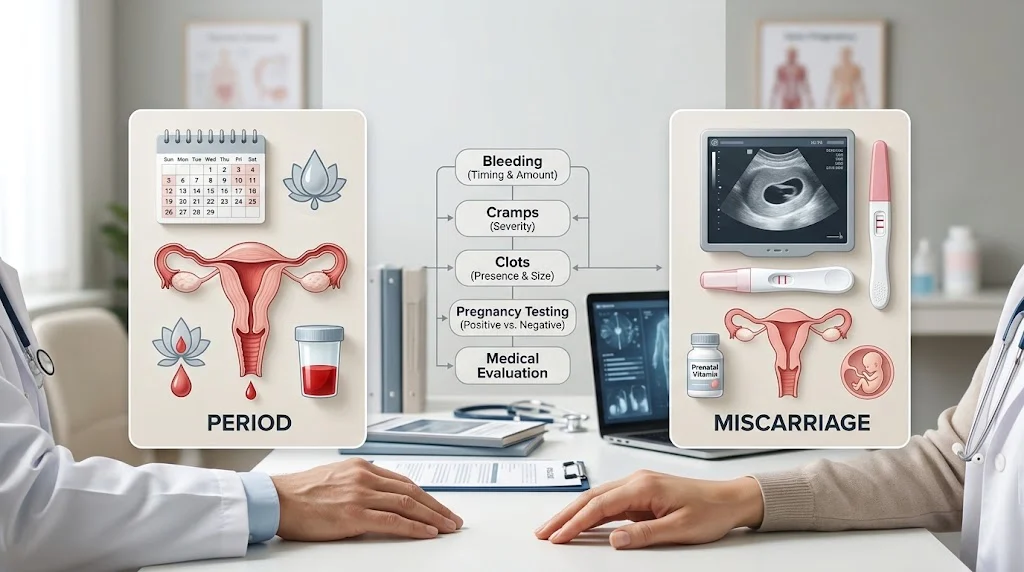
A miscarriage and a menstrual period can sometimes look surprisingly similar, especially when pregnancy is very early. Both can cause vaginal bleeding, cramps, lower abdominal discomfort, and blood clots. However, a miscarriage occurs after pregnancy has begun, while a period is the normal shedding of the uterine lining when pregnancy has not occurred. Because symptoms overlap, bleeding alone cannot always tell you what is happening.
Miscarriage or Period | What Is the Difference?
The biggest difference is that a miscarriage involves the loss of a pregnancy, whereas a period is part of the normal menstrual cycle.
A period usually occurs when an egg has not been fertilized and implanted. Hormone levels fall, causing the uterine lining to break down and leave the body through vaginal bleeding.
A miscarriage occurs when a pregnancy ends. It can happen very early, sometimes before a person realizes they are pregnant. Common symptoms include vaginal bleeding, pelvic cramping, lower back pain, and sometimes the passage of fluid or pregnancy tissue.
| Feature | Period | Miscarriage |
|---|---|---|
| Pregnancy involved | No | Yes |
| Bleeding | Usually follows your normal cycle | May be lighter or heavier than expected |
| Cramps | Common | Common and sometimes stronger |
| Blood clots | Can occur | Can occur |
| Tissue passage | Usually menstrual material | Pregnancy tissue may pass |
| Timing | Around expected period | Can happen at different points during pregnancy |
| Pregnancy symptoms | Usually absent | May have been present |
| Pregnancy test | Usually negative | May remain positive for some time |
| Medical assessment | Usually unnecessary | May be needed to confirm what happened |
The important point is that these features are not absolute. A heavy period can include clots and intense cramps, while an early miscarriage can initially look much like an unusually heavy period.
Quick Answer
If you are experiencing unexpected bleeding and think you could be pregnant, you cannot reliably distinguish a miscarriage from a period based only on the amount or appearance of blood. A pregnancy test, medical history, blood testing, and sometimes an ultrasound may be needed to determine what happened.
Miscarriage Bleeding vs Period Bleeding
Bleeding is one of the main reasons people search for information about miscarriage versus period symptoms. Unfortunately, there isn’t one particular color, amount, or pattern that proves a miscarriage has occurred.
Period bleeding often begins lightly, becomes heavier, and then gradually becomes lighter. The exact pattern varies considerably from person to person.
Miscarriage bleeding can also vary. It may begin as spotting and become heavier, or it may start suddenly. Some people experience bleeding with cramping, while others have little pain. Pregnancy tissue or fluid may sometimes pass through the vagina.
The color of blood is not enough to determine the cause. Pink, red, or brown blood can occur with vaginal bleeding in pregnancy. Blood may also appear differently as it moves through the reproductive tract.
Is Miscarriage Bleeding Heavier Than a Period?
It can be, but not always.
Some miscarriages cause heavy bleeding, while others cause relatively light bleeding or spotting. Similarly, menstrual periods can range from very light to very heavy.
This means that saying, “My bleeding is heavier than usual, so it must be a miscarriage,” is not a reliable conclusion.
If you are pregnant and experiencing moderate or heavy bleeding, you should contact a healthcare professional. Heavy bleeding accompanied by severe pain, dizziness, fainting, or shoulder pain requires urgent medical attention.
Miscarriage Symptoms vs Period Symptoms
The symptoms of a miscarriage and a period overlap considerably.
A period may cause:
- Lower abdominal cramps
- Lower back discomfort
- Bloating
- Breast tenderness
- Fatigue
- Mood changes
- Headaches
- Vaginal bleeding
- Blood clots
A miscarriage may cause:
- Vaginal bleeding
- Pelvic cramping
- Lower abdominal pain
- Lower back pain
- Passage of fluid
- Passage of tissue
- Blood clots
- A reduction in pregnancy symptoms in some cases
According to Mayo Clinic, miscarriage symptoms can include vaginal bleeding with or without pain, pelvic or lower back pain, and the passage of fluid or tissue.
However, experiencing these symptoms does not automatically mean a miscarriage has occurred.
For example, bleeding during early pregnancy does not always result in pregnancy loss. Vaginal bleeding during the first trimester can have several causes, including implantation bleeding, cervical changes, infection, ectopic pregnancy, and miscarriage.
Early Miscarriage vs Period
An early miscarriage can be particularly difficult to recognize because it may occur around the time a period is expected.
Imagine someone has a menstrual cycle that is usually regular. Their period is a few days late. They then begin experiencing cramps and bleeding. The bleeding may look similar to a normal period.
If they were not aware that they were pregnant, they might assume the bleeding is simply a late period.
This is one reason very early pregnancy loss can sometimes go unnoticed. Mayo Clinic notes that some miscarriages occur so early that a person may not realize they were pregnant.
A chemical pregnancy is another term you may encounter. It refers to a very early pregnancy that ends shortly after implantation. Because it happens early, it can sometimes resemble a late or unusually heavy period.
A pregnancy test can provide useful information, particularly if it was positive before the bleeding began. However, a healthcare professional may need to perform additional testing to determine a pregnancy is continuing or has ended.
Miscarriage Cramps vs Period Cramps
Cramping can occur with both menstruation and miscarriage, so pain alone cannot reliably distinguish between them.
Period cramps generally occur because the uterus contracts to help shed its lining. Some people experience mild discomfort, while others have severe menstrual cramps.
During a miscarriage, uterine contractions can also cause cramping as pregnancy tissue passes.
Some people describe miscarriage cramps as stronger than their usual menstrual cramps, but this isn’t true for everyone. Pain intensity is highly individual.
Severe abdominal or pelvic pain, particularly pain concentrated on one side, deserves prompt medical evaluation when pregnancy is possible. Severe one sided pain, shoulder pain, fainting, or dizziness can be warning signs of ectopic pregnancy, which requires urgent treatment.
Miscarriage Blood Clots vs Period Clots
Blood clots can occur during a normal period and do not automatically indicate miscarriage.
During menstruation, blood and tissue from the uterine lining can collect before leaving the body. This can produce clots, particularly during heavier bleeding.
A miscarriage can also involve clots and pregnancy tissue.
The difficulty is that what looks like tissue to one person may simply be menstrual material to another. Visual inspection at home cannot always establish what has passed.
If you believe you may have passed pregnancy tissue, contact a healthcare professional. In some circumstances, tissue can be examined in a laboratory to help determine a miscarriage occurred.
What Does Miscarriage Tissue Look Like?
There is no single appearance that applies to every miscarriage.
Pregnancy tissue may appear pink, gray, or white and can sometimes look stringy or different from ordinary blood clots. Fluid may also pass from the vagina. The appearance can depend on how early the pregnancy was and how much tissue has passed.
It is important not to diagnose a miscarriage simply by looking at blood or material that has passed.
If you believe you have passed tissue during a possible pregnancy, speak with a healthcare professional. They can determine further examination, blood testing, or ultrasound is appropriate.
Can a Miscarriage Be Mistaken for a Period?
Yes. An early miscarriage can sometimes be mistaken for a period, particularly when pregnancy has not yet been confirmed.
This is more likely when the bleeding happens close to the expected menstrual date.
However, the reverse can also happen. A person may assume that bleeding means they have lost a pregnancy when the bleeding actually has another cause.
This is why the timing of bleeding, pregnancy test results, symptoms, and medical evaluation are more useful than bleeding appearance alone.
If you have taken a pregnancy test and received a positive result before bleeding begins, tell your healthcare professional. If you have not taken a test but pregnancy is possible, a pregnancy test can be a useful first step.
How to Tell the Difference Between a Miscarriage and a Period
There is no completely reliable home method for distinguishing an early miscarriage from a period based solely on symptoms.
Consider these factors:
1. Was pregnancy possible?
If you have had unprotected sex or another situation in which pregnancy was possible, pregnancy should be considered when bleeding is unusual.
2. Was your period late?
A late period followed by unusual bleeding can occur for many reasons. It can also happen with an early pregnancy loss.
3. Did you have a positive pregnancy test?
A positive pregnancy test provides evidence that pregnancy hormones were detected. Tell your healthcare professional about any previous positive test if bleeding occurs.
4. Are you experiencing unusual symptoms?
Heavy bleeding, severe pain, fainting, dizziness, fever, or unusual discharge should not be ignored.
5. Do you need confirmation?
A healthcare professional may use urine or blood testing and ultrasound to investigate suspected pregnancy loss.
Can You Have a Miscarriage Before a Missed Period?
Yes. A pregnancy loss can occur very early, including around the time when a menstrual period would normally be expected.
Because the pregnancy may not yet have been recognized, the bleeding can be interpreted as a period.
Very early pregnancy loss is one reason some people may never know they were pregnant.
If you suspect this has happened, a healthcare professional can help explain testing is appropriate.
Implantation Bleeding vs Period
Implantation bleeding is another reason early pregnancy bleeding can be confusing.
Some people experience light bleeding or spotting around the time their period is expected. NHS guidance notes that very early pregnancy can sometimes involve a bleed similar to a very light period.
Implantation bleeding is generally described as light spotting rather than heavy bleeding.
However, not every instance of spotting means implantation, and bleeding during early pregnancy can have many possible causes.
If you know or suspect that you are pregnant, unusual bleeding should be discussed with a healthcare professional, especially if it becomes heavy or occurs with significant pain.
Chemical Pregnancy vs Period
A chemical pregnancy is an extremely early pregnancy loss that occurs shortly after implantation.
Because it occurs so early, the symptoms may resemble a period. Someone might experience a positive pregnancy test followed by bleeding and a later negative test.
If you have experienced a positive pregnancy test followed by bleeding, it is worth discussing the situation with a healthcare professional.
The term “chemical” does not mean the pregnancy was imaginary. It describes a pregnancy detected through biochemical testing before it can be confirmed through ultrasound.
When Bleeding During Early Pregnancy Needs Medical Attention
Bleeding during pregnancy should be taken seriously even though it does not always mean miscarriage.
Contact a healthcare professional if you experience bleeding during a known or suspected pregnancy.
Seek urgent medical care if bleeding is accompanied by:
- Severe abdominal or pelvic pain
- Severe pain on one side
- Shoulder pain
- Fainting
- Significant dizziness
- Feeling very weak or unwell
- Heavy bleeding that rapidly soaks a pad
- Fever or chills
- Foul smelling vaginal discharge
These symptoms can sometimes indicate miscarriage, ectopic pregnancy, infection, or another condition requiring treatment.
Do not wait for bleeding to become extremely heavy before seeking help if you have severe pain, fainting, or other serious symptoms.
How Doctors Diagnose a Miscarriage
A healthcare professional does not usually diagnose miscarriage from bleeding alone.
The evaluation may include questions about:
- When your last period occurred
- Pregnancy was confirmed
- When bleeding began
- How much bleeding you have experienced
- You have pain or cramps
- You have passed clots or tissue
- Previous pregnancies and relevant medical history
Depending on the situation, healthcare professionals may use a urine pregnancy test, blood tests, pelvic examination, or transvaginal ultrasound.
An ultrasound can provide information about the pregnancy and uterus, while blood testing can help assess pregnancy hormone levels.
The appropriate evaluation depends on how far along the pregnancy may be and what symptoms are occurring.
Common Mistakes People Make
Mistake 1: Assuming heavy bleeding automatically means miscarriage
Heavy menstrual bleeding can happen without pregnancy.
Mistake 2: Assuming light bleeding means everything is fine
Light bleeding during pregnancy can have several causes and should be discussed with a healthcare professional when appropriate.
Mistake 3: Using blood color as a diagnosis
Red, pink, and brown blood can occur in different situations. Color alone does not establish the cause.
Mistake 4: Assuming cramps prove pregnancy loss
Menstrual cramps and miscarriage cramps can overlap.
Mistake 5: Assuming every clot is pregnancy tissue
Menstrual periods can produce blood clots and tissue from the uterine lining.
Mistake 6: Ignoring severe one sided pain
Severe one sided pelvic pain during possible pregnancy can be an emergency because ectopic pregnancy is a possibility.
Mistake 7: Blaming yourself
Most early miscarriages happen because the pregnancy does not develop normally, often because of genetic or chromosomal problems. Everyday activities such as exercise, sex, working, or having an argument are not generally considered causes of miscarriage.
Decision Guide: What Should You Do?
If you are unsure your bleeding is a period or pregnancy related bleeding, think about the situation in this order:
If pregnancy is possible: take a pregnancy test and consider contacting a healthcare professional.
If you had a positive pregnancy test: tell your healthcare professional about the bleeding.
If bleeding is heavy or accompanied by severe pain: seek urgent medical care.
If you have shoulder pain, fainting, severe dizziness, or severe one sided pain: seek emergency medical attention.
If the bleeding resembles your normal period and pregnancy is not possible: it may simply be menstruation, although unusual or persistent bleeding should still be evaluated.
Miscarriage or Period: A Simple Comparison
The easiest way to remember the distinction is this:
A period is a normal part of the menstrual cycle and occurs when pregnancy has not occurred.
A miscarriage is the loss of a pregnancy.
The symptoms can overlap so much that bleeding, cramps, clots, or pain alone cannot always tell you which one is happening.
When pregnancy is possible, testing and professional medical evaluation provide a much more reliable answer than trying to identify the cause from the appearance of bleeding.
FAQs
Can an early miscarriage look like a period?
Yes. A very early miscarriage can resemble a period, particularly when pregnancy has not been confirmed. This can make early pregnancy loss difficult to recognize.
How can you tell if it is a miscarriage or period?
You cannot always tell from bleeding and cramps alone. Pregnancy testing, medical history, blood testing, and ultrasound may be needed to determine a pregnancy existed and it has ended.
Is miscarriage bleeding heavier than a period?
Sometimes, but not necessarily. Miscarriage bleeding can be light, moderate, or heavy, while menstrual bleeding also varies between individuals.
Does a miscarriage feel like a period?
It can. Both can cause uterine cramping and vaginal bleeding. Some miscarriages cause stronger pain, but symptom intensity varies.
What does miscarriage bleeding look like?
It may include pink, red, or brown blood, spotting, heavier bleeding, clots, fluid, or tissue. There is no single appearance that confirms miscarriage.
Can you have a miscarriage before a missed period?
Yes. Very early pregnancy loss can occur before a person realizes they are pregnant.
Can a pregnancy test detect a miscarriage?
A pregnancy test detects pregnancy hormone rather than directly diagnosing miscarriage. A positive result does not by itself establish a pregnancy is continuing. Additional evaluation may be needed.
What is the difference between miscarriage blood clots and period clots?
Both can contain clotted blood and tissue. Because their appearance can overlap, it is not reliable to diagnose miscarriage simply by examining a clot.
Can spotting mean miscarriage?
It can, but spotting does not automatically mean miscarriage. Bleeding during early pregnancy has multiple possible causes, and many pregnancies with early bleeding continue normally.
When should I seek emergency care for bleeding?
Seek emergency care for heavy bleeding, severe abdominal or pelvic pain, severe one sided pain, shoulder pain, fainting, or significant dizziness, particularly when pregnancy is possible.
Conclusion
A period and an early miscarriage can have very similar symptoms, which is why the distinction can be confusing. Both may involve bleeding, cramps, clots, and lower abdominal discomfort. The key difference is that a miscarriage involves a pregnancy, while menstruation is the normal shedding of the uterine lining when pregnancy has not occurred.
If pregnancy is possible and your bleeding is unusual, don’t rely solely on the amount, color, or appearance of the blood. A pregnancy test and professional medical evaluation can provide a much clearer answer. If bleeding is heavy or accompanied by severe pain, fainting, dizziness, shoulder pain, or other concerning symptoms, seek urgent medical care.
Discover More Related Articles:
- Pimple or Herpes | How to Tell the Difference & When to Get Medical Advice In 2026
- Cetaphil or CeraVe | Which Is Better for Your Skin Type In 2026
- Innie or Outie | Meaning, Difference & Usage Explained In 2026