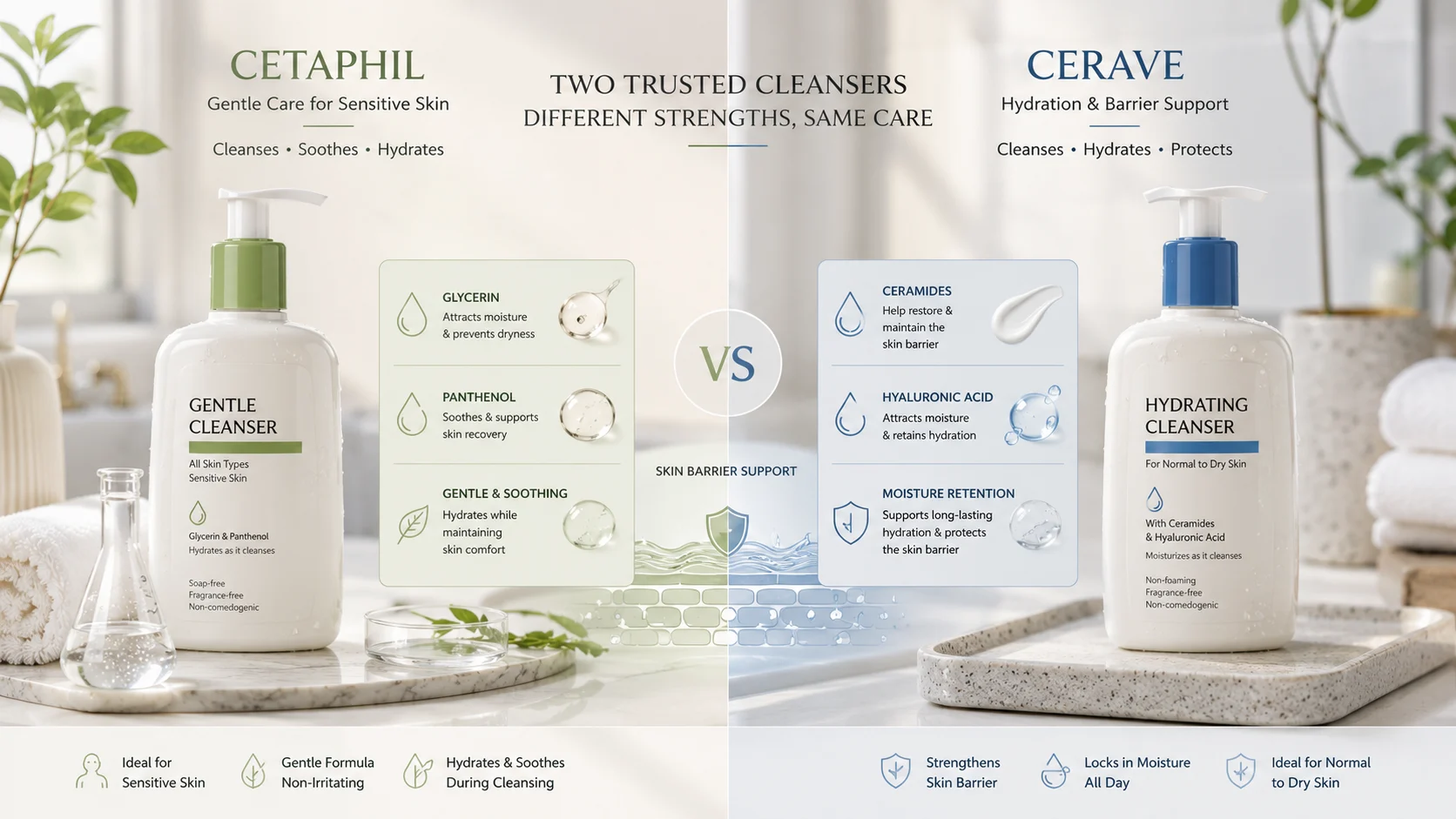
Cetaphil or CeraVe is a common skincare comparison because both brands offer dermatologist developed cleansers and moisturizers designed for different skin needs. Cetaphil often emphasizes gentle cleansing and sensitive skin support, while CeraVe is especially recognized for ceramides and skin barrier care. The better choice depends on your skin type, product formula, and specific skincare goal.
Choosing between Cetaphil and CeraVe can be confusing when both skincare brands are known for gentle cleansers, moisturizers, and products designed to support healthy-looking skin. Although they may seem similar at first, their formulas, featured ingredients, and product options can differ in ways that matter for your skincare routine. you have dry, oily, sensitive, or combination skin, understanding these differences can help you make a more informed choice instead of relying on brand popularity alone.
In this guide, we’ll compare Cetaphil vs. CeraVe by looking at their key ingredients, cleansing products, moisturizers, skin-type suitability, and overall skincare benefits. Cetaphil is widely recognized for its gentle, skin-friendly formulations, while CeraVe is particularly known for products containing ceramides that help support the skin’s protective barrier. Rather than declaring one brand universally better, we’ll explore what each offers so you can choose the products that best match your skin’s needs, preferences, and budget.
Cetaphil or CeraVe| What’s the Difference?
The biggest difference between Cetaphil and CeraVe is not simply which brand is better. Both make products for sensitive, dry, normal, oily, and acne prone skin, but individual formulas use different combinations of ingredients and textures.
Cetaphil is widely associated with gentle skincare. Its Gentle Skin Cleanser, for example, is designed for normal to dry sensitive skin and contains glycerin, panthenol, and niacinamide. The current formula is fragrance free, hypoallergenic, non comedogenic, and clinically tested for sensitive skin.
CeraVe places particularly strong emphasis on the skin barrier. Its Hydrating Facial Cleanser contains three essential ceramides and hyaluronic acid and is designed for normal to dry skin. The product is also non comedogenic and intended to cleanse without leaving skin feeling tight or stripped.
| Feature | Cetaphil | CeraVe |
|---|---|---|
| Main reputation | Gentle skincare and sensitive skin support | Skin barrier support and ceramide based formulas |
| Common ingredients | Glycerin, panthenol, niacinamide | Ceramides, hyaluronic acid, niacinamide |
| Sensitive skin | Strong focus across many products | Many formulas are designed for sensitive skin |
| Dry skin | Hydrating cleanser and moisturizer options | Strong focus on hydration and barrier support |
| Oily skin | Offers formulas designed for oily and acne prone skin | Offers foaming formulas designed for normal to oily skin |
| Fragrance options | Many fragrance free choices | Many fragrance free choices |
| Best selection method | Choose according to sensitivity and hydration needs | Choose according to skin barrier, hydration, and formula needs |
In simple terms, neither brand automatically wins for everyone.
Cetaphil can be an excellent starting point when gentle cleansing is your priority.
CeraVe can be especially appealing when maintaining the skin barrier and adding ceramides to your routine is important.
The exact product matters more than the logo on the bottle.
Is Cetaphil or CeraVe a Skin Care, Ingredient or Usage Issue?
This comparison is primarily a skincare product choice rather than a vocabulary or grammar issue. The two names refer to separate skincare brands, and they are not interchangeable terms.
In casual conversations, people sometimes use the names as though they were direct substitutes. Someone might say, “I need a gentle cleanser, should I get Cetaphil or CeraVe?” That question makes sense because both companies sell comparable categories of products.
However, comparable does not mean identical.
A cleanser from one brand can have a substantially different ingredient list, texture, surfactant system, fragrance profile, and intended skin type from a cleanser sold by the other brand. Even two products within the same brand can behave differently.
For academic or professional discussion, it is therefore more accurate to identify the exact product rather than comparing brands in general.
For example, comparing Cetaphil Gentle Skin Cleanser with CeraVe Hydrating Facial Cleanser is much more useful than declaring one entire brand superior.
The American Academy of Dermatology recommends gentle, fragrance free skincare for people dealing with dry or sensitive skin and emphasizes that harsh cleansing can contribute to irritation.
When Cetaphil May Be the Better Choice
Cetaphil is particularly well known for gentle cleansing. Its current Gentle Skin Cleanser is formulated for normal to dry skin and is marketed for sensitive skin. The formula contains glycerin, niacinamide, and panthenol, ingredients associated with hydration and skin comfort. Cetaphil states that the cleanser is clinically proven to be gentle on sensitive skin.
This can make Cetaphil attractive for someone who dislikes the tight or dry feeling that sometimes follows facial cleansing.
Workplace example
Imagine someone working in an air conditioned office who notices that their face feels dry after washing it in the morning. A gentle cleanser that removes everyday impurities without leaving a tight sensation may be more appropriate than a highly aggressive cleanser designed mainly for heavy oil removal.
Cetaphil offers several gentle cleansing options, including a foaming cleanser for dry to normal sensitive skin.
Academic example
In a skincare research discussion, a useful example would be a participant with sensitive skin who needs a basic cleansing routine. The relevant question would not simply be Cetaphil is better. Researchers would consider the exact formula, frequency of use, skin type, and measured outcome.
Technology example
Modern skincare brands increasingly use digital tools to help consumers choose products. Cetaphil currently provides an AI based skin analysis feature on its website, showing how technology is becoming part of consumer skincare guidance.
Cetaphil usage recap
Choose a Cetaphil product when the specific formula matches your skin needs.
For sensitive or dry skin, prioritize fragrance free and gentle formulas.
Do not assume every Cetaphil product is identical. Always check the product label and ingredient list.
When CeraVe May Be the Better Choice
CeraVe is particularly associated with ceramides and skin barrier support. Its Hydrating Facial Cleanser contains ceramide NP, ceramide AP, and ceramide EOP together with hyaluronic acid. The company states that the formula is designed to support the natural moisture barrier while cleansing normal to dry skin.
Ceramides are naturally occurring lipids that form an important part of the skin barrier. Products containing ceramides can therefore be appealing to people who are specifically looking for barrier focused skincare.
Workplace example
Consider someone who spends long hours in an office with air conditioning and frequently washes their face. If repeated cleansing leaves the skin feeling dry, a hydrating cleanser containing barrier supporting ingredients may be worth considering.
Academic example
In an academic skincare discussion, CeraVe provides a useful example of an ingredient focused formulation. Its Hydrating Facial Cleanser combines ceramides with hyaluronic acid, allowing researchers or students to discuss cleansing, hydration, and barrier support together.
Technology example
CeraVe also uses technology in its product development and consumer experience. Its Hydrating Facial Cleanser uses MVE Delivery Technology, which the company describes as a system designed to release moisturizing ingredients gradually.
CeraVe usage recap
CeraVe can be a strong option when barrier support is a major priority.
Look for formulas containing ceramides when that ingredient category fits your routine.
Choose the specific product according to your skin type rather than choosing CeraVe solely because of its reputation.
When You Should NOT Use Cetaphil or CeraVe
| Situation | Why You Should Be Careful |
|---|---|
| You are choosing only because a friend recommended it | Different people can respond differently to the same formula. |
| You have a known ingredient allergy | Check the complete current ingredient list before use. |
| You assume every product is fragrance free | Formulas differ, so the individual product label matters. |
| You have severe or persistent irritation | A skincare product should not replace professional evaluation. |
| You choose a cleanser without considering your skin type | A formula designed for oily skin may not suit very dry skin. |
| You compare brands instead of products | Two products from the same brand can have very different purposes. |
| You ignore changes in formulation | Ingredient lists can change over time. |
| You expect a cleanser to solve every skin concern | Cleansers have a limited contact time and a specific role in a routine. |
Neither brand should be treated as universally suitable for every person or every skin concern. A product can be excellent for one person and uncomfortable for another.
CeraVe itself notes that ingredient lists can be updated regularly and recommends checking the packaging for the most current information.
Common Mistakes and Decision Rules
| Correct Sentence | Incorrect Sentence | Explanation |
|---|---|---|
| I chose the cleanser that matches my dry skin. | CeraVe is always better for dry skin. | The exact product formula matters more than the brand name. |
| I checked the ingredients before buying it. | All Cetaphil products have the same ingredients. | Brands offer many different formulations. |
| This fragrance free formula suits my routine. | Every product from both brands is fragrance free. | Individual product labels should always be checked. |
| I selected a product for my skin concern. | I picked the brand because everyone online recommends it. | Popularity does not guarantee personal suitability. |
One of the biggest mistakes in skincare comparisons is treating brand names as if they describe one single formula. They do not.
Decision Rule: If your goal is gentle cleansing, look for a formula designed around mild cleansing and your skin type. If your goal is barrier focused hydration, consider formulas containing ceramides and other moisturizing ingredients. Always judge the individual product rather than assuming one brand is universally better.
Cetaphil and CeraVe in Modern Technology and AI Tools
Artificial intelligence is changing how consumers discover skincare products. Instead of relying entirely on generic recommendations, newer tools can collect information about skin concerns and suggest routines or products.
Cetaphil currently features an AI Skin Analysis tool, demonstrating how digital assessment is becoming part of the modern skincare shopping experience.
However, AI recommendations should be treated as guidance rather than a diagnosis. A photograph cannot reliably reveal every cause of redness, irritation, acne, or dryness.
Technology is most useful when it helps consumers understand ingredients, compare formulas, organize routines, and identify products that match clearly stated needs.
Etymology and Brand Identity
The names Cetaphil and CeraVe are brand names rather than ordinary English words that can be substituted for each other.
CeraVe strongly emphasizes its ceramide based identity. The name itself has become closely associated with the brand’s focus on ceramides and skin barrier care.
Cetaphil has developed a long standing identity around gentle skincare and products intended for sensitive skin. Its current Gentle Skin Cleanser reflects that positioning through ingredients such as glycerin, panthenol, and niacinamide.
Expert style perspective
A useful dermatology principle is simple: skincare should be selected according to skin needs rather than popularity. The American Academy of Dermatology similarly emphasizes gentle cleansing, regular moisturizing, and fragrance free products for people concerned about dryness and sensitivity.
Case study 1: Dry and sensitive skin
Consider a hypothetical adult with normal to dry sensitive skin who experiences tightness after cleansing. A reasonable approach would be to select a gentle, fragrance free cleanser and monitor comfort over several weeks rather than switching between multiple products at once. Cetaphil’s Gentle Skin Cleanser is specifically marketed for this type of skin and is clinically tested for sensitive skin.
The concrete result to monitor would be reduced post cleansing tightness, improved comfort, and the absence of new irritation. This is a practical evaluation method rather than a guarantee that the product will produce the same result for every person.
Case study 2: Barrier focused hydration
Now consider a person with normal to dry skin who wants a cleanser that supports a moisture focused routine. CeraVe’s Hydrating Facial Cleanser contains three essential ceramides and hyaluronic acid and is specifically designed for normal to dry skin.
The measurable outcome in this situation would be how the skin feels after cleansing, tightness decreases, and the routine remains comfortable with continued use. Again, these are practical outcomes to evaluate rather than universal clinical promises.
Author expertise: Written from a skincare education and SEO content perspective, with emphasis on ingredient literacy, accurate product comparison, search intent, and consumer friendly explanations.
Error Prevention Checklist
| Always Use This Approach When | Never Use This Approach When |
|---|---|
| Comparing the exact products | Comparing entire brands as though they contain one formula |
| Checking your skin type | Buying purely because of online popularity |
| Reading the current ingredient list | Assuming an old ingredient list is still current |
| Considering fragrance and sensitivity | Ignoring a known ingredient sensitivity |
| Introducing one major product at a time | Changing your entire routine simultaneously |
Related Skincare Confusions You Should Master
Understanding this comparison becomes easier when you also understand several related skincare concepts.
- Hydrating cleanser vs foaming cleanser
- Ceramides vs hyaluronic acid
- Dry skin vs dehydrated skin
- Sensitive skin vs sensitized skin
- Fragrance free vs unscented
- Non comedogenic vs acne treatment
- Moisturizer vs facial cream
- Skin barrier vs moisture level
- Gentle cleanser vs exfoliating cleanser
- Acne prone skin vs oily skin
These distinctions matter because a product can be excellent in one category without being the best choice for every other category.
FAQs
Is Cetaphil or CeraVe better for sensitive skin?
Both brands offer products designed for sensitive skin, so the best choice depends on the exact formula, ingredients, and individual tolerance rather than the brand name alone.
Is Cetaphil or CeraVe better for dry skin?
Both offer hydrating options for dry skin, while CeraVe places particular emphasis on ceramides and barrier support and Cetaphil offers gentle formulas featuring ingredients such as glycerin and panthenol.
Is Cetaphil or CeraVe better for oily skin?
Neither brand is automatically better. Choose a product specifically formulated for oily or combination skin and consider it leaves the skin comfortable without excessive residue.
Can I use Cetaphil and CeraVe together?
Yes, products from the two brands can generally be used in the same routine when their ingredients and purposes complement each other.
Which is better for acne prone skin, Cetaphil or CeraVe?
The answer depends on the exact acne focused product rather than the brand. Look for a formula appropriate for acne prone skin and avoid assuming that every cleanser or moisturizer from either company treats acne.
Are Cetaphil and CeraVe fragrance free?
Many products from both brands are fragrance free, but not every product should be assumed to have the same formulation. Check the current package and ingredient list before purchasing.
Which brand is better for repairing the skin barrier?
CeraVe is especially associated with barrier support because many of its formulas contain ceramides, while Cetaphil also offers products designed to support the skin barrier.
Can I use these cleansers every day?
Many gentle cleansers from both brands are designed for daily use, but frequency should depend on your skin type, routine, and how your skin responds.
How do I choose between Cetaphil and CeraVe?
Start with your skin type and specific goal, then compare the exact products, ingredient lists, texture, fragrance status, and intended use.
Conclusion
The real answer to Cetaphil or CeraVe is that neither brand is universally superior. Cetaphil is a strong choice for people who prioritize gentle cleansing and sensitive skin support, while CeraVe can be especially attractive to people who want ceramides and a strong focus on skin barrier care.
The smarter approach is to stop asking which brand wins and start asking which specific formula fits your skin.
If your skin is dry or sensitive, prioritize gentle cleansing, hydration, and fragrance free options. If barrier support is your main concern, ceramide containing products may deserve particular attention. For oily or acne prone skin, select a formula specifically designed for those needs.
Most importantly, read the current ingredient list. Product formulations can change, and even highly regarded brands offer products for very different purposes. CeraVe explicitly advises consumers to check the ingredient list on the package for the most up to date information.
In other words, the best choice is not determined by the name on the bottle. It is determined by the formula, your skin, and what you want the product to accomplish.
Discover More Related Articles:
- Cozy or Cosy | Which Spelling Works in Formal Writing In 2026
- W2 or W4 | What Is the Difference & Which Form Do You Need In 2026
- Rock or Something | Everything You Need to Know In 2026