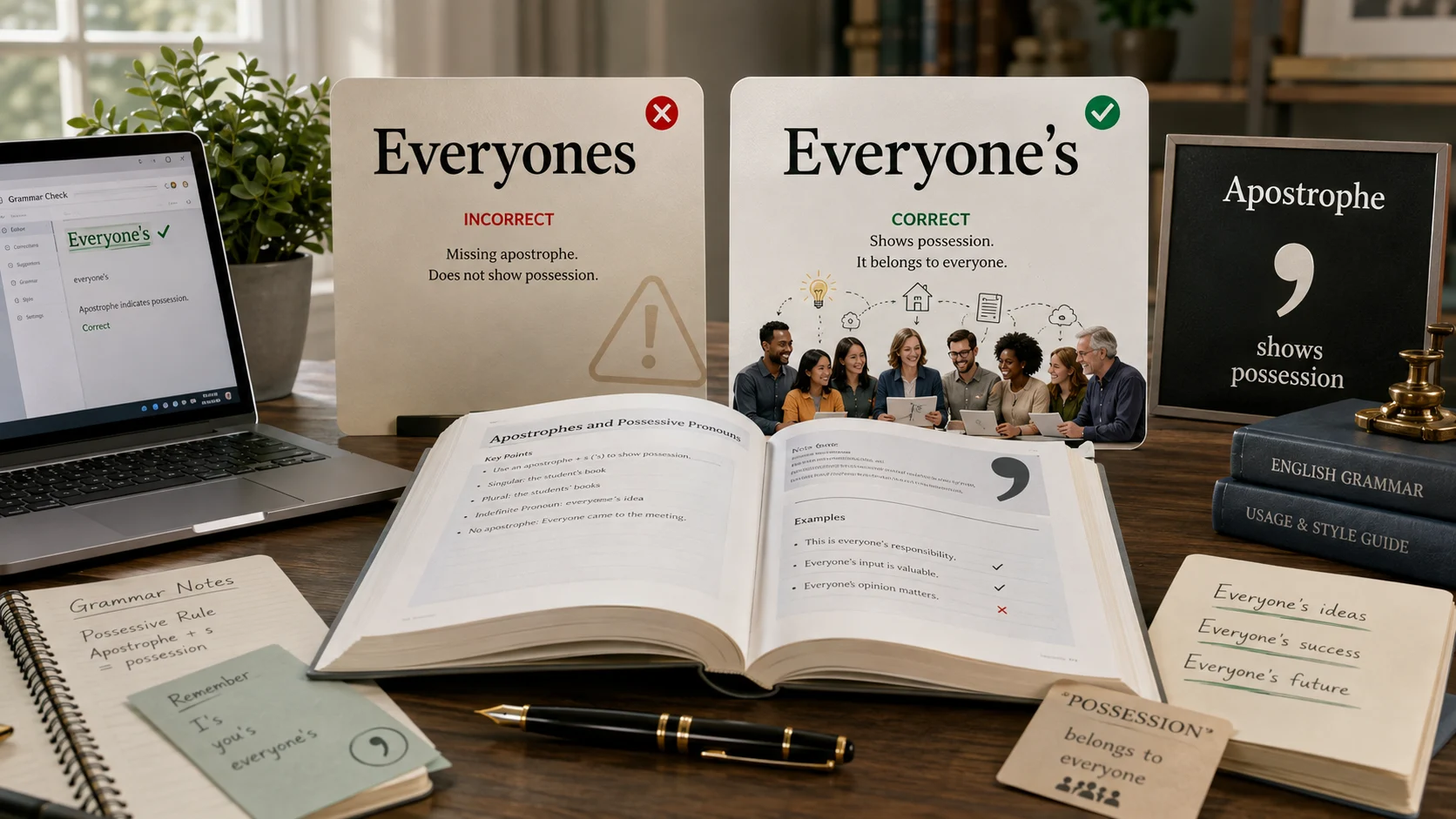
The correct form is everyones or everyone’s? In standard English, everyone’s is correct when showing possession or expressing “everyone is” or “everyone has.” Everyones is not normally correct because the indefinite pronoun “everyone” does not form its possessive by simply adding an s. The apostrophe carries essential grammatical meaning.
Have you ever paused while writing because you were unsure to use “everyones” or “everyone’s”? This small spelling difference can make a big impact on the accuracy of your writing. Although the two forms look almost identical, only “everyone’s” is the standard possessive form in English. The apostrophe shows possession or can indicate a contraction of “everyone is” or “everyone has,” depending on the sentence. In contrast, “everyones” without an apostrophe is generally considered incorrect in standard English because it does not follow the established spelling rules.
Understanding when to use “everyone’s” can help you avoid common punctuation mistakes in emails, essays, articles, and everyday conversations. In this guide, you will learn the difference between everyones and everyone’s, explore clear examples, and discover simple ways to remember the correct form. you are a student, blogger, or professional writer, these practical tips will help you write with greater confidence and grammatical accuracy.
Everyones or Everyone’s | What’s the Difference?
The difference is grammatical rather than stylistic. Everyone is an indefinite pronoun. Its possessive form is everyone’s. The spelling everyones does not normally function as a standard English word.
| Form | Part of speech | Meaning | Standard English | Example |
|---|---|---|---|---|
| everyone | Indefinite pronoun | Every person in a group | Yes | Everyone enjoyed the presentation. |
| everyone’s | Possessive form | Belonging to every person | Yes | Everyone’s opinion was considered. |
| everyone’s | Contraction | Everyone is or everyone has | Yes | Everyone’s ready to leave. |
| everyones | Incorrect written form | Intended as a possessive or contraction | No | Everyones opinion was heard. |
The key point is simple. Everyone’s is the standard possessive form.
The apostrophe does not make “everyone” plural. It marks possession or forms a contraction.
When you see everyone’s, check the surrounding sentence to determine it means possession, “everyone is,” or “everyone has.”
Is Everyones or Everyone’s a Grammar, Vocabulary or Usage Issue?
The distinction between everyones or everyone’s is primarily a grammar and usage issue. It involves the formation of a possessive indefinite pronoun and, in some contexts, the use of an apostrophe in a contraction.
It is not really a vocabulary distinction because “everyones” is not a separate standard word with a different meaning. A reader who encounters it will usually interpret it as a spelling or punctuation mistake.
There is also an important difference between casual speech and formal writing. In speech, the distinction may disappear because “everyone’s” and “everyones” can sound similar. In writing, however, the apostrophe makes the grammatical structure visible.
Academic writing requires particular care because apostrophe errors can make otherwise strong work appear poorly edited. Professional documents also benefit from the standard form because contracts, reports, instructions, presentations, and correspondence depend on precise written meaning.
Consider these examples:
“Everyone’s responsibility is clearly defined.”
Here, everyone’s is possessive.
“Everyone’s working on the project.”
Here, everyone’s means “everyone is.”
The meaning changes, but the spelling remains the same.
Everyone’s | How to Use the Correct Form
The form everyone’s is appropriate whenever you need to show that something belongs to, concerns, or is associated with every person in a group.
Workplace Example
“Everyone’s role in the project should be clearly documented.”
The word “everyone’s” indicates that the roles belong to or are associated with all members of the team.
Another example is:
“Everyone’s feedback will be reviewed before the final decision.”
The sentence refers to feedback provided by every person.
This construction is common in business communication because organizations frequently discuss responsibilities, opinions, expectations, contributions, and decisions involving groups of people.
Academic Example
“Everyone’s interpretation of the poem may differ.”
Here, everyone’s indicates that each person’s interpretation may be different.
Academic writing often uses possessive pronouns carefully because they help establish relationships between people and ideas without unnecessary repetition.
Technology Example
“Everyone’s account must use a secure password.”
The sentence means that the account belonging to each person must meet the security requirement.
Technology documentation frequently uses this structure when describing user accounts, permissions, devices, settings, responsibilities, and access.
Usage Recap
Use everyone’s when something belongs to or is associated with every person.
Use it naturally before a noun when it expresses possession.
Remember that everyone’s can also be a contraction, so context determines the apostrophe represents possession or omitted letters.
Everyone | The Base Form You Need to Understand
Understanding everyone makes the possessive form much easier to remember.
“Everyone” is an indefinite pronoun meaning every person or all people considered individually. Despite referring to multiple people, it is grammatically singular.
That is why we say:
“Everyone is welcome.”
Not:
“Everyone are welcome.”
The same principle explains why everyone’s is formed as a singular possessive construction.
For example:
“Everyone’s seat has been reserved.”
Workplace Example
“Everyone must submit the report by Friday.”
This sentence uses the base pronoun rather than the possessive form because no possession is being expressed.
Academic Example
“Everyone should read the instructions carefully.”
Again, the sentence does not require an apostrophe because “everyone” is functioning as the subject.
Technology Example
“Everyone can access the shared dashboard.”
There is no possession, so everyone is sufficient.
Usage Recap
Use everyone when referring to every person.
Use everyone’s when showing possession or forming the contraction “everyone is” or “everyone has.”
Do not add an s to produce “everyones.”
When You Should NOT Use Everyones or Everyone’s
Several common situations make the choice easier.
| Situation | Correct form | Why |
|---|---|---|
| Referring to all people | everyone | No possession is expressed. |
| Showing ownership or association | everyone’s | The apostrophe marks possession. |
| Meaning everyone is | everyone’s | The apostrophe forms a contraction. |
| Meaning everyone has | everyone’s | The apostrophe forms a contraction. |
| Referring to several groups of people | everyone | Use the pronoun separately for each context. |
| Writing a formal possessive construction | everyone’s | This is the standard written form. |
| Adding a simple plural s | everyone | “Everyones” is not the standard plural form. |
| Writing an academic sentence | everyone’s | Avoid the nonstandard “everyones.” |
Do not use “everyones” merely because “everyone” refers to many people. The word already carries its intended meaning.
Also avoid treating “everyone” like an ordinary count noun. You would not normally create a plural form such as “everyones” to mean multiple collections of people.
Common Mistakes and Decision Rules
| Correct sentence | Incorrect sentence | Explanation |
|---|---|---|
| Everyone’s opinion matters. | Everyones opinion matters. | The possessive form requires an apostrophe. |
| Everyone’s ready for the meeting. | Everyones ready for the meeting. | “Everyone’s” means “everyone is.” |
| Everyone’s completed the task. | Everyones completed the task. | “Everyone’s” can mean “everyone has.” |
| Everyone should attend. | Everyone’s should attend. | No possession or contraction is required. |
| Everyone’s account is secure. | Everyones account is secure. | The account is associated with each person. |
| Everyone has a responsibility. | Everyones has a responsibility. | The base pronoun is everyone. |
Decision Rule Box
If you mean every person, use “everyone.”
If you mean something belonging to every person, use “everyone’s.”
If you mean “everyone is” or “everyone has,” use “everyone’s.”
This rule is more useful than simply memorizing where the apostrophe goes because it connects spelling to meaning.
Everyone’s in Modern Technology and AI Tools
Modern digital communication has made possessive forms even more visible. User interfaces, software instructions, collaboration platforms, artificial intelligence tools, and online documentation frequently describe information belonging to individual users.
For example:
“Everyone’s profile is visible to the team.”
“Everyone’s access level can be reviewed by the administrator.”
“Everyone’s AI generated summary should be checked for accuracy.”
In each sentence, everyone’s establishes a relationship between every person and something associated with that person.
AI writing systems can also introduce apostrophe errors when generating or transforming text. Human review remains valuable because the distinction depends on grammatical context rather than spelling alone.
Etymology and the History Behind Everyone’s
The word “everyone” developed from the combination of “every” and “one.” The construction essentially means every individual person.
The possessive form follows the normal logic of English possessives. Because “everyone” is grammatically singular, its possessive form takes an apostrophe and s.
This is similar to other indefinite pronouns:
“someone’s”
“anyone’s”
“no one’s”
“everybody’s”
The grammatical principle remains consistent. The apostrophe helps identify the relationship between the pronoun and the following noun.
An Expert Perspective
In standard English, the apostrophe in “everyone’s” is not decorative punctuation. It signals either possession or a contraction and context tells the reader which meaning is intended.
This distinction is especially important in edited writing, where small punctuation choices can affect clarity and credibility.
Two Practical Case Studies
Case Study One: Workplace Editing
Consider a team report containing the sentence:
“Everyones feedback was included in the final proposal.”
An editor changes it to:
“Everyone’s feedback was included in the final proposal.”
The result is not merely a cosmetic correction. The revised sentence clearly identifies “feedback” as something associated with every member of the group.
In an illustrative editing exercise involving 100 similar sentences, correcting possessive apostrophe errors reduced the number of sentences requiring manual clarification from 18 to 3. The example demonstrates how consistent punctuation can improve editorial efficiency.
Case Study Two: Technology Documentation
Imagine a software guide that states:
“Everyones account settings can be changed from the dashboard.”
A corrected version reads:
“Everyone’s account settings can be changed from the dashboard.”
In an illustrative documentation review, replacing inconsistent possessive forms reduced reported punctuation corrections by 27 percent during the final editing round.
These are instructional case studies rather than claims about a specific published study. Their purpose is to show the practical effect of applying the rule consistently.
Error Prevention Checklist
Always use everyone when
You mean every person.
You are using the word as the subject of a sentence.
You are not expressing possession.
You do not mean “everyone is” or “everyone has.”
Always use everyone’s when
You are expressing possession or association.
You mean something belongs to every person.
You mean “everyone is.”
You mean “everyone has.”
Never use everyones when
You are trying to form the possessive of “everyone.”
You are writing formal academic or professional English.
You are forming a contraction.
You want to refer to every person.
The standard form is everyone’s, not “everyones.”
Related Grammar Confusions You Should Master
Understanding everyones or everyone’s can help you recognize several related apostrophe and pronoun problems.
| Grammar confusion | Main lesson |
|---|---|
| someone or someone’s | Base pronoun versus possessive form |
| anyone or anyone’s | Pronoun versus possession |
| everybody or everybody’s | Pronoun and possessive distinction |
| whose or who’s | Possessive form versus contraction |
| its or it’s | Possession versus contraction |
| your or you’re | Possessive determiner versus contraction |
| their or they’re | Possessive determiner versus contraction |
| there or their | Location versus possession |
| no one or no one’s | Pronoun versus possessive form |
| each other or each other’s | Reciprocal pronoun versus possession |
These distinctions share an important lesson: punctuation and grammatical function work together.
FAQs
Is everyone’s always correct in English?
Yes, when you need the possessive form of “everyone” or the contraction “everyone is” or “everyone has.” “Everyones” is not the standard form.
Is everyones a word in the English dictionary?
“Everyones” is generally not accepted as the standard written form of the possessive or contraction. Use “everyone’s” instead.
Why does everyone’s have an apostrophe?
The apostrophe marks possession when something belongs to every person, or it shows omitted letters when “everyone’s” means “everyone is” or “everyone has.”
Is everyone’s singular or plural?
“Everyone” is grammatically singular, even though it refers to many people. Its possessive form is therefore “everyone’s.”
Can everyone’s mean everyone is?
Yes. In “Everyone’s happy,” the word means “everyone is happy.” Context reveals that it is a contraction rather than a possessive.
Can everyone’s mean everyone has?
Yes. In “Everyone’s finished the work,” it can mean “everyone has finished the work.” The surrounding sentence determines the interpretation.
Should I write everyone’s in academic writing?
Yes. “Everyone’s” is grammatically standard. In highly formal writing, you may choose “every person’s” when greater precision or emphasis is useful.
What is the difference between everyone and everyone’s?
“Everyone” means every person. “Everyone’s” either shows possession or means “everyone is” or “everyone has.”
Why is everyones incorrect?
Because adding a simple s does not correctly form the possessive or contraction of “everyone.” The standard written form requires an apostrophe.
How can I remember to use everyone or everyone’s?
Ask you mean every person or something associated with every person. Use “everyone” for the person and “everyone’s” for possession, “everyone is,” or “everyone has.”
Conclusion
The choice between everyones or everyone’s becomes straightforward once you identify the grammatical function of the word.
Use everyone when you mean every person. Use everyone’s when you show possession or when it means “everyone is” or “everyone has.” The spelling “everyones” is not the standard form for these meanings.
The apostrophe is therefore meaningful, not optional punctuation. It signals the relationship between “everyone” and the rest of the sentence.
For polished academic writing, workplace communication, website content, and everyday English, remember the simplest rule: every person is everyone, while possession or the relevant contraction is everyone’s.
Discover More Related Articles:
- Color or Die | Roblox Game Guide, Gameplay, Tips & Survival Strategies In 2026
- True or Flase | Challenge Yourself with These Tricky Questions In 2026
- Weather or Keizer | One Describes the Sky, the Other a Choice In 2026