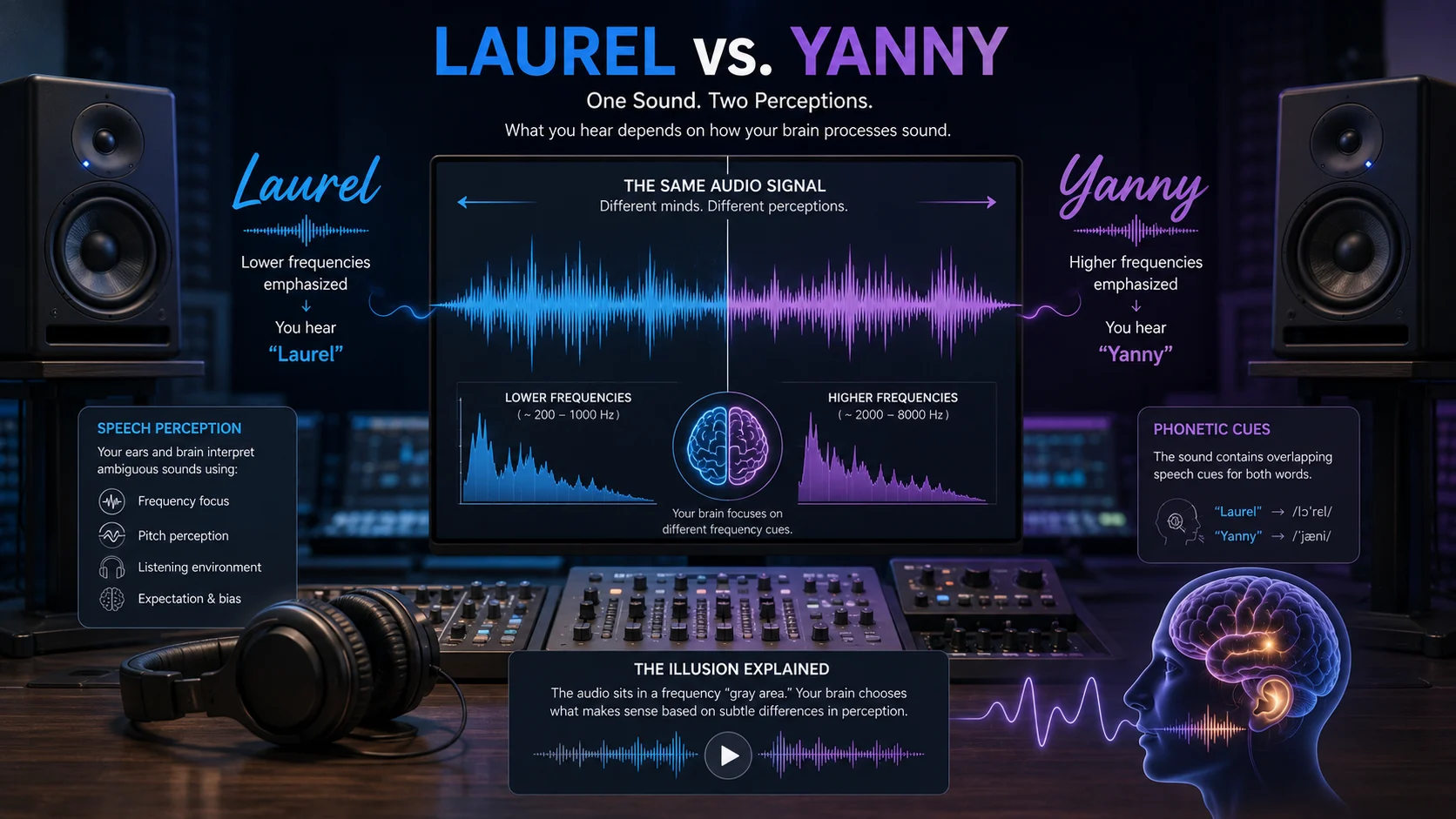
Laurel or Yanny refers to a viral audio illusion in which different listeners perceive the same recording as saying either “Laurel” or “Yanny.” The disagreement is caused by differences in how the brain processes speech sounds, frequencies, pitch, recording quality, and individual hearing. There is no simple indication that one listener is hearing correctly while another is not.
What Is the Laurel Yanny Audio Illusion?
The famous audio clip became an internet sensation in 2018 when people began arguing about a short recording contained the word “Laurel” or “Yanny.”
What made the phenomenon unusual was that people could listen to exactly the same recording and confidently hear different words. Some listeners heard a clear “Laurel,” while others were certain the recording said “Yanny.” In some cases, people could even change what they heard by adjusting the sound or focusing on different frequencies.
This is an example of an auditory illusion, a phenomenon in which the brain interprets an actual sound in a way that differs from another listener’s perception.
The important point is that your ears are not necessarily receiving completely different information. Instead, your brain is interpreting ambiguous acoustic information differently.
Why Did the Audio Become So Popular?
The recording spread rapidly across social media because it created an unusually easy experiment. People didn’t need special equipment or scientific knowledge. They simply listened and reported what they heard.
The disagreement also made the phenomenon highly shareable. Friends, families, students, celebrities, and online communities compared their answers, often becoming surprised that another person could hear something completely different.
The debate demonstrated an important principle of human perception: hearing is not simply the process of receiving sound. The brain actively interprets sound.
Laurel vs Yanny: What’s the Difference?
The two words have noticeably different pronunciations, but the recording contains acoustic characteristics that can be interpreted in more than one way.
| Feature | Laurel | Yanny |
|---|---|---|
| Word type | Proper name | Proper name |
| Pronunciation | Often pronounced with sounds similar to “Lor” and “ul” | Often pronounced with sounds similar to “Yan” and “ee” |
| Perception | More listeners may hear lower frequency information as Laurel | More listeners may hear higher frequency information as Yanny |
| Main issue | Interpretation of ambiguous speech sounds | Interpretation of ambiguous speech sounds |
| Related field | Phonetics and speech perception | Phonetics and speech perception |
The disagreement isn’t simply about vocabulary. It involves phonetics, auditory perception, sound frequency, speech recognition, and cognitive processing.
Quick Recap
The recording contains acoustic information that can support different interpretations.
Some listeners emphasize lower frequency components and perceive Laurel.
Others perceive higher frequency components and hear Yanny.
Your individual hearing and the way your brain processes speech can influence the result.
Why Do People Hear Different Words?
One of the biggest questions surrounding the viral recording is why two people can hear different words from the same audio.
The answer involves several factors.
1. Frequency
Sound consists of different frequencies. Human speech contains a mixture of low, middle, and high frequency information.
The recording associated with the viral phenomenon contains frequencies that can be interpreted differently depending on how they are emphasized. When higher frequency components become more noticeable, some listeners report hearing Yanny. When lower frequency information becomes more prominent, Laurel may become more apparent.
This doesn’t mean that everyone with excellent hearing will hear the same thing. Perception involves more than the physical sound wave.
2. Hearing Ability
People do not all hear frequencies with exactly the same sensitivity.
Hearing naturally changes throughout life. Younger listeners generally tend to be more sensitive to higher frequencies, while sensitivity to certain higher frequencies can decline with age.
Because the Laurel Yanny recording contains ambiguous frequency information, differences in frequency sensitivity can influence perception.
This is one reason two people sitting next to each other can produce completely different answers.
3. Audio Quality
The device used to play the recording can change the listening experience.
A smartphone speaker, laptop, headphones, television, or professional audio system may reproduce different frequencies with different levels of clarity.
Compression can also affect the sound.
If certain frequencies are reduced or emphasized, the perceived word may change.
This is why someone might hear Laurel on headphones but hear Yanny when playing the same recording through a different speaker.
4. Accent and Dialect
Speech perception is strongly influenced by previous exposure to language.
People become familiar with the pronunciation patterns of the languages, accents, and dialects they regularly hear. When an ambiguous sound occurs, the brain can compare it with familiar speech patterns.
Your linguistic background can therefore influence how you interpret an unclear recording.
5. Expectations
The brain doesn’t process every sound completely from scratch.
If someone tells you, “Listen carefully for Yanny,” your brain may become more likely to interpret ambiguous information as Yanny.
Likewise, being told to listen for Laurel can influence what you perceive.
This demonstrates the relationship between sensory information and expectation.
Is This a Hearing Problem or a Brain Perception Effect?
For most people, hearing one word rather than the other isn’t evidence of a hearing problem.
The phenomenon is primarily an example of perceptual ambiguity.
Your ears detect sound waves, but your brain has to interpret those waves as meaningful speech. When acoustic information is unclear or overlaps between possible interpretations, the brain chooses an interpretation based on the available evidence.
This process is similar to what happens when you encounter an unclear word during an ordinary conversation.
Imagine someone speaking in a noisy restaurant. You may initially misunderstand a word. Once you understand the context, the same sound can suddenly become obvious.
The Laurel Yanny phenomenon makes this process unusually visible because the ambiguity is preserved in a short recording.
How Does the Laurel Yanny Illusion Work?
The illusion works because spoken words are made up of complex combinations of frequencies.
When a person says a word, the recording captures the resulting sound wave. That sound wave contains information about pitch, consonants, vowels, resonance, and other acoustic characteristics.
A recording can therefore contain multiple clues.
When the acoustic clues are sufficiently ambiguous, the brain has to determine which interpretation makes the most sense.
This is called speech perception.
Speech perception is not merely a matter of detecting individual frequencies. The brain combines acoustic information with linguistic knowledge and expectations to recognize a spoken word.
That is why the same recording can produce different perceptual experiences.
What Role Does Pitch Play?
Pitch describes how high or low a sound is perceived.
Changing the pitch of an ambiguous recording can sometimes make one interpretation more noticeable than another.
When people experiment with the viral recording by changing its pitch, they may notice that the perceived word changes.
This happens because pitch shifting changes the relationship between the frequency components present in the recording. The brain consequently receives a different acoustic pattern to interpret.
It is important to distinguish pitch from frequency, although the two concepts are closely related. Frequency is a measurable property of a sound wave, while pitch is the way the brain perceives the relative highness or lowness of that sound.
Can You Hear Both Words?
Yes.
Some listeners report that they can hear both words, especially after hearing another person explain what to listen for.
Once the brain has two possible interpretations available, it may become easier to switch between them.
This is a useful demonstration of how perception can be flexible.
You aren’t necessarily changing the original recording. Instead, you’re changing the way you attend to and interpret its acoustic information.
The experience can feel surprisingly strange because the sound itself remains unchanged while your perception changes.
Why Can I Hear Yanny Instead of Laurel?
If you hear Yanny, your brain is emphasizing or interpreting particular acoustic features of the recording in a way that matches the word Yanny.
This may be influenced by frequency sensitivity, listening equipment, age related changes in hearing, expectations, linguistic experience, and other perceptual factors.
Hearing Yanny does not automatically mean that you have better hearing.
Likewise, hearing Laurel does not mean that your hearing is more accurate.
The recording is sufficiently ambiguous that different listeners can arrive at different perceptual conclusions.
Why Can I Hear Laurel Instead of Yanny?
If you hear Laurel, your auditory system is likely giving greater perceptual weight to acoustic information that corresponds more closely to Laurel.
The result can be influenced by the same collection of factors that affect other listeners.
Your headphones, speakers, volume level, hearing sensitivity, accent familiarity, and expectations can all play a role.
This is why simply asking another person what they hear can sometimes change your own experience.
Does Age Affect What You Hear?
Age can be one factor, although it isn’t a universal explanation.
Human hearing changes naturally over time. Sensitivity to higher frequencies can decrease with age, which may affect how someone perceives an ambiguous recording.
Because the viral audio contains different frequency components, changes in frequency sensitivity may influence which interpretation is most noticeable.
However, age alone cannot predict exactly what someone will hear.
Two people of a similar age can still hear different words because auditory perception depends on many variables.
Does Your Accent Change the Answer?
Accent and language experience can influence speech perception.
When you hear an unclear sound, your brain draws upon familiar pronunciation patterns. Someone accustomed to particular vowel and consonant combinations may interpret ambiguous acoustic information differently from someone with another linguistic background.
This doesn’t mean that one accent is responsible for hearing the “correct” answer.
Instead, it illustrates an important principle in linguistics: language experience influences how people categorize speech sounds.
The brain becomes highly efficient at recognizing patterns that occur frequently in the languages and dialects a person encounters.
Laurel Yanny and the McGurk Effect
The Laurel Yanny phenomenon is sometimes discussed alongside the McGurk effect, another famous example of how the brain constructs speech perception.
The McGurk effect occurs when visual information about a speaker’s mouth movements influences what a listener believes they hear.
For example, seeing a person’s mouth form one sound while hearing another can cause the brain to perceive a third sound.
Although the two phenomena are not identical, they demonstrate a shared principle.
Speech perception is an active process involving the brain, not merely a mechanical recording of sound.
What you perceive can depend on acoustic information, context, visual information, expectations, and previous linguistic experience.
Common Misconceptions About the Viral Audio
Myth 1: One Word Must Be Correct for Everyone
Not necessarily.
The original recording may have had an intended word, but the perceptual experience can still vary between listeners.
Myth 2: Hearing Yanny Means You Have Better Hearing
There is no simple basis for that conclusion.
Hearing one interpretation does not automatically indicate superior hearing.
Myth 3: Hearing Laurel Means You Are Older
Age can influence high frequency hearing, but it isn’t a reliable way to determine what someone will hear.
Myth 4: Changing the Volume Changes the Word
Volume can influence clarity, but it isn’t the only variable. Frequency response, equipment, background noise, and attention can also affect perception.
Myth 5: The Brain Is Making Up the Sound
The brain isn’t randomly inventing a word.
It is interpreting real acoustic information contained in the recording.
How to Test the Audio Yourself
You can explore the phenomenon with several simple experiments.
First, listen through headphones.
Then try a laptop or phone speaker.
Next, listen in a quiet room and compare the result with listening in a noisy environment.
You can also experiment with the pitch of the recording if you have suitable audio software.
Finally, ask another person what they hear before telling them your answer.
The interesting part is not simply determining which word you hear. The experiment demonstrates how flexible human auditory perception can be.
The Science Behind the Viral Phenomenon
The popularity of this recording provided an accessible demonstration of a much broader scientific idea.
Human perception involves interpretation.
When we see an ambiguous image, the brain chooses between possible visual interpretations. When we hear ambiguous speech, the brain similarly evaluates acoustic information and selects an interpretation.
This is why auditory perception is important in linguistics, psychology, neuroscience, communication research, and speech recognition technology.
The Laurel Yanny debate turned a technical concept into an everyday experience.
Millions of people effectively performed a small perception experiment without realizing it.
Why This Matters Beyond an Internet Debate
The phenomenon may seem like a simple internet curiosity, but it illustrates important principles about communication.
In real conversations, people frequently encounter unclear speech.
Background noise, accents, poor microphones, unfamiliar vocabulary, fast speaking, and overlapping conversations can all make speech difficult to understand.
The brain has to fill in missing information and make educated interpretations.
Modern speech recognition systems face a similar challenge.
Voice assistants and automated transcription systems must distinguish between similar sounds while dealing with accents, background noise, recording quality, and incomplete information.
The human brain is remarkably good at this process, although it isn’t perfect.
A Simple Decision Guide
If you hear Laurel, don’t assume that everyone else is wrong.
If you hear Yanny, don’t assume that you have unusually sensitive hearing.
If you can hear both, you’ve experienced how strongly context and attention can influence auditory perception.
If the answer changes when you switch headphones or speakers, that is also useful evidence that frequency reproduction matters.
The key lesson is simple: the sound entering your ears and the sound you consciously perceive are not always identical experiences.
FAQs
Is it Laurel or Yanny?
The viral recording can be perceived as either Laurel or Yanny by different listeners. The disagreement results from ambiguous acoustic information and differences in auditory perception.
Why do people hear different words in the same recording?
People can hear different words because the brain interprets ambiguous frequency information differently. Hearing sensitivity, audio equipment, expectations, accent, and linguistic experience can all contribute.
What causes the Laurel Yanny illusion?
The illusion is caused by ambiguous speech sounds and the way the auditory system processes frequency information. The brain uses acoustic clues and previous language experience to determine what word it believes it is hearing.
Can changing the pitch change what you hear?
Yes. Changing the pitch can alter the frequency relationships in the recording, making one interpretation more noticeable than another.
Does age affect you hear Laurel or Yanny?
Age can influence hearing sensitivity, particularly at higher frequencies, so it may affect perception. However, age alone does not determine which word a person will hear.
Can headphones change the answer?
Yes. Different headphones and speakers reproduce frequencies differently. As a result, an ambiguous recording can sound more like one interpretation on one device and another interpretation on a different device.
Is Laurel or Yanny an optical illusion?
No. It is an auditory illusion, meaning that the ambiguity occurs in the perception of sound rather than vision.
Is the Laurel Yanny phenomenon related to the McGurk effect?
They are different phenomena, but both demonstrate that speech perception is an active brain process influenced by more than the raw sound signal.
Why can I switch between Laurel and Yanny?
Once you know that two interpretations are possible, your attention and expectations can influence how you categorize the ambiguous acoustic information. This can make it possible to switch between interpretations.
Conclusion
The Laurel Yanny phenomenon became famous because it turned an invisible process inside the human brain into an entertaining public debate. The recording demonstrates how frequency, pitch, hearing sensitivity, audio equipment, accent, expectations, and language experience can influence speech perception.
There isn’t anything strange about hearing a different word from someone else. In fact, the disagreement reveals something fascinating about human hearing. Our brains constantly interpret incomplete and sometimes ambiguous information so that we can understand the world around us.
What sounds obvious to one person may be interpreted differently by another. That doesn’t necessarily mean one person is listening incorrectly. It shows just how sophisticated and flexible auditory perception really is.
Discover More Related Articles:
- Pimple or Herpes | How to Tell the Difference & When to Get Medical Advice In 2026
- Cetaphil or CeraVe | Which Is Better for Your Skin Type In 2026
- Innie or Outie | Meaning, Difference & Usage Explained In 2026