A pimple is usually a small inflamed skin bump associated with acne, blocked pores, or an irritated hair follicle, while herpes is a viral infection that can cause painful blisters or sores. Because early herpes can resemble a pimple, appearance alone cannot reliably confirm the cause. Testing may be needed for certainty.
A small bump on your skin or lips can leave you wondering: is it a pimple or herpes? Although these two conditions may look similar at first, they have different causes, symptoms, and treatment approaches. Pimples commonly develop when pores become clogged with oil, dead skin cells, and bacteria, while herpes is a viral infection caused by the herpes simplex virus (HSV). Understanding these differences can help you avoid common misconceptions and make more informed decisions about your skin health. However, appearance alone cannot always provide a reliable diagnosis.
In this guide, we’ll explore pimple vs. herpes, including their key symptoms, appearance, causes, and typical locations. You’ll also learn how to recognize possible warning signs, when medical advice may be necessary, and why confusing these conditions can lead to inappropriate treatment. With clear, evidence-informed information, this comparison will help you better understand what you’re noticing and when to consult a healthcare professional for an accurate diagnosis.
Pimple vs Herpes | What’s the Difference?
A pimple is a noun referring to a small raised spot or inflamed elevation of the skin. It is commonly associated with acne, although acne is not the only reason a pimple like bump can appear. Folliculitis, shaving irritation, friction, and ingrown hairs can also create acne like bumps.
Herpes is a noun referring to a group of viral infections caused by herpesviruses. When people use the word in this context, they often mean herpes simplex infection. Oral herpes commonly affects the mouth or lips, while genital herpes can affect the genitals, anus, buttocks, and nearby areas.
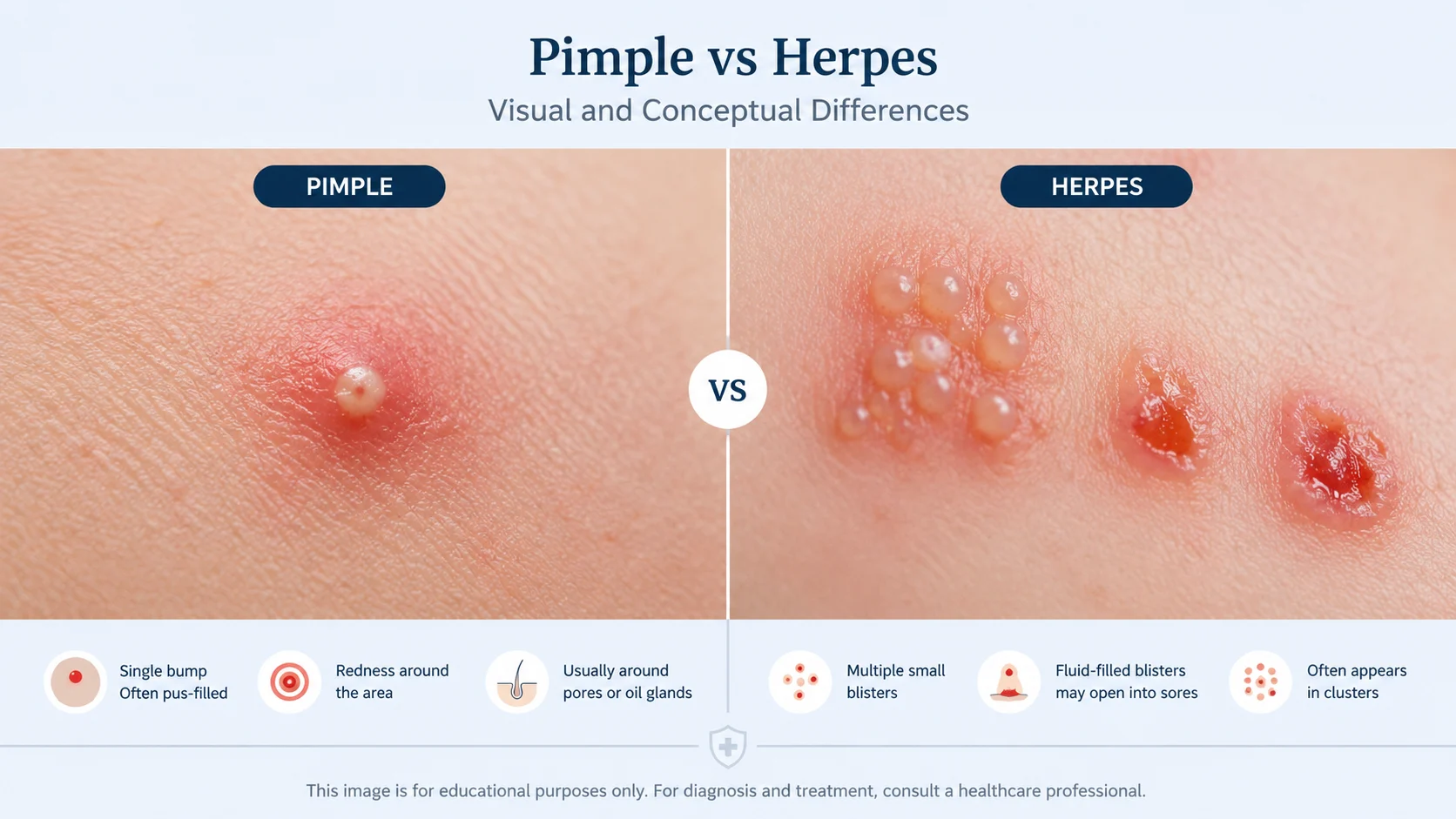
| Feature | Pimple | Herpes |
|---|---|---|
| Basic cause | Often acne, blocked pores, inflammation, or follicle irritation | Herpes simplex virus infection |
| Typical appearance | Raised red spot, papule, or pustule | Small bumps, fluid filled blisters, or sores |
| Fluid | May contain pus | May contain clear or cloudy fluid |
| Sensation | May be tender or painless | Often painful, burning, itching, or tingling |
| Pattern | Often an individual spot or acne breakout | May occur as several nearby lesions |
| Development | Can become swollen and develop a whitehead | May progress from bumps to blisters, open sores, and crusting |
| Recurrence | Acne may recur but not necessarily in the same pattern | Recurrent outbreaks can occur |
| Location | Can occur almost anywhere with pores or follicles | Often around the mouth or genitals, depending on infection |
| Diagnosis | Usually based on skin examination | May require examination and laboratory testing |
| Infectious nature | A pimple itself is not an STI | Genital herpes is sexually transmissible |
The important point is that these features are clues rather than a diagnostic test.
A pimple may sometimes look like a small blister, particularly when inflamed.
Herpes may initially look like an ordinary bump before its characteristic changes become apparent.
An active herpes sore can be tested, making professional evaluation much more reliable than visual comparison alone.
Is Pimple vs Herpes a Grammar, Vocabulary or Usage Issue?
This is primarily a medical vocabulary and usage distinction, not a grammar problem.
The two words are not interchangeable. Pimple describes a type of skin lesion or bump, while herpes identifies a viral infection. Calling a herpes lesion a pimple may describe what it resembles visually, but it does not identify its underlying cause.
In casual conversation, someone might say, “I have a pimple near my mouth.” In a clinical setting, however, a healthcare professional would want to distinguish among acne, folliculitis, an ingrown hair, a cold sore, herpes simplex infection, and other possible causes.
Academic and medical writing should therefore avoid treating visual appearance as proof of diagnosis. A more accurate sentence is, “The lesion resembles a pimple, but herpes cannot be excluded without appropriate evaluation.”
This distinction is especially important when discussing genital lesions. Genital herpes can be mild enough to resemble pimples or ingrown hairs, according to the American Academy of Dermatology.
What Does a Pimple Usually Look and Feel Like?
A typical pimple is a small raised skin spot. Depending on its type, it may be red, swollen, tender, or filled with pus. Oxford describes a pimple as a small raised red spot on the skin.
Pimples can appear on the face, chest, back, shoulders, buttocks, and other areas. When a hair follicle becomes irritated or infected, folliculitis can also create an acne like breakout. Shaving, waxing, friction, tight clothing, and sweating can contribute to follicle irritation.
Workplace Example
Imagine an employee notices a single tender bump after shaving. It is located where hair grows and resembles other razor related bumps the person has experienced. Describing it as a pimple or irritated follicle may be reasonable as a preliminary description, but a workplace conversation should not turn that observation into a medical diagnosis.
Academic Example
In a health education assignment, writing “a pimple is always acne” would be too broad. A more accurate statement is that pimples are raised skin lesions commonly associated with acne, while similar looking lesions can arise from other causes.
Technology Example
A symptom checker or image recognition application may identify a lesion as pimple like, but such an output should not be treated as confirmation. Artificial intelligence can assist with information gathering, but it cannot replace appropriate clinical examination or laboratory testing.
Pimple usage recap: A pimple describes an appearance or type of skin lesion. It does not automatically identify the underlying condition, especially when a bump occurs around the genitals or mouth.
What Does Herpes Usually Look and Feel Like?
Herpes simplex can produce no symptoms at all, very mild symptoms, or noticeable sores. When symptoms occur, people may experience tingling, itching, burning, small bumps, fluid filled blisters, ulcers, or crusting. Genital herpes can also cause painful urination and, during a first outbreak, fever, body aches, headache, or swollen lymph nodes.
One reason herpes is easily confused with ordinary skin problems is that the first visible lesion may not immediately look like a classic blister. The American Academy of Dermatology notes that mild genital herpes can be mistaken for pimples or ingrown hairs.
Workplace Example
If a person develops painful genital sores, continuing normal work is not necessarily the central issue. The more important consideration is obtaining appropriate medical advice and avoiding sexual contact that could transmit infection while symptoms are present.
Academic Example
In a health sciences paper, it would be inaccurate to define herpes only as a blistering condition. Some infected people have no visible symptoms, and symptoms can vary considerably between individuals.
Technology Example
A medical application may compare photographs of skin lesions, but visual similarity cannot reliably determine a lesion contains HSV. A healthcare professional can collect a sample from an active sore and laboratory testing can identify herpes simplex virus.
Herpes usage recap: Herpes identifies a viral infection, not simply a particular looking bump. Symptoms can vary widely, so the absence of a classic blister does not automatically rule it out.
When You Should NOT Use Pimple or Herpes
There are several situations where labeling a lesion yourself can be misleading.
| Situation | Why the label can be misleading | Better approach |
|---|---|---|
| A new genital bump appears after sexual contact | Several conditions can resemble one another | Consider professional evaluation |
| A lesion becomes a painful open sore | This can occur with herpes and other conditions | Seek medical advice |
| Several fluid filled bumps appear together | A cluster can be associated with herpes but is not definitive | Arrange clinical assessment |
| A bump repeatedly returns in the same area | Recurrence can have multiple explanations | Discuss the pattern with a clinician |
| Burning or tingling occurs before sores | These symptoms can occur with herpes | Consider testing if appropriate |
| Painful urination occurs with genital sores | This can accompany genital herpes | Seek medical evaluation |
| You have a possible STI exposure | Appearance alone cannot establish infection status | Ask about appropriate STI testing |
| You are pregnant and suspect herpes | New or active infection can require special medical attention | Contact your healthcare professional promptly |
The key principle is simple: do not use either word as a substitute for diagnosis.
Common Mistakes and Decision Rules
| Correct sentence | Incorrect sentence | Explanation |
|---|---|---|
| This bump looks like a pimple, but I should have it checked. | This bump is definitely a pimple. | Appearance alone cannot always establish the cause. |
| Herpes can sometimes resemble a pimple. | Every pimple is a sign of herpes. | Many ordinary skin conditions produce bumps. |
| A healthcare professional can test an active herpes sore. | I can confirm herpes by looking at a photo. | Laboratory testing can provide stronger evidence. |
| Genital herpes can cause painful sores. | Genital herpes always causes painful sores. | Some people have mild or no symptoms. |
| Folliculitis can resemble acne. | Every acne like bump is acne. | Several conditions can produce similar appearances. |
Decision Rule Box
If the lesion looks like a pimple, describe it as pimple like rather than assuming its cause.
If herpes is possible because of the location, symptoms, recurrence, or exposure history, do not rely on appearance alone. Seek appropriate medical evaluation and ask testing is recommended.
This rule is more medically useful than attempting to classify every bump from its appearance.
Pimple and Herpes in Modern Technology and AI Tools
Modern health applications can help users organize symptoms, compare general descriptions, and prepare questions for a medical appointment. Image based systems may also recognize patterns associated with common skin conditions.
However, technology has important limitations. A photograph cannot reliably determine a lesion contains herpes simplex virus. Lighting, camera quality, skin tone, lesion stage, and visual similarity can all affect interpretation.
AI should therefore be treated as an educational aid rather than a diagnostic authority. When herpes is genuinely suspected, professional assessment and appropriate laboratory testing remain more dependable. Mayo Clinic notes that a sample from an active sore can be tested for herpes simplex virus and can identify HSV 1 or HSV 2 is present.
Authority and Trust | What Medical Evidence Says
The distinction between a pimple and herpes becomes clearer when the underlying biology is considered. A pimple is a visible skin lesion, while herpes is an infection caused by a virus. Similar appearance does not mean identical cause.
The American Academy of Dermatology makes an important observation:
“Many people who have genital herpes never notice any signs or symptoms.”
That statement explains why visual identification has limits. A person can have herpes without having an obvious lesion, while another person can have a completely nonherpetic bump that looks concerning.
Etymology
The word pimple dates to Middle English and is associated with older English terms connected with breaking out in pustules. Modern dictionaries continue to define it as a small swelling or raised spot of the skin.
The word herpes has a very different history. It came through Latin from Greek herpēs, associated with the idea of “creeping” or spreading. The historical term originally referred more broadly to spreading skin eruptions before modern medical classifications became more specific.
Case Study One: A Single Post Shaving Bump
Consider an educational scenario involving an adult who notices one red bump shortly after shaving. The bump occurs in a hair bearing area and resembles previous shaving irritation. There is no blistering, no spreading cluster, and no systemic illness.
This pattern can fit follicle irritation or folliculitis, which the American Academy of Dermatology says can produce acne like breakouts. The practical result is that the person should avoid assuming the lesion is herpes solely because it occurs near the genital region.
This is an illustrative clinical pattern, not a diagnosis of a real patient.
Case Study Two: Recurrent Painful Blisters
Consider another educational scenario in which several painful lesions appear close together. The person first notices tingling and burning, followed by small blisters that break open and form sores. Similar episodes occur again later.
That pattern is more concerning for herpes simplex than an ordinary isolated pimple. The American Academy of Dermatology describes tingling, itching, or burning followed by painful fluid filled blisters as possible herpes symptoms. A clinician can examine an active sore and may collect a swab for laboratory testing.
Again, this is an educational example rather than a diagnosis of a real patient.
Error Prevention Checklist
Always use pimple when
- You are describing a small raised skin spot without claiming a specific medical cause.
- The lesion is consistent with ordinary acne or a similar skin condition.
- You are using the word descriptively rather than diagnostically.
Never use herpes when
- You are basing the conclusion only on the fact that a bump is red.
- You have not considered other common causes of bumps or sores.
- You are diagnosing yourself from an online photograph.
- You are using the term to describe every genital bump automatically.
At the same time, do not dismiss herpes simply because a lesion initially resembles a pimple. Mild genital herpes can look like a pimple or ingrown hair.
How Is Herpes Confirmed?
A healthcare professional may assess the lesion, symptoms, medical history, and possible exposure. When an active sore is present, a sample can be collected and tested for herpes simplex virus. Mayo Clinic notes that testing can identify HSV infection and determine HSV 1 or HSV 2 is involved.
Blood testing may sometimes be used in particular circumstances, although testing recommendations depend on symptoms, exposure, and individual circumstances. The American Academy of Dermatology notes that routine testing is not recommended for most people who have no symptoms.
If you have genital sores, unexplained blisters, painful urination, or a possible STI exposure, medical advice is more useful than trying to reach a definite conclusion from appearance alone.
When Should You Seek Medical Advice?
Consider prompt medical evaluation if you develop unexplained genital sores, painful blisters, recurrent lesions, unusual discharge, painful urination, fever with genital symptoms, or symptoms following a possible STI exposure.
Pregnancy is another important situation. People who are pregnant and have suspected genital herpes should discuss it with their healthcare professional because herpes infection around childbirth can pose serious risks to a newborn.
You should also seek urgent medical attention for concerning eye symptoms associated with a possible herpes infection. Herpes simplex can affect the eye and may cause pain, light sensitivity, discharge, or vision problems.
Related Grammar Confusions You Should Master
Although this topic is medical rather than grammatical, several related terminology distinctions are useful for clear health writing.
- Acne vs pimple: Acne is a skin condition, while a pimple can be an individual lesion.
- Cold sore vs herpes: A cold sore is commonly associated with oral herpes, but herpes simplex can occur in different locations.
- Blister vs sore: A blister describes a fluid filled lesion, while sore is a broader everyday term.
- Folliculitis vs acne: Folliculitis involves inflamed hair follicles and can resemble acne.
- HSV 1 vs HSV 2: Both are herpes simplex viruses and either can be associated with genital infection.
- Symptom vs diagnosis: A symptom is an observation or experience, while a diagnosis identifies the underlying condition.
- STI vs STD: STI is commonly preferred because an infection can exist without obvious disease symptoms.
- Lesion vs sore: Lesion is a broader medical term for an abnormal area of tissue, while sore is more general.
- Infection vs outbreak: An infection describes the presence of the infectious agent, while an outbreak refers to a period when symptoms become apparent.
- Exposure vs infection: Possible exposure does not automatically mean that infection occurred.
FAQs
How can you tell if a bump is a pimple or herpes?
You cannot reliably confirm the difference from appearance alone because herpes can resemble pimples.
Can herpes look like a single pimple?
Yes, mild herpes can initially resemble a pimple or ingrown hair, particularly around the genital area.
Do herpes bumps always turn into blisters?
No. Herpes symptoms vary, and some infected people have very mild symptoms or none at all.
Are pimples on the genitals always herpes?
No. Shaving, ingrown hairs, folliculitis, irritation, and other skin conditions can cause genital bumps.
Can a pimple have clear fluid?
A skin lesion may contain different types of fluid depending on its cause, so fluid appearance alone cannot diagnose herpes.
Is herpes always painful?
No. Herpes can cause painful symptoms, but some people experience mild symptoms or no noticeable symptoms.
How is genital herpes tested?
A healthcare professional can often test an active sore by collecting a sample for laboratory analysis.
Can shaving cause a bump that looks like herpes?
Yes. Shaving can damage hair follicles and contribute to folliculitis or razor bumps that resemble acne.
Should I see a doctor for a suspicious genital bump?
Yes, especially when the bump is painful, recurrent, blistering, associated with other symptoms, or follows a possible STI exposure.
Conclusion
The difference between pimple or herpes is ultimately a difference between a visible skin lesion and a viral infection. A pimple is commonly associated with acne, irritation, or an inflamed follicle, while herpes simplex can cause blisters and sores and may sometimes look remarkably similar to an ordinary bump.
Because appearance alone is not definitive, the safest strategy is to avoid self diagnosis. Pay attention to symptoms, timing, recurrence, location, and possible exposure, then seek professional evaluation when herpes is a realistic possibility. An active sore can often be tested, giving much stronger evidence than visual comparison.
Understanding the distinction can prevent two common mistakes: dismissing a potentially important infection as an ordinary pimple and unnecessarily assuming that every bump is herpes.
Discover More Related Articles:
- Cozy or Cosy | Which Spelling Works in Formal Writing In 2026
- W2 or W4 | What Is the Difference & Which Form Do You Need In 2026
- Rock or Something | Everything You Need to Know In 2026