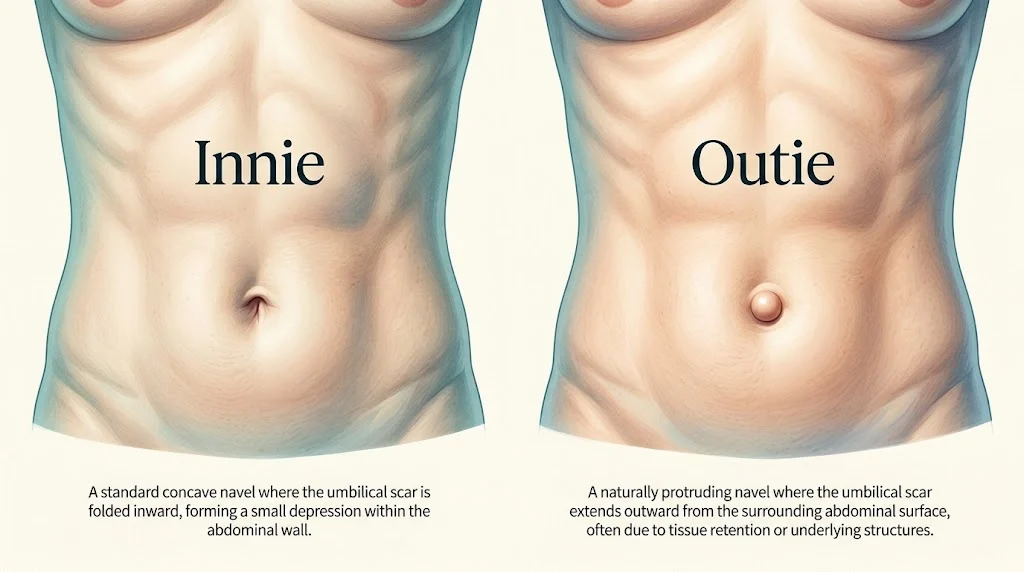
Innie or outie describes the two common visible shapes of the navel, or belly button. An innie is a navel that appears recessed or concave, while an outie protrudes outward from the abdomen. These terms are informal vocabulary, not competing medical diagnoses, and confusing them can make ordinary descriptions unclear or misleading.
Have you ever wondered why some belly buttons dip inward while others stick outward? The difference between innie and outie is simple, but these familiar terms often raise questions about body shape, appearance, and everyday vocabulary. An innie describes a belly button that curves inward, creating a small hollow, while an outie refers to a belly button that protrudes outward from the surrounding skin. Both are common natural variations in human anatomy, and neither is inherently better or more attractive than the other.
Understanding innie vs. outie helps you use these terms correctly in conversations, articles, and everyday writing. In this guide, you’ll discover their meanings, key differences, and practical examples to make the distinction easy to remember. You’ll also learn how belly button shapes develop and why their appearance can vary from person to person. With clear explanations and reliable information, this comparison will help you understand the terms confidently without confusing a normal physical variation with a medical concern.
Innie or Outie | What’s the Difference?
Both innie and outie are informal nouns when they describe a belly button. They are formed from ordinary English words associated with inward and outward position. Merriam Webster defines innie as a concave navel and outie as a convex navel.
An innie is a recessed or concave navel. Looking at it from the outside, the center appears to go inward toward the abdomen.
An outie is a protruding or convex navel. Instead of forming a hollow, part of the navel extends outward and can look like a small button or knot.
| Term | Part of Speech | Meaning | Appearance | Typical Context |
|---|---|---|---|---|
| innie | Noun | A concave or recessed navel | Looks pushed inward | Informal everyday conversation |
| outie | Noun | A convex or protruding navel | Looks pushed outward | Informal everyday conversation |
The key difference is direction.
An innie goes visually inward.
An outie projects visually outward.
Neither term automatically means that something is wrong.
Innie or Outie: Is This a Grammar, Vocabulary or Usage Issue?
This is primarily a vocabulary and usage issue, rather than a difficult grammar problem.
The two words are not interchangeable when they describe the navel. If someone says, “She has an innie,” the listener understands that her navel is recessed. If someone says, “She has an outie,” the listener understands that the navel protrudes.
The terms are informal. In casual conversation, family discussions, social media posts, and general lifestyle writing, they are perfectly understandable. In medical writing, however, navel or umbilicus is usually more precise.
For example, a casual sentence might say:
“Does your baby have an innie or an outie?”
A clinical description would more likely say:
“The infant has a protruding umbilicus.”
The second version is more appropriate when discussing anatomy or a possible medical condition.
This distinction matters because informal vocabulary and medical terminology serve different purposes. The word outie describes an appearance. It does not by itself diagnose an umbilical hernia.
What Is an Innie?
An innie is a navel that appears recessed into the abdomen. It is often described as a hollow, indentation, or small depression.
Merriam Webster classifies innie as an informal noun and records its first known use in this sense as 1966.
Innie in the workplace
In ordinary workplace communication, the word innie is rarely necessary. If the subject comes up in a casual conversation, the term can be used naturally.
For example:
“She has always had an innie.”
In a professional medical document, a more precise sentence would be:
“The patient has a concave umbilicus.”
The second sentence communicates anatomical information without relying on informal vocabulary.
Innie in academic writing
Academic writing generally favors anatomical terminology. A biology, nursing, anatomy, or medical student would normally use umbilicus, navel, concave navel, or another appropriate anatomical description.
Using innie in a formal research paper could make the sentence sound unnecessarily conversational unless the paper is specifically discussing everyday language.
Innie in technology
Technology has made informal terminology even more visible. Search engines, image generators, social platforms, and conversational AI systems may encounter the word innie frequently because users describe physical characteristics in ordinary language.
For example, an image prompt might specify a character with a recessed belly button. The word innie could communicate the same idea more casually, while “recessed navel” provides greater anatomical precision.
Usage recap: Use innie when you want a simple, informal way to describe a recessed belly button. For clinical, academic, or technical writing, navel, umbilicus, or concave navel is usually more precise.
What Is an Outie?
An outie is a navel that protrudes outward instead of forming a visible depression. Merriam Webster defines it as a convex navel and records its first known use in this sense as 1972.
An outie may look like a small raised button or knot. The appearance can result from the way the umbilical scar formed, and the shape of the navel can vary naturally between individuals.
Outie in the workplace
In a workplace conversation, outie would normally appear only in an informal context. For example:
“My baby has an outie.”
That sentence is understandable and natural in casual conversation.
A healthcare professional would generally choose more specific language if the appearance itself were clinically relevant.
Outie in academic writing
In academic or medical writing, outie should usually be replaced with terms such as protruding navel, convex umbilicus, or protruding umbilicus.
This is particularly important because a protruding navel can sometimes be associated with an umbilical hernia. However, an outie and an umbilical hernia are not automatically the same thing.
Mayo Clinic explains that an umbilical hernia occurs when tissue pushes through an opening in the abdominal muscles near the navel. It can create a soft swelling or bulge.
Outie in technology
In technology, outie can appear in natural language searches, image descriptions, character profiles, and AI generated visual prompts. The word is useful when the context is casual and the intended meaning is obvious.
For anatomical accuracy, however, systems and users may benefit from a phrase such as “protruding umbilicus” or “convex navel.”
Usage recap: Use outie for an informal description of a protruding belly button. Do not automatically use outie as a synonym for an umbilical hernia.
When You Should NOT Use Innie or Outie
There are several situations where these informal terms can create confusion.
- Do not use innie when the navel protrudes. The word describes a recessed appearance.
- Do not use outie when you simply mean any unusual navel. A navel can have many shapes, and unusual appearance does not automatically mean it is an outie in the ordinary sense.
- Do not use outie as a medical diagnosis. A protruding navel can have several explanations, and a doctor may need to examine it before identifying a condition.
- Do not replace precise medical terminology with slang in clinical documentation. Terms such as umbilicus and umbilical hernia communicate more specific information.
- Do not assume an outie is unhealthy. Many people naturally have protruding navels without having a medical problem.
- Do not assume an innie guarantees normal anatomy. The visible shape alone does not determine the underlying abdominal wall is healthy.
- Do not use either term when discussing a sudden painful change without clarification. A newly developed or painful bulge deserves more precise description and, when appropriate, professional evaluation.
- Do not treat pregnancy related changes as permanent automatically. Pregnancy can temporarily change the appearance of a belly button as abdominal pressure increases.
Common Mistakes and Decision Rules
The easiest way to remember the distinction is to focus on the visual direction of the navel.
A few changes are needed because the table currently labels some grammatically possible sentences as “incorrect.” The main issue is factual precision, especially around outie, recessed, and umbilical hernia.
For an educational article, I’d recommend this version:
| Correct sentence | Incorrect sentence | Explanation |
|---|---|---|
| She has an innie belly button. | She has an outie belly button, but it is recessed. | An innie is generally recessed or indented, while an outie generally protrudes outward. |
| Her baby has an outie. | Her baby has an innie that sticks outward. | Innie and outie describe opposite visible shapes of the belly button. |
| The doctor examined the umbilicus. | The doctor diagnosed an outie. | Outie describes the appearance of a belly button. It is not, by itself, a medical diagnosis. |
| The patient has a protruding umbilicus. | The patient has an outie hernia. | Outie hernia is not the standard medical term. An umbilical hernia is a separate medical condition that may cause the belly button to protrude. |
Decision Rule Box
If you mean a recessed or inward appearing navel, use innie.
If you mean a protruding or outward appearing navel, use outie.
If you mean a medical structure, use umbilicus or navel.
If you suspect a medical condition, describe the symptoms or use the appropriate clinical term rather than treating innie or outie as a diagnosis.
Why Do Some People Have an Innie and Others Have an Outie?
The visible navel is essentially a scar associated with the former attachment of the umbilical cord. Merriam Webster defines the navel as a depression in the middle of the abdomen marking the point where the umbilical cord was attached.
The way that scar looks varies naturally. The final appearance depends on how the tissue heals and how the surrounding abdominal structures and skin form.
It is therefore inaccurate to think that an outie necessarily means the umbilical cord was cut incorrectly. The popular idea that the person who cuts the cord determines someone will have an innie or outie is not a reliable explanation of normal navel variation.
A person can also experience changes in navel appearance over time. Pregnancy is one well known example. Cleveland Clinic explains that pressure from a growing fetus can cause a belly button to flatten or pop outward, and an innie can temporarily become an outie.
Innie and Outie During Pregnancy
Pregnancy can make the distinction especially confusing because a person who normally has an innie may notice that the navel becomes flatter or protrudes.
This happens because the growing uterus changes pressure on the abdominal wall. Cleveland Clinic notes that this change can occur during pregnancy and that the appearance may return toward its previous form afterward.
A temporary change does not necessarily indicate a problem.
However, a painful, tender, swollen, or discolored bulge near the navel should not simply be labeled an outie. Mayo Clinic recommends medical evaluation for concerning umbilical changes, particularly when pain or tenderness is present.
Innie and Outie in Modern Technology and AI Tools
Modern search engines and AI systems can interpret both informal and technical descriptions, but specificity still matters.
For casual content, “outie belly button” is easy to understand. For an anatomy lesson, “protruding umbilicus” is more precise. For an AI image prompt, specifying “recessed navel” or “protruding navel” can reduce ambiguity.
This distinction is especially useful for educational content, accessibility descriptions, image metadata, and digital health information. A good content creator should choose vocabulary according to the audience rather than assuming that the most casual term is always the best term.
The same principle applies to search optimization. Users may search for innie or outie, while authoritative medical content may use navel, umbilicus, umbilical anatomy, or umbilical hernia. Covering both forms naturally helps readers while maintaining terminology accuracy.
Etymology of Innie and Outie
The two informal words are straightforward formations.
Innie comes from in plus the informal suffix ie. Merriam Webster records its first known use in the navel sense as 1966.
Outie comes from out plus ie. Merriam Webster records its first known use as 1972.
The medical word umbilicus has a much older history. It comes from Latin umbilicus, meaning navel or central point.
The everyday word navel traces back through Middle English to Old English forms related to the idea of a central point or hub.
Expert style quotation
A useful way to summarize the terminology is:
“An innie is concave; an outie is convex.”
That distinction reflects the standard dictionary definitions of the two informal terms.
Two Practical Case Studies
Case Study One: Pregnancy Related Change
Consider a person who has had a recessed navel for many years and notices during pregnancy that it becomes flatter and then begins to protrude.
The appropriate description is that the person’s navel has changed from an innie appearance toward an outie appearance. Cleveland Clinic specifically notes that pregnancy can put enough pressure on the abdominal wall to make a belly button pop outward.
The concrete result is that a previously recessed navel can temporarily become protruding. This demonstrates why the terms describe appearance rather than permanent biological categories.
Case Study Two: Surgical Navel Conversion
A different example involves cosmetic umbilical surgery. A published surgical report from 1983 described a procedure designed to convert a protruding outie into an innie appearance by removing scar tissue and reconstructing the navel with skin flaps.
The concrete result in that report was successful surgical conversion from a protruding umbilical appearance to a recessed tubular appearance.
This case also demonstrates an important vocabulary point. The surgical literature uses umbilicus and umbilicoplasty, while innie and outie remain informal descriptions of the visible result.
When an Outie May Need Medical Attention
An outie by itself is not a diagnosis. Many people naturally have a protruding navel.
The important distinction is between a stable anatomical appearance and a new or symptomatic bulge.
An umbilical hernia can produce a soft swelling near the navel. Mayo Clinic explains that umbilical hernias can occur when tissue protrudes through an opening in the abdominal muscles near the belly button.
Medical attention becomes more important when a navel bulge is painful, tender, enlarging, discolored, or associated with other concerning symptoms.
For infants, Mayo Clinic notes that umbilical hernias are common and often close naturally during early childhood. Adults with umbilical hernias are more likely to require surgical repair, particularly when the hernia grows or becomes painful.
The key lesson is simple: outie describes shape, while umbilical hernia describes a medical condition.
Error Prevention Checklist
Always use innie when
- The navel visibly forms an inward depression.
- You are speaking casually about a recessed belly button.
- You are comparing the common informal navel shapes.
Never use outie when
- You mean a clearly recessed navel.
- You are trying to diagnose an umbilical hernia.
- You need precise clinical terminology.
- You are describing a medical symptom without explaining the actual symptom.
- You simply mean that the navel looks different from average.
Related Grammar Confusions You Should Master
Learning innie and outie is useful alongside other common vocabulary distinctions involving informal and formal terminology.
- belly button or navel: Learn when the casual and formal terms fit.
- navel or umbilicus: Understand everyday versus anatomical usage.
- concave or convex: Learn the precise descriptive vocabulary for inward and outward shapes.
- affect or effect: A classic English usage confusion.
- lay or lie: A frequent grammar problem involving verb forms.
- further or farther: Understand the difference between related meanings.
- fewer or less: Learn when countable and uncountable nouns matter.
- everyday or every day: Distinguish adjective use from a time expression.
- advice or advise: Separate the noun from the verb.
- compliment or complement: Learn how spelling changes meaning.
These comparisons reinforce a broader principle: similar sounding or related terms can have different meanings, grammatical functions, and appropriate contexts.
FAQs
What is the difference between an innie and an outie belly button?
An innie is recessed inward, while an outie protrudes outward. The terms describe visible navel shape rather than medical conditions.
Is an innie or outie more common?
Innies are generally more common, and Merriam Webster notes that an innie is a concave navel. Individual navel shape varies naturally.
Is an outie belly button normal?
Yes, an outie can be a normal variation in navel shape. A protruding appearance alone does not mean that a person has a medical problem.
Can an innie become an outie during pregnancy?
Yes, pregnancy can cause a previously recessed navel to flatten or protrude because of increased pressure on the abdominal wall.
Is an outie the same thing as an umbilical hernia?
No. An outie describes appearance, whereas an umbilical hernia is a condition involving tissue protruding through an opening near the navel.
Is innie a real English word?
Yes. Innie is an informal noun meaning a concave navel, with Merriam Webster recording its first known use in this sense in 1966.
Is outie a real English word?
Yes. Outie is an informal noun meaning a convex or protruding navel, with Merriam Webster recording its first known use in this sense in 1972.
What is the medical word for an innie or outie?
The medical term for the belly button is umbilicus. Medical writing may describe it more specifically as concave or protruding depending on its appearance.
When should a protruding belly button be checked by a doctor?
A new, painful, tender, enlarging, or discolored bulge near the navel should be medically assessed because these features can occur with an umbilical hernia or another condition.
Conclusion
The distinction between innie or outie is easy once the visual difference is clear. An innie is a recessed or concave navel, while an outie is a protruding or convex navel. Both are informal terms used to describe appearance.
The most important rule is not to confuse an outie with an umbilical hernia. A naturally protruding navel can be completely normal, while a new or painful bulge may require medical evaluation.
For casual conversation, innie and outie are clear and natural. For academic, professional, or medical contexts, navel, umbilicus, concave, and protruding are more precise choices.
Discover More Related Articles:
- Cozy or Cosy | Which Spelling Works in Formal Writing In 2026
- W2 or W4 | What Is the Difference & Which Form Do You Need In 2026
- Rock or Something | Everything You Need to Know In 2026