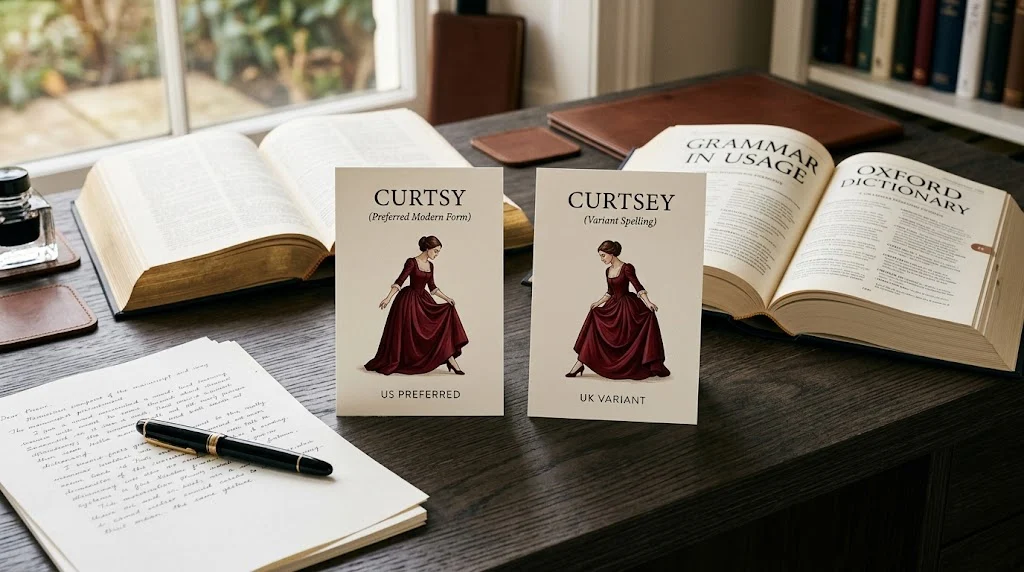
Curtsy or curtsey refers to the same formal gesture in which a woman or girl bends her knees to show respect, greeting, or acknowledgment. Both spellings are correct, and both can function as a noun or verb. Curtsy is the more commonly preferred spelling in many modern dictionaries, while curtsey remains an accepted variant.
The question of curtsy or curtsey often causes uncertainty because the two forms look almost identical and have the same pronunciation and meaning. Unlike many spelling pairs in English, this is not a case where one word has a completely different definition. Both describe a traditional gesture of respect made by bending the knees, usually with one foot positioned in front of the other.
The confusion matters because choosing between the spellings can affect consistency in essays, articles, historical writing, formal descriptions, and published content. If you are writing about etiquette, dance, royalty, theater, or traditional gestures, knowing which form to favor can make your writing look more polished.
The simplest answer is that curtsy is generally the safest modern choice, but curtsey is not wrong. Oxford lists curtsey as a variant of curtsy, while Cambridge also gives curtsey as an alternative spelling.
Curtsy vs Curtsey | What’s the Difference?
The essential difference is spelling rather than meaning. Both words refer to the same gesture and can be used as either a noun or a verb.
As a noun, curtsy or curtsey refers to the physical gesture itself.
Example:
“She made a graceful curtsy before leaving the stage.”
As a verb, curtsy or curtsey describes the act of performing that gesture.
Example:
“She curtsied before the royal guest.”
Oxford identifies curtsy as both a noun and an intransitive verb, and explicitly gives curtsey as an alternative form.
| Feature | Curtsy | Curtsey |
|---|---|---|
| Part of speech | Noun and verb | Noun and verb |
| Meaning | A formal gesture involving a bend of the knees | The same formal gesture |
| Pronunciation | Usually pronounced /ˈkɜːrtsi/ | Usually pronounced the same way |
| Correctness | Standard and widely recognized | Correct variant spelling |
| Preferred modern form | Often the safer choice in general writing | Acceptable, but less commonly preferred |
| Plural | Curtsies | Curtseys |
Mini Recap
Curtsy and curtsey have the same meaning.
Both forms can be nouns and verbs.
Curtsy is generally the better default for modern writing.
Curtsey is still a legitimate spelling, not a spelling mistake.
Is Curtsy vs Curtsey a Grammar, Vocabulary or Usage Issue?
The distinction is primarily a spelling and usage issue, rather than a grammatical difference.
Both forms belong to the same vocabulary item. Neither spelling changes the basic meaning, grammatical function, or pronunciation. A writer can use either form in a sentence such as “She made a curtsy” or “She made a curtsey.”
The important issue is consistency.
If an article uses curtsy throughout, suddenly changing to curtsey can make the writing look inconsistent. The same applies in academic work, publishing, journalism, and professional editing.
Are Curtsy and Curtsey Interchangeable?
Yes. In ordinary English, they are interchangeable when they mean the traditional gesture.
Cambridge defines curtsy as a verb meaning to bend quickly at the knees, especially as a sign of respect, and identifies curtsey as an alternative spelling. Its noun entry follows the same pattern.
Formal and Informal Usage
Neither form is inherently informal. The gesture itself is associated with formal etiquette, traditional manners, dance, ceremonies, and historical settings.
However, curtsy is usually the more practical choice when you want the spelling most readers will recognize immediately.
Academic and Casual Usage
In academic writing, either spelling can be grammatically acceptable. Still, curtsy is a sensible default because it is the main headword used by major learner dictionaries.
In casual writing, the choice is less important. If the sentence is clear and the spelling is consistent, readers are unlikely to misunderstand either version.
How to Use Curtsy Correctly
Curtsy is commonly used when describing the gesture itself or the act of performing it. It works naturally in writing about royalty, etiquette, dance, theater, ceremonies, historical traditions, and social customs.
As a noun, you can write:
“She performed a graceful curtsy.”
“The dancer ended with a deep curtsy.”
“The child practiced her curtsy before the ceremony.”
As a verb, you can write:
“She curtsied to the queen.”
“The performers curtsied together after the show.”
“The young dancer curtsied before the audience.”
Oxford gives the verb pattern curtsy to somebody, with forms including curtsied and curtsying.
Workplace Example
“The presenter gave a playful curtsy after receiving the award.”
Here, curtsy functions as a noun and describes the gesture.
Academic Example
“The historical account describes how women were expected to curtsy when introduced at court.”
This sentence uses curtsy as a verb.
Technology Example
“A digital character may curtsy when the player completes the ceremonial sequence.”
Here, curtsy describes an action performed by a digital character.
Usage Recap
Use curtsy when you want the most straightforward modern spelling.
It can be a noun or a verb.
Its meaning does not change according to the grammatical role.
How to Use Curtsey Correctly
Curtsey is also correct. It is a recognized spelling variant rather than an error.
For example:
“She gave a formal curtsey.”
“The dancer curtseyed before leaving the stage.”
However, writers should pay attention to derived forms. The spelling changes when the word takes different grammatical endings.
For curtsy, common forms include:
Curtsy
Curtsies
Curtsied
Curtsying
For curtsey, corresponding forms include:
Curtsey
Curtseys
Curtseyed
Curtseying
Oxford specifically records curtsies and curtseys as the plural forms of the two spellings.
Workplace Example
“The employee gave a small curtsey as part of the historical demonstration.”
Academic Example
“The researcher notes that the curtsey was traditionally associated with formal social etiquette.”
Technology Example
“The game character performs a curtsey during the royal ceremony.”
Usage Recap
Curtsey is completely acceptable.
It has the same meaning as curtsy.
It is best treated as a spelling variant rather than a separate word.
If you are choosing a default spelling, curtsy is usually the simpler modern option.
When You Should NOT Use Curtsy or Curtsey
The most important mistake is using either word when the intended action is something else.
- Do not use curtsy when you mean a general bow. A bow can involve the head or upper body, while a curtsy specifically involves bending the knees.
- Do not use curtsey when you mean courtesy. Courtesy means polite behavior or respectful treatment. It is a different word.
- Do not use curtsy when you mean curtsy as a person or title. The word does not name a person who performs the gesture.
- Do not use curtsey when describing a simple nod unless the physical gesture actually involves the traditional knee bend.
- Do not assume curtsey is incorrect merely because curtsy looks more familiar. Dictionaries recognize both forms.
- Do not switch between curtsy and curtsey randomly within the same document.
- Do not treat curtsy and courteous as interchangeable. Courteous is an adjective meaning polite or respectful.
- Do not choose curtsey simply because you think the extra e makes the word more formal. The spelling does not make the gesture more formal.
Common Mistakes and Decision Rules
| Correct sentence | Incorrect sentence | Explanation |
|---|---|---|
| She gave a graceful curtsy. | She gave a graceful courtesy. | Curtsy names the formal gesture. Courtesy means polite behavior. |
| She curtsied to the guest. | She curtsyed to the guest. | The past tense of curtsy is curtsied, not curtsyed. |
| The dancer performed a curtsey. | The dancer performed a bow when a knee bending gesture is specifically meant. | A bow and a curtsy are related gestures, but they are not identical. |
| She curtsied before leaving. | She curtsyed before leaving. | Curtsied is the standard past tense and past participle form. |
| She gave several curtsies. | She gave several curtsy. | The plural of curtsy is curtsies. |
| She gave a polite curtsey to the audience. | She gave a polite curtsey and later switched to curtsy in the same terminology system. | Curtsy and curtsey are both correct spellings. Consistency is preferable within formal writing. |
Decision Rule Box
If you mean the traditional knee bending gesture, use curtsy or curtsey.
If you mean the act of performing that gesture, use curtsy or curtsey as a verb.
If you mean polite behavior, use courtesy.
If you want the safest modern default, choose curtsy.
Curtsy and Curtsey in Modern Technology and AI Tools
Modern technology can use either spelling when describing virtual characters, games, animation systems, digital assistants, or generated scenes.
For example:
“The virtual princess curtsied when the player entered the palace.”
An AI writing system should also recognize that curtsy and curtsey are spelling variants rather than unrelated vocabulary. A good grammar or spelling assistant should not automatically mark curtsey as an error merely because curtsy is more familiar.
This distinction matters for automated editing. Language tools increasingly evaluate context rather than simply checking a word exists in a dictionary. Since both forms are established, the better editorial recommendation is usually consistency and audience awareness.
For digital content aimed at a broad international audience, curtsy is a strong default because it is immediately recognizable and supported by major contemporary dictionaries. Cambridge and Oxford both recognize curtsey as an alternative.
Etymology | Where Did Curtsy Come From?
The history of the word explains why the spelling can seem unusual.
Oxford traces curtsy to the early sixteenth century and describes it as a variant of courtesy. The older expression referred to an act or expression of respect, and the modern physical gesture developed from that tradition.
This connection also explains why curtsy resembles courtesy in sound and history while having a much more specific modern meaning.
The spelling changed as English speakers shortened and reshaped the older form. In linguistic terms, this type of sound reduction is sometimes described as syncope. The important point for modern writers is that the unusual spelling is historically motivated rather than arbitrary.
An Expert Editorial Principle
“When two established spellings carry the same meaning, clarity and consistency matter more than pretending one accepted form is wrong.”
That principle is especially useful with curtsy and curtsey. A professional editor should distinguish between an actual spelling error and a legitimate variant.
Two Practical Case Studies
Case Study 1: The School History Essay
A student writing about royal etiquette repeatedly alternates between curtsy and curtsey. The sentences are grammatically correct, but the spelling changes from paragraph to paragraph.
The practical result is simple: standardizing the article to curtsy creates a consistent editorial style without changing a single idea or fact. The correction improves presentation while preserving the student’s original meaning.
Case Study 2: A Digital Game Description
A game description says, “The princess curtseys when she meets the king,” while the rest of the product documentation uses curtsy.
Changing the documentation to one consistent spelling produces a cleaner style guide. The result is not a change in meaning. It is a consistency improvement that makes the interface copy, character descriptions, and help documentation feel like one unified product.
These examples illustrate an important point: the problem is rarely curtsey is legal English. The real editorial question is which accepted form should be used consistently for the intended audience.
Author expertise: Written from a professional English language and SEO perspective, with reference to established dictionary definitions and usage guidance from Oxford and Cambridge.
Error Prevention Checklist
Always Use Curtsy When
- You want the simplest modern default spelling.
- You are describing a formal knee bending gesture.
- You are writing educational content for a broad audience.
- You want consistency with the main dictionary headword.
- You are describing a character performing the traditional gesture.
Never Use Curtsey When
- You are trying to mean courtesy.
- You are describing a general bow rather than a curtsy.
- You are treating curtsey as the name of a person.
- You are mixing it randomly with curtsy in the same document.
- Your publication style guide specifically requires curtsy.
Related Grammar Confusions You Should Master
English contains many pairs that look similar but require careful attention.
- Bow vs curtsy
- Courtesy vs curtsy
- Courteous vs curt
- Practice vs practise
- License vs licence
- Advice vs advise
- Affect vs effect
- Compliment vs complement
- Principal vs principle
- Stationary vs stationery
Learning these distinctions helps writers develop a stronger sense of spelling, vocabulary, and context instead of relying only on how a word sounds.
FAQs
Is curtsy or curtsey the correct spelling?
Both are correct spellings for the same gesture, although curtsy is generally the better modern default. Oxford and Cambridge both recognize curtsey as an alternative.
Is curtsey a British spelling of curtsy?
Curtsey is an accepted variant, but it is not simply a separate British meaning. Both forms can be found in English usage, and major dictionaries recognize them as variants.
What is the difference between curtsy and curtsey?
There is no meaningful difference in definition. Both can function as nouns and verbs and describe the traditional gesture of bending the knees to show respect.
Is curtsy a noun or a verb?
It can be both. As a noun, it names the gesture. As a verb, it describes performing the gesture. Oxford records both grammatical uses.
What is the past tense of curtsy?
The standard past tense is curtsied. For example, “She curtsied before the audience.”
What is the plural of curtsy?
The plural is curtsies. The corresponding plural of curtsey is curtseys.
Is curtsey a misspelling?
No. Curtsey is a recognized variant spelling, so it should not automatically be treated as an error.
Should I use curtsy or curtsey in formal writing?
Curtsy is usually the safest default because it is the main dictionary form and is widely recognized. If your chosen style uses curtsey, consistency is more important than switching forms.
Is a curtsy the same as a bow?
No. Both can express respect, but a curtsy traditionally involves bending the knees with one foot positioned in front of the other, while a bow generally involves bending the head or upper body.
Conclusion
The answer to curtsy or curtsey is straightforward: both spellings are correct, both describe the same traditional gesture, and both can be used as nouns or verbs. The main difference is spelling preference rather than meaning.
For most modern writing, curtsy is the strongest default. It is concise, widely recognized, and used as the primary form by major dictionaries. Curtsey remains a valid variant and should not be treated as an error.
The most important rule is consistency. Choose one spelling, use it throughout your article or document, and make sure you are not confusing the word with courtesy, courteous, or the broader term bow.
When in doubt, remember this simple rule: curtsy is the preferred modern choice, while curtsey is an accepted alternative.
Discover More Related Articles:
- Cozy or Cosy | Which Spelling Works in Formal Writing In 2026
- W2 or W4 | What Is the Difference & Which Form Do You Need In 2026
- Rock or Something | Everything You Need to Know In 2026