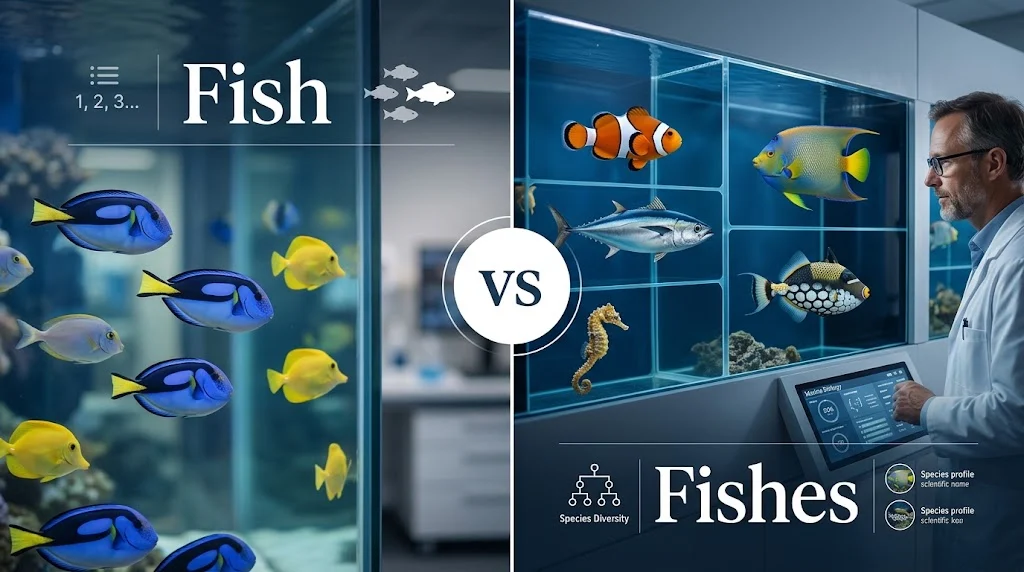
Both fish or fishes can be correct plural forms, but they are not equally common. Fish is the standard plural when referring to more than one fish, while fishes is mainly used when emphasizing different species, kinds, or groups of fish.
Fish vs Fishes | What’s the Difference?
The main difference between fish and fishes is not that one is correct and the other is incorrect. Both forms are grammatically acceptable. The choice depends largely on what the writer wants to emphasize.
Fish is a noun that can refer to one aquatic animal or to multiple animals. Its plural form usually remains unchanged. For example, “I saw one fish” becomes “I saw five fish.”
Fishes is also a plural noun. It is less common in everyday English and is especially useful when the writer is talking about different species, kinds, or varieties. Oxford identifies fish as the usual plural and notes that fishes can refer to different kinds of fish.
| Form | Part of speech | Main use | Example |
|---|---|---|---|
| Fish | Noun | Standard singular and plural form | We saw several fish in the lake. |
| Fishes | Noun | Different kinds or species | The reef contains many fishes. |
| A fish | Noun | One individual animal | I caught a fish. |
| Fish | Uncountable noun | Fish as food | We had fish for dinner. |
Quick recap
Fish is the normal plural in everyday English.
Fishes is grammatical but more specialized.
Use fish when simply counting individual animals.
Use fishes when emphasizing different species or kinds.
Cambridge likewise lists both plural forms and provides corpus examples in which fishes is used in scientific contexts.
Is Fish vs Fishes a Grammar, Vocabulary, or Usage Issue?
The difference is primarily a usage issue involving plural nouns, rather than a simple right versus wrong grammar rule.
English has several nouns whose singular and plural forms are identical. Examples include “sheep,” “deer,” and “fish.” This type of plural is sometimes called an unchanged plural because the word itself does not need an additional ending.
For most ordinary situations, fish is the natural choice.
Consider these sentences:
There are six fish in the aquarium.
We caught several fish during the trip.
The pond is full of fish.
Adding “es” in these sentences would sound unnecessarily formal or unusual.
However, fishes has a useful role when the writer needs to distinguish between different types of fish. Oxford specifically gives this distinction, explaining that fish is the usual plural while fishes can refer to different kinds of fish.
Formal and informal usage
In everyday conversation, fish is overwhelmingly the more natural option.
In scientific writing, marine biology, ecology, taxonomy, environmental studies, and museum descriptions, fishes can appear more frequently because researchers often discuss species diversity.
That doesn’t mean scientists always use fishes. In fact, Cambridge’s corpus examples show both forms being used according to context.
Academic usage
Academic writers should choose the form that accurately communicates the intended meaning.
For example:
“Researchers observed 200 fish in the lagoon.”
This focuses on the number of animals.
“Researchers documented several fishes from different taxonomic groups.”
This focuses attention on diversity between types or species.
The distinction is subtle but meaningful. Good academic writing uses the plural form that best communicates the intended classification.
When to Use Fish
Fish is the default plural form for most writing and conversation.
If you are talking about two or more individual fish without emphasizing species differences, use fish.
Examples include:
“I bought three fish for my aquarium.”
“The fishermen caught twenty fish.”
“There are hundreds of fish in the river.”
“She studies fish in freshwater environments.”
The word also works naturally when the species is unknown or irrelevant.
Workplace example
A restaurant manager might write:
“We received 50 fresh fish this morning.”
The manager is discussing the quantity of individual fish rather than contrasting species.
A seafood supplier might say:
“Our shipment contains several hundred fish.”
Again, the focus is quantity.
Academic example
A biology student could write:
“The researchers examined 75 fish collected from the lake.”
The sentence emphasizes the number of specimens studied.
Technology example
A developer creating aquarium management software might label a database field:
“Number of fish”
That wording is natural because the system is counting individual animals rather than identifying different species.
Usage recap
Use fish when talking about multiple individual fish, especially when the species is not important. It is the safest and most natural choice for general English.
When to Use Fishes
Fishes is useful when the meaning involves different species, kinds, or varieties.
For example:
“The reef supports many fishes.”
This can suggest a diverse collection of fish species rather than simply a large number of individual animals.
A scientific text might say:
“The coastal ecosystem contains fishes adapted to different habitats.”
Here, the writer is interested in a broad biological category and its diversity.
Workplace example
A marine conservation organization might write:
“The protected area supports numerous fishes, including reef dwelling and migratory species.”
The plural draws attention to the range of species.
Academic example
A zoology paper might state:
“The survey identified 18 fishes belonging to seven families.”
This is a particularly clear context for fishes because the sentence concerns taxonomic diversity.
Technology example
An online biodiversity database might organize records under:
“Fishes of the Indian Ocean”
This heading can signal that the database covers multiple types and species.
Cambridge provides a particularly useful corpus example in which 2,681 fishes represent 46 species and 10 families. That example illustrates why specialized scientific writing may prefer the plural fishes when species diversity matters.
Usage recap
Use fishes when the discussion focuses on multiple species, kinds, or taxonomic groups. It is valid English, but it is less common than fish in ordinary communication.
When You Should NOT Use Fish or Fishes
Understanding when not to use each form prevents awkward or misleading sentences.
| Situation | Better choice | Reason |
|---|---|---|
| Counting several individual animals | Fish | Standard plural |
| Talking about fish in an aquarium | Fish | Species distinction is usually unnecessary |
| Talking about fish as food | Fish | Usually an uncountable noun |
| Discussing several species | Fishes | Species diversity is important |
| Writing a taxonomy focused study | Fishes | Different groups may be emphasized |
| Casual conversation | Fish | Fishes can sound unnecessarily formal |
| A general statement about aquatic animals | Fish | Natural everyday usage |
| A scientific comparison of species | Fishes | Helps emphasize different kinds |
Avoid automatically adding “es” simply because you see more than one animal.
For example:
“Five fishes are swimming in the tank.”
This isn’t necessarily grammatically wrong, but five fish is much more natural if the sentence merely counts the animals.
Similarly, don’t assume that fishes must always mean “many individual fish.” In specialized contexts, it often highlights species diversity rather than simple quantity.
Common Mistakes and Decision Rules
One of the most common mistakes is treating fishes as the mandatory plural form because most countable nouns take an ending when they become plural.
That rule doesn’t apply universally in English. Some nouns retain their singular form in the plural.
| Correct sentence | Incorrect or less natural sentence | Explanation |
|---|---|---|
| I saw three fish in the pond. | I saw three fishes in the pond. | Fish is the normal plural for individual animals. |
| The aquarium contains many fish. | The aquarium contains many fishes. | Fish is more natural for a general group. |
| Scientists identified several fishes. | Scientists identified several fish. | Both can work, but fishes can emphasize different species. |
| We caught ten fish. | We caught ten fishes. | Fish is the conventional plural for counting catches. |
| The study examines tropical fishes. | The study examines tropical fish. | Both are possible, but fishes can emphasize diversity. |
Decision Rule
If you mean multiple individual animals, use fish. If you mean different species or kinds, fishes may be the more precise choice.
This rule is more accurate for this topic than trying to force the generic action and person distinction used for other word pairs.
Fish and Fishes in Modern Technology and AI Tools
Modern technology doesn’t change the underlying grammar, but digital systems make consistency increasingly important.
Search engines, grammar checkers, AI writing assistants, scientific databases, and content management systems can encounter both forms. An AI system may generate fish for general contexts and fishes when the surrounding text suggests taxonomy or species diversity.
For example, an AI generated sentence such as:
“The aquarium contains several fish.”
is completely natural.
A scientific database might instead use:
“The survey records 42 fishes from 12 species.”
The second sentence communicates a more specialized classification.
This distinction is especially useful for SEO writers. A page aimed at general readers should normally use fish naturally. A specialist page about marine biodiversity may legitimately use fishes where the meaning calls for it.
Etymology: Why Does Fish Have Two Plural Forms?
The history of fish helps explain why its plural behavior seems unusual.
The word comes from Old English fisc, with related forms appearing in other Germanic languages. Over the history of English, the unchanged plural form became well established. The Oxford English Dictionary explains that the unmarked plural became established during the Middle English period.
English has preserved similar patterns in words such as “deer” and “sheep.”
The existence of fishes does not mean the standard plural was somehow incomplete. Instead, it represents an additional plural form that survived and developed a specialized role.
An expert style explanation
A useful linguistic principle is this:
The most appropriate plural is determined by meaning and convention, not simply by adding a standard plural ending.
That principle explains why fish is perfectly normal as a plural while fishes remains legitimate in particular contexts.
Two Practical Case Studies
Case Study 1: Aquarium Description
Imagine an aquarium website describing a tank containing 30 individual fish.
Original wording:
“The aquarium contains 30 fishes.”
Revised wording:
“The aquarium contains 30 fish.”
Result: The revised sentence is shorter, more natural, and better suited to a general audience because the writer is counting individual animals rather than contrasting species.
Case Study 2: Marine Biology Report
Now consider a scientific report comparing organisms from several taxonomic groups.
Original wording:
“The reef supports many fish from different species.”
More precise wording:
“The reef supports many fishes from different species.”
Result: The second version places stronger emphasis on species diversity, making the classification focused meaning clearer.
These examples demonstrate an important point: neither plural should be treated as universally superior. Context determines the strongest choice.
Why Fish Is Usually the Better Choice
If you’re unsure which form to choose, fish is normally the safest option.
That recommendation is supported by major learner dictionaries. Oxford explicitly identifies fish as the usual plural, while Cambridge lists both fish and fishes as accepted plural forms.
A general audience expects phrases such as:
“many fish”
“several fish”
“a school of fish”
“three fish”
“fresh fish”
“tropical fish”
These expressions sound natural because fish is deeply established in ordinary English.
Fishes becomes more useful when your sentence has a clear reason to emphasize species or kinds.
Error Prevention Checklist
Always use Fish when
☐ You are counting individual fish.
☐ You are writing for a general audience.
☐ You are talking about fish in an aquarium.
☐ You are discussing fish as food.
☐ You are making an ordinary conversational statement.
☐ The species is unknown or irrelevant.
Never use Fishes when
☐ You are adding it only because the noun is plural.
☐ You want to make ordinary conversation sound more formal.
☐ You are simply counting individual fish.
☐ The sentence does not involve different types or species.
Remember that “never” here means you should avoid fishes in these situations unless there is a specific contextual reason for using it.
Related Grammar Confusions You Should Master
Learning this distinction can help you understand several other English plural patterns.
- Deer or deers: Deer is normally both singular and plural.
- Sheep or sheeps: Sheep is normally used for both singular and plural.
- Mouse or mice: Mouse has an irregular plural.
- Person or people: People is the standard plural in ordinary usage.
- Child or children: Children is an irregular plural.
- Species or species: Species remains unchanged in singular and plural.
- Series or series: Series also retains the same form.
- Data or datum: Data has a specialized history and varies by context.
- Criteria or criterion: Criteria is traditionally plural, while criterion is singular.
- Phenomena or phenomenon: Phenomena is traditionally plural and phenomenon is singular.
These examples show why English plurals cannot always be predicted simply by adding “s” or “es.”
FAQs
Is fish or fishes correct?
Both are correct plural forms, but fish is the usual choice for multiple individual animals, while fishes is mainly used when different species or kinds are being emphasized.
What is the plural of fish?
The most common plural is fish, as in “There are ten fish in the pond.” Fishes is also accepted in contexts involving different species or varieties.
Is fishes grammatically correct?
Yes, fishes is grammatically correct, but it has a more specialized usage. It is particularly useful when discussing different species, kinds, or taxonomic groups.
Should I say two fish or two fishes?
In normal English, say “two fish.” Use “two fishes” only when the context specifically emphasizes different kinds or species.
Why does fish have the same singular and plural form?
Fish developed an unchanged plural form in English, similar to words such as deer and sheep. The Oxford English Dictionary documents this development historically.
Is fishes more formal than fish?
Fishes can sound more specialized because it appears frequently in scientific and biological contexts, but it is not simply a more formal version of fish.
Can fishes refer to different species?
Yes. Fishes is commonly used when a writer wants to distinguish among different kinds or species of fish.
Which form should I use in academic writing?
Use fish for ordinary plural reference and fishes when the academic discussion specifically concerns different species, groups, or kinds.
Is fish an uncountable noun?
Fish can be countable when referring to individual animals and uncountable when referring to fish as food, as in “We ate fish for dinner.”
Conclusion
For most readers and most situations, fish is the correct and natural plural. Use fishes when your meaning specifically involves different species, kinds, or taxonomic groups. Major dictionaries agree that both forms are valid, but fish remains the usual plural in modern English.
The simplest way to remember the distinction is this: fish usually tells readers how many individual animals you mean, while fishes can tell readers that the variety of species matters.
Discover More Related Articles:
- Indexes or Indices | Which Plural Form Is Correct In 2026
- Curtsy or Curtsey | Which Spelling Is Correct & When Should You Use Each In 2026
- License or Licence | Which Spelling Is Correct & When Should You Use Each In 2026