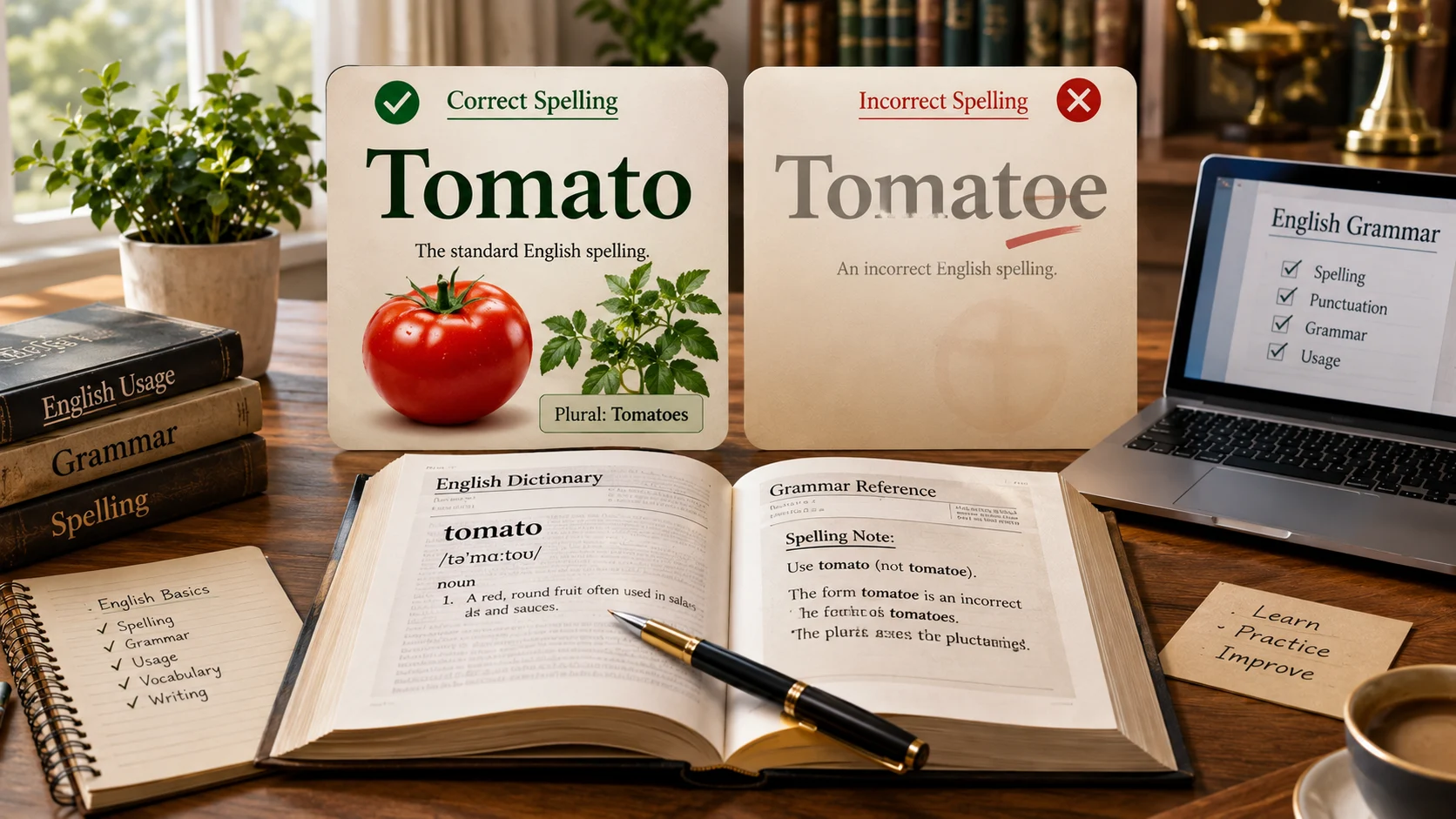
The correct spelling is tomato, while tomatoe is a misspelling in standard English. The word tomato refers to the edible fruit of the tomato plant and is used as a singular noun. Although tomatoe may look plausible because some English words form plurals with an added e, it is not accepted as the standard singular spelling in dictionaries or formal writing.
Have you ever wondered the correct spelling is tomato or tomatoe? Although both forms may look reasonable, only one is accepted in standard English. This common spelling confusion often occurs when writers try to apply familiar plural spelling patterns to singular nouns. You are writing a school assignment, preparing professional content, or improving your everyday English, knowing the correct form helps you communicate clearly and confidently.
The correct spelling is tomato, while tomatoe is a misspelling. According to standard English spelling conventions, tomato refers to the edible fruit commonly used in salads, sauces, and countless recipes. When referring to more than one, the correct plural is tomatoes, not tomatos. Understanding this simple distinction can help you avoid common writing mistakes and strengthen your vocabulary. In this guide, you will learn the meaning of tomato, why tomatoe is incorrect, and how to use the word correctly in everyday sentences.
Tomato or Tomatoe | What’s the Difference?
The difference is straightforward: tomato is the correct English spelling, while tomatoe is an incorrect spelling.
Tomato is a singular countable noun. It names the round or oval fruit produced by a tomato plant. You can use it in everyday conversation, academic writing, recipes, workplace communication, journalism, and technical material.
Tomatoe is not a standard alternative spelling of the word. It usually appears because writers mistakenly apply a spelling pattern from other English words. For example, words such as potato and echo can make an unfamiliar writer wonder tomato should also contain an additional letter in certain forms. However, the singular noun is simply tomato.
The correct spelling remains the same in both American English and British English. Unlike some spelling differences between varieties of English, this word does not have a standard American form and a separate British form.
Quick recap
Tomato is the correct singular spelling.
Tomatoe is a spelling error, not an accepted variant.
The correct plural is tomatoes.
The spelling is the same in American and British English.
Is Tomato or Tomatoe a Grammar, Vocabulary or Usage Issue?
This is primarily a spelling and vocabulary issue, rather than a grammatical distinction.
Grammar determines how a word functions within a sentence. For example, tomato can function as a noun and can appear as a subject, object, or complement. Spelling determines how that noun should be written.
Because tomatoe is not an accepted standard spelling, the two forms are not interchangeable. A writer should not choose tomatoe for informal writing while reserving tomato for formal writing. The distinction is not comparable to genuine differences such as color and colour or center and centre.
Consider these examples:
The tomato is ripe.
We bought several tomatoes.
Both sentences use standard English spelling.
A sentence such as:
The tomatoe is ripe.
contains a spelling mistake even though its grammar and meaning are understandable.
This distinction matters because spelling errors can reduce credibility. In academic assignments, professional documents, product descriptions, food labels, menus, recipes, and websites, a simple spelling mistake can make otherwise polished content appear less reliable.
Formal and informal usage
There is no standard situation in which tomatoe becomes preferable because the writing is casual. A text message, social media post, school essay, business report, scientific paper, and published article should all use tomato when the singular fruit is intended.
The only exception would be a deliberate reproduction of an error, such as when discussing spelling mistakes, quoting an original document, or analyzing a fictional character’s unusual writing.
How to Use Tomato Correctly
The singular noun tomato is used when you are referring to one fruit or to the concept of the fruit as a category.
For example:
I bought a tomato from the market.
This tomato tastes surprisingly sweet.
The recipe requires one tomato.
A tomato contains seeds surrounded by fleshy tissue.
The word can also appear after determiners such as a, the, this, that, each, and one.
The plural form is different:
I bought three tomatoes.
Notice that the plural adds es rather than simply adding s. This is one reason writers sometimes become confused about the singular spelling. They may incorrectly transfer the spelling pattern from the plural back to the singular.
Workplace example
Imagine a restaurant employee preparing an inventory report:
We received forty tomatoes this morning.
That sentence is clear and professional.
If the report refers to one item, the singular form is required:
One tomato was damaged during delivery.
Writing tomatoe in an inventory spreadsheet would be a spelling error and could make the document look less carefully prepared.
Academic example
In academic writing, the word may appear in research involving agriculture, nutrition, botany, food science, or horticulture.
For example:
The tomato is an important crop cultivated in many regions.
A student writing a research paper should use the standard spelling consistently. A spelling checker may identify tomatoe as an error, but writers should also understand the underlying rule rather than relying entirely on software.
Technology example
Technology provides another useful context. Search engines, recipe applications, grocery databases, nutrition platforms, and artificial intelligence systems commonly process tomato as a recognized English word.
For example, a recipe application might categorize ingredients under:
tomato
A search for tomatoe may still return useful results because modern search systems often recognize likely spelling errors. However, search engines correcting a mistake does not make the mistaken spelling correct.
Usage recap
Use tomato when referring to one fruit.
Use tomatoes when referring to more than one.
Use tomato in professional, academic, technical, and casual writing.
Do not replace tomato with tomatoe simply because the plural is tomatoes.
How to Use Tomatoes Correctly
The plural of tomato is tomatoes.
This is an important point because the plural form can make the singular spelling seem less intuitive. When tomato becomes plural, the word normally takes es:
one tomato
two tomatoes
one tomato plant
several tomato plants
The plural ending does not mean that tomatoe is a valid singular form.
Workplace example
A grocery manager might write:
The shipment contains five hundred tomatoes.
The noun is plural because the sentence refers to multiple fruits.
Academic example
A horticulture researcher could write:
Tomatoes are cultivated under a range of environmental conditions.
Again, tomatoes is correct because the sentence discusses the crop in the plural.
Technology example
A food database might contain entries such as tomato, tomatoes, tomato sauce, and tomato soup. These related terms do not change the spelling of the singular noun.
Usage recap
Tomatoes is the standard plural form.
Tomato is the standard singular form.
Tomatoe should not be used as the singular noun.
When You Should NOT Use Tomato or Tomatoe
There are several situations where writers make avoidable mistakes with these words.
- Do not write tomatoe when you mean one tomato.
- Do not assume that tomatoes proves that tomatoe is a correct singular form.
- Do not use tomatoe in academic papers simply because the writing is informal or conversational.
- Do not use tomatoe in professional documents, menus, reports, product descriptions, or business communication.
- Do not treat tomatoe as a British spelling of tomato because British English does not use it as the standard form.
- Do not create a false spelling distinction between American English and British English.
- Do not assume that an understandable spelling is automatically a dictionary accepted spelling.
- Do not copy tomatoe from an unedited website, social media post, or user generated recipe without checking the spelling.
A useful habit is to look at the complete word rather than trying to reconstruct its spelling from a similar word. English contains many spelling patterns, but individual words still need to be learned in their standard forms.
Common Mistakes and Decision Rules
Decision Rule Box
If you mean one fruit, use tomato. If you mean more than one, use tomatoes. Tomatoe is not the standard spelling.
This decision rule is more appropriate for this pair than a rule involving an action, person, or tool. Neither tomato nor tomatoe names an action, person, or tool.
Tomato and Tomatoe in Modern Technology and AI Tools
Modern technology has made spelling mistakes easier to detect, but it has also made some errors easier to overlook.
Search engines can often interpret tomatoe as an attempted spelling of tomato. Autocorrect systems may automatically replace the incorrect form. Grammar applications can flag it as a spelling problem. Artificial intelligence systems can usually identify tomatoe as a misspelling when asked to distinguish the two forms.
However, automatic correction should not replace language knowledge. Search engines are designed to understand user intent, not to certify every spelling as correct. A search result appearing for tomatoe does not mean that tomatoe is an accepted English spelling.
For writers producing educational content, product information, recipes, or professional material, the safest approach is to use the standard dictionary form from the beginning.
The Etymology of Tomato
The history of tomato helps explain why the word does not follow every spelling pattern that English learners might expect.
The English word tomato ultimately traces back through Spanish tomate to languages associated with Indigenous peoples of Mesoamerica. The word entered European languages after contact between Europe and the Americas and later became established in English.
English spelling has been influenced by many languages, historical pronunciation changes, regional conventions, and established word forms. As a result, it is not always possible to predict a word’s spelling simply by looking at another word with a similar ending.
The important practical point is that the modern English singular form is tomato, while the standard plural is tomatoes.
What Linguists Say About Spelling Accuracy
A useful principle in language education is that a familiar spelling pattern should never override the established spelling of an individual word.
That principle is especially valuable with words that look as though they should follow a different pattern. Writers often make errors not because they do not understand the meaning, but because they apply a reasonable sounding spelling rule to a word that does not follow it.
In professional editing, consistency and standard usage matter because readers often notice spelling mistakes immediately, even when they can understand the intended meaning.
Two Practical Case Studies
Case Study One: A Recipe Website
Imagine a recipe website publishing an ingredient list that repeatedly uses tomatoe instead of tomato.
The meaning remains understandable, but the error can affect perceived quality. Readers may question other ingredients, measurements, or instructions were checked carefully. Correcting the ingredient spelling to tomato improves editorial consistency and removes an unnecessary distraction.
The concrete result is a cleaner recipe that follows standard English spelling and presents a more professional appearance.
Case Study Two: A Student Research Paper
Consider a student writing a paper about tomato cultivation. The student correctly uses tomatoes in several sentences but repeatedly writes tomatoe when discussing a single fruit.
A teacher or editor can correct the pattern by explaining the singular and plural distinction:
tomato for one
tomatoes for more than one
The concrete result is not simply the correction of one spelling error. The student gains a reusable spelling rule that can prevent similar mistakes in future writing.
Error Prevention Checklist
Always use tomato when
- You mean one fruit.
- You are writing an academic paper.
- You are preparing professional content.
- You are writing a recipe or menu.
- You are describing the crop in the singular.
Never use tomatoe when
- You mean the standard English noun tomato.
- You are writing formal or published content.
- You are describing one fruit.
- You are creating educational material.
- You are using standard American or British English.
Related Grammar Confusions You Should Master
Understanding tomato and tomatoe is useful, but English contains many other spelling and usage pairs that can cause similar confusion.
- Potato or potatoe
- Tomatoes or tomatos
- Grammar or grammer
- Definitely or definately
- Separate or seperate
- Receive or recieve
- Their or there
- Its or it’s
- Affect or effect
- Your or you’re
These examples demonstrate an important lesson: English spelling is often based on established word forms rather than perfectly predictable rules.
FAQs
Is tomato or tomatoe correct?
Tomato is correct. Tomatoe is a misspelling and is not the standard singular form.
What is the correct spelling of tomato?
The correct spelling is tomato, with no e at the end.
Is tomatoe a real English word?
Tomatoe is not a standard English spelling for the fruit. It generally represents a spelling error.
What is the plural of tomato?
The standard plural is tomatoes. The singular is tomato.
Why do people spell tomato as tomatoe?
The mistake often occurs because writers transfer spelling patterns from other English words or from the plural tomatoes.
Is tomato spelled differently in British English?
No. Tomato is the standard spelling in both British English and American English.
Is tomatoe acceptable in informal writing?
No. Informal writing may contain errors, but tomatoe is still not the standard spelling.
Why does tomato become tomatoes?
The plural form normally takes es, producing tomatoes. This does not create tomatoe as a singular spelling.
Can autocorrect fix tomatoe automatically?
Many modern writing and search systems can recognize or correct the error, but writers should still learn the standard spelling.
Conclusion
The correct spelling is tomato, not tomatoe. The word is a singular noun referring to the fruit of the tomato plant, while tomatoes is the standard plural form. The confusion usually develops because the plural contains es, but that spelling pattern does not mean the singular should contain a final e.
you’re writing a recipe, school assignment, business document, research paper, website, or everyday message, choose tomato for one fruit and tomatoes for more than one. Once this singular and plural distinction becomes familiar, the spelling becomes easy to remember.
Discover More Related Articles:
- Color or Die | Roblox Game Guide, Gameplay, Tips & Survival Strategies In 2026
- True or Flase | Challenge Yourself with These Tricky Questions In 2026
- Weather or Keizer | One Describes the Sky, the Other a Choice In 2026