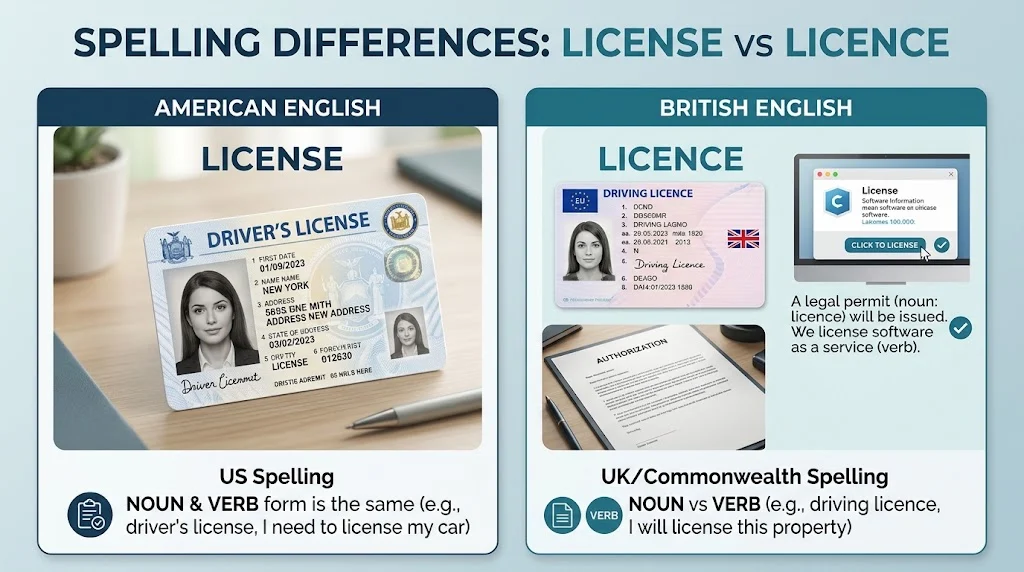
License or licence are two spellings of the same English word, but the correct choice depends mainly on the variety of English being used. American English uses license for both the noun and verb, while British English generally uses licence as a noun and license as a verb. Choosing the wrong form can create inconsistencies in academic, professional, legal, and international writing.
License or Licence | What Is the Difference?
The difference between license and licence is primarily regional spelling and grammatical usage. The words refer to official permission, authorization, or the document that grants permission to do something.
In American English, license is used as both a noun and a verb.
For example:
She has a valid driver’s license.
The state may license the company.
In British English, Australian English, and several other varieties influenced by British spelling, licence is normally used as a noun, while license is used as a verb.
For example:
She has a valid driving licence.
The authority may license the company.
This distinction is especially important because many writers assume that one spelling is simply correct and the other is incorrect. That isn’t the case. Both forms are legitimate, but your choice should match the English variety and style guide you are following.
| Feature | License | Licence |
|---|---|---|
| American English noun | Correct | Usually incorrect |
| American English verb | Correct | Incorrect |
| British English noun | Usually incorrect | Correct |
| British English verb | Correct | Incorrect |
| Meaning | Official permission or authorization | Official permission or authorization |
| Main difference | American spelling and British verb spelling | British noun spelling |
| Common example | Driver’s license | Driving licence |
Quick recap
License is the standard spelling in American English for both nouns and verbs.
Licence is mainly the British English noun spelling.
British English normally uses license as the verb.
The meaning remains essentially the same, so geography and grammatical function determine the preferred spelling.
Is License or Licence a Grammar, Vocabulary or Usage Issue?
The license or licence question is mainly a spelling and usage issue rather than a vocabulary problem. The two forms belong to the same word family and generally express the same concept.
Grammar becomes important when British English is involved because British usage traditionally distinguishes between the noun licence and the verb license.
Consider these examples:
The restaurant has a liquor licence.
Here, licence is a noun in British English.
The government will license the restaurant.
Here, license is a verb.
American English simplifies the spelling:
The restaurant has a liquor license.
The government will license the restaurant.
This means the choice is not simply about formal versus informal language. Both forms can appear in formal writing. Academic writing, legal documents, business communication, government publications, and everyday communication all follow the spelling conventions of the English variety being used.
Academic writing should therefore follow the required style guide. A British university may expect licence as a noun, while an American university will normally expect license.
The same principle applies to casual writing. A British speaker might write driving licence, while an American speaker would write driver’s license.
When to Use License in American English
American English uses license consistently for both the noun and verb. If your audience is primarily in the United States, this is usually the safest choice.
As a noun, license means official permission or an official document proving that permission.
Workplace example
Employees must have a valid professional license before providing regulated services.
Here, license is a noun referring to official authorization.
Academic example
Students must obtain a research license before accessing the restricted laboratory.
The spelling remains license because the sentence follows American English conventions.
Technology example
The company purchased a software license for every employee.
Technology companies frequently use license when discussing software permissions, subscriptions, and intellectual property.
The verb also uses the same spelling:
The agency will license the new provider next year.
Usage recap
Use license for both nouns and verbs when writing in American English. This applies to expressions such as driver’s license, business license, software license, professional license, licensed provider, and license a product.
When to Use Licence in British English
British English normally uses licence when the word functions as a noun. This spelling appears in official documents, newspapers, educational materials, business writing, and everyday British communication.
Workplace example
All engineers must hold a valid professional licence.
Here, licence is a noun describing official authorization.
Academic example
The university requires a research licence for certain controlled activities.
The spelling reflects British English conventions.
Technology example
The company renewed its software licence for another year.
British technology publications and organizations may use licence when referring to a software authorization as a noun.
However, British English normally changes back to license when the word becomes a verb:
The authority will license the company.
This noun and verb distinction is one of the most important details to remember.
Usage recap
Use licence as a noun in British English. Use license as a verb. If you are writing for a British audience, this distinction helps your writing look polished and consistent.
When You Should NOT Use License or Licence
The spelling mistake usually happens when writers switch between American and British conventions without noticing. Here are common situations where extra care is needed.
- Do not use licence as an American English noun. Write driver’s license, not driver’s licence.
- Do not use license as a British English noun when following traditional British spelling. Write driving licence, not driving license.
- Do not write licence as the standard British verb. The verb is license.
- Do not switch spelling systems within the same formal document unless there is a specific reason.
- Do not assume that British spelling is automatically more formal. Regional spelling and formality are separate issues.
- Do not change the spelling simply because a website uses another variety of English.
- Do not treat license and licence as words with different meanings. Their difference is primarily conventional spelling and grammatical usage.
- Do not rely on autocorrect without checking the intended English variety.
Common Mistakes and Decision Rules
| Correct sentence | Incorrect sentence | Explanation |
|---|---|---|
| She renewed her driver’s license. | She renewed her driver’s licence. | American English uses license as the noun. |
| She renewed her driving licence. | She renewed her driving license. | Traditional British English uses licence as the noun. |
| The agency will license the company. | The agency will licence the company. | License is the verb in both major varieties. |
| He needs a professional license. | He needs a professional licence. | License is preferred in American English. |
| He needs a professional licence. | He needs a professional license. | Licence is the British noun spelling. |
| The software license expires soon. | The software licence expires soon. | American technology writing normally uses license. |
| The software licence expires soon. | The software license expires soon. | British English commonly uses licence as a noun. |
Decision Rule Box
If you are writing American English: use license for both the noun and verb.
If you are writing British English: use licence for the noun and license for the verb.
The often suggested rule that says “use one spelling for an action and another for a person or tool” does not accurately describe this word pair. The useful distinction is regional English plus grammatical function.
License and Licence in Modern Technology and AI Tools
The distinction also appears frequently in software, artificial intelligence, cloud computing, and digital products.
American technology companies commonly write:
This software license permits commercial use.
British technology publications may write:
This software licence permits commercial use.
The verb remains license in both systems:
The company can license the technology to other businesses.
AI tools introduce another layer of terminology because software may be distributed under a particular license or licence depending on the publishing organization’s English conventions.
For international technical documentation, consistency matters more than choosing one variety as universally superior. A company targeting American users should normally use American spelling throughout its documentation. A British organization should follow its established British style.
Etymology of License and Licence
The history of the word helps explain why these spellings exist.
The English word comes from Latin licentia, meaning freedom, permission, or liberty. It entered English through French and developed into the concept of official permission or authorization.
Over time, English developed regional spelling conventions. American English generally favored license for both grammatical functions. British English retained a distinction between the noun licence and the verb license.
This is similar to other spelling patterns in British and American English, although the exact conventions differ from word to word.
An expert style principle can be summarized this way:
The best spelling is the one that matches your audience, grammatical function, and chosen style guide.
That principle is more useful than memorizing one spelling as universally correct.
Two Real World Case Studies
Case Study 1: Driving Documentation
Consider a company producing driving materials for users in the United States and the United Kingdom.
For American readers, the natural expression is driver’s license. For British readers, driving licence is the conventional expression.
The practical result is improved consistency and audience recognition. A document using the expected regional terminology feels more natural and avoids unnecessary spelling corrections.
Case Study 2: Software Documentation
Imagine a software company publishing documentation for an international audience.
Its American English documentation may state:
Your software license allows installation on three devices.
Its British English documentation may state:
Your software licence allows installation on three devices.
The underlying legal or technical permission has not changed. Only the spelling convention has changed.
The concrete result is terminology consistency across product pages, help documentation, contracts, and user interfaces. This is especially valuable for organizations that maintain separate regional versions of their content.
Error Prevention Checklist
Always use license when
- You are writing in American English.
- You are using the word as a noun in American English.
- You are using the word as a verb in either American or British English.
- You are writing expressions such as software license or business license for an American audience.
Never use licence when
- You are following standard American English.
- You are using the word as a verb.
- Your publication requires consistent American spelling.
Remember licence when
- You are writing British English and need the noun.
- You are referring to a driving licence, business licence, or professional licence for a British audience.
- Your organization’s style guide specifically requires British spelling.
Related Grammar Confusions You Should Master
Understanding license or licence becomes easier when you also understand other regional spelling differences. These common topics are worth mastering:
- Color or colour
- Center or centre
- Theater or theatre
- Organization or organisation
- Analyze or analyse
- Practice or practise
- Defense or defence
- Program or programme
- Traveler or traveller
- Realize or realise
One especially useful comparison is practice and practise because British English, unlike American English, uses different spellings for the noun and verb. That pattern can help learners understand why licence and license may also appear differently according to grammatical function.
FAQs
Is license or licence correct in English?
Both are correct, but the preferred spelling depends on the English variety. American English uses license for both noun and verb, while British English generally uses licence as a noun and license as a verb.
Is licence British or American spelling?
Licence is primarily the British English spelling used for the noun, while American English normally uses license for both the noun and verb.
Is license British or American spelling?
License is standard American spelling for both noun and verb. British English also uses license as the verb but generally uses licence as the noun.
What is the difference between license and licence?
The meaning is essentially the same. The main difference is regional spelling and, in British English, the distinction between the noun licence and verb license.
Is driving licence or driving license correct?
Driving licence is standard British English, while driver’s license is standard American English. The choice depends on your target audience and regional style.
Should I write software license or software licence?
Use software license for American English and software licence for British English when the term functions as a noun.
Is license a noun or a verb?
In American English, license can be both a noun and a verb. In British English, licence is normally the noun and license is the verb.
Why does British English use licence and license?
British English traditionally distinguishes the noun licence from the verb license, while American English generally uses license for both functions.
Which spelling should I use in academic writing?
Follow the English variety and style guide required by your institution. American academic writing normally uses license, while British academic writing generally uses licence as the noun.
Conclusion
The choice between license or licence is easier once you identify your English variety and the grammatical role of the word. American English uses license for both nouns and verbs. British English normally uses licence as a noun and license as a verb.
If you’re writing for an American audience, choose license consistently. If you’re writing for a British audience, remember the simple noun and verb distinction: licence for the noun and license for the verb. Most importantly, don’t mix regional spelling conventions within the same piece of professional or academic writing.
Discover More Related Articles:
- Brookings or Weather | A Complete Guide to Brookings Weather & Climate In 2026
- Cooly or Coolly | Correct Spelling, Meaning & Usage Explained In 2026
- Rancher or Tiller | One Works Livestock, the Other Works Soil In 2026