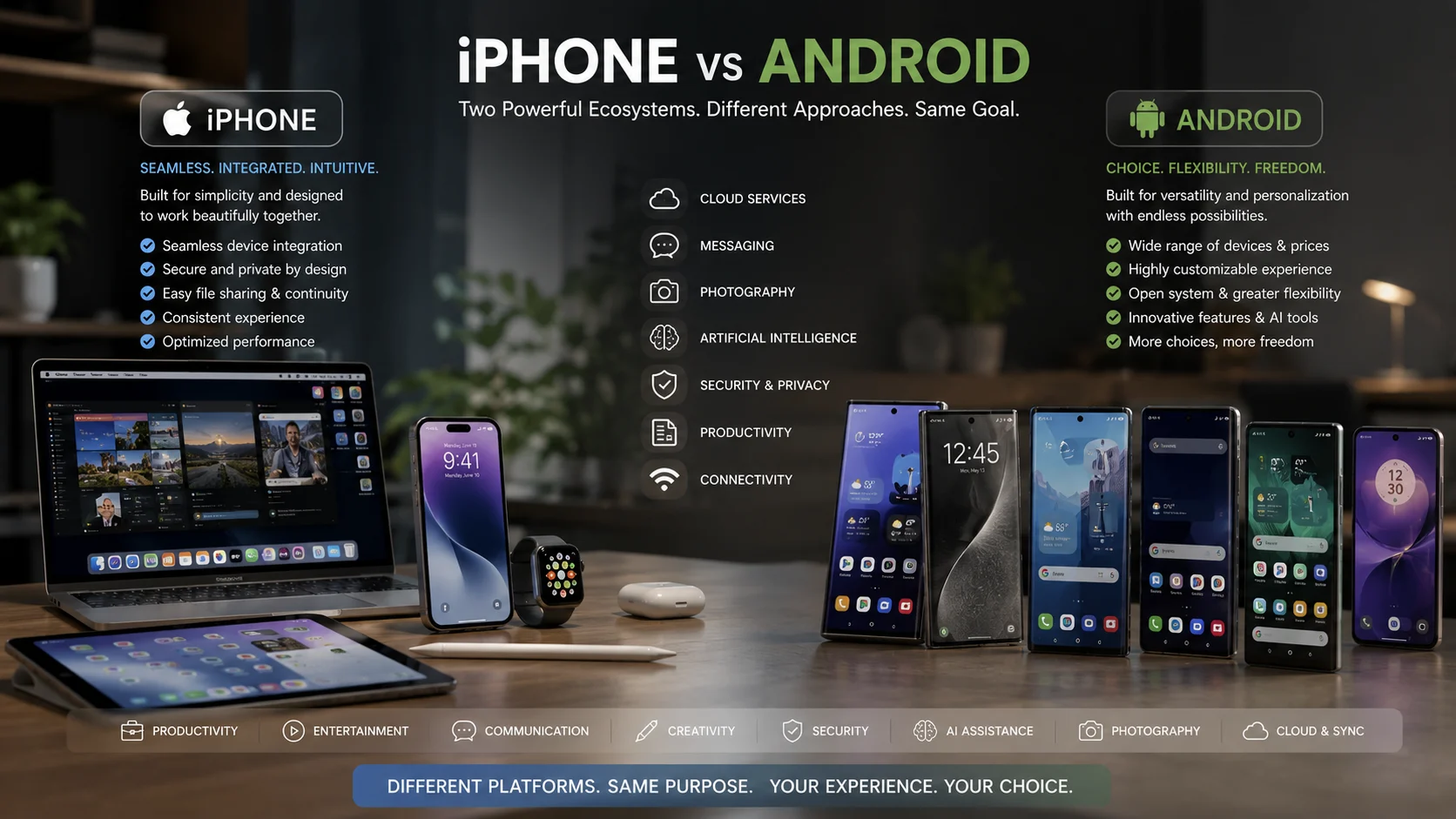
Apple or Android refers to the choice between Apple’s iPhone ecosystem and smartphones powered by Google’s Android operating system. Apple emphasizes a tightly integrated hardware and software experience, while Android offers greater device variety, customization, and price flexibility. The better choice depends on your priorities, existing devices, budget, and preferred level of control.
Choosing between Apple and Android can seem simple until you start comparing actual features. The difference isn’t just about the logo on the back of a phone. It affects how you share files, install apps, connect to computers, customize your home screen, protect personal information, and move between devices.
For someone already using a Mac, iPad, or Apple Watch, an iPhone may provide a particularly smooth experience. Someone who values customization, hardware variety, expandable choices, or a wider range of prices may prefer Android.
This guide explains the differences clearly so you can make an informed decision instead of choosing based on brand loyalty alone.
apple or android: What’s the Difference?
Apple and Android are not exactly the same type of thing. Apple is a technology company that designs iPhones and develops the operating systems and services used throughout its ecosystem. Android is a mobile operating system developed by Google and used by many smartphone manufacturers.
This distinction matters. When people say they are choosing between Apple and Android, they are usually comparing an iPhone with an Android smartphone.
| Feature | Apple iPhone | Android Smartphone |
|---|---|---|
| Operating system | iOS | Android |
| Device manufacturers | Apple | Many manufacturers |
| Hardware variety | More controlled selection | Very broad selection |
| Customization | Moderate | Generally extensive |
| Price range | Generally concentrated in premium and upper mid range models | Ranges from affordable to premium |
| Computer integration | Especially strong with Mac | Strong integration with Windows and Google services |
| App ecosystem | Apple App Store | Google Play and manufacturer specific options |
| Device choice | Limited to Apple products | Many brands and models |
| Personalization | Controlled and consistent | Highly flexible across many devices |
The simplest way to understand the difference is this:
Apple gives you a highly controlled ecosystem where hardware and software are designed to work together.
Android gives you a flexible platform available across many manufacturers and device categories.
Neither approach is automatically better. The right option depends on how you actually use your phone.
Is apple or android a Technology, Vocabulary, or Usage Issue?
The phrase is primarily a technology comparison, not a grammar issue. People often use Apple and Android as shorthand for two different smartphone ecosystems.
They are also not interchangeable terms. An iPhone runs iOS, while Android phones run Android. Saying that an iPhone is an Android phone would be technically incorrect.
The confusion usually happens because Apple controls both its smartphone hardware and its mobile operating system, while Android is an operating system used by companies such as Samsung, Google, Motorola, OnePlus, and others.
In casual conversation, someone might say, “I have an Apple,” when they mean an iPhone. Similarly, someone might say, “I have a Google,” when they actually mean a Google Pixel phone. These expressions are understandable, but they aren’t technically precise.
In professional, academic, or technology writing, it is better to distinguish between the company, device, and operating system.
For example, say:
“She uses an iPhone running iOS.”
“He uses a Samsung phone running Android.”
That wording makes the comparison immediately clear.
When Apple Is the Better Choice
Apple is often the stronger choice for people who value simplicity, consistency, long software support, and integration between devices.
The biggest advantage appears when several Apple products are used together. Apple’s Continuity features allow compatible Macs, iPhones, iPads, and Apple Watches to work together in ways that reduce repetitive tasks. Handoff can allow a task started on one device to continue on another, while Universal Clipboard can help move copied content between Apple devices.
Workplace example
Imagine that you receive a message on your iPhone while working on a Mac. You can continue working across devices without constantly emailing files to yourself or manually transferring information.
For a professional who spends the day moving between an iPhone and Mac, this can reduce friction.
Apple also provides features such as iPhone Mirroring, phone calls on Mac, message access, and Continuity Camera. These features are designed around the idea that your devices should behave like parts of one connected system.
Academic example
A university student who takes notes on an iPad, photographs documents with an iPhone, and writes assignments on a Mac can benefit from the same ecosystem.
Instead of thinking about each device separately, the student can treat them as connected tools.
Technology example
Apple’s Handoff feature is a good example. A user can begin an email on an iPhone and continue it on a Mac when supported devices and settings are in place. Apple also supports AirDrop for transferring photos, documents, videos, and other content between compatible devices.
Apple usage recap
Choose Apple when ecosystem integration matters more than hardware variety.
Choose an iPhone when you already rely heavily on Macs, iPads, or Apple Watches.
Apple is especially appealing if you prefer a controlled and consistent user experience.
When Android Is the Better Choice
Android is often the better choice for people who want more hardware options, customization, price flexibility, and freedom to choose between manufacturers.
Unlike Apple’s iPhone model, Android appears across a large range of smartphones. Google describes Android as a platform built around diversity and choice, allowing manufacturers to tailor the operating system to their hardware and customers.
Workplace example
Consider a business buying smartphones for employees with different budgets and requirements.
With Android, the company can select different models based on price, screen size, battery capacity, camera requirements, durability, and other specifications.
That flexibility can be useful when one phone model isn’t appropriate for every employee.
Academic example
A student with a limited budget may want a capable smartphone without paying for a premium flagship. Android provides devices across a much wider range of prices, making it easier to match a phone to a specific budget.
A student who prefers a particular display size, camera arrangement, battery capacity, or manufacturer can also shop among many models.
Technology example
Customization is one of Android’s defining strengths. Depending on the manufacturer and software version, users can personalize elements of the interface, widgets, home screen, icons, default applications, and other settings.
Google’s current Android documentation also highlights customization, device diversity, Google Play, and cross device connectivity as important parts of the platform.
Android usage recap
Choose Android when flexibility and device choice are major priorities.
Android is particularly attractive if you want to compare many manufacturers and price levels.
It can also be a better fit if you enjoy adjusting your phone to suit your personal workflow.
Apple vs Android for Camera Quality
Camera quality is no longer a simple question of megapixels.
Both ecosystems include phones with excellent cameras, but the experience varies significantly by model. Premium iPhones are known for strong video capabilities, consistent processing, and integration with Apple’s broader ecosystem.
Android is more diverse. A premium Samsung, Google Pixel, or another high end Android phone can offer sophisticated photography features, while less expensive Android phones may provide more basic camera systems.
Therefore, saying that Apple always has the better camera or Android always has the better camera is too simplistic.
The sensible approach is to compare the exact models you are considering.
If photography and video are important, evaluate image processing, low light performance, stabilization, portrait quality, video recording, zoom performance, and editing tools rather than relying on brand reputation.
Apple vs Android for Privacy and Security
Security is another area where broad claims can be misleading.
Apple has a tightly controlled hardware and software ecosystem. This gives the company significant control over how devices, operating systems, and services interact.
Android uses a broader ecosystem involving Google and multiple manufacturers. Google continues to develop security features and protections for Android, while individual manufacturers can influence the update experience.
The practical question isn’t simply Apple or Android is more secure.
The better question is the specific phone receives regular security updates, the manufacturer has a strong update policy, the user installs applications carefully, and important security settings are enabled.
A well maintained modern smartphone can be significantly safer than an outdated device, regardless of the logo.
Apple vs Android for Customization
This is one of the clearest differences.
Apple generally favors consistency and controlled design. Android generally gives users and manufacturers more freedom to change the experience.
Android’s ecosystem allows manufacturers to customize the platform, creating differences between devices while retaining a shared Android foundation.
That can be useful for people who enjoy experimenting with launchers, widgets, default applications, visual layouts, and other settings.
Apple is often better for users who don’t want to spend much time adjusting their phone.
Android is often better for users who see customization as part of the smartphone experience.
When You Should NOT Use Apple or Android as Your Only Decision Rule
Brand alone isn’t a reliable buying strategy.
There are several situations where choosing purely by ecosystem name can lead to a poor purchase.
| Situation | Better approach |
|---|---|
| You already own several devices | Consider compatibility with your existing ecosystem |
| Your budget is limited | Compare specific models rather than brands |
| You care strongly about photography | Compare camera systems on exact models |
| You need a long battery life | Compare battery testing and real usage results |
| You need specific professional applications | Check application availability before purchasing |
| You want extensive customization | Examine the exact Android or iOS features available |
| You frequently change computers | Consider Windows, Mac, and Google service compatibility |
| You keep phones for many years | Check the manufacturer’s software support policy |
The important lesson is simple: compare the phone you will actually buy, not an imaginary average Android phone against an imaginary average iPhone.
Common Apple and Android Mistakes
| Correct statement | Incorrect statement | Explanation |
|---|---|---|
| An iPhone runs iOS. | An iPhone runs Android. | iPhones use Apple’s mobile operating system. |
| Android is used by many manufacturers. | Android is a phone brand. | Android is an operating system and platform. |
| Samsung makes Android phones. | Samsung makes Android itself. | Samsung is a manufacturer that uses Android on many devices. |
| Apple controls iPhone hardware and software. | Apple makes every Android phone. | Apple’s smartphone business centers on iPhone hardware and its software ecosystem. |
| Android offers many device choices. | Every Android phone works exactly the same. | Manufacturers can customize Android in different ways. |
Decision Rule
If your priority is a tightly integrated ecosystem, choose Apple.
If your priority is device variety, customization, and price flexibility, consider Android.
If you already own a Mac, iPad, or Apple Watch, the ecosystem advantage may be especially important. If you want to compare phones from multiple manufacturers and price categories, Android deserves serious consideration.
apple or android in Modern Technology and AI Tools
Artificial intelligence is becoming a larger part of the smartphone experience, but AI alone doesn’t make one platform automatically superior.
Both ecosystems increasingly incorporate intelligent features into areas such as photography, writing assistance, search, notifications, accessibility, translation, and personal productivity.
Android’s diversity also means AI features can vary between manufacturers and models. Google’s current Android materials highlight AI powered notification features and continued personalization improvements in Android 16.
Apple similarly integrates intelligence and automation into its broader hardware and software ecosystem.
The important point for buyers is to evaluate the AI features available on the specific phone model and software version rather than assuming every Apple or Android device has identical capabilities.
Which Is Better for Students?
For students, the answer depends heavily on existing devices and budget.
An iPhone can make sense for someone already using a Mac or iPad because communication, file sharing, and device continuity can become easier.
Android may be more attractive to students who want a wider selection of affordable phones or more control over customization.
A sensible student buying decision should consider total cost, battery life, storage, camera quality, application requirements, repair options, software support, and compatibility with computers.
The cheapest phone isn’t always the best value, and the most expensive phone isn’t automatically the best choice.
Which Is Better for Work?
For professional use, ecosystem compatibility often matters more than small differences in specifications.
An employee using a Mac every day may benefit from Apple’s Continuity features. Apple specifically supports workflows involving Handoff, AirDrop, Universal Clipboard, iPhone Mirroring, phone calls, messages, and other cross device functions.
A professional working primarily with Google services or Windows hardware may find Android equally practical or more flexible.
For business purchasing, Android can also provide a broader range of hardware options, which may help organizations match devices to different employee roles.
Two Practical Case Studies
Case Study One: The Mac Based Professional
Consider a designer who uses a MacBook, iPad, and smartphone throughout the workday.
The designer receives a message on the phone, photographs a physical document, moves the image to the computer, and continues writing a report on another Apple device.
With Apple’s Continuity features, several of these activities can happen across devices without treating each product as a completely separate system. Apple documents Handoff, AirDrop, Universal Clipboard, Continuity Camera, iPhone Mirroring, and related features as parts of this connected experience.
Result: the strongest advantage isn’t a single specification. It is the reduction of friction across multiple devices.
Case Study Two: The Budget Conscious Buyer
Now consider a student who needs a smartphone but wants to spend carefully.
Instead of choosing one manufacturer, the student can compare Android devices from several manufacturers based on battery, camera, screen, storage, performance, and price.
Google describes Android as an ecosystem built around device diversity and manufacturer choice.
Result: the buyer gains more opportunities to match the phone’s specifications and price to personal requirements.
These examples show why the best answer isn’t universal. The winning platform changes according to the user’s ecosystem and priorities.
The History Behind Apple and Android
Apple introduced the first iPhone in 2007, combining a touchscreen interface with mobile computing, communication, media, and internet capabilities in a single product.
Android emerged as a mobile operating system that could be adopted by multiple hardware manufacturers. That approach helped create a much broader smartphone ecosystem.
Over time, the two platforms developed different philosophies.
Apple built a tightly controlled ecosystem around its own hardware.
Android developed around a wider collection of manufacturers and devices.
Those origins still influence the differences users experience today.
Expert Perspective
A useful technology principle is:
The best smartphone is not necessarily the one with the highest specification. It is the one that creates the least friction in the way you actually live and work.
That principle explains why two people can compare the same phones and reach completely different conclusions.
Someone deeply invested in Apple devices may value integration above customization. Another person may consider device choice and price more important.
Error Prevention Checklist
☐ Always compare the exact phone model before buying.
☐ Always consider the computers and tablets you already use.
☐ Always check software support when keeping a phone for several years.
☐ Always compare battery, camera, display, storage, and performance according to your own needs.
☐ Never assume every Android phone provides the same experience.
☐ Never assume every iPhone is automatically better for every user.
☐ Never choose solely because friends or family prefer one platform.
☐ Never judge value from specifications alone.
Related Technology Comparisons You Should Master
Understanding Apple and Android becomes easier when you also understand several related technology comparisons.
iOS vs Android: compares the operating systems directly.
iPhone vs Samsung: compares Apple’s smartphone with one of Android’s largest manufacturers.
iPhone vs Google Pixel: useful for comparing Apple’s ecosystem with Google’s hardware and software approach.
Mac vs Windows: important when choosing a phone that must work with your computer.
iCloud vs Google Drive: compares two major cloud storage ecosystems.
AirDrop vs Google sharing tools: useful when transferring files between devices.
Apple Watch vs Android compatible watches: important for users who want wearable integration.
App Store vs Google Play: compares the major mobile application ecosystems.
Apple ecosystem vs Google ecosystem: useful when deciding which platform fits your broader digital life.
FAQs
Is Apple or Android better for most people?
The answer depends on your priorities. Apple is strong for ecosystem integration and consistency, while Android offers broader device choice, customization, and price flexibility.
Is an iPhone an Android phone?
No. An iPhone is Apple’s smartphone, and it runs iOS rather than Android.
Why do people prefer Apple over Android?
Many users prefer Apple’s consistent interface, device integration, software ecosystem, and convenient connection between products such as iPhone, Mac, and iPad.
Why do people prefer Android over Apple?
Android attracts users who want more manufacturers, more price choices, greater customization, and more freedom when selecting hardware.
Is Android more customizable than iPhone?
Generally, yes. Android provides broader customization options across many devices, although iPhone customization has also expanded considerably.
Which is better for students, Apple or Android?
Either can work well. Students using Macs and iPads may benefit from Apple integration, while budget conscious students may appreciate Android’s wider range of devices.
Which is better for business, Apple or Android?
It depends on the company’s existing technology. Apple can be attractive for Mac based workplaces, while Android can provide greater hardware choice for organizations.
Which is safer, Apple or Android?
Both platforms include substantial security protections. The specific device, software support, update policy, application behavior, and user settings matter greatly.
Should I switch from Android to iPhone?
Switch if Apple’s ecosystem, interface, applications, or device integration better match your needs. Don’t switch solely because one brand is considered more popular.
Should I switch from iPhone to Android?
Android can be worth considering if you want greater customization, more hardware choices, different manufacturers, or a different price range.
Conclusion
There is no single winner for every smartphone user.
Apple is usually the stronger choice for people who value simplicity, consistency, premium hardware, and seamless integration with other Apple products. Its Continuity system is particularly compelling for people who already use a Mac, iPad, or Apple Watch.
Android is usually the stronger choice for people who value flexibility, customization, hardware variety, and a broad range of prices. Its multi manufacturer ecosystem gives buyers more ways to find a device that matches their exact needs.
So, which should you choose?
If your digital life already revolves around Apple products and you want everything to work together with minimal effort, an iPhone is likely the better fit.
If you want more freedom to choose your hardware, customize your experience, and compare phones across manufacturers and budgets, Android may be the smarter choice.
The best smartphone isn’t the one that wins a brand argument. It’s the one that fits your budget, workflow, devices, applications, and daily habits.
Discover More Related Articles:
- Maui or Kauai | Which Hawaiian Island Is Right for You In 2026
- Play or Draw | What Happens When a Game Ends Even In 2026
- Dinner or Diner | One Means a Meal, the Other Is a Restaurant In 2026