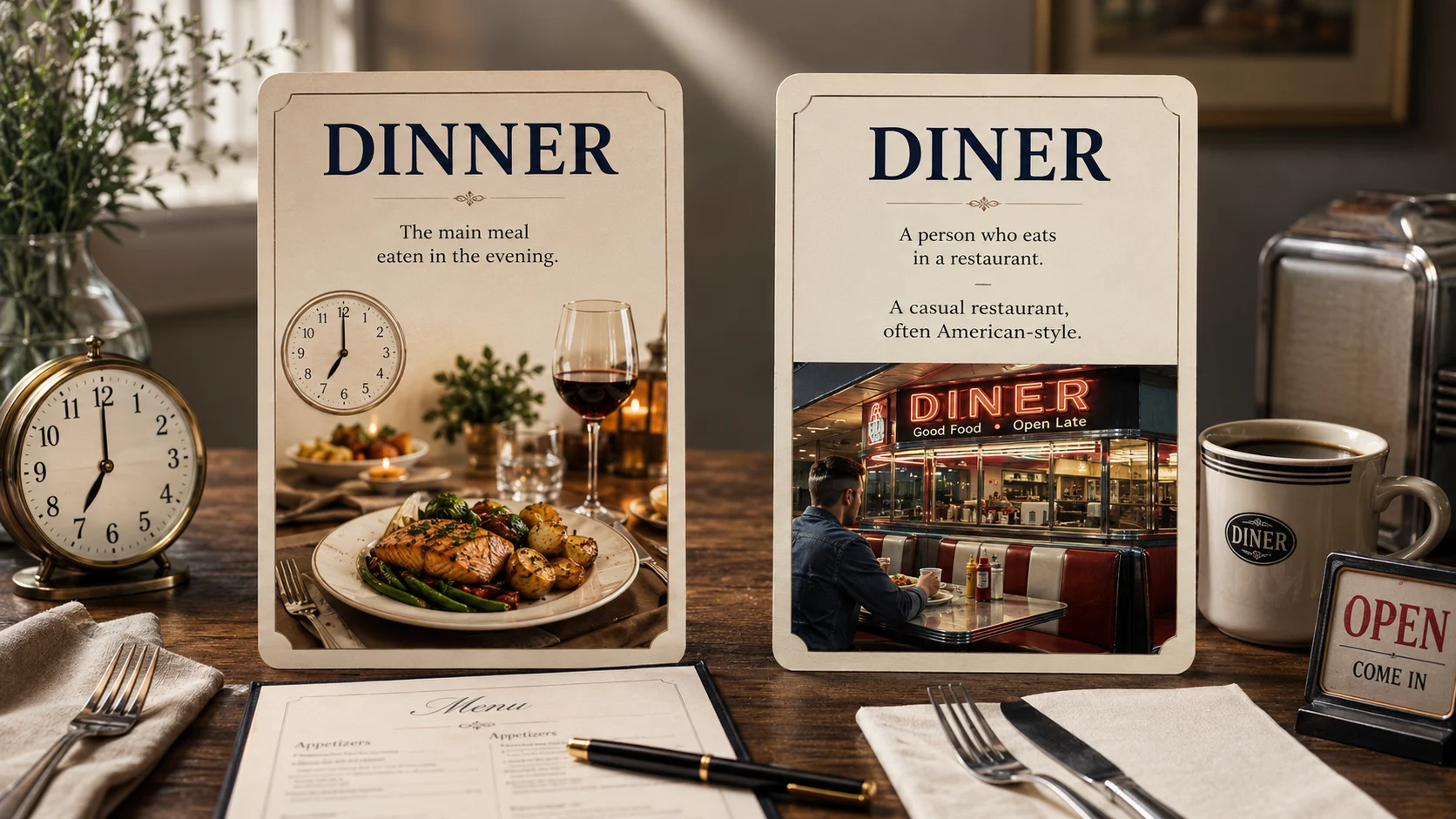
Dinner means the main meal of the day, while diner can mean a person who is eating or a casual restaurant that serves meals. These words sound similar but have different meanings and grammatical roles. Confusing them can lead to incorrect spelling and awkward sentences, especially when discussing meals, restaurants, or people eating.
Have you ever confused dinner or diner while writing about food, restaurants, or evening plans? Although these two words differ by just one letter, they have completely different meanings. Dinner refers to a main meal, usually eaten in the evening, while a diner is a person who eats a meal or, more commonly in American English, a casual restaurant serving meals throughout the day.
Understanding this small but important difference can help you avoid spelling mistakes and communicate your ideas clearly. you are writing a restaurant review, planning a dinner invitation, or creating food-related content, choosing the correct word matters.
In this guide, we’ll explore dinner vs. diner, explain their meanings and grammatical roles, and provide simple examples to show how each word works in everyday English. You’ll also discover common mistakes to avoid and practical tips for remembering the difference. By the end, you’ll know exactly when to use dinner and when diner is the right choice.
Dinner or Diner | What’s the Difference?
The simplest way to remember the distinction is to focus on meaning. Dinner refers to a meal, usually the main evening meal. Diner has two common meanings. It can describe a person who is eating a meal, or it can refer to a type of casual restaurant, especially in American English.
Although the words differ by only one letter, they belong to different vocabulary categories.
Dinner is a noun. It names a meal or an occasion centered around a meal.
Example:
We are having dinner at eight tonight.
Here, dinner refers to the meal itself.
Diner is also a noun, but its meaning depends on context. When it refers to a person, it means someone who is eating.
Example:
Every diner received a menu when they arrived.
In American English, diner can also mean a casual restaurant, often associated with a relaxed atmosphere, counter seating, booths, breakfast food, sandwiches, and traditional comfort food.
Example:
We stopped at a diner for breakfast.
The following comparison makes the distinction clearer.
| Word | Part of Speech | Primary Meaning | Example |
|---|---|---|---|
| dinner | Noun | A meal, usually the main meal of the day | We had dinner with our friends. |
| diner | Noun | A person eating a meal, or a casual restaurant | The diner ordered soup. |
The difference is therefore about meaning, not pronunciation alone.
Use dinner when you mean the meal.
Use diner when you mean a person who is eating or a casual restaurant.
Once you connect dinner with the meal and diner with the person or restaurant, the spelling becomes much easier to remember.
Is Dinner or Diner a Grammar, Vocabulary or Usage Issue?
The confusion between dinner and diner is primarily a vocabulary and usage issue rather than a complicated grammar rule. Both words are nouns, and both can appear naturally in similar sentences. The problem occurs when a writer selects the wrong noun for the intended meaning.
They are not interchangeable.
If someone says, “I am going to dinner,” the word dinner describes the meal or the occasion involving a meal. Replacing it with diner changes the meaning entirely.
“I am going to the diner” usually means that the speaker is going to a restaurant.
Similarly, “The diner ordered pasta” normally refers to a person who ordered pasta. It does not mean that the person ordered dinner.
This distinction matters in both formal and casual writing. In everyday conversation, listeners may understand what you intended from context. In professional emails, academic writing, menus, articles, and published content, however, precise word choice is important.
The words can also appear in different grammatical constructions.
Consider these examples:
Dinner was served at seven.
The diner asked for another glass of water.
We ate dinner at a local restaurant.
The diner was crowded after midnight.
The surrounding words usually make the intended meaning obvious.
How to Use Dinner Correctly
Dinner describes a meal. In many English speaking communities, it commonly refers to the evening meal, although its exact timing and importance can vary by region, family, culture, and personal routine.
You can use dinner when talking about eating, preparing food, arranging a meal, inviting someone to a meal, or describing a social occasion.
Workplace example
The company organized a dinner for the visiting executives.
Here, dinner describes the meal or social event.
Another example is:
We discussed the project during dinner.
The word does not describe a person or building. It identifies the meal during which the discussion took place.
Academic example
The researchers recorded what participants ate at dinner.
Dinner identifies the meal being studied. In academic writing, this use is straightforward because the word refers to a specific eating occasion.
You might also write:
Participants were asked to describe their typical dinner habits.
Again, dinner is the meal.
Technology example
Technology can also involve dinner naturally. For example:
The food delivery application estimated that our dinner would arrive in thirty minutes.
Here, dinner refers to the food or meal being delivered.
A restaurant application might also display:
Dinner reservation confirmed for 8:00 p.m.
The meaning remains the same. Dinner identifies the meal or dining occasion.
Usage recap: Use dinner when you mean a meal, especially the main meal of the day or an evening meal. It can describe the food, the eating occasion, or an event centered around eating.
How to Use Diner Correctly
Diner has two important meanings, and context determines which one applies.
The first meaning is a person who is eating.
The diner asked the waiter for the bill.
Here, diner means a customer who is eating at a restaurant.
The second meaning is a restaurant, especially a casual restaurant traditionally associated with American dining culture.
We found a small diner outside the city.
In this sentence, diner refers to the establishment rather than a customer.
Workplace example
Each diner received a feedback form after the meal.
In this context, diner means each person who ate.
A restaurant manager might say:
The diner complained about the waiting time.
The word identifies the customer.
Academic example
The study examined how diners respond to menu descriptions.
Here, diners means people who eat at restaurants. The word is particularly useful in research about consumer behavior, restaurant experiences, food choices, or hospitality.
Technology example
Modern restaurant technology frequently uses diner to describe customers.
For example:
The application allows diners to leave reviews after visiting a restaurant.
Here, diners clearly means restaurant customers.
A reservation platform may also use phrases such as “diner preferences,” “diner reviews,” or “diner feedback.” These expressions refer to people using restaurant services.
Usage recap: Use diner when you mean a person who eats or a casual restaurant. Context tells the reader which meaning is intended.
When You Should NOT Use Dinner or Diner
There are several common situations where choosing the wrong word can change the meaning of a sentence.
- Do not use diner when you simply mean an evening meal. Write “We had dinner at seven,” not “We had diner at seven.”
- Do not use dinner when you mean a restaurant. Write “We ate at a diner,” when you are describing a casual restaurant.
- Do not use dinner to identify a person eating. Write “The diner ordered coffee,” when the subject is the customer.
- Do not use diner to name a meal. A diner is not a meal.
- Do not assume every use of diner means a restaurant. It can also refer to the person eating.
- Do not treat dinner and diner as alternative spellings. They are separate words with different meanings.
- Do not choose the word only because it sounds similar to the word you intended. Check what the noun actually represents.
- Do not rely entirely on pronunciation when proofreading. The spelling difference reflects a genuine difference in meaning.
Common Mistakes and Decision Rules
The most frequent mistakes happen when writers type quickly and accidentally replace dinner with diner. Because the two words look and sound similar, spellcheck may not always identify the problem. Both are legitimate English words, so automated correction can miss the intended meaning.
Decision Rule Box
If you mean the meal, use dinner.
If you mean a person who is eating, use diner.
If you mean a casual restaurant, use diner.
This rule is more accurate than treating the distinction as simply a spelling difference. The key question is what you are naming.
Are you naming a meal? Choose dinner.
Are you naming the person eating? Choose diner.
Are you naming the restaurant? Choose diner.
Dinner or Diner in Modern Technology and AI Tools
Digital tools have made precise word choice more important, not less. Search engines, writing assistants, translation systems, grammar checkers, restaurant applications, and AI tools frequently process sentences according to context.
Consider the sentence:
Find a diner near me.
A technology system is likely to interpret diner as a restaurant.
Now compare:
Find dinner near me.
That sentence is more likely to be interpreted as a request for food or a meal.
The distinction becomes especially important in conversational AI. A user might ask an assistant to “book dinner,” which refers to a meal reservation, while “find a diner” can refer to finding a restaurant.
AI systems can usually use surrounding context to distinguish the words, but human writers should still choose the precise term. Good writing does not depend on software understanding an obvious typo.
This is also important for search engine optimization. A page targeting restaurant terminology should understand words such as restaurant, diner, dining, customer, meal, menu, reservation, and food service as related concepts. A page about the evening meal may instead focus on dinner, supper, meal planning, recipes, dining, and evening meals.
Etymology and Word History
The history of these words helps explain why they look so similar.
Dinner developed through French and earlier Germanic language influences and has been used in English for centuries to describe an important meal. Its meaning and timing have changed somewhat across different periods and regions.
Diner has a different formation. In the sense of a person eating, it is connected to the verb dine, with the ending indicating a person associated with an action. In American English, diner later became strongly associated with the distinctive casual restaurant tradition that developed in the United States.
This explains why diner can refer both to a person and to a restaurant. The person meaning connects naturally to dining, while the restaurant meaning developed through American cultural usage.
An Expert Style Explanation
A useful linguistics principle is this: When two similar sounding words perform different semantic jobs, context should determine the word rather than pronunciation.
That principle applies especially well here. Dinner identifies the eating occasion, while diner identifies either the participant in that occasion or a place where the occasion takes place.
Case Study 1: Restaurant Writing
Imagine a restaurant website publishing the sentence:
Every dinner can leave a review.
The intended meaning is probably that every customer can leave a review. The correct word is:
Every diner can leave a review.
Changing one letter makes the sentence semantically precise.
Case Study 2: Event Invitations
Now consider an invitation that says:
You are invited to our annual diner.
Readers may wonder the event is a restaurant, a customer, or an incorrectly spelled meal.
The intended wording is:
You are invited to our annual dinner.
The correction immediately establishes that the event involves a meal.
These examples demonstrate why proofreading similar words is more than checking spelling. Writers need to check meaning.
Author expertise: Written from a professional language and SEO perspective, with emphasis on practical English usage, semantic clarity, search intent, and reader friendly explanations.
Error Prevention Checklist
Use the following quick check before publishing or sending a sentence containing either word.
Always use dinner when
You mean a meal.
You mean an evening meal.
You mean a formal or informal meal event.
You are discussing dinner recipes, dinner plans, or a dinner invitation.
Never use diner when
You are simply naming the meal.
You are describing food as a meal.
You are talking about being invited to a meal.
You are discussing the time at which the meal takes place.
Always use diner when
You mean a person who is eating.
You mean a customer at a restaurant.
You mean a casual restaurant, particularly in American English.
This simple semantic check can prevent most errors.
Related Grammar Confusions You Should Master
Learning dinner versus diner becomes easier when you develop the same habit with other commonly confused words.
- Desert and dessert: One usually refers to a dry region, while the other refers to a sweet course.
- Advice and advise: One is a noun, while the other is a verb.
- Compliment and complement: One relates to praise, while the other describes something that completes or enhances something else.
- Affect and effect: These words have different grammatical functions and meanings in many common contexts.
- Principal and principle: One can refer to a person or something primary, while the other refers to a rule or belief.
- Stationary and stationery: One relates to remaining still, while the other refers to writing materials.
- Than and then: One is commonly used for comparison, while the other usually relates to time or sequence.
- Their, there, and they’re: These words sound alike but perform different grammatical roles.
- Your and you’re: One expresses possession, while the other is a contraction meaning you are.
- Accept and except: One commonly means to receive or agree to something, while the other means excluding something.
The broader lesson is consistent: similar sounds do not guarantee similar meanings.
FAQs
What is the difference between dinner and diner?
Dinner means a meal, usually the main meal of the day, while diner can mean a person eating or a casual restaurant.
Is diner the correct spelling for a meal?
No. The correct spelling for the meal is dinner. Diner has a different meaning and refers to an eating person or a casual restaurant.
Does diner mean a restaurant?
Yes. In American English, diner commonly refers to a casual restaurant, often serving traditional and informal meals.
Does diner also mean a person?
Yes. A diner can mean a person who is eating, especially a customer at a restaurant.
Should I say I am going to dinner or diner?
Say “I am going to dinner” when you mean a meal. Say “I am going to the diner” when you mean a restaurant.
Is dinner a noun or a verb?
Dinner is primarily a noun in modern standard English when it refers to a meal or eating occasion.
Why do dinner and diner sound so similar?
They share related historical and linguistic connections with dining, but they developed different meanings and spellings in modern English.
Which word should I use for a restaurant customer?
Use diner when you mean a person who is eating or has eaten at a restaurant.
Conclusion
The distinction between dinner or diner becomes straightforward once you focus on meaning. Dinner is the meal or eating occasion, while diner can mean the person eating or a casual restaurant. Although the words are visually and phonetically similar, they cannot normally replace one another.
When proofreading, ask one simple question: What am I naming?
If you are naming the meal, choose dinner.
If you are naming the person eating, choose diner.
If you are naming a casual restaurant, choose diner.
That small distinction is enough to eliminate most spelling and usage mistakes. It also makes your writing clearer for readers, search engines, grammar tools, and AI systems.
Discover More Related Articles:
- Studder or Stutter | The Easy Way to Remember the Correct Spelling In 2026
- Blankie or Blanky | The Word You’ve Been Spelling Wrong In 2026
- Cced or CC’d | Which Form Belongs in Professional Emails In 2026