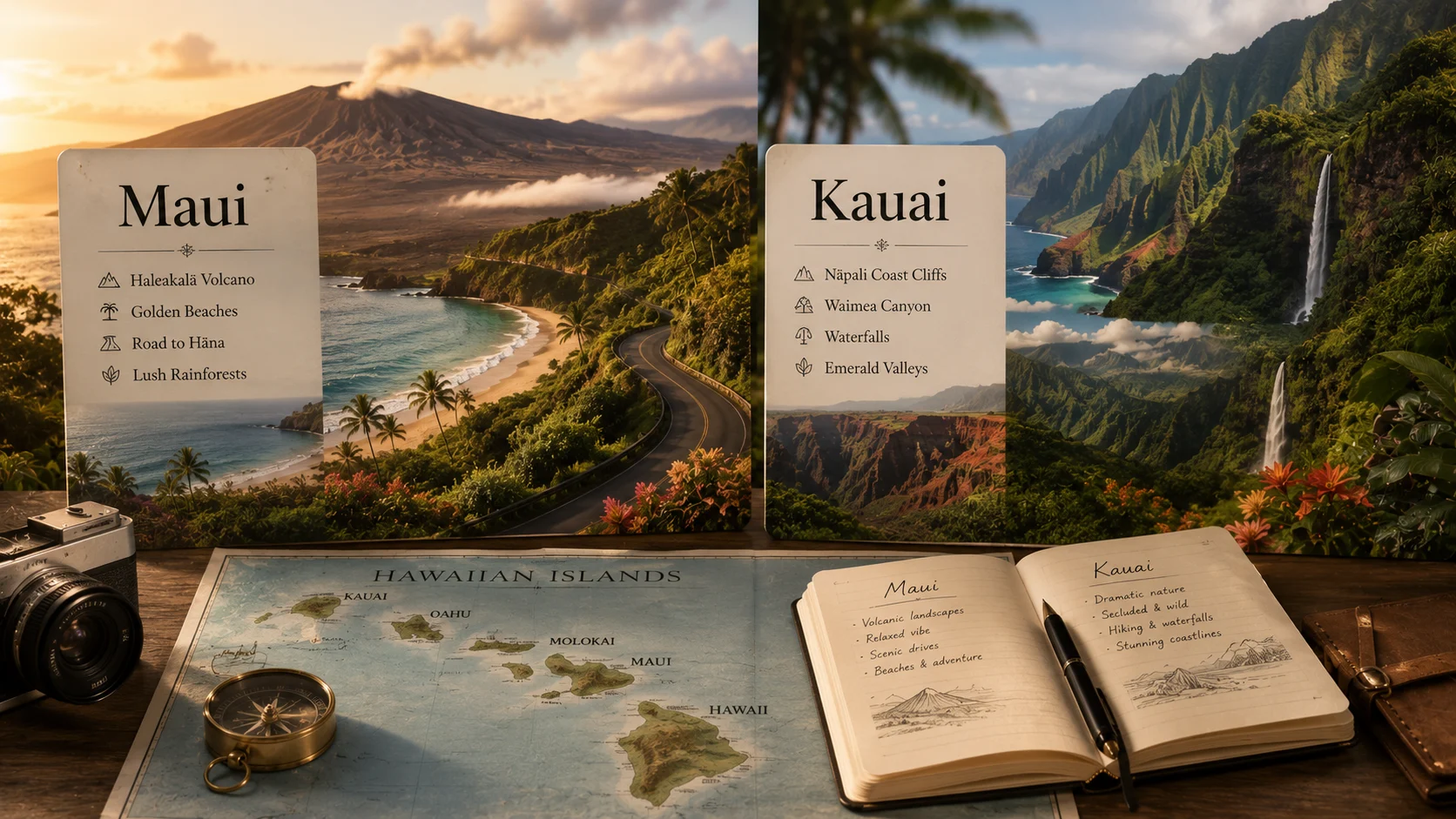
Maui and Kauai are two distinct Hawaiian islands, not interchangeable names. Maui is known for resort beaches, volcanic landscapes, Haleakalā, and the famous Road to Hāna, while Kauai is celebrated for lush mountains, waterfalls, the Nāpali Coast, and Waimea Canyon. Confusing them can lead to inaccurate travel descriptions, incorrect place references, and misleading recommendations.
Planning a Hawaiian getaway but can’t decide between Maui or Kauai? Both islands offer breathtaking beaches, tropical landscapes, and unforgettable outdoor adventures, yet each delivers a different vacation experience. Maui is famous for its golden beaches, scenic Road to Hana, luxury resorts, and spectacular whale-watching opportunities. Kauai, often called the “Garden Isle,” is known for its lush rainforests, dramatic cliffs, cascading waterfalls, and peaceful natural beauty. Choosing between them depends on your travel style, budget, and the kind of Hawaiian adventure you want to experience.
In this guide, we’ll compare Maui vs. Kauai to help you understand their key differences, including beaches, outdoor activities, accommodations, weather, and overall travel costs. you’re planning a romantic honeymoon, a family vacation, or an adventure-filled escape, this comparison will help you make an informed decision. By exploring what each island offers, you can choose the Hawaiian destination that best matches your preferences and travel plans.
Maui or Kauai | What’s the Difference?
The simplest distinction is geographical and cultural: Maui and Kauai are both proper nouns because each names a specific Hawaiian island.
Maui, traditionally written as Maui or Māui depending on context, is the second largest island in the Hawaiian chain. It is often associated with beaches, resort areas, Haleakalā, the Road to Hāna, snorkeling, whale watching, and a mixture of developed visitor areas and rural landscapes.
Kauai, more precisely written Kauaʻi in Hawaiian, is another Hawaiian island and is often called the Garden Island. It is particularly recognized for its extraordinary greenery, dramatic cliffs, waterfalls, valleys, Nāpali Coast, Hanalei Bay, and Waimea Canyon.
| Feature | Maui | Kauai |
|---|---|---|
| Part of speech | Proper noun | Proper noun |
| Refers to | A Hawaiian island | A Hawaiian island |
| Common nickname | Valley Isle | Garden Island |
| Best known for | Beaches, Haleakalā, Road to Hāna, resorts, snorkeling | Nāpali Coast, Waimea Canyon, waterfalls, lush scenery |
| General atmosphere | More developed and varied | More secluded and nature focused |
| Major scenic attraction | Haleakalā and Road to Hāna | Nāpali Coast and Waimea Canyon |
| Common travel style | Beach vacation, sightseeing, resort stays, outdoor activities | Hiking, nature exploration, scenic drives, kayaking |
| Main airport | Kahului Airport | Līhuʻe Airport |
| Correct example | We are visiting Maui. | We are visiting Kauai. |
| Incorrect substitution | We are visiting Kauai when the destination is Maui. | We are visiting Maui when the destination is Kauai. |
The key point is simple. Maui and Kauai identify different islands.
Maui generally offers a broader combination of resort infrastructure, beaches, scenic drives, and major attractions.
Kauai tends to appeal especially strongly to travelers seeking dramatic natural scenery, hiking, waterfalls, and a quieter island experience.
Because they are both Hawaiian destinations, replacing one name with the other changes the meaning of a sentence.
Is Maui or Kauai a Grammar, Vocabulary or Usage Issue?
The question is primarily a vocabulary and usage issue rather than a grammar problem.
Grammar determines how a word behaves in a sentence. In this case, both Maui and Kauai are proper nouns that can function as the names of geographical places. The grammar of the sentence may be perfectly correct while the destination name is completely wrong.
For example:
“We booked a hotel in Maui.”
This is grammatically correct if the hotel is actually on Maui.
“We booked a hotel in Kauai.”
This is also grammatically correct if the hotel is on Kauai.
The problem occurs when a writer intends one island but names the other.
The terms are therefore not interchangeable. They cannot be substituted merely because both refer to Hawaiian islands. In formal writing, academic writing, travel journalism, tourism content, and professional communication, accuracy matters. A travel guide that calls a Kauai attraction a Maui attraction contains a factual error even if every sentence is grammatically polished.
In casual conversation, people may occasionally confuse the names because both islands belong to Hawaii and are popular vacation destinations. That does not make the terms interchangeable.
For academic or professional writing, use the exact island name. If the context involves Hawaiian language, cultural history, or official place names, preserving the ʻokina in Kauaʻi can also be appropriate. The Hawaiʻi Tourism Authority uses Hawaiian linguistic markings such as the ʻokina and kahakō in its communications.
Maui | Meaning, Usage and Context
Maui is a proper noun used to identify one specific Hawaiian island. The island is commonly associated with contrasting landscapes, including beaches, rainforest, volcanic terrain, agricultural areas, and mountain scenery.
Maui is particularly useful in writing about the Road to Hāna, Haleakalā, Kāʻanapali Beach, Wailea, Kīhei, Upcountry Maui, snorkeling, whale watching, and resort travel. The official tourism information describes Maui as having five distinct regions and highlights destinations ranging from West Maui beaches to East Maui rainforest landscapes.
A workplace example might be:
“Our company is planning a team retreat in Maui.”
An academic example could be:
“The study examines tourism development on Maui and its effects on local communities.”
A technology example might appear in an online booking application:
“The travel app recommends Maui based on the user’s interest in beaches and scenic drives.”
These examples show that Maui behaves like other geographical proper nouns. It names a specific location and normally appears with a capital letter.
Maui is not a synonym for Hawaii as a whole. Hawaii can refer to the state, while Maui refers to one island within the Hawaiian Islands. It is also important not to confuse Maui with Maui County, which is a governmental jurisdiction that includes more than the island of Maui.
Usage recap: Use Maui when you specifically mean the island of Maui. Do not use it as a general replacement for Hawaii, Kauai, or another Hawaiian island.
Kauai | Meaning, Usage and Context
Kauai, conventionally written Kauaʻi when Hawaiian orthography is preserved, is the proper name of a different Hawaiian island.
Kauai is strongly associated with lush landscapes, waterfalls, mountainous terrain, the Nāpali Coast, Hanalei, Poʻipū, Wailua, and Waimea Canyon. The island’s official tourism information highlights its natural scenery and outdoor activities, while county information describes its volcanic geography, rainforests, valleys, waterfalls, and dramatic coastline.
A workplace example might be:
“Our company retreat will take place on Kauai.”
An academic example could be:
“The researchers examined agricultural history on Kauai.”
A technology example might be:
“The travel platform suggests Kauai for users searching for hiking and nature experiences.”
Kauai is especially important when writing about Waimea Canyon. The official tourism site describes the canyon as a major scenic attraction on the island’s western side and notes its extraordinary scale and inland views.
Kauai is also strongly associated with the Nāpali Coast and outdoor experiences. The island’s official tourism resources emphasize hiking, kayaking, scenic exploration, beaches, local communities, and natural landmarks.
Usage recap: Use Kauai or Kauaʻi when you mean the Garden Island. Do not substitute Maui simply because both destinations are Hawaiian islands.
When You Should NOT Use Maui or Kauai
Several common situations make the distinction especially important.
- Do not use Maui when the destination is Kauai. A hotel, beach, canyon, or hiking trail on Kauai should not be labeled as being on Maui.
- Do not use Kauai when describing Haleakalā. Haleakalā is on Maui, and the official tourism site identifies it as one of Maui’s signature attractions.
- Do not use Maui when discussing Waimea Canyon. Waimea Canyon is on Kauai.
- Do not use Kauai when describing the Road to Hāna. The famous route is associated with East Maui and runs along Maui’s northern coastline toward Hāna.
- Do not treat either island as another word for Hawaii. Hawaii can refer to the state, while Maui and Kauai identify individual islands.
- Do not assume that similar vacation experiences make the names interchangeable. Both islands offer beaches and outdoor recreation, but their landscapes and travel experiences differ substantially.
- Do not remove the distinction in professional travel writing. A polished article still becomes inaccurate if the geographical names are mixed up.
- Do not assume spelling variation means geographical variation. Kauai and Kauaʻi refer to the same island, with the latter preserving the Hawaiian ʻokina.
Common Mistakes and Decision Rules
| Correct sentence | Incorrect sentence | Explanation |
|---|---|---|
| We are flying to Maui. | We are flying to Kauai. | Use Maui only when Maui is the actual destination. |
| Waimea Canyon is on Kauai. | Waimea Canyon is on Maui. | Waimea Canyon is a Kauai landmark. |
| Haleakalā is on Maui. | Haleakalā is on Kauai. | Haleakalā is located on Maui. |
| The Road to Hāna is on Maui. | The Road to Hāna is on Kauai. | The famous scenic route is on Maui. |
| We stayed in Kauai for a week. | We stayed in Maui for a week. | The island name must match the actual location. |
| Kauaʻi is also called the Garden Island. | Maui is also called the Garden Island. | Garden Island is a common nickname for Kauai. |
Decision Rule Box
If you mean the island known for Haleakalā and the Road to Hāna, use Maui.
If you mean the island known for the Nāpali Coast and Waimea Canyon, use Kauai or Kauaʻi.
If you mean Hawaii as the state or the broader destination, do not substitute either island name.
Maui and Kauai in Modern Technology and AI Tools
Modern travel websites, mapping applications, search engines, hotel platforms, and AI travel assistants depend heavily on accurate geographical entities.
A user asking an AI system for “beaches in Maui” expects recommendations on Maui. A system that retrieves Kauai beaches has misunderstood the location even if the recommendations themselves are excellent.
The same principle applies to maps and booking systems. Location databases distinguish islands, towns, airports, attractions, hotels, and administrative regions. A single incorrect geographical name can therefore produce an incorrect search result, itinerary, hotel recommendation, or map destination.
AI writing tools create another potential problem. Because Maui and Kauai frequently appear in similar travel contexts, an automated system can associate both with generic concepts such as beaches, Hawaii vacations, tropical weather, hiking, and resorts. Human review remains important when geographical precision matters.
For content creators, the safest practice is to connect each island with its defining landmarks before publishing. Maui suggests Haleakalā and the Road to Hāna. Kauai suggests the Nāpali Coast and Waimea Canyon. These associations help prevent accidental substitution.
Etymology and Name History
The names themselves have deep connections with Hawaiian language and tradition.
The University of Hawaiʻi’s Kahoʻiwai resource explains that Maui is named for the demigod Māui and records several traditional names associated with the island.
Kauaʻi has its own linguistic history. The University of Hawaiʻi’s Wehewehe Hawaiian language dictionary identifies Kauaʻi as the name of one of the Hawaiian islands and records historical explanations and interpretations of the name.
This history matters because these are not arbitrary labels. They are established Hawaiian place names with cultural and linguistic significance.
Expert style quotation: In careful geographical writing, the most important rule is simple: use the name that identifies the place you actually mean.
Case Study 1: Travel Content Editing
Consider an illustrative travel article comparing Hawaiian islands. The writer describes the Road to Hāna but accidentally labels it as a Kauai attraction.
The prose may be engaging, the grammar may be excellent, and the search optimization may be strong. Yet the article contains a factual geographical error.
The concrete result of correcting the island name is that readers can associate the Road to Hāna with the correct destination, Maui. Official tourism information confirms that the route is in East Maui.
Case Study 2: AI Travel Recommendation
Imagine an AI travel assistant receives a request for a destination centered on Waimea Canyon, lush mountain scenery, and the Nāpali Coast. If it recommends Maui simply because Maui is another popular Hawaiian destination, the response fails the location requirement.
Correcting the destination to Kauai produces a much more coherent recommendation because those landmarks are strongly associated with Kauai. Official tourism resources identify both Waimea Canyon and the Nāpali Coast among the island’s major attractions.
Error Prevention Checklist
Always use Maui when: you are referring to Haleakalā, the Road to Hāna, Kāʻanapali, Wailea, or another attraction located on Maui.
Always use Kauai or Kauaʻi when: you are referring to the Nāpali Coast, Waimea Canyon, Hanalei, or another attraction located on Kauai.
Never use Kauai when: your source, map, itinerary, or factual reference specifically identifies Maui.
Never use Maui when: your subject is a landmark or location situated on Kauai.
Always check the island name: before publishing travel articles, academic writing, destination guides, or AI generated content.
Related Grammar Confusions You Should Master
Understanding Maui and Kauai is part of a broader skill: distinguishing similar looking terms according to meaning and context.
Other useful language distinctions include Hawaii or Hawaiian, island or isle, beach or shore, vacation or holiday, traveler or traveller, itinerary or schedule, tourism or travel, historic or historical, farther or further, and affect or effect.
These pairs demonstrate an important principle of effective English usage. Similar words or closely related concepts should not automatically be treated as interchangeable. Context determines the correct choice.
The same principle applies here. Maui and Kauai belong to the same broad category, but they identify different geographical entities.
FAQs
Is Maui or Kauai better for a first trip to Hawaii?
Maui often suits travelers wanting beaches, resorts, scenic drives, and varied activities, while Kauai is especially appealing for dramatic scenery and outdoor exploration.
Is Maui or Kauai more beautiful?
Beauty is subjective, but Kauai is especially famous for lush mountains, waterfalls, and dramatic coastal scenery, while Maui combines beaches, volcanic landscapes, and rainforest.
Is Maui or Kauai better for beaches?
Maui is often favored for its extensive collection of well known beaches and resort areas, although Kauai also offers beautiful beaches and coastal scenery.
Is Maui or Kauai better for hiking?
Kauai is particularly strong for hikers because of its mountainous terrain, valleys, waterfalls, and Nāpali Coast scenery, while Maui also offers excellent hiking.
Is Maui or Kauai more developed?
Maui generally has more extensive resort infrastructure and a broader concentration of established visitor facilities, while Kauai often feels quieter and more nature focused.
Is Kauai the same island as Maui?
No. Kauai and Maui are separate Hawaiian islands with different landscapes, attractions, communities, and geographical locations.
Why is Kauai called the Garden Island?
Kauai is widely known as the Garden Island because of its exceptionally lush vegetation, abundant rainfall, valleys, waterfalls, and tropical landscapes.
What is Maui famous for?
Maui is especially famous for Haleakalā, the Road to Hāna, beaches, snorkeling, resort areas, scenic landscapes, and outdoor recreation.
What is Kauai famous for?
Kauai is particularly famous for the Nāpali Coast, Waimea Canyon, waterfalls, lush mountains, Hanalei, and outdoor adventures.
Conclusion
The choice between Maui and Kauai is not a matter of spelling or grammar. They are two separate Hawaiian islands, and accurate usage depends on identifying the correct geographical destination. Maui is strongly associated with Haleakalā, beaches, resorts, and the Road to Hāna, while Kauai is renowned for the Nāpali Coast, Waimea Canyon, waterfalls, and lush mountain scenery.
When deciding between Maui and Kauai, remember the landmark rule: Haleakalā and the Road to Hāna point you toward Maui, while Waimea Canyon and the Nāpali Coast point you toward Kauai. Once that distinction is clear, the confusion becomes easy to avoid.
For writers, students, travelers, editors, and AI content creators, precision matters. Using the correct island name makes the sentence more accurate, the recommendation more useful, and the overall content more trustworthy.
Discover More Related Articles:
- Vallies or Valleys | Never Misspell This Word Again in 2026
- Dryed or Dried | The Correct Spelling & Usage Guide Today In 2026
- Traveler or Traveller | British vs American English Made Simple In 2026