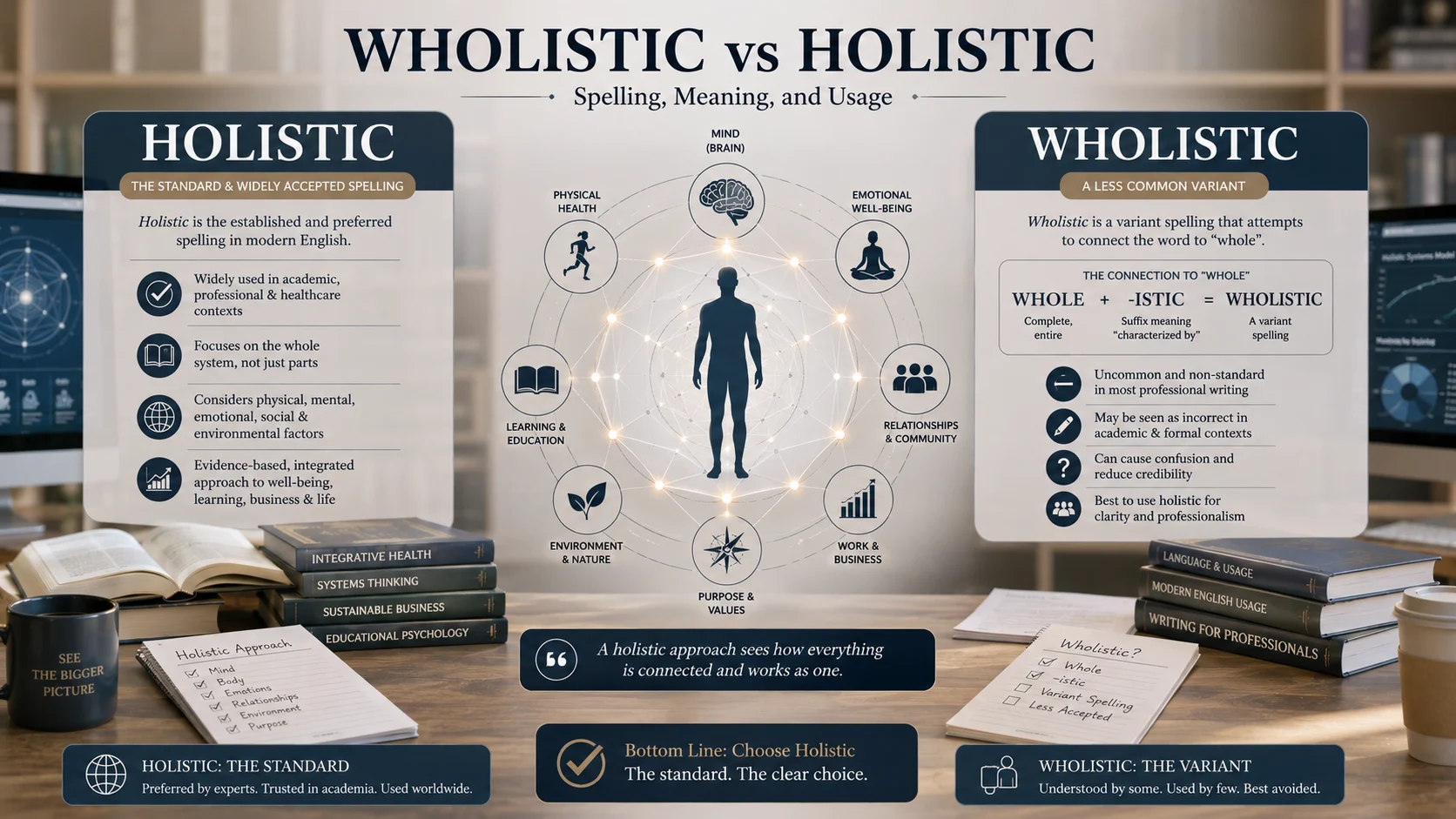
Wholistic or holistic refers to two forms used to describe an approach that considers a person, system, or subject as a complete whole rather than focusing on separate parts. Holistic is the standard and widely preferred form, while wholistic is a less common variant that makes the connection with the word whole more explicit.
The question of wholistic or holistic usually appears when writers encounter both spellings in books, websites, professional documents, or academic discussions. At first glance, the words seem identical in meaning, and in most contexts they are. Both can describe an approach that considers the complete picture instead of examining isolated components.
The important distinction is usage and convention. Holistic is the established form used widely in standard English, particularly in healthcare, education, psychology, business, science, and academic writing. Wholistic is also a legitimate word, but it is considerably less common and is often chosen to emphasize the idea of looking at the whole.
This difference matters because word choice can influence how polished, credible, and conventional your writing appears. A reader may understand both terms, but holistic is normally the safer choice when you are writing for a broad professional or academic audience.
Understanding the history, meaning, pronunciation, and context of both forms makes the choice much easier.
Wholistic or Holistic | What’s the Difference?
Holistic is an adjective meaning concerned with the whole of something rather than only its individual parts. It is the standard and much more common form in contemporary English.
Wholistic is also an adjective with essentially the same meaning. It explicitly resembles the word whole, which may make its meaning feel more transparent to some readers. However, it is less frequent and is not generally the preferred form in formal writing.
| Feature | Holistic | Wholistic |
|---|---|---|
| Part of speech | Adjective | Adjective |
| Basic meaning | Considering something as a complete whole | Considering something as a complete whole |
| Standard usage | Very common | Less common |
| Formal writing | Preferred | Acceptable but uncommon |
| Academic writing | Strong preference | Used occasionally |
| Professional communication | Recommended | Usually avoid unless context favors it |
| Meaning | Whole system or complete picture | Whole system or complete picture |
| Pronunciation | Usually pronounced with a silent initial h | Usually pronounced with an audible w |
| Example | A holistic approach considers every major factor. | A wholistic approach considers every major factor. |
Quick Recap
Holistic is the standard choice in most situations.
Wholistic is a recognized but much less common variant.
Both generally communicate the idea of considering the whole rather than isolated parts.
For professional, academic, and general purpose writing, holistic is usually the strongest choice.
Is Wholistic or Holistic a Grammar, Vocabulary, or Usage Issue?
The difference between wholistic and holistic is primarily a vocabulary and usage issue rather than a grammar problem.
Neither word is grammatically incorrect simply because of its spelling. Both function as adjectives and can modify nouns such as approach, treatment, education, strategy, perspective, development, or analysis.
The real question is which form fits the expectations of your audience.
In everyday communication, people may encounter both spellings without difficulty. However, frequency matters in standard English. Holistic has become the dominant form and appears extensively in established professional and academic contexts.
For formal writing, the conventional choice is therefore holistic.
Formal Versus Informal Usage
In formal reports, research papers, business proposals, medical material, educational documents, and professional publications, holistic is normally preferable.
In informal writing, wholistic may appear without causing confusion. Some writers deliberately use it because they want the word to visibly connect with whole.
The choice is therefore less about correctness and more about established usage, audience expectations, and editorial consistency.
Academic Versus Casual Usage
Academic writers generally favor holistic because it is the conventional spelling used across established terminology.
A university paper might discuss a holistic model of education, a holistic approach to leadership, or holistic development.
A casual writer might use wholistic because it seems more intuitive. That doesn’t necessarily make the sentence wrong, but it can make the wording appear less conventional.
How to Use Holistic Correctly
Holistic is the form you should normally choose when you want your writing to sound natural, professional, and widely accepted.
The word is especially common when discussing systems where different elements influence one another.
Workplace Example
A manager might say:
Our company needs a holistic approach to employee development.
This means the organization should consider multiple dimensions of development rather than focusing only on one skill or performance measure.
A business may consider training, communication, leadership, workplace culture, employee goals, and long term development as connected factors.
Academic Example
A researcher might write:
The study examines a holistic approach to language education.
Here, holistic suggests that language learning is being considered as a broader process involving communication, comprehension, culture, confidence, vocabulary, and practical use.
Technology Example
A technology company might describe its cybersecurity strategy as holistic.
For example:
The organization adopted a holistic cybersecurity strategy that considers people, processes, software, and infrastructure.
The word communicates that security isn’t being treated as a single technical problem.
Holistic Usage Recap
Use holistic when discussing a complete system or broad perspective.
It is the preferred form for professional and academic communication.
It works naturally with words such as approach, perspective, strategy, treatment, education, development, and assessment.
How to Use Wholistic Correctly
Although wholistic is much less common, it can be used when the writer intentionally wants to emphasize the concept of the whole.
The spelling can feel intuitive because it visually contains whole. This is one reason some writers and organizations prefer it.
Workplace Example
A consultant might write:
The organization requires a wholistic review of its internal processes.
The meaning is understandable and essentially the same as saying:
The organization requires a holistic review of its internal processes.
However, the second version will usually sound more conventional to a general professional audience.
Academic Example
A writer discussing a particular theoretical tradition might deliberately retain wholistic if that spelling is characteristic of the terminology used by the relevant author, institution, or field.
In such a situation, consistency matters more than replacing the term simply because it is uncommon.
Technology Example
A technology writer could say:
The platform provides a wholistic view of customer activity.
This is understandable, but holistic view would normally be the more familiar expression.
Wholistic Usage Recap
Wholistic is not simply a spelling mistake.
It is a recognized variant with the same broad meaning as holistic.
Its main limitation is frequency and convention.
When you have no specific reason to choose it, holistic is generally the better editorial decision.
When You Should NOT Use Wholistic or Holistic
Knowing when a word should not be used is just as important as knowing its definition.
- Do not use holistic when you mean complete in every possible sense.
Holistic usually emphasizes relationships among parts within a whole. It does not automatically mean perfect, exhaustive, or comprehensive in every context. - Do not use holistic as a vague substitute for good.
A holistic approach should describe a particular way of considering interconnected factors, not simply something positive. - Do not use wholistic merely to sound more sophisticated.
The unusual spelling does not automatically make writing more authoritative. - Do not switch between the two spellings without a reason.
Consistency is important in professional documents. - Do not assume wholistic is always incorrect.
It is less common, but it has established usage. - Do not use holistic when you are discussing only one isolated component.
If a report examines a single variable, calling the analysis holistic may be misleading. - Do not confuse holistic with whole.
Whole is a general adjective or noun, while holistic usually describes an approach that considers interconnected parts as a complete system. - Do not choose wholistic in formal writing simply because it looks closer to whole.
Established usage is usually more important than visual intuition.
Common Mistakes: Wholistic or Holistic
| Correct sentence | Incorrect or weaker sentence | Explanation |
|---|---|---|
| The doctor recommended a holistic approach. | The doctor recommended a wholistic approach. | Wholistic is possible, but holistic is the conventional choice. |
| We need a holistic business strategy. | We need a wholistic business strategy. | Holistic is more natural in professional writing. |
| The course promotes holistic development. | The course promotes whole development. | Holistic expresses the broader conceptual meaning more precisely. |
| The researcher used a holistic perspective. | The researcher used a wholistic perspective. | The standard academic form is holistic. |
| The system provides a holistic view of performance. | The system provides a whole view of performance. | Holistic is the established term for this conceptual approach. |
Decision Rule
If you mean an approach that considers interconnected parts as a complete system, use holistic. If you specifically need the less common variant that emphasizes the word whole, wholistic can be used.
This rule works well for most editing decisions.
Wholistic or Holistic in Modern Technology and AI Tools
Modern technology frequently uses the concept behind holistic thinking.
Artificial intelligence systems often combine information from multiple sources rather than evaluating a single signal in isolation. A business analytics platform may examine sales, customer behavior, operational data, and market conditions together. A cybersecurity system may consider users, devices, applications, networks, and unusual activity.
In these contexts, phrases such as holistic analysis, holistic strategy, holistic assessment, and holistic view are natural.
AI generated content also benefits from choosing the conventional spelling. When an automated writing system produces professional or academic text, holistic is generally the safest form because readers are more familiar with it.
The important point is that technology does not change the basic meaning. It simply creates more situations in which a whole system must be considered rather than a single component.
Etymology: Why Does Holistic Look Different From Whole?
The history of holistic explains why its spelling may initially seem surprising.
The term is associated with holism, a concept built around the idea that a system can have properties that are not adequately understood by examining its individual components separately. The English word developed from the Greek concept associated with being whole or complete.
The connection with the word whole is therefore conceptually strong, even though the spelling of holistic does not directly reproduce the modern English word whole.
Wholistic developed as a more transparent variant influenced by the visible spelling and pronunciation of whole. In other words, the unusual form can be understood as an attempt to make the relationship with whole immediately obvious.
That explains why both forms exist while one has become far more conventional.
Why Holistic Is Usually the Better Editorial Choice
From an editorial perspective, the strongest word is not always the most logically constructed word. Established usage matters.
Readers recognize holistic immediately. It appears naturally in medicine, education, psychology, business, leadership, wellness, research, environmental studies, and technology.
Wholistic communicates essentially the same idea, but its lower frequency means that some readers may pause and wonder it is a spelling error.
A useful professional writing principle is:
Choose the established form when two words communicate the same meaning and one is substantially more conventional for your audience.
That principle favors holistic in most general writing.
Practical Case Studies
Case Study One: Professional Communication
Imagine a consulting firm preparing a report about organizational performance. The report examines leadership, employee engagement, internal communication, training, and business processes.
The phrase holistic organizational assessment immediately tells professional readers that the evaluation considers multiple connected areas.
Replacing holistic with wholistic would not necessarily change the meaning, but it could introduce an unnecessary moment of uncertainty for readers who are accustomed to the standard form.
The practical result is clearer communication when the conventional spelling is selected.
Case Study Two: Academic Writing
Consider a university paper examining student development. The researcher considers academic performance, social interaction, emotional development, motivation, and learning environment.
The phrase holistic student development accurately signals that these factors are being viewed as connected elements.
Using holistic also aligns the terminology with established academic usage, making the paper appear more consistent with conventional scholarly English.
The lesson from both cases is simple: precision includes not only meaning but also conventional word choice.
Error Prevention Checklist
Always Use Holistic When
- Writing an academic paper.
- Preparing a professional report.
- Writing business or corporate content.
- Describing a broad healthcare approach.
- Discussing education or personal development.
- Explaining interconnected parts of a system.
- Writing for a general international audience.
- Choosing the safest standard spelling.
Never Use Wholistic When
- You are required to follow a style guide that specifically prefers holistic.
- You are writing formal academic material without a contextual reason for the variant.
- You are trying to make your writing sound more authoritative through unusual spelling.
- You are editing content for broad professional audiences and want maximum familiarity.
- You are mixing both forms inconsistently.
- You assume an uncommon spelling is automatically more correct.
Related Grammar Confusions You Should Master
Understanding similar word choices can make your writing considerably more precise.
- Affect or effect concerns influence versus result.
- Complement or compliment distinguishes something that completes from praise.
- Principal or principle separates a person or primary thing from a rule or belief.
- Practice or practise depends partly on you are following American or British usage.
- Advice or advise distinguishes a noun from a verb.
- Further or farther often involves figurative versus physical distance.
- Stationary or stationery separates something that remains still from writing materials.
- Licence or license reflects differences between British and American conventions.
- Everyday or every day distinguishes an adjective from a time expression.
- Who or whom concerns grammatical function and formal usage.
These distinctions follow the same larger principle: accurate writing depends on meaning, grammatical role, convention, and context.
FAQs
Is holistic or wholistic correct?
Both forms are recognized, but holistic is the standard and much more common choice in contemporary English, especially in formal, academic, and professional writing.
Is wholistic a real word?
Yes. Wholistic is an established variant of holistic, although it is considerably less common and is often avoided when the conventional form is preferred.
What is the difference between holistic and wholistic?
There is generally no meaningful difference in definition. Both describe an approach that considers a complete whole and the relationships among its parts.
Which spelling is more common, holistic or wholistic?
Holistic is much more common. It is the form most readers expect to see in professional, academic, healthcare, educational, and business contexts.
Should I use holistic in academic writing?
Yes. Holistic is normally the safest and most conventional choice for academic writing unless a particular source, theory, or style guide specifically uses wholistic.
Why do some people spell holistic as wholistic?
Wholistic makes the connection with the English word whole more visually obvious. Some writers therefore prefer it because the meaning seems more transparent.
Is wholistic considered a spelling mistake?
Not necessarily. It is a recognized variant, but many editors prefer holistic because it is the established and substantially more frequent form.
What does holistic approach mean?
A holistic approach considers relevant parts, relationships, and circumstances together instead of evaluating one isolated element without considering the larger system.
Conclusion
When choosing between wholistic or holistic, the safest answer for most readers is holistic. Both forms generally refer to an approach that considers something as a whole, but holistic is far more established in modern English.
Wholistic remains a legitimate variant and can appear in particular communities, publications, or contexts. However, if you’re writing an academic paper, business report, professional article, healthcare resource, or general web content, holistic will usually provide the clearest and most conventional wording.
The simplest rule is to choose holistic unless you have a specific reason to preserve wholistic. Good writing is not only about a word can be understood. It is also about selecting the form readers recognize, expect, and trust.
Discover More Related Articles:
- Maui or Kauai | Which Hawaiian Island Is Right for You In 2026
- Play or Draw | What Happens When a Game Ends Even In 2026
- Dinner or Diner | One Means a Meal, the Other Is a Restaurant In 2026