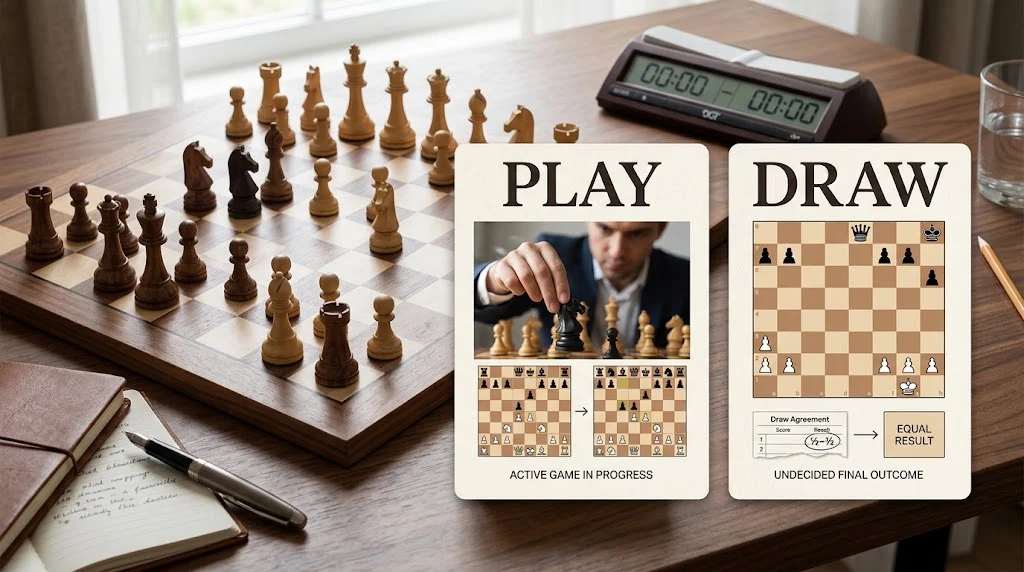
In chess, play or draw refers to two different outcomes or actions. To play means to take part in a chess game or make moves, while to draw means to finish a game without either player winning. Confusing these terms can create mistakes because playing describes participation or action, whereas a draw describes a result.
Have you ever wondered what it means when a team can play or draw a match? This phrase is especially common in sports betting, football predictions, and match analysis, where understanding the possible outcomes is essential. Although play and draw are familiar English words, their meanings differ significantly in this context. The word play refers to participating in a game or match, while draw describes a result in which both teams finish with the same score. Confusing these terms can lead to misunderstandings when reading sports discussions, match previews, or betting-related content.
In this guide, we’ll explore the meaning of play or draw, explain how the phrase is used in different contexts, and provide practical examples to make the distinction easier to understand. you’re a football fan, a beginner learning sports terminology, or a writer creating sports-related content, understanding this expression will help you interpret match outcomes more accurately. Let’s break down the meaning, usage, and key differences in simple, reader-friendly language.
Play or Draw | What’s the Difference?
The words play and draw are both common English verbs, but their meanings change significantly when they appear in a chess context.
Play is primarily a verb meaning to take part in a game, compete against an opponent, or make moves during a game. In chess, a player can play a match, play against another person, or play a particular opening.
Draw can also function as a verb, but in chess it means to finish a game with no winner. It can also describe the act of agreeing to or achieving a drawn result. As a noun, a draw means a game that ends without a winner.
The distinction becomes clearer when you look at the terms side by side.
| Term | Part of Speech | Meaning in Chess | Example |
|---|---|---|---|
| Play | Verb and noun | To participate in a chess game, compete, or make moves | She will play against the club champion. |
| Draw | Verb and noun | To finish a game without a winner, or a game ending without a winner | The players agreed to draw after forty moves. |
| Play | Verb | To make or choose moves during a game | He played the opening accurately. |
| Draw | Verb | To reach an equal result in a competitive game | The two grandmasters drew their match. |
The easiest distinction is simple.
Play describes participating in the game or making moves.
Draw describes a result in which neither side wins.
A player can play a game and then draw it.
A game may therefore be played without necessarily being drawn.
Is Play or Draw a Grammar, Vocabulary or Usage Issue?
The confusion between play or draw is mainly a vocabulary and usage issue rather than a difficult grammar rule.
Both words are grammatically correct. The important question is what you want to communicate. If you are talking about participating in chess, play is normally appropriate. If you are talking about the final result, draw is the appropriate word.
Consider these examples:
“I play chess every weekend.”
This sentence describes participation in the activity.
“I drew my game yesterday.”
This sentence describes the result.
The two words are not interchangeable. Saying “I draw chess every weekend” would normally be incorrect if your intended meaning is that you regularly participate in chess. Likewise, saying “The game was played” does not tell the reader someone won or the game ended in a draw.
In formal writing, sports reporting, tournament summaries, and academic discussions about chess, precise terminology matters. Casual conversation may sometimes contain shortened or informal expressions, but the underlying distinction remains the same.
When to Use Play
Use play when you are describing participation, competition, or the act of making moves.
In everyday English, you might say:
“I play chess with my brother.”
“He plays online every evening.”
“They played a difficult game yesterday.”
The same principle works in professional and academic contexts.
Workplace example:
“Our company team will play against the regional office next Friday.”
Here, play means participate in a competitive game.
Academic example:
“The experiment examined how beginners play chess after learning basic tactical patterns.”
Here, play refers to the activity itself.
Technology example:
“The application lets users play chess against an artificial intelligence opponent.”
Here, play describes the user’s participation through technology.
A useful point is that play does not tell you the outcome. The game could end in a win, loss, or draw.
Usage recap for play
Use play for participation, competition, or making moves. It is the general word you need when describing someone taking part in chess. Playing a game does not automatically mean winning or drawing it.
When to Use Draw
Use draw when neither player wins the game.
For example:
“The match ended in a draw.”
“Both players agreed to draw.”
“She drew her final tournament game.”
In chess, a draw is a recognized result. It can happen for several reasons, including agreement between players, stalemate, insufficient mating material, threefold repetition, or the fifty move rule when the relevant conditions are satisfied.
Workplace example:
“The company tournament ended with two players drawing the final round.”
The word draw identifies the result rather than the act of participation.
Academic example:
“Researchers recorded each chess game ended in a win, loss, or draw.”
Here, draw is part of a classification system for game results.
Technology example:
“The chess platform automatically records a game as a draw when the position meets the relevant rules.”
Again, the word identifies an outcome.
Usage recap for draw
Use draw when you mean that a chess game ends without a winner. Remember that draw can also be a noun, as in “The game was a draw,” or a verb, as in “They drew the game.”
How Play and Draw Work in Real Chess Sentences
Understanding the words individually is useful, but seeing them together makes the difference much clearer.
Consider this sentence:
“Magnus played twelve games and drew three.”
The first verb tells us that he participated in twelve games. The second tells us that three of those games ended without a winner.
Another example is:
“She played five rounds and drew two of them.”
The word played describes participation in all five rounds. The word drew identifies the result of two rounds.
This distinction is especially important in tournament statistics. A player’s record may include wins, losses, and draws. The total number of games played represents participation, while the number of draws represents one specific result.
For example, if a player has a record of four wins, three draws, and two losses, the player has played nine games in total.
That simple relationship demonstrates why the terms cannot be treated as synonyms.
When You Should NOT Use Play or Draw
There are several situations where choosing the wrong term can change the meaning of a sentence.
- Do not use draw when you simply mean participating in chess. “I draw chess every Saturday” does not normally mean “I play chess every Saturday.”
- Do not use play when you specifically mean that neither player won. “The match was played” says nothing about the result.
- Do not use draw as a replacement for play when discussing hobbies. Someone who regularly participates in chess usually says, “I play chess.”
- Do not assume that every completed chess game is a draw. A game can end in a win, loss, or draw.
- Do not use play when tournament statistics specifically require the number of drawn games. The result should be described with draw.
- Do not confuse draw with the separate English meaning of pulling something. In “draw the curtain,” draw has nothing to do with a chess result.
- Do not assume that “play” describes the final outcome. Playing is an activity, not a guarantee of a particular result.
- Do not use the noun draw where the sentence requires a verb. “The game was a draw” and “The players drew” are both correct, but their grammatical structures differ.
Common Mistakes and Decision Rules
| Correct Sentence | Incorrect Sentence | Explanation |
|---|---|---|
| I play chess every weekend. | I draw chess every weekend. | Play describes regular participation in chess. |
| The players drew the game. | The players played the game as a draw. | Draw directly describes the result. |
| The match ended in a draw. | The match ended in a play. | Draw is the noun used for an undecided result. |
| She played six games. | She drew six games. | Played means she participated in six games, while drew means all six ended without a winner. |
| They played against each other. | They drew against each other. | Play describes the competition. Draw should be used only when the result was a tie. |
Decision Rule Box
If you mean participating in chess or making moves, use play.
If you mean that the chess game ended without a winner, use draw.
A helpful memory trick is this: you play the game, and you may draw the game.
Play and Draw in Modern Technology and AI Tools
Modern chess platforms make the distinction especially visible.
A player can play against a human opponent, a chess engine, or an artificial intelligence system. Platforms may also allow players to play puzzles, practice openings, or analyze positions.
Once the game finishes, the software determines the result was a win, loss, or draw.
Artificial intelligence has made chess terminology even more visible because automated systems constantly classify game outcomes. A chess engine may evaluate a position, recommend a move, or predict the likely result. However, the human user still plays the game, while the completed game may be recorded as a draw.
This distinction also appears in digital statistics. A player’s profile might show games played alongside wins, losses, and draws. These categories describe different pieces of information and should not be confused.
The Etymology of Play and Draw
The history of these words helps explain why their meanings are broad.
Play comes from Old English and developed from an early sense associated with activity, movement, amusement, and exercise. Over time, its meaning expanded to include games, sports, dramatic performance, and many other forms of activity.
Draw has Germanic origins and has long been associated with pulling or moving something. Its modern meanings developed in several directions. In competitive contexts, the word came to describe an outcome in which neither side prevailed.
English often preserves this kind of semantic expansion. One word can develop several related meanings, which is why draw can refer to pulling something, creating an image, selecting something by chance, or ending a chess game without a winner.
Expert Style Explanation
A useful linguistic principle is:
“Choose the verb that identifies the action you mean, not merely the activity surrounding it.”
Applied to chess, play identifies participation, while draw identifies a particular outcome. Precision comes from identifying your sentence is describing what the players did or what happened at the end of the game.
Two Practical Case Studies
Case Study One: Tournament Reporting
Imagine a school chess tournament in which one student participates in seven games. The student wins four, loses one, and draws two.
A report saying “The student drew seven games” would incorrectly suggest that all seven games ended without a winner.
The accurate report is:
“The student played seven games, winning four, drawing two, and losing one.”
This example shows how replacing play with draw can completely change the statistical meaning.
Case Study Two: Digital Chess Records
Consider a chess application that records ten games for a user. The player wins five, loses three, and draws two.
The correct summary is:
“Games played: 10. Wins: 5. Draws: 2. Losses: 3.”
The concrete result is that the player played ten games but drew only two.
These examples are illustrative language case studies rather than claims about a particular tournament or software platform. Their purpose is to show how precise word choice prevents numerical and semantic confusion.
Error Prevention Checklist
Always use play when
You mean taking part in a chess game.
You mean competing against another player.
You mean making moves during a game.
You are describing the number of games someone participated in.
You are talking about chess as a hobby or activity.
Never use draw when
You only mean that someone participated in chess.
You do not know the game’s result.
You are describing the general activity of playing chess.
You are talking about a game that was won or lost.
You are counting total games played rather than drawn games.
Related Grammar Confusions You Should Master
If you want to strengthen your command of commonly confused English terms, these related topics are worth learning:
Win or beat: Learn why you win a game but beat an opponent.
Lose or loose: Understand the difference between losing a match and something being loose.
Advice or advise: Distinguish the noun from the verb.
Practice or practise: Learn the spelling difference between American and British English.
Affect or effect: Understand the most common meanings of these frequently confused words.
Lay or lie: Master the difference between placing something and reclining.
Rise or raise: Learn when something moves upward by itself and when someone causes it to move upward.
Sit or set: Distinguish position from placement.
Watch or see: Understand the difference between intentionally observing something and simply perceiving it.
Game or match: Learn how these terms can differ depending on the sport or activity.
FAQs
What is the difference between play and draw in chess?
Play means participating in a chess game, while draw means the game ends without a winner.
Is it correct to say I draw chess?
Usually no. Say “I play chess” when you mean that you participate in chess as an activity.
Does play mean you win the chess game?
No. Playing only means participating or making moves. A player can win, lose, or draw a game they play.
What does draw mean in chess?
A draw is a result in which neither player wins. The game can reach a draw in several ways under chess rules.
Can play and draw be used in the same sentence?
Yes. For example, “She played five games and drew two.” Play describes participation, while draw describes the result.
Is draw a noun or a verb in chess?
It can be both. “The game was a draw” uses draw as a noun, while “They drew the game” uses it as a verb.
Should I say played or drew in chess statistics?
Use played for the total number of games and drew for the number of games that ended without a winner.
What is the easiest way to remember play and draw?
Remember that you play a game, and the game may end in a draw.
Conclusion
The difference between play or draw becomes straightforward once you separate the activity from the result. You play chess when you participate, compete, or make moves. You draw a chess game when neither player wins.
Using these terms accurately makes everyday conversation, tournament reports, academic writing, and digital chess statistics much clearer.
When in doubt, ask yourself one question: am I describing the game being played, or am I describing its result? If you mean participation, choose play. If you mean an undecided result, choose draw.
Discover More Related Articles:
- Vallies or Valleys | Never Misspell This Word Again in 2026
- Dryed or Dried | The Correct Spelling & Usage Guide Today In 2026
- Traveler or Traveller | British vs American English Made Simple In 2026