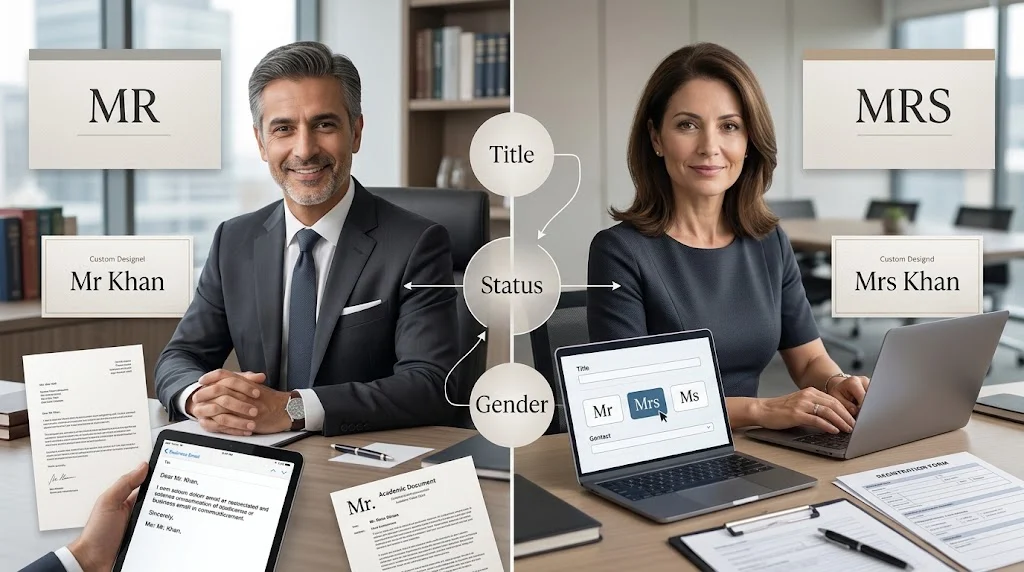
Mr is a title used for a man, while Mrs is traditionally used for a married woman. They are not interchangeable because they identify different genders and, in the case of Mrs, traditionally communicate marital status in formal address.
Choosing between mr or mrs can seem simple, but the distinction matters in emails, forms, invitations, applications, academic records, and professional communication. Mr is an honorific used before a man’s surname or full name, regardless of he is married. Mrs is traditionally an honorific for a married woman. Confusion often happens because modern naming conventions are more flexible, while official forms still ask users to select a title.
Understanding the difference helps you address people respectfully and avoid awkward mistakes. It also clarifies how Mr vs Mrs, marital status titles, formal titles, and gendered honorifics work in contemporary English.
Mr vs Mrs | What’s the Difference?
Mr and Mrs are both honorifics, which means they are titles placed before a person’s name as a form of respectful address. The principal difference is that Mr traditionally identifies a man, whereas Mrs traditionally identifies a married woman.
Mr does not reveal a man is married. A married man and an unmarried man can both be addressed as Mr.
Mrs has historically indicated that a woman is married. However, modern English provides another widely accepted title, Ms, for women who do not want their marital status identified.
| Title | Part of Speech | Traditional Use | Marital Status | Example |
|---|---|---|---|---|
| Mr | Honorific noun or title | Used for a man | Not specified | Mr Ahmed |
| Mrs | Honorific noun or title | Used for a married woman | Traditionally married | Mrs Ahmed |
| Ms | Honorific noun or title | Used for a woman | Not specified | Ms Ahmed |
The distinction is therefore more than a spelling difference.
Mr can be used for virtually any adult man in formal English.
Mrs is traditionally connected with marriage and is normally used when a woman identifies with that title.
Ms is often the safest choice when a woman’s preferred title or marital status is unknown.
Quick recap
Mr is used for men and does not indicate marital status.
Mrs is traditionally used for married women.
Mr and Mrs cannot normally replace each other.
Ms is an alternative title when marital status should not be specified.
Is Mr vs Mrs a Grammar, Vocabulary or Usage Issue?
The difference between Mr and Mrs is primarily a usage and vocabulary issue, rather than a difficult grammatical rule.
Both words function as titles before names. Their position is generally straightforward. For example, you can write Mr Khan or Mrs Khan. The challenge is deciding which title accurately represents the person being addressed.
They are not interchangeable. Using Mrs for a man is incorrect, while using Mr for a woman is also incorrect in standard English.
The more complicated question concerns women and marital status. Traditional English distinguishes Mrs from Ms, but contemporary professional communication often favors Ms when marital status is irrelevant.
Formal versus informal usage
Mr and Mrs are strongly associated with formal or respectful communication. You may see them in business correspondence, official forms, school records, invitations, legal documents, and professional introductions.
In casual conversation, people often use first names instead.
For example:
“Good morning, Mr Wilson.”
is formal, while:
“Good morning, James.”
is more personal and informal.
Academic versus casual usage
Academic institutions may use titles in official records, recommendation letters, certificates, correspondence, and formal introductions. However, individual preferences should still be respected.
A university lecturer might be formally addressed as Mr Brown or Mrs Brown if that is the person’s preferred title.
In casual student communication, a first name may be appropriate depending on the institution and the person’s preference.
When to Use Mr
Mr is the standard courtesy title for an adult man. It is normally written before a surname, full name, or occasionally a professional name.
Examples include Mr Ali, Mr Robert Smith, and Mr Daniel Brown.
The title does not tell the reader the man is married, unmarried, divorced, or widowed. That neutrality is one of the simplest differences between Mr and Mrs.
Workplace example
A formal business email might begin:
“Dear Mr Ahmed,”
This is appropriate when Ahmed is an adult man and the writer wants to maintain a professional tone.
Another example is:
“Please contact Mr Wilson regarding the revised contract.”
Here, Mr provides a respectful formal reference to the individual.
Academic example
A school or university notice might state:
“Mr Thomas will supervise the examination.”
The title identifies Thomas as a man while maintaining the formal style expected in institutional communication.
Technology example
Online registration systems frequently include a title field containing options such as Mr, Mrs, Ms, and sometimes Dr or other professional titles.
If the user is an adult man and prefers Mr, the appropriate selection is Mr.
Usage recap
Use Mr before the name of a man when a courtesy title is required.
Do not use Mr to indicate that a man is married.
Mr is suitable in professional, academic, administrative, and formal contexts.
When to Use Mrs
Mrs is traditionally used before the name of a married woman. It is a formal courtesy title and has a long history in English.
For example:
“Mrs Patel will attend the meeting.”
The title tells the reader that Patel is a woman who uses Mrs, traditionally because she is married.
However, marital status alone does not mean that Mrs is always the correct choice. A woman may prefer Ms, and her personal preference should take priority over assumptions based on marriage.
Workplace example
A formal letter may begin:
“Dear Mrs Johnson,”
This is appropriate when Johnson uses Mrs and the writer knows that this is her preferred title.
Academic example
A school record might identify a teacher as Mrs Taylor if she uses that title professionally.
However, institutions should avoid assuming a title when the person’s preference is unknown.
Technology example
An online form may offer Mrs as one of several title options. Selecting Mrs is appropriate when the user identifies with that title.
Some modern platforms increasingly avoid requiring titles altogether because they can be unnecessary for ordinary transactions.
Usage recap
Use Mrs traditionally for a married woman who uses that title.
Do not assume every married woman prefers Mrs.
When a woman’s preferred title is unknown, Ms may be a more neutral choice.
When You Should NOT Use Mr or Mrs
There are several situations where choosing Mr or Mrs without checking the context can create an avoidable mistake.
- Do not use Mr for a woman simply because you do not know her marital status.
- Do not use Mrs for a woman merely because you assume she is married.
- Do not use Mrs when the woman has specifically stated that she prefers Ms.
- Do not use Mr or Mrs when a person has provided another professional title that should take priority, such as Dr.
- Do not add a title when a form specifically requests a person’s full name without an honorific.
- Do not assume that marriage automatically determines how a woman wants to be addressed.
- Do not use a formal title in casual communication when the person has clearly invited you to use their first name.
- Do not confuse an honorific with a person’s legal name. Mr and Mrs are forms of address, not normally part of someone’s given name.
Common Mr and Mrs Mistakes
| Correct sentence | Incorrect sentence | Explanation |
|---|---|---|
| Mr Khan will attend the meeting. | Mrs Khan will attend the meeting. | Mr is used for a man. |
| Mrs Khan signed the document. | Mr Khan signed the document. | Mrs traditionally refers to a married woman. |
| Dear Mr Wilson, | Dear Mrs Wilson, | The title should match the person’s preferred title and gender. |
| Dear Mrs Carter, | Dear Mr Carter, | Mrs is traditionally used for a married woman. |
| Ms Ahmed will contact you. | Mrs Ahmed will contact you. | Ms may be preferred when marital status is not specified or is irrelevant. |
Decision Rule
If you mean an adult man, use Mr. If you mean a married woman who uses that title, use Mrs. If you do not know or should not specify a woman’s marital status, consider Ms.
This rule is more accurate for Mr and Mrs than rules designed for word pairs involving an action and a person or tool. Mr and Mrs are both titles, so the decision depends on the person being addressed and the title they use.
Mr or Mrs in Modern Technology and AI Tools
Digital forms have made the distinction between formal titles more visible.
When creating an account, applying for a service, purchasing a product, or completing an official application, users may encounter a dropdown menu containing Mr, Mrs, Ms, and other titles.
Modern software increasingly recognizes that titles are not always necessary. Some systems allow users to leave the title blank, while others provide several options.
AI writing tools also need to handle these titles carefully. An AI assistant generating a business email should not automatically turn a woman’s name into Mrs merely because the context suggests that she may be married. The safest approach is to use the title supplied by the user or organization.
This reflects a broader principle in modern professional communication: do not infer personal information when it is unnecessary to complete the task.
The History and Etymology of Mr and Mrs
Mr is an abbreviation of Mister, which developed from the older form Master. Over time, Mister became the ordinary courtesy title for men.
Mrs developed from Mistress, a historical feminine counterpart to Mister. Over the centuries, Mistress developed several meanings, while Mrs became established as a courtesy title associated with married women.
The spelling and punctuation conventions have also changed. In contemporary American English, Mr and Mrs are commonly written without periods. British English also frequently uses Mr and Mrs without periods, particularly in modern publishing.
The important point is that these forms are now established English titles rather than ordinary vocabulary words used independently.
What Linguists Say About Mr and Mrs
A useful principle for understanding honorifics is that “a title should identify how a person is formally addressed, not invite the writer to make unnecessary assumptions.”
This explains why modern usage has moved toward greater flexibility. English titles have historically encoded information about gender and, for women, marital status. Contemporary communication increasingly separates respectful address from assumptions about a person’s private life.
The result is not that Mrs has become incorrect. Rather, its use is more dependent on personal preference and context than traditional grammar books sometimes suggest.
Two Practical Case Studies
Case study: A professional email
Imagine a company receives an email from Daniel Khan and another from Sarah Khan.
Daniel’s message can be addressed to Mr Khan without knowing he is married.
Sarah’s message should not automatically be addressed to Mrs Khan simply because the writer believes she may be married. If Sarah has supplied Ms Khan as her preferred form, the company should use Ms Khan.
The practical result is greater accuracy and more respectful communication.
Case study: An online registration form
Consider a registration form containing Mr, Mrs, and Ms.
A married man would normally select Mr.
A married woman who prefers Mrs can select Mrs.
A woman who prefers not to identify her marital status can select Ms.
The result is a form that accommodates traditional titles while recognizing modern preferences.
Error Prevention Checklist
Always use Mr when
✓ The person is an adult man.
✓ The person uses Mr as his preferred title.
✓ A formal document requires a courtesy title.
✓ You are addressing a man professionally and Mr is appropriate.
Never use Mrs when
✓ The person is a man.
✓ You are guessing a woman’s preferred title.
✓ You have been told that the woman prefers Ms.
✓ The context does not require a courtesy title.
✓ You are using Mrs solely because you assume a woman is married.
Related Grammar Confusions You Should Master
Learning Mr and Mrs is easier when you understand other commonly confused English forms.
- Mr vs Ms: Mr identifies a man, while Ms is commonly used for a woman without specifying marital status.
- Mrs vs Ms: Mrs traditionally identifies a married woman, while Ms does not specify marital status.
- Miss vs Ms: Miss traditionally refers to an unmarried woman, while Ms is neutral regarding marital status.
- Mr vs Dr: Mr is a general courtesy title, while Dr can identify a professional or academic qualification.
- Their vs There: Their shows possession, while there generally refers to a place or existence.
- Its vs It’s: Its shows possession, while it’s is a contraction of it is or it has.
- Who vs Whom: Who generally functions as a subject, while whom is traditionally used as an object.
- Affect vs Effect: Affect is commonly a verb, while effect is commonly a noun, although both words have additional grammatical uses.
- Practice vs Practise: Practice is the standard noun in British English, while practise is traditionally the corresponding verb.
- License vs Licence: American English commonly uses license for both noun and verb, while British English traditionally distinguishes licence as a noun and license as a verb.
FAQs
What is the difference between Mr and Mrs?
Mr is used for a man, while Mrs is traditionally used for a married woman who uses that title.
Should I use Mr for a married man?
Yes. Mr is appropriate for men regardless of they are married, unmarried, divorced, or widowed.
Should every married woman be called Mrs?
No. A married woman may prefer Mrs, Ms, or another form of address, so personal preference matters.
Is Mrs only used for married women?
Traditionally, yes. In modern usage, Mrs generally continues to indicate a married woman who chooses that title.
What should I use if I do not know a woman’s marital status?
Ms is usually the safer neutral choice when the woman’s preferred title is unknown.
Is Mr a formal title?
Yes. Mr is a conventional courtesy title used in formal, professional, academic, and administrative communication.
Can Mr and Mrs be used before a first name?
They are normally used before a surname or full name, such as Mr Khan or Mrs Sarah Khan.
Do Mr and Mrs need periods?
Modern British and American English commonly write Mr and Mrs without periods, although style conventions can vary.
Is Mrs more formal than Ms?
Neither is inherently more respectful. The difference is that Mrs traditionally identifies marital status, while Ms does not.
Conclusion
The difference between mr or mrs is straightforward once you understand what each title communicates. Mr is the standard courtesy title for an adult man and does not indicate marital status. Mrs is traditionally used for a married woman who chooses that form of address.
The most important modern rule is to avoid assumptions. Use the title a person provides or prefers whenever possible. When addressing a woman whose preferred title is unknown and marital status is irrelevant, Ms is often the most neutral option.
Getting these small details right can make professional emails, academic documents, official forms, invitations, and everyday correspondence sound more polished and respectful.
Discover More Related Articles:
- Maui or Kauai | Which Hawaiian Island Is Right for You In 2026
- Play or Draw | What Happens When a Game Ends Even In 2026
- Dinner or Diner | One Means a Meal, the Other Is a Restaurant In 2026