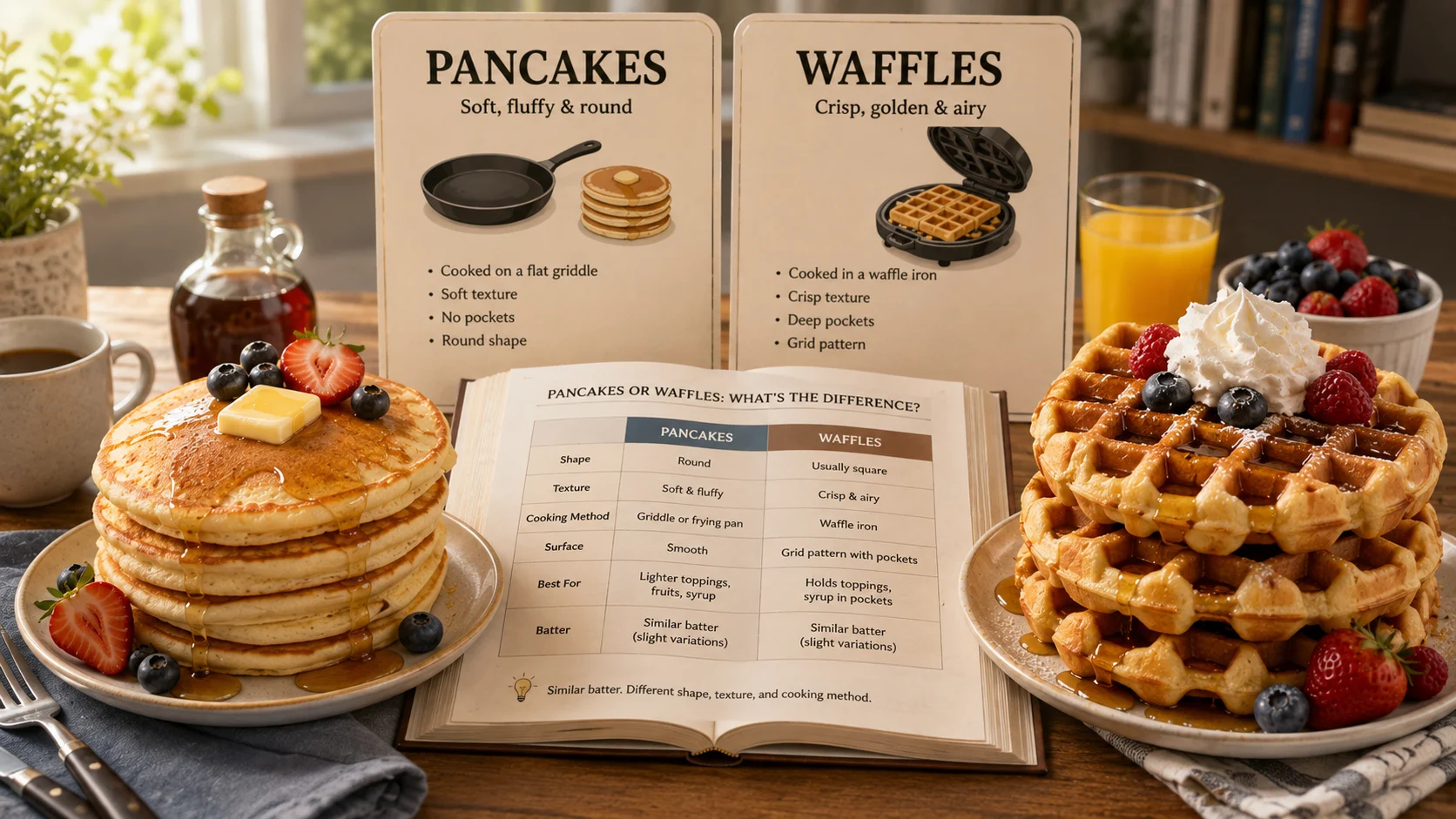
Pancakes or waffles are two popular breakfast foods made from similar basic ingredients, but they differ in texture, shape, preparation and serving style. Pancakes are soft, flat and tender, while waffles are crisp on the outside with a lighter interior and a patterned surface. Understanding these differences helps you choose the right option for taste, toppings, nutrition and occasion.
Pancakes or waffles which one should you choose when both can turn a simple breakfast into something special? Although they are often served with similar toppings such as maple syrup, butter, fruit, or whipped cream, pancakes and waffles are not the same. Their differences go beyond appearance, as each has its own batter, texture, cooking method, and ideal serving style. If you have ever wondered pancakes or waffles are better, understanding what sets them apart can make the choice much easier.
In this guide, we’ll explore the key differences between pancakes and waffles, including their ingredients, texture, shape, preparation, and common uses. you prefer soft and fluffy pancakes or crisp, golden waffles with syrup-filled pockets, knowing how each one works will help you choose the right option for breakfast, brunch, or any sweet craving.
Pancakes vs Waffles | What’s the Difference?
Pancakes and waffles are both prepared from a batter that commonly contains flour, eggs, milk, a leavening agent, and some form of fat. However, their cooking methods and final textures are significantly different.
A pancake is a noun referring to a flat, round food made by pouring batter onto a heated pan or griddle. The batter spreads naturally and cooks into a relatively soft surface.
A waffle is also a noun, but it refers to a batter based food cooked in a waffle iron. The iron presses the batter between heated plates and creates the familiar square or rectangular pattern.
Pancakes are usually the better choice when you want something soft and simple.
Waffles are ideal when you prefer crisp edges and a structured surface.
The two foods can use similar ingredients, but the cooking method changes the final result.
Is Pancakes vs Waffles a Grammar, Vocabulary or Usage Issue?
The phrase “pancakes or waffles” is not a grammar problem. It is primarily a vocabulary and food usage distinction.
Pancakes and waffles are not interchangeable when you are referring to the actual foods because they describe different preparations. You cannot normally call a waffle a pancake simply because both are made from batter.
The terms are also appropriate in both formal and informal English. In a restaurant, you might ask, “Would you like pancakes or waffles?” In a casual conversation, someone might simply say, “I want waffles.”
Academic writing can also use both words when discussing food culture, nutrition, culinary traditions, or cooking methods. For example, a food science article could compare the moisture content of pancakes and waffles.
The distinction therefore depends on meaning rather than grammatical formality.
Pancakes: Meaning, Usage and Examples
Pancakes are generally associated with a soft, fluffy texture. Their circular shape comes from spreading batter over a heated cooking surface.
The word “pancake” is a compound noun formed from “pan” and “cake.” The name reflects its traditional preparation because the batter is cooked in a pan.
Pancakes can vary considerably between cultures. American style pancakes are often thick and fluffy, while other traditions include much thinner varieties. Crepes, for example, are technically a type of pancake, although their texture and preparation differ substantially from the fluffy breakfast pancakes commonly served in North America.
Workplace Example
A workplace breakfast menu might say, “Employees can choose between pancakes and fresh fruit.”
Here, “pancakes” clearly identifies a food option. The word works naturally in professional settings because there is no informal slang involved.
Academic Example
A nutrition researcher might write, “The pancake mixture contained flour, eggs, milk, and baking powder.”
In academic writing, the term can describe the food precisely without requiring a more technical substitute.
Technology Example
Food technology companies may develop pancake makers that automatically dispense and cook measured portions of batter. Recipe applications can also provide cooking instructions specifically for pancakes.
Pancake Usage Recap
Use “pancake” when referring to a flat, usually round batter based food cooked on a pan or griddle.
Its defining characteristics are its flat shape, soft texture, and pan based cooking method.
Waffles | Meaning, Usage and Examples
Waffles are batter based foods cooked between two heated surfaces. Their most recognizable feature is the grid or honeycomb pattern created by the waffle iron.
The word “waffle” has a long culinary history and is associated with European cooking traditions. Modern waffles appear in many forms, including Belgian style waffles, American waffles, and regional variations with different thicknesses and ingredients.
Waffles are particularly useful for toppings because their indentations create small spaces that can hold syrup, melted butter, fruit, cream, sauces, and other ingredients.
Workplace Example
A hotel breakfast menu might offer waffles alongside eggs, fruit, and other breakfast choices.
The word is equally appropriate in workplace communication, restaurant descriptions, and professional food writing.
Academic Example
A culinary study might state, “Waffles generally develop a crisp surface because the batter is cooked directly between heated plates.”
This example demonstrates how the term can be used in technical and academic discussions.
Technology Example
Modern waffle makers often include adjustable temperature controls, automatic timers, removable plates, and nonstick surfaces. Smart kitchen devices can even provide preset cooking programs.
Waffle Usage Recap
Use “waffle” when referring to a patterned batter based food cooked in a waffle iron.
Its defining characteristics are its structured surface, crisp exterior, and specialized cooking method.
Pancakes or Waffles | Which One Should You Choose?
The best choice depends on what you want from the meal.
If you prefer a soft and fluffy breakfast that absorbs syrup easily, pancakes may be the better option. They are also convenient when you’re preparing several portions on a large griddle.
If you enjoy a crisp exterior and toppings that settle into small pockets, waffles may be more appealing. Their structured surface gives them a different eating experience even when the basic batter resembles pancake batter.
Pancakes are often associated with simplicity and flexibility. Waffles are frequently chosen when presentation and texture are more important.
Neither option is universally better. The right choice depends on personal preference, ingredients, preparation time, and the occasion.
When You Should NOT Use Pancakes or Waffles
There are several situations where confusing the two terms can create an inaccurate description.
The most common mistake is treating pancakes and waffles as different names for exactly the same food. They may share ingredients, but their preparation and physical characteristics are different.
Common Mistakes and Decision Rules
The following examples show how the two words should be used accurately.
Decision Rule
If you mean a soft, flat cake cooked on a pan or griddle, use “pancake.”
If you mean a patterned cake cooked between heated plates, use “waffle.”
This rule is more useful than trying to decide based only on the ingredients because recipes can vary.
Pancakes or Waffles in Modern Technology and AI Tools
Modern technology has changed how people prepare, compare, and order breakfast foods.
Recipe applications can generate pancake recipes based on dietary preferences, available ingredients, or cooking time. Similar tools can produce waffle recipes with different levels of crispness or sweetness.
Artificial intelligence can also help users compare recipes. A person might ask an AI assistant to create a high protein pancake recipe, convert a waffle recipe into metric measurements, or suggest toppings based on ingredients already available at home.
Smart kitchen appliances add another layer of convenience. Programmable waffle makers can regulate cooking temperature and timing, while electric griddles can provide a large surface for cooking multiple pancakes at once.
Technology does not change the basic meanings of the words. Pancakes remain pan or griddle cooked cakes, while waffles remain foods traditionally cooked in a waffle iron.
Etymology of Pancake and Waffle
“Pancake” is a straightforward compound word combining “pan” with “cake.” Its structure essentially describes a cake cooked in a pan.
“Waffle” has a more complex linguistic history. The modern English word is connected to older European terms associated with cakes cooked in patterned irons. Related forms appear in Dutch and other Germanic languages.
The history of both words reflects their culinary identities. Pancake emphasizes the cooking vessel, while waffle is associated with a particular type of patterned cake.
An expert style summary would be:
“Similar ingredients do not make two foods identical when their cooking methods create different structures and textures.”
That principle applies beyond breakfast. Culinary terminology often depends on preparation technique as much as ingredients.
Case Study One: Restaurant Menus
Consider a restaurant that lists both pancakes and waffles. If a customer orders pancakes but receives a grid patterned cake cooked in a waffle iron, the restaurant has not simply substituted one spelling for another. It has provided a different food.
Clear menu terminology reduces ordering errors and helps customers understand what they are purchasing.
Case Study Two: Recipe Publishing
Recipe publishers also benefit from precise terminology. A recipe titled “Classic Pancakes” needs instructions suited to griddle cooking. A recipe titled “Crispy Waffles” needs instructions designed for a waffle iron.
Using the correct term improves search relevance, recipe expectations, and user satisfaction.
Author bio: Written by a language and SEO specialist focused on clear English usage, vocabulary distinctions, search intent, and reader friendly educational content.
Error Prevention Checklist
Always Use “Pancakes” When
☐ The food is flat and usually round.
☐ The batter is cooked on a pan or griddle.
☐ You are describing a traditional fluffy pancake recipe.
☐ The recipe specifically instructs you to cook individual cakes on a flat surface.
Never Use “Waffles” When
☐ The food is clearly cooked only on a flat griddle.
☐ You are describing a pancake recipe.
☐ The dish has no waffle iron preparation or waffle structure.
☐ The menu specifically identifies the dish as pancakes.
Always Use “Waffles” When
☐ The batter is cooked in a waffle iron.
☐ The food has a grid pattern.
☐ You are describing crisp waffle edges.
☐ The recipe is designed specifically for a waffle maker.
Related Grammar Confusions You Should Master
Understanding food vocabulary is only one part of accurate English usage. Readers who enjoy comparing similar terms should also master these common distinctions.
FAQs
Are pancakes and waffles the same thing?
No. They can contain similar ingredients, but pancakes are cooked on a pan or griddle while waffles are cooked in a waffle iron.
Which is healthier, pancakes or waffles?
Neither is automatically healthier. Nutrition depends on ingredients, portion size, toppings, added sugar, and preparation methods.
Why are waffles crispy while pancakes are soft?
Waffles are cooked between heated plates that expose their batter to direct heat and create a crisp exterior.
Can pancake batter be used to make waffles?
Sometimes, but the recipe may need adjustments because waffle batter is often formulated to produce a crisp exterior and tender center.
Which holds syrup better, pancakes or waffles?
Waffles generally hold syrup particularly well because their patterned pockets provide small spaces where syrup and toppings can collect.
Are waffles better than pancakes for breakfast?
There is no universal winner. Waffles suit people who prefer crisp textures, while pancakes are often better for those who prefer soft and fluffy foods.
Why do pancakes and waffles taste similar?
Many recipes use similar basic ingredients, including flour, milk, eggs, fat, and a leavening agent, so their flavors can overlap.
What is the main difference between pancakes and waffles?
The main difference is preparation. Pancakes are cooked on a flat surface, while waffles are cooked in a patterned waffle iron.
Conclusion
Pancakes and waffles may share many ingredients, but they are distinct foods with different cooking methods, textures, shapes, and serving characteristics. Pancakes are generally soft, flat, and fluffy, while waffles are structured, crisp, and patterned.
When deciding between pancakes or waffles, consider the texture and eating experience you prefer. Choose pancakes for a tender, flexible breakfast that works beautifully with syrup and fruit. Choose waffles when you want crisp edges and built in pockets for toppings.
The key distinction is simple: pancakes are cooked on a flat surface, while waffles are cooked in a waffle iron. Once you understand that difference, choosing and using the correct term becomes easy.
Discover More Related Articles:
- Outting or Outing | Which Version Belongs in Standard English In 2026
- Argentine or Argentinian | Which Word Is Correct & When Should You Use It In 2026
- Cacoon or Cocoon | The Quick Grammar Guide Every Writer Needs In 2026