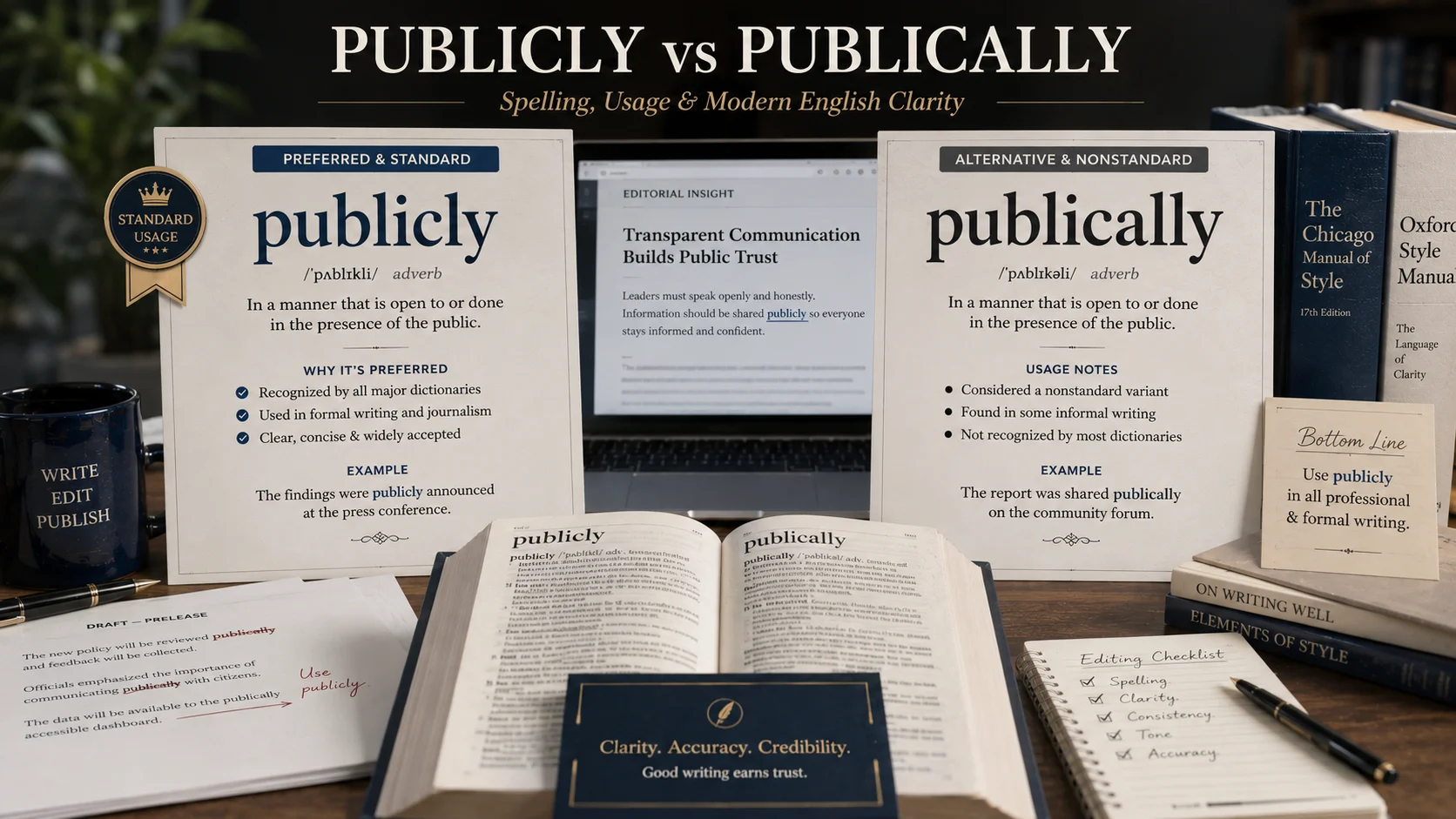
Publicly is the standard and widely accepted spelling of the adverb meaning in an open, visible, or public manner. Publically is sometimes encountered, but it is generally considered a less preferred variant and is best avoided in formal, academic, professional, and edited writing.
Publicly or Publically | What Is the Difference?
The main difference is spelling and standard usage. Publicly is the established standard form of the adverb derived from the adjective public. It means something is done openly, openly before other people, or in a manner accessible to the public.
Publically also appears in English, and readers can understand its meaning, but it is much less common and is generally treated as a nonstandard or less preferred spelling. In polished writing, publicly is the safer and more widely accepted choice.
The confusion often happens because many adverbs are formed by adding ly directly to an adjective. Since the adjective is public, some writers naturally expect the adverb to be publicly while others instinctively insert an extra al and produce publically.
| Word | Part of speech | Meaning | Standard usage | Example |
|---|---|---|---|---|
| Publicly | Adverb | In an open or public manner | Preferred standard form | The company publicly announced the decision. |
| Publically | Adverb | In a public manner | Less preferred variant | The spelling may appear in some sources, but publicly is normally preferred. |
Quick recap
Publicly is the standard spelling used in modern edited English.
Publically is understandable but considerably less preferred.
For professional, academic, business, and website content, choose publicly.
The safest rule is simple: when you need the adverb of public, write publicly.
Is Publicly or Publically a Grammar, Vocabulary or Usage Issue?
The question is primarily a spelling and usage issue, rather than a major grammar problem.
Both forms are intended to function as adverbs. They modify a verb by explaining that an action happens openly or before the public.
For example:
The politician publicly apologized.
Here, publicly tells us how the politician apologized.
The important distinction is not usually meaning. It is standardness and editorial preference.
Are publicly and publically interchangeable?
In a broad sense, readers may understand both forms to have the same intended meaning. However, that doesn’t make them equally suitable in every context.
Publicly is overwhelmingly the safer choice when writing for a broad audience. It is the form most readers expect in edited prose, professional communication, journalism, educational material, and business writing.
Publically can occasionally be found in published material, historical texts, dictionaries, or informal writing. Its existence does not mean it is the preferred spelling for modern standard English.
Formal versus informal usage
In formal writing, publicly should be your default.
Consider these examples:
The organization publicly confirmed the allegations.
The professor publicly criticized the proposed method.
The company publicly disclosed its annual results.
Each sentence sounds natural because publicly is the conventional adverbial form.
In casual writing, you may occasionally encounter publically, especially when someone is spelling the word according to how they perceive its structure. Even then, choosing publicly avoids unnecessary questions about correctness.
Academic versus casual usage
Academic writing places a particularly strong emphasis on consistency and accepted conventions.
A research paper might say:
The researchers publicly released the findings.
A thesis might say:
The institution publicly acknowledged the limitations of the study.
Using publicly keeps the prose conventional and professional.
Usage recap: The two forms are understandable in context, but publicly is the preferred choice for standard contemporary English.
How to Use Publicly Correctly
Publicly functions as an adverb. It normally modifies a verb and describes something done openly, officially, or in front of other people.
The word can describe statements, announcements, apologies, criticism, support, disagreement, disclosure, recognition, and many other actions.
Workplace example
The manager publicly thanked the team for completing the project.
Here, publicly explains that the manager gave the thanks openly rather than privately.
Another example is:
The company publicly announced its new policy.
This wording is particularly natural in business communication.
Academic example
The university publicly released the research findings.
The sentence indicates that the findings were made available openly.
Another example:
The researcher publicly responded to the criticism.
Again, publicly modifies responded.
Technology example
The software company publicly disclosed the security issue.
This is common language in technology reporting because companies may announce vulnerabilities, updates, policy changes, or product decisions to users and the wider public.
Usage recap
Use publicly when you mean openly, officially, or before the public.
It is the preferred spelling in edited English.
It works naturally in business, academic, journalistic, technological, and everyday contexts.
How to Understand Publically
Publically is intended to function as an adverb with essentially the same meaning as publicly. The difficulty is that it is not the form most editors would normally recommend.
A writer might produce:
The organization publically addressed the complaint.
The intended meaning is perfectly understandable. However, an editor would generally change the sentence to:
The organization publicly addressed the complaint.
This is why the issue matters more for standard usage than for basic comprehension.
Workplace example
Less preferred:
The director publically rejected the proposal.
Preferred:
The director publicly rejected the proposal.
Academic example
Less preferred:
The author publically discussed the limitations.
Preferred:
The author publicly discussed the limitations.
Technology example
Less preferred:
The company publically announced the update.
Preferred:
The company publicly announced the update.
Usage recap
Publically can be understood, but it is not the best choice when you want polished standard English.
If you’re writing something that will be published, submitted, reviewed, or professionally edited, publicly is the better option.
When You Should NOT Use Publicly or Publically
Although publicly is usually the correct choice between the two spellings, there are situations where neither word is necessary.
1. When you mean privately
If an action occurs away from public attention, use privately.
The manager privately discussed the issue with the employee.
2. When you mean secretly
If something happens without others knowing, secretly may be more precise.
The two companies secretly negotiated the agreement.
3. When you mean openly
Sometimes openly communicates the meaning more naturally.
She openly admitted her mistake.
Publicly and openly can overlap, but they aren’t always identical.
4. When you mean officially
Officially may be better when the emphasis is on formal confirmation rather than public visibility.
The organization officially confirmed the appointment.
5. When you mean in front of an audience
In front of the audience can be more specific when physical presence matters.
The speaker answered the question in front of the audience.
6. When the context already establishes public visibility
Adding publicly can sometimes create unnecessary repetition.
The announcement was released to the public.
In this sentence, publicly may not add useful information.
7. When another adverb is more precise
Good writing chooses the most exact word rather than simply adding an adverb.
Instead of:
The company publicly officially announced the decision.
Write:
The company officially announced the decision.
Precision is more valuable than repetition.
Common Mistakes: Publicly or Publically
| Correct sentence | Incorrect or less preferred sentence | Explanation |
|---|---|---|
| The company publicly announced the change. | The company publically announced the change. | Publicly is the preferred standard spelling. |
| She publicly apologized. | She publically apologized. | Publicly is the conventional adverb. |
| The researcher publicly shared the results. | The researcher publically shared the results. | Use publicly in formal and academic prose. |
| The organization publicly supported the proposal. | The organization publically supported the proposal. | Publicly is the safer editorial choice. |
| The actor publicly addressed the rumor. | The actor publically addressed the rumor. | Publicly is preferred in polished writing. |
Decision Rule
If you mean something happens openly, officially, or before the public, use publicly.
If you encounter publically, understand the intended meaning, but choose publicly when you need the standard and widely preferred form.
Why Is Publicly Spelled Without the Extra Al?
The spelling becomes easier to remember when you look at the structure of the word.
The adjective is public.
When the adverbial ending ly is added, the word becomes publicly.
The extra al in publically is therefore unnecessary in the standard form.
Compare:
public → publicly
Rather than:
public → publical → publically
This pattern is not unique to English. Writers sometimes add letters because they perceive a word as needing a more familiar structural pattern. In this case, however, standard usage has settled strongly around publicly.
Publicly or Publically in Modern Technology and AI Tools
Digital communication makes this distinction more important, not less.
Websites, software documentation, artificial intelligence systems, corporate announcements, social media posts, and online publications frequently use language that describes information being made available to the public.
For example:
The platform publicly displays the user’s profile information.
The developer publicly released the source code.
The company publicly explained how the system works.
Search engines and AI writing systems may encounter both spellings because online content contains enormous amounts of user generated and published material. However, frequency of appearance alone does not determine which form is best for formal writing.
For editors and content creators, the practical rule remains straightforward: choose publicly when producing polished contemporary English.
Etymology and Word Formation
The word public ultimately traces back through French and Latin to a term associated with the people and the commonwealth.
English developed the adjective public to describe something connected with the community or people generally.
The adverb publicly then developed naturally from public plus the adverbial ending ly.
This helps explain why publicly has become the established form. The word doesn’t need an additional al before ly because public already functions as the base adjective.
Understanding word formation can be more useful than memorizing isolated spelling rules. Once you recognize public as the complete base word, publicly becomes much easier to remember.
An Editorial Principle for Choosing the Correct Form
A useful editorial principle is: When two spellings communicate the same basic idea, prefer the form that is most established in contemporary edited English.
That principle is especially valuable when writing for universities, businesses, newspapers, websites, publishers, and professional organizations.
The goal isn’t simply to produce a word that readers can understand. Strong writing also aims for consistency, familiarity, precision, and credibility.
Practical Case Studies
Case Study 1: Business website editing
Imagine a company website containing 12 instances of publically across its About page, newsroom, and policy pages.
An editorial review changes all 12 instances to publicly.
The meaning does not change. What changes is consistency with the spelling expected in polished business English. The final website contains one consistent standard form instead of two competing spellings.
Concrete result: 12 instances are standardized without changing the underlying meaning or sentence structure.
Case Study 2: Academic proofreading
Consider a 5,000 word academic paper containing six uses of publically.
A proofreading pass changes each occurrence to publicly.
Again, no argument or research claim changes. The revision simply removes a recurring spelling variation that may distract readers from the substance of the paper.
Concrete result: six occurrences are corrected while the paper’s meaning, evidence, and conclusions remain unchanged.
These examples demonstrate an important point: the problem with publically is usually not comprehension. It is editorial suitability.
Publicly or Publically: Error Prevention Checklist
Always use publicly when
You are writing a formal article.
You are preparing academic work.
You are writing business communication.
You are creating website content.
You are publishing professional material.
You want the most widely accepted modern form.
You are writing for an international English speaking audience.
Never prefer publically when
You are submitting edited academic writing.
You are preparing professional documentation.
You are writing polished marketing content.
You are producing content for publication.
You want to avoid a spelling form that may be questioned by editors.
Related Grammar Confusions You Should Master
Learning publicly versus publically is useful, but it belongs to a larger group of English spelling and usage questions.
Affect versus Effect
Affect is commonly used as a verb, while effect is commonly used as a noun.
Compliment versus Complement
A compliment expresses praise, while a complement completes or enhances something.
Principal versus Principle
Principal can refer to a person or something primary, while principle refers to a fundamental rule or belief.
Stationary versus Stationery
Stationary means staying still, while stationery refers to writing materials.
Practice versus Practise
Practice is the standard noun in both major varieties of English, while practise is commonly used as the verb in British English.
License versus Licence
American English normally uses license for both noun and verb, while British English commonly distinguishes license as a noun and licence as a verb.
Advice versus Advise
Advice is a noun, while advise is a verb.
Its versus It’s
Its indicates possession, while it’s is a contraction of it is or it has.
Your versus You’re
Your indicates possession, while you’re means you are.
Their versus There versus They’re
Their indicates possession, there refers to a place or existence, and they’re means they are.
Mastering these distinctions improves both accuracy and overall writing confidence.
FAQs
Is publicly or publically correct?
Publicly is the preferred standard spelling in contemporary English. Publically is understandable but much less preferred.
Is publically a real word?
Publically can be found in English usage, but it is generally treated as a less preferred variant. Publicly is the safer choice for standard edited writing.
Why is publicly spelled without an extra al?
Publicly is formed from the adjective public and the adverbial ending ly. The additional al in publically is unnecessary in the standard form.
Can I use publically in academic writing?
It is better to use publicly in academic writing because it is the established and widely preferred form.
Is publicly more common than publically?
Yes. Publicly is substantially more established in contemporary standard English and is the form most writers should choose.
What does publicly mean?
Publicly means in a manner that is open, visible, official, or accessible to the public.
Is publically grammatically wrong?
The issue is better understood as one of spelling and usage than basic grammar. Publicly is the preferred standard form.
How do I remember publicly?
Remember the simple formation public plus ly, which gives publicly.
Should I write publicly in professional documents?
Yes. Publicly is the clearest and safest choice for professional, academic, business, and published writing.
Conclusion
When choosing between publicly or publically, publicly is the clear practical choice for modern standard English. It is the established spelling used when describing something done openly, officially, or before the public.
Publically may appear in some sources, but there is little reason to choose it when publicly is available. For essays, business documents, websites, journalism, professional communication, and academic writing, use publicly.
The easiest memory rule is equally simple: public + ly = publicly.
Once you remember that structure, this spelling question becomes much easier. More importantly, choosing the standard form helps your writing look polished, consistent, and authoritative.
Discover More Related Articles:
- Cant or Can’t | How One Apostrophe Changes Everything In 2026
- Sew or Sow | Meaning, Difference & Correct Usage In 2026
- Short or Tall | Understanding Height Terms & Correct Usage In 2026