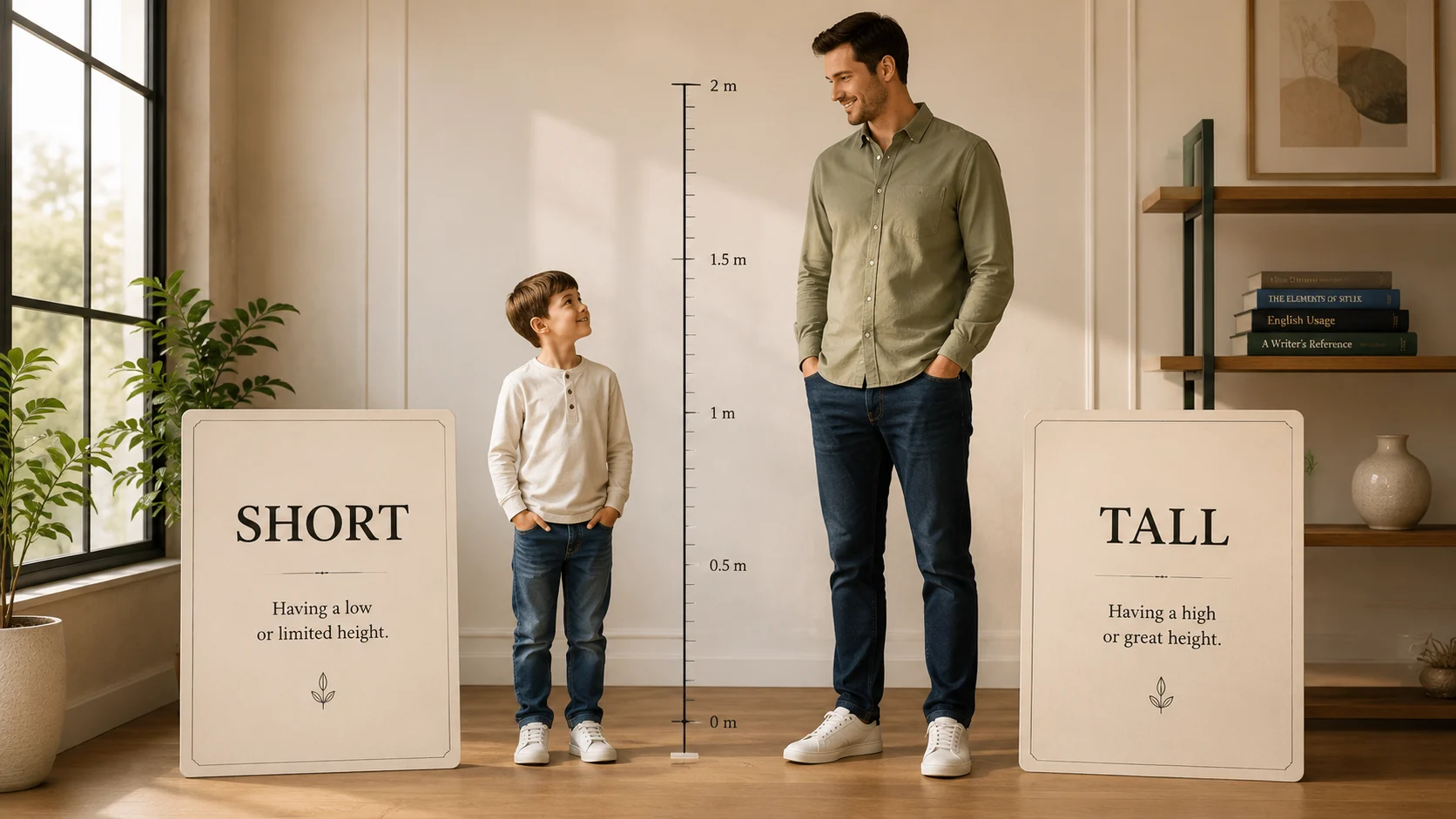
When comparing a person’s height, short or tall describes someone is below or above the usual height expected in a particular context. Short means having relatively little height, while tall means having relatively great height. Neither word is automatically positive or negative and the correct choice depends on the comparison being made.
What is the difference between short and tall, and how do you know which word to use in the right context? Although both words describe height, they express opposite ideas and can influence how clearly you communicate. From describing a person’s physical appearance to comparing buildings, objects, or everyday items, choosing the correct word helps readers understand exactly what you mean. However, their usage can sometimes depend on what you are describing and the context of the sentence.
In this guide, we’ll explore short vs. tall, including their meanings, differences, and practical examples to help you use each word confidently. You’ll learn when to describe someone or something as short and when tall is the more appropriate choice. With clear explanations and real-life examples, this comparison makes the distinction easy to understand for students, English learners, and anyone looking to improve their vocabulary. By the end, you’ll know how to use both words naturally in everyday conversations and professional writing.
Short or Tall | What’s the Difference?
Short and tall are opposite adjectives that describe relative height. Short means having less than the usual or expected height. Tall means having more than the usual or expected height.
The important point is that neither adjective has one universal numerical definition. English speakers usually understand height in relation to context. A child may be tall for their age but still short compared with an adult. A building may be short compared with a skyscraper but tall compared with a house.
| Term | Part of Speech | Basic Meaning | Common Use | Example |
|---|---|---|---|---|
| Short | Adjective | Having relatively little height | People, buildings, trees, objects, periods of time | She is shorter than her sister. |
| Tall | Adjective | Having relatively great height | People, buildings, trees, structures, objects with vertical shape | He is very tall for his age. |
| Shorter | Comparative adjective | Having less height than another thing | Direct comparisons | This shelf is shorter than that one. |
| Taller | Comparative adjective | Having greater height than another thing | Direct comparisons | This tree is taller than the old one. |
| Height | Noun | The measurement from bottom to top | People and objects | What is the height of the building? |
A useful distinction is that short and tall describe relative height, while height names the measurement itself.
For people, tall and short are especially common and natural. For many objects, however, English speakers may choose words such as low, high, small, large, or compact depending on the shape and purpose of the object.
For example, a person can naturally be described as tall or short. A chair can be described as tall or short, but low may be more appropriate when discussing its seating position. A wall may be described as high rather than tall when the emphasis is on vertical distance.
In simple terms, short points toward less vertical height, while tall points toward greater vertical height.
Is Short or Tall a Grammar, Vocabulary or Usage Issue?
The difference is primarily a vocabulary and usage issue, rather than a complicated grammar rule. Both words are grammatically correct adjectives, but they cannot normally be substituted for each other because they communicate opposite meanings.
The basic grammatical pattern is straightforward:
Subject + be + adjective
For example:
Sarah is short.
Daniel is tall.
You can also use comparative forms when comparing two people or objects.
Sarah is shorter than Maria.
Daniel is taller than his brother.
The superlative forms are shortest and tallest.
She is the shortest person in the group.
He is the tallest player on the team.
The words are suitable in formal and informal English. Academic writing may use them when discussing measurable characteristics, although a more precise measurement may be preferred in scientific contexts.
In casual conversation, people frequently use tall and short without giving an exact measurement. That is perfectly natural because ordinary conversation usually depends on relative impressions rather than exact statistics.
The key is sensitivity. Although short and tall are neutral descriptive words in many contexts, describing someone’s height can sometimes be socially delicate. In professional or formal communication, it is better to mention height only when it is relevant.
How to Use Short Correctly
Short describes something that has relatively little height. When talking about people, it generally means that the person has less height than is typical for the relevant population or group.
A person can say:
I am fairly short.
She is shorter than her brother.
The child is short for his age.
These sentences are grammatically correct because the adjective describes physical height.
Workplace Example
A workplace might need to describe equipment, furniture, or people for practical reasons.
The storage cabinet is too short for the equipment.
The technician selected a short ladder for the indoor repair.
When describing a colleague’s physical height, however, the information should have a genuine practical purpose. For example, a clothing or safety equipment context may make height relevant.
Academic Example
Academic writing may use short when discussing height differences among groups.
The study examined younger participants were shorter on average than older participants.
In a research context, short should not replace precise measurements when accuracy matters. A scientific report might give an average height in centimeters or inches rather than relying only on a subjective adjective.
Technology Example
Technology often uses height as a design measurement.
The monitor stand is too short for the user’s preferred viewing position.
The device has a short vertical profile.
Here, short describes physical dimensions rather than a person’s height.
Usage recap: Use short when you mean relatively little vertical height. For precise technical or scientific communication, give an actual measurement when possible.
How to Use Tall Correctly
Tall describes something that has relatively great height. It is particularly natural when describing people, trees, buildings, towers, and other objects with a noticeable vertical dimension.
Common examples include:
My brother is very tall.
That tree is taller than the others.
They live in a tall apartment building.
Tall is especially common with people. English speakers normally say that someone is tall rather than high.
For example:
She is tall.
He is a tall man.
That child is unusually tall for his age.
Workplace Example
In a workplace, tall can describe people when height is relevant to a task, or it can describe physical objects.
The tall employee adjusted the overhead equipment.
The office has tall windows that provide more natural light.
The second example is especially natural because windows have a strong vertical dimension.
Academic Example
Tall can appear in educational and research contexts when describing measurable characteristics.
The researchers found that the taller participants tended to have longer reach.
Again, academic writing may require numerical measurements rather than relying entirely on tall.
Technology Example
Technology products can have tall or vertically oriented designs.
The new speaker has a tall, narrow design.
The tall display allows more information to appear on the screen at once.
Here, tall describes the shape and proportions of the product.
Usage recap: Use tall when something has relatively great vertical height. For exact technical comparisons, combine the adjective with a numerical measurement.
When You Should NOT Use Short or Tall
Knowing when not to use these words is just as important as knowing when to use them. English has several alternative expressions that may be more precise.
- Do not use tall when you really mean high.
The mountain is high is more natural than the mountain is tall.
- Do not automatically use short for every object with limited vertical measurement.
A low table is usually more natural than a short table when discussing its position from the floor.
- Do not use short or tall when an exact measurement is required.
Instead of saying the box is tall, a technical document may need to state that it is 60 centimeters high.
- Do not assume that tall and short are absolute categories.
Someone can be tall for their age without being tall compared with every adult.
- Do not use height descriptions when they are irrelevant in professional communication.
Unnecessary comments about someone’s body can sound inappropriate even when the vocabulary itself is grammatically correct.
- Do not confuse tall with high in every context.
Tall usually emphasizes vertical shape or physical stature, while high often emphasizes position, elevation, or distance above a reference point.
- Do not use short when you mean brief.
Short can describe both physical dimensions and duration, but the intended meaning must be clear from context.
- Do not use tall and short as measurements.
They are descriptive adjectives, not standardized units.
Common Mistakes and Decision Rules
| Correct sentence | Incorrect sentence | Explanation |
|---|---|---|
| She is short. | She is high. | People are normally described as short or tall when discussing physical height. |
| He is tall. | He is high. | Tall is the natural adjective for a person’s physical stature. |
| The building is tall. | The building is short in height. | Tall is natural when emphasizing a building’s vertical structure. |
| The mountain is high. | The mountain is tall. | High is generally more natural for elevation or distance above sea level. |
| The table is low. | The table is short. | Low often better describes furniture positioned close to the floor. |
| The tower is tall. | The tower is high. | Both can occur, but tall emphasizes the tower’s vertical form. |
| He is taller than me. | He is more tall than me. | Tall normally takes the comparative form taller. |
| She is the tallest student. | She is the most tall student. | Tall normally forms its superlative as tallest. |
Decision Rule Box
If you mean relatively little physical height, use short.
If you mean relatively great physical height, use tall.
If you mean elevation or distance above a reference point, high may be more appropriate.
If you mean furniture or an object positioned close to the floor, low may be more natural.
This decision rule prevents one of the most common problems in height vocabulary: assuming that tall and high are interchangeable simply because both can relate to vertical distance.
Short and Tall in Modern Technology and AI Tools
Modern technology frequently uses height related vocabulary when describing physical products, interfaces, displays, robots, buildings, and digital visualization.
A product designer might describe a device as tall and narrow. A technical specification may instead give its exact dimensions. An artificial intelligence system generating an image might interpret tall as a strong vertical proportion rather than a specific numerical measurement.
AI tools also depend heavily on context. If a prompt says “a tall building,” the system generally understands that the building should appear vertically prominent. If a prompt says “a high building,” the intended meaning may overlap, but tall usually gives a stronger visual description of vertical form.
This difference matters when writing prompts, product descriptions, accessibility documentation, or technical instructions. Clear language produces more predictable results.
For exact results, combine descriptive language with measurements. For example, “a tall cabinet measuring 180 centimeters in height” is considerably more precise than simply saying “a tall cabinet.”
Etymology and Language History
The English adjective short has roots in Old English sceort, which referred to limited length or extent. Over time, its meaning developed across several dimensions, including physical length, duration, distance, and height.
Tall has a more interesting history. Earlier forms were associated with ideas such as being sturdy, proper, or well built. Over centuries, its meaning became increasingly connected with greater than average height, particularly when describing people and vertically extended objects.
This history helps explain why these words are not simply mathematical labels. Their modern meanings developed through ordinary descriptions of size, proportion, and physical form.
An expert style explanation would be: “Height adjectives describe physical proportion relative to an understood reference point, so their meaning depends on context rather than one universal numerical threshold.”
Two Practical Case Studies
Case Study One: Clothing and Retail
Imagine a clothing store serving customers with different body proportions. A product description that says “suitable for tall customers” communicates a useful general category. However, a professional sizing guide should provide inseam length, garment length, sleeve length, and other exact measurements.
The result is better communication because tall functions as a broad descriptive label while numerical measurements provide precision.
Case Study Two: Interior Design
Consider a furniture company describing a chair. Calling it a tall chair may be understandable, but customers may actually need to know the seat height.
A product page that says “tall chair with a 75 centimeter seat height” gives both a quick descriptive impression and a measurable specification. This reduces ambiguity and helps customers choose correctly.
These examples demonstrate an important principle: descriptive adjectives are excellent for general communication, while measurements are better when decisions depend on precision.
Error Prevention Checklist
Always use short when
- You mean relatively little physical height.
- You are describing a person’s stature as lower than the relevant norm.
- You are comparing vertical dimensions and one item has less height.
- You are discussing limited height in an informal or general context.
Never use tall when
- You actually mean high elevation.
- You are describing something whose important measurement is distance above the ground rather than vertical form.
- You need a precise measurement and have not supplied one.
- You are using the word merely because something is large.
- A more specific adjective such as high or low communicates the intended meaning better.
Related Grammar Confusions You Should Master
Understanding height vocabulary becomes easier when you study related adjective contrasts. Useful topics include high vs tall, low vs short, big vs large, little vs small, long vs short, wide vs broad, thin vs slim, farther vs further, older vs elder, and fewer vs less.
These pairs demonstrate an important feature of English vocabulary: words that appear similar often differ in collocation, context, tone, or grammatical behavior.
Learning the difference between these terms improves both everyday communication and formal writing because it helps you choose words according to meaning rather than relying on literal translation.
FAQs
Is short or tall correct when describing a person’s height?
Both are correct. Use short for relatively little height and tall for relatively great height.
Is it better to say tall or high for a person?
Use tall for a person’s physical stature. High is generally used for elevation, position, or distance above a reference point.
Can a person be short and tall at the same time?
Not in the same comparison. However, someone can be tall for one group and short for another because height is relative to context.
What is the comparative form of tall?
The comparative form is taller. For example, “James is taller than Mark.”
What is the superlative form of tall?
The superlative form is tallest. For example, “She is the tallest student in the class.”
Can short describe objects?
Yes. Short can describe objects with relatively little vertical height, although words such as low may sometimes sound more natural.
Should I use tall or high for a building?
Both can occur, but tall is particularly natural when emphasizing the building’s vertical structure. High can emphasize elevation or position.
Does short always mean a person is below average height?
Not necessarily. It is a relative description whose interpretation depends on the comparison group and context.
Is short a negative word?
Not inherently. It is a neutral adjective, although comments about someone’s physical appearance should be made with appropriate sensitivity.
Conclusion
The difference between short and tall is straightforward once you understand that both adjectives describe relative height. Short refers to relatively little height, while tall refers to relatively great height. The correct choice depends on the person or object being described and the comparison implied by the context.
For people, tall and short are the natural everyday choices. For buildings and vertically shaped objects, tall is often appropriate. For elevation, high may be better, while low can be preferable for furniture and objects positioned close to the floor. When precision matters, an exact measurement is better than either adjective.
Ultimately, choosing between short or tall is less about memorizing a rigid grammar rule and more about understanding context, collocation, proportion, and communicative purpose.
Discover More Related Articles:
- Vallies or Valleys | Never Misspell This Word Again in 2026
- Dryed or Dried | The Correct Spelling & Usage Guide Today In 2026
- Traveler or Traveller | British vs American English Made Simple In 2026