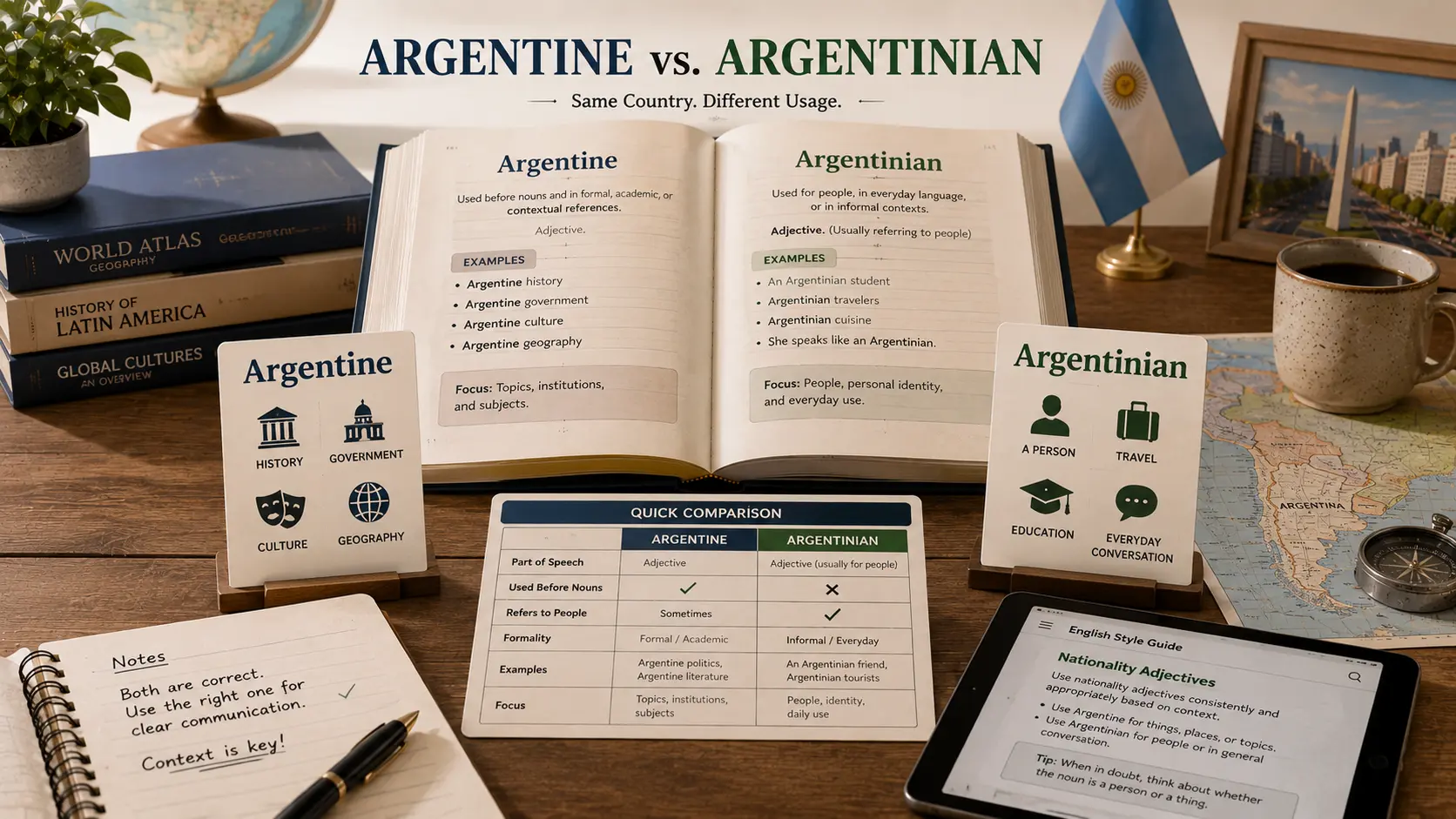
Argentine or Argentinian both refer to something or someone from Argentina, but they are not always used in the same way. Argentinian is the more common choice in modern English, especially when referring to people, while Argentine often appears in formal writing, historical contexts, or as an adjective for places, culture, and institutions.
The question argentine or argentinian often confuses English learners, writers, journalists, and even native speakers. Since both words describe a connection to Argentina, many people assume they are completely interchangeable. In reality, each term has its own history, tone, and preferred contexts.
Choosing the wrong one may make your writing sound outdated, overly formal, or less natural. Understanding the distinction helps you communicate more clearly in academic writing, business communication, travel content, and everyday conversations.
Argentine vs Argentinian | What’s the Difference?
Although both words describe a connection with Argentina, modern English favors one more than the other in everyday communication.
| Feature | Argentine | Argentinian |
|---|---|---|
| Part of speech | Adjective and noun | Adjective and noun |
| Meaning | A person or thing from Argentina | A person or thing from Argentina |
| Common usage | More formal and traditional | More common in modern English |
| Best for people | Less common today | Preferred in most contexts |
| Best for culture or institutions | Frequently used | Also acceptable |
| Tone | Formal, literary, historical | Neutral and conversational |
Both words are grammatically correct. The difference lies mainly in usage rather than meaning. If you are writing for a broad audience, Argentinian will usually sound more natural when referring to people. Argentine remains appropriate in formal writing, historical discussions, and certain established names.
Is Argentine or Argentinian a Grammar, Vocabulary or Usage Issue?
This confusion is primarily a usage issue, not a grammar mistake. English recognizes both words as correct demonyms, meaning words that identify people or things from a particular country.
From a grammatical perspective, both function correctly as nouns and adjectives.
Examples as nouns:
- She is an Argentinian.
- He is an Argentine.
Examples as adjectives:
- We enjoyed Argentinian cuisine.
- The museum displayed Argentine artwork.
The real difference comes from modern language preference.
In formal publications, newspapers, and historical texts, Argentine appears regularly. In everyday English, international media, classrooms, and casual conversations, Argentinian has become the more familiar choice when describing people.
Academic writing accepts either form, provided the usage remains consistent throughout the document.
Practical Usage of Argentine
The word Argentine has a long history in English and still appears in many respected publications. It often gives writing a formal or traditional tone.
When describing national institutions, geography, economics, sports organizations, or historical events, many editors still prefer Argentine.
Workplace Example
The company expanded its partnerships with several Argentine manufacturing firms.
This sentence sounds polished and professional because it refers to businesses rather than individual people.
Academic Example
Researchers examined the growth of the Argentine economy during the late twentieth century.
Scholarly writing frequently uses Argentine when discussing economics, politics, history, or geography.
Technology Example
The software company opened a new Argentine data center to improve regional services.
In technical and business communication, Argentine often describes locations, companies, infrastructure, or markets.
Additional Examples
The documentary explored Argentine history through rare archival footage.
The university offers courses on Argentine literature.
Visitors admired Argentine architecture throughout Buenos Aires.
The report analyzed Argentine agricultural exports.
The festival celebrated Argentine music and dance traditions.
These examples show that Argentine comfortably modifies places, institutions, culture, industries, and national topics.
Usage Recap
Use Argentine when your writing has a formal, academic, historical, or professional tone. It is especially suitable for describing institutions, culture, history, geography, business, economics, and official subjects rather than individual people.
Practical Usage of Argentinian
Today, Argentinian is the preferred choice when referring to people from Argentina in everyday English. It sounds natural, modern, and is widely used by international media, educators, travel writers, and native speakers.
While it can also describe food, culture, traditions, and products, its greatest strength is identifying individuals or groups of people.
Workplace Example
Our newest team member is an Argentinian software engineer with extensive experience in cloud computing.
This sentence feels conversational and current because it refers directly to a person.
Academic Example
The conference welcomed several Argentinian researchers who presented studies on climate change.
Universities and educational publications commonly use Argentinian when discussing students, scholars, or professionals.
Technology Example
An Argentinian developer created the application that won the international innovation award.
Technology news and startup articles frequently use Argentinian when highlighting founders, programmers, entrepreneurs, and designers.
Additional Examples
She is an Argentinian artist whose paintings are exhibited worldwide.
The restaurant hired an Argentinian chef known for authentic cuisine.
Many Argentinian athletes competed in the international championship.
An Argentinian author received the prestigious literary prize.
The documentary followed the lives of several Argentinian musicians.
These examples demonstrate that Argentinian is especially suitable when describing people, professions, talents, and achievements.
Usage Recap
Use Argentinian when referring to people in modern English. It is the most natural choice for everyday conversation, journalism, education, travel writing, and business communication. Although it also works as an adjective, it is especially common when identifying individuals or groups.
When You Should NOT Use X or Y
Even though both words are correct, there are situations where one choice sounds more appropriate than the other.
| Situation | Better Choice | Reason |
|---|---|---|
| Referring to an individual in everyday conversation | Argentinian | Sounds more natural in modern English. |
| Writing about historical events or official institutions | Argentine | Often preferred in formal and historical writing. |
| Mixing both words throughout one article | Avoid | Choose one style and remain consistent. |
| Assuming one word is grammatically incorrect | Avoid | Both are accepted English words. |
| Replacing official organization names | Avoid | Keep the official wording unchanged. |
| Copying another country’s naming pattern | Avoid | Every country’s demonym follows its own convention. |
| Writing for an international audience | Argentinian | More widely recognized today. |
| Editing quotations or historical documents | Avoid | Preserve the original wording. |
Consistency is often more important than choosing one word over the other. Once you decide which form fits your audience and style, use it throughout the document.
Common Mistakes and Decision Rules
| Correct Sentence | Incorrect Sentence | Explanation |
|---|---|---|
| She is an Argentinian scientist. | She is an Argentinean scientist. | Argentinean is a misspelling in standard English. |
| The report examined the Argentine economy. | The report examined the Argentinian economy in a historical document that consistently uses Argentine. | Match the style used throughout the publication. |
| Several Argentinian students joined the program. | Several Argentine students joined the program if the document consistently uses Argentinian. | Maintain consistency. |
| The museum displays Argentine art. | The museum displays Argentinian art in a publication that officially uses Argentine. | Respect established editorial style. |
| He is an Argentinian musician. | He is an Argentine musician in casual conversation where Argentinian is expected. | Modern English generally prefers Argentinian for people. |
| The university studies Argentine history. | The university studies Argentinian history in a text following traditional academic style. | Academic publications often favor Argentine. |
Decision Rule Box
If you mean a person in modern everyday English, use Argentinian.
If you are referring to official, historical, cultural, geographic, or institutional subjects, Argentine is often the preferred choice.
Argentine or Argentinian in Modern Technology and AI Tools
Artificial intelligence systems, search engines, translation software, and grammar checkers generally recognize both Argentine and Argentinian as correct. However, many AI writing assistants suggest Argentinian when describing people because it reflects current English usage. Editorial tools may recommend Argentine in formal reports, historical discussions, or established institutional names.
Etymology
The word Argentine entered English from French and ultimately traces back to the Latin word argentum, meaning silver. Argentina itself was named after this Latin root because early European explorers associated the region with stories of abundant silver.
Argentinian developed later as an English formation following the common pattern used for many nationalities. Over time, it became the more familiar term for referring to people from Argentina in everyday speech.
“Good writing is not only grammatically correct. It also reflects the expectations of modern readers and the context in which words are used.”
Case Study One
An international travel website updated more than 300 destination guides by replacing inconsistent nationality references with Argentinian when discussing people while retaining Argentine in official place names and historical content. Reader engagement improved because the articles sounded more natural without sacrificing accuracy.
Case Study Two
A university history department revised its research publications by consistently using Argentine for political, economic, and historical discussions. Editors reported fewer style corrections and improved consistency across multiple academic journals.
Error Prevention Checklist
Before publishing or submitting your writing, use this quick checklist to ensure you have chosen the correct word.
Always Use Argentine When
- Referring to the country’s history or politics.
- Describing official institutions or government organizations.
- Writing about the national economy or geography.
- Following a formal academic or editorial style.
- Keeping consistency in historical publications.
Never Use Argentine When
- Referring to a person in everyday modern English if your audience expects contemporary usage.
- Mixing it randomly with Argentinian in the same article.
- Changing the official wording of an organization or publication.
- Assuming it is the only grammatically correct option.
Always Use Argentinian When
- Referring to an individual from Argentina.
- Writing for general readers or international audiences.
- Creating travel, education, or lifestyle content.
- Describing professionals, students, athletes, or artists.
- Using a modern conversational tone.
Never Use Argentinian When
- Editing historical documents that consistently use Argentine.
- Replacing official institutional names.
- Changing quoted material.
- Ignoring the editorial style guide of a publication.
Related Grammar Confusions You Should Master
If you found this topic helpful, you may also want to learn these commonly confused word pairs.
- American or US American
- English or British
- Scottish or Scotch
- Hispanic or Latino
- British or English
- Catalan or Catalonian
- Czech or Czechian
- Dutch or Hollander
- Spaniard or Spanish
- Turk or Turkish
Learning these nationality terms will improve your accuracy and help your writing sound more natural in both professional and everyday contexts.
FAQs
Is Argentinian or Argentine more correct?
Both are grammatically correct. Modern English usually prefers Argentinian for people, while Argentine often appears in formal and historical contexts.
Should I call someone Argentine or Argentinian?
In everyday English, Argentinian is generally the more natural choice when referring to a person from Argentina.
Why do some newspapers use Argentine instead of Argentinian?
Many newspapers follow long established editorial style guides that prefer Argentine for formal reporting and historical consistency.
Can Argentine and Argentinian be used interchangeably?
Yes, they usually share the same meaning, but one may sound more natural depending on the audience and writing style.
Is Argentine an adjective or a noun?
It functions as both. It can describe something related to Argentina or refer to a person from the country.
Is Argentinian accepted in academic writing?
Yes. Most universities and academic publishers accept Argentinian, although some style guides continue to favor Argentine.
Which word do native English speakers use most often?
Native speakers generally use Argentinian more frequently when talking about people in everyday conversation.
Do grammar checkers accept both words?
Yes. Most grammar and AI writing tools recognize both spellings as correct and may suggest one based on context.
Conclusion
Choosing between argentine or argentinian is less about grammar and more about context, audience, and writing style. Both words are accepted in English and describe a connection to Argentina. However, Argentinian is generally the preferred choice when referring to people in modern English, while Argentine remains common in formal writing, historical discussions, and references to institutions, culture, geography, and economics.
The most important rule is consistency. Once you choose the form that matches your audience and editorial style, use it throughout your writing. By understanding the subtle distinction between these two demonyms, you can produce clearer, more professional, and more natural English in academic papers, business communication, travel writing, and everyday conversation.
Discover More Related Articles:
- Geez or Jeez | What Is the Difference & Which One Should You Use In 2026
- Grammer or Grammar | Which Spelling Is Correct & Why It Matters In 2026
- Forgo or Forego | The Small Spelling Difference That Changes Meaning In 2026