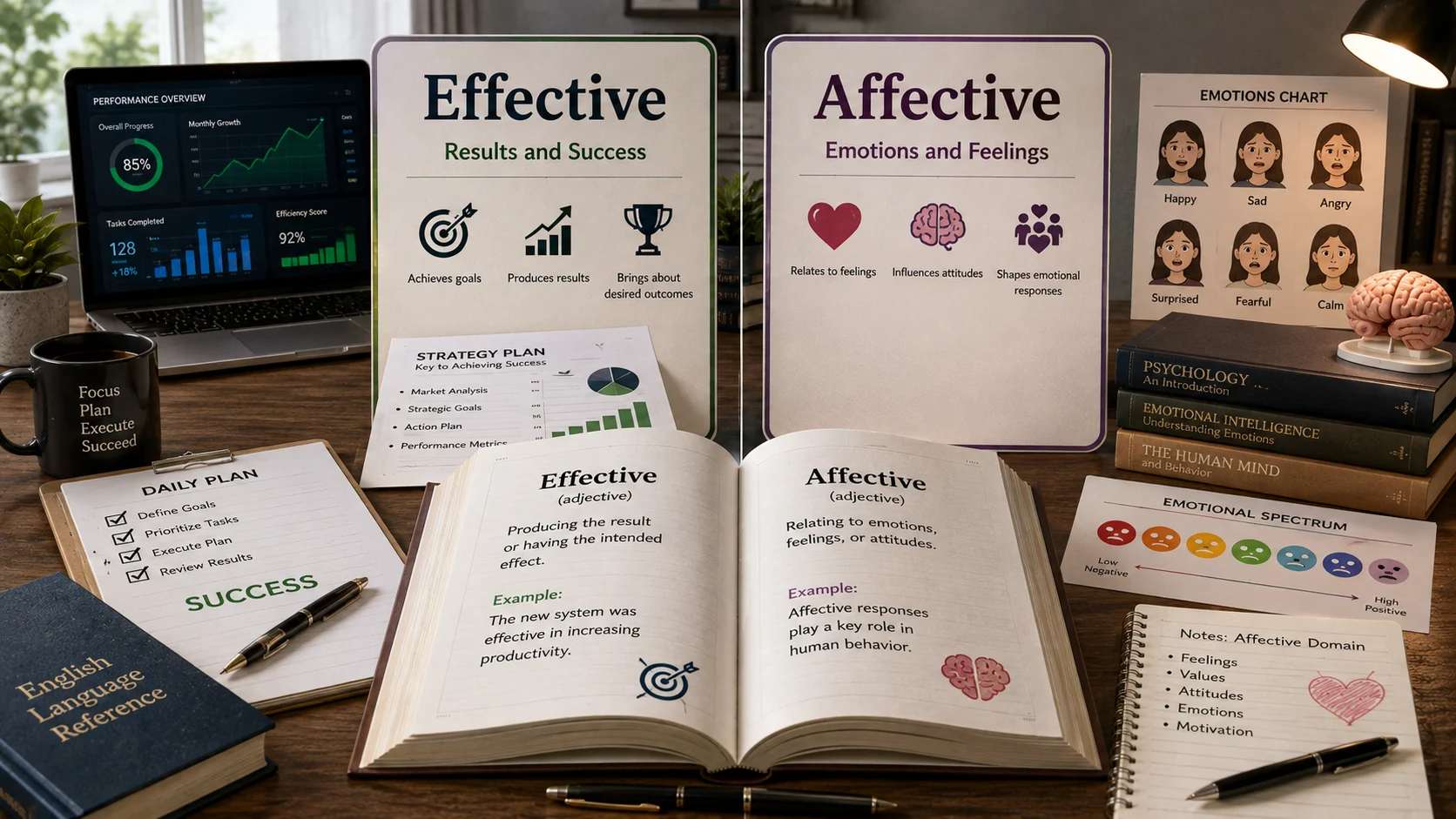
Effective or affective are two different English words that are often confused because they look and sound similar. Effective usually describes something that produces the intended result or works successfully, while affective relates to emotions, feelings, and mood. Knowing the difference helps prevent unclear writing in academic, professional, medical and everyday contexts.
Have you ever written effective when you actually meant affective? These two words look and sound remarkably similar, but their meanings are quite different. Effective usually describes something that produces the desired result or works successfully, while affective relates to emotions, feelings, or emotional responses.
Because both words appear frequently in academic, professional, and everyday English, confusing them can easily change the meaning of a sentence. Understanding this small but important distinction can help you communicate with greater accuracy and confidence.
In this guide, we’ll break down effective vs. affective with clear definitions, practical examples, and simple usage tips. You’re writing an email, preparing an academic paper, or improving your everyday vocabulary, knowing when to use each word will make your writing more precise and polished.
Effective or Affective | What’s the Difference?
The main difference between effective and affective is their meaning and function. Although both words are adjectives, they describe completely different ideas.
Effective means successful in producing a desired result. It can describe a method, treatment, strategy, argument, solution, communication style, or action that achieves its intended purpose.
Affective relates to feelings, emotions, emotional responses, or mood. It is commonly used in psychology, education, neuroscience, and other academic fields when discussing the emotional side of human behavior.
| Word | Part of Speech | Meaning | Common Context | Example |
|---|---|---|---|---|
| Effective | Adjective | Producing the intended result | Work, education, business, medicine, communication | The new teaching method is highly effective. |
| Affective | Adjective | Related to emotions or feelings | Psychology, education, neuroscience, behavior | The activity supports students’ affective development. |
The easiest way to remember the distinction is to focus on the idea behind each word.
Effective is connected with results and success.
Affective is connected with feelings and emotions.
If something works well, effective is usually the correct choice. If you are describing an emotional response or emotional process, affective is generally the appropriate word.
Is Effective or Affective a Grammar, Vocabulary or Usage Issue?
The confusion between effective and affective is primarily a vocabulary and usage issue rather than a grammatical error. Both words are grammatically correct, but they communicate different meanings.
They aren’t interchangeable. Replacing one with the other can completely change the meaning of a sentence. Consider the difference between these statements:
The treatment was effective.
This means the treatment worked successfully.
The treatment had an affective component.
This means the treatment involved emotions or emotional responses.
The first sentence evaluates an outcome. The second describes an emotional dimension.
Formal and Informal Usage
Effective is extremely common in both formal and informal English. You can use it when discussing workplace performance, study methods, advertisements, communication, health treatments, leadership, technology, or everyday solutions.
Affective is considerably more specialized. It appears frequently in academic and professional writing, especially in psychology, education, behavioral science, neuroscience, and medicine.
For example, a manager might say:
This strategy is effective.
A psychologist might write:
The study examined affective responses to stressful situations.
Both sentences are correct, but the vocabulary reflects different concepts.
Academic and Casual Usage
In everyday conversation, effective is far more common.
You might say:
That study technique is effective.
You would rarely use affective unless you were discussing emotions in a specialized context.
Affective becomes more natural in academic writing when the subject involves emotional development, emotional regulation, mood, or responses to experiences.
This distinction matters because using affective simply because it resembles affect can make ordinary writing sound unnecessarily technical or, worse, change the intended meaning.
What Does Effective Mean?
Effective is an adjective meaning successful in achieving a particular purpose or producing a desired result.
It is closely associated with words such as successful, useful, efficient, practical, powerful, and productive, although these words are not always exact synonyms.
For example:
The new advertising strategy was effective.
The sentence tells us that the strategy achieved its intended purpose.
Her explanation was effective.
This means her explanation successfully communicated the idea or helped solve the problem.
The medicine proved effective.
This means the medicine produced the desired result.
Effective in the Workplace
Effective is extremely common in professional communication.
A company may develop an effective marketing strategy. A manager may use effective leadership techniques. An employee may demonstrate effective communication skills.
For example:
The manager introduced an effective system for handling customer complaints.
The adjective describes the system according to its results.
Effective in Academic Writing
Students and researchers often use effective to evaluate methods, arguments, approaches, and techniques.
For example:
The research found that visual instruction was an effective teaching method.
Here, effective tells the reader that the teaching method achieved a useful educational outcome.
Effective in Technology
Technology writers frequently use effective when evaluating software, security systems, algorithms, tools, or digital strategies.
For example:
Two factor authentication is an effective way to improve account security.
The sentence focuses on the result of the security method.
Usage Recap for Effective
Use effective when you mean something works successfully.
It commonly describes methods, strategies, solutions, treatments, communication, policies, arguments, and tools.
If you can reasonably replace the word with successful or producing the desired result, effective is probably the correct choice.
What Does Affective Mean?
Affective is an adjective connected with emotions, feelings, mood, and emotional responses.
It is particularly important in fields that study human behavior and mental processes. You will often encounter it in psychology, education, neuroscience, medicine, and social science research.
For example:
The researchers measured participants’ affective responses to the images.
This means the researchers examined how participants emotionally responded to the images.
Another example is:
The teacher considered both cognitive and affective development.
Here, cognitive development concerns thinking and learning, while affective development concerns emotions, attitudes, and values.
Affective in the Workplace
Affective can be useful when discussing emotional experiences in professional environments.
For example:
The organization conducted a study of affective responses to workplace stress.
The word does not mean successful. It specifically identifies an emotional dimension.
Affective in Academic Writing
Affective is particularly common in educational research.
Educators sometimes distinguish among cognitive, behavioral, and affective aspects of learning.
For example:
The course aims to improve students’ affective engagement with the subject.
The focus is on students’ emotional connection and attitudes toward learning.
Affective in Technology
Affective computing is an established area of technology research concerned with systems that can recognize, interpret, simulate, or respond to human emotions.
For example:
The researchers developed an affective computing system that analyzes facial expressions.
The word affective here refers to emotional information.
Usage Recap for Affective
Use affective when you mean related to emotions or feelings.
It is especially appropriate in psychology, education, behavioral science, and research.
If the sentence is discussing mood, emotional reactions, attitudes, or emotional development, affective may be the word you need.
When You Should NOT Use Effective or Affective
Many mistakes happen when writers choose a word based only on spelling rather than meaning. The following situations can help you avoid the most common errors.
1. Do not use affective when you mean successful
Incorrect:
The new system was affective.
Correct:
The new system was effective.
The system is being evaluated according to it worked.
2. Do not use effective when discussing emotional responses
Incorrect:
The researchers measured effective responses to the photographs.
Correct:
The researchers measured affective responses to the photographs.
The researchers are studying emotions, so affective is appropriate.
3. Do not use affective as a sophisticated replacement for effective
Affective is not a more formal version of effective. They have different meanings.
4. Do not use effective when describing mood
If you are discussing emotional states or feelings, effective usually does not express the intended idea.
5. Do not use affective to describe a successful strategy
A strategy that achieves its purpose is effective, not affective.
6. Do not assume the words are interchangeable
Their similar spelling can make them appear related in meaning, but their meanings are distinct.
7. Do not choose based only on pronunciation
Because the words can sound similar in rapid speech, pronunciation alone is not a reliable way to distinguish them.
8. Do not use affective in ordinary writing without a reason
Affective is a useful technical term, but effective is normally the better choice when you simply mean successful.
Common Mistakes and Decision Rules
The following examples show how a single spelling choice can change the meaning of a sentence.
| Correct Sentence | Incorrect Sentence | Explanation |
|---|---|---|
| The new policy was effective. | The new policy was affective. | The policy successfully achieved its purpose. |
| The researchers studied affective responses. | The researchers studied effective responses. | The researchers examined emotional responses. |
| This is an effective treatment. | This is an affective treatment. | The treatment is being evaluated by its results. |
| Students showed strong affective reactions. | Students showed strong effective reactions. | The reactions involve emotions or feelings. |
| The training program is effective. | The training program is affective. | The program produces a desired result. |
| The study examined affective development. | The study examined effective development. | The study concerns emotional development. |
Decision Rule Box
If you mean success, results, or the ability to produce a desired outcome, use effective.
If you mean emotions, feelings, mood, or emotional responses, use affective.
This simple distinction will resolve most instances of effective versus affective.
Effective or Affective in Modern Technology and AI Tools
The distinction has become especially relevant as technology increasingly interacts with human behavior.
Effective is commonly used to evaluate an AI system, application, algorithm, or digital tool accomplishes its intended purpose.
For example:
The AI tool provides an effective way to organize large amounts of information.
Affective appears in specialized technology contexts involving emotional recognition and human computer interaction.
Affective computing, for instance, explores how technology can identify or respond to emotional signals such as facial expressions, speech patterns, gestures, or physiological responses.
Consider these two sentences:
The AI model is effective at detecting spam.
This evaluates performance.
The AI model recognizes affective signals in speech.
This describes emotional information.
Modern technology therefore provides a useful illustration of the central distinction. Effective concerns what a system successfully does, while affective concerns emotions and emotional information.
The Etymology of Effective and Affective
Understanding the origins of these words can make their difference easier to remember.
Effective comes from the Latin root connected with producing or accomplishing something. Its modern meaning developed around the idea of producing an intended result.
Affective is connected to affect, a word associated with emotional feeling or emotional disposition. In modern academic English, affective commonly refers to the emotional component of human experience.
The words may look similar because both ultimately relate to Latin linguistic roots, but their modern meanings have developed in different directions.
An Expert Style Explanation
A useful way to express the distinction is:
Effective evaluates what something accomplishes, while affective describes what someone feels.
This is not a formal quotation from a named linguist. It is a concise linguistic rule designed to capture the practical difference between the two adjectives.
Case Study 1: Education
Imagine a school introduces a new reading program and wants to determine it improves student performance.
If test scores improve significantly, researchers might describe the program as effective.
If researchers instead study students develop greater confidence, motivation, enjoyment, or emotional engagement with reading, they may examine affective outcomes.
The same educational program can therefore be both effective and affective in different respects.
Case Study 2: Healthcare
Consider a medical treatment.
Researchers may ask the treatment reduces symptoms. That question concerns effectiveness.
They may also investigate patients’ emotional responses, attitudes, anxiety, or quality of life. Those findings can involve affective factors.
The distinction prevents researchers from confusing treatment results with emotional experience.
Author expertise: Written from a professional language and SEO perspective with emphasis on precise vocabulary, contextual usage, and search friendly educational explanations.
Error Prevention Checklist
Always Use Effective When
✓ You mean successful.
✓ You are describing a method that works.
✓ You are evaluating a strategy or solution.
✓ You are discussing results or outcomes.
✓ You are describing successful communication.
✓ You are evaluating the performance of a treatment or tool.
Never Use Affective When
✓ You simply mean successful.
✓ You mean efficient or productive.
✓ You are describing something works.
✓ You are evaluating a strategy based on its results.
Instead, reserve affective for contexts involving emotions, feelings, moods, attitudes, and emotional responses.
Related Grammar Confusions You Should Master
Understanding effective and affective is easier when you recognize other commonly confused English words.
- Affect vs Effect: One of the most important vocabulary distinctions in English.
- Advice vs Advise: A noun and verb that differ in pronunciation and function.
- Compliment vs Complement: Words involving praise and completion or matching.
- Principal vs Principle: A person or primary element versus a fundamental rule.
- Stationary vs Stationery: Remaining still versus writing materials.
- Farther vs Further: Physical distance versus extended degree or development.
- Your vs You’re: Possession versus the contraction of you are.
- Its vs It’s: Possession versus the contraction of it is or it has.
- Then vs Than: Time or sequence versus comparison.
- Accept vs Except: Receiving or agreeing versus excluding.
Mastering these pairs improves accuracy in professional, academic, and online writing.
FAQs
What is the difference between effective and affective?
Effective means successful or capable of producing a desired result, while affective relates to emotions, feelings, moods, and emotional responses.
Is affective the same as effective?
No. Effective describes successful results, whereas affective describes emotional experiences or responses, so the two words cannot normally be used interchangeably.
When should I use effective in a sentence?
Use effective when you are saying that a method, strategy, treatment, solution, argument, or tool works successfully and achieves its intended purpose.
When should I use affective in a sentence?
Use affective when discussing emotions, feelings, mood, attitudes, emotional reactions, or other aspects of human emotional experience.
Is effective a common word in English?
Yes. Effective is widely used in everyday, professional, academic, business, medical, and technological English to describe successful results.
Is affective a formal word?
Affective is more specialized and appears frequently in academic and professional fields such as psychology, education, neuroscience, behavioral science, and medicine.
Can a teaching method be both effective and affective?
Yes. A teaching method can be effective because it improves learning outcomes and can involve affective factors if it influences students’ emotions, attitudes, or motivation.
How can I easily remember effective versus affective?
Remember that effective focuses on results and success, while affective focuses on affect, meaning emotions and feelings.
Which is correct, effective treatment or affective treatment?
Effective treatment is normally correct when you mean a treatment that works successfully, while affective treatment would refer specifically to an emotional dimension.
Conclusion
The difference between effective or affective becomes straightforward once you focus on meaning rather than spelling. Effective describes something that succeeds, works, or produces an intended result. Affective describes emotions, feelings, moods, and emotional responses.
When evaluating a strategy, treatment, method, argument, or tool, choose effective. When discussing emotional development, emotional reactions, attitudes, or mood, choose affective.
A quick memory rule can prevent most mistakes: effective is about results, while affective is about feelings. Keeping this distinction in mind will make your academic, professional, and everyday writing more precise.
Discover More Related Articles:
- Outting or Outing | Which Version Belongs in Standard English In 2026
- Argentine or Argentinian | Which Word Is Correct & When Should You Use It In 2026
- Cacoon or Cocoon | The Quick Grammar Guide Every Writer Needs In 2026