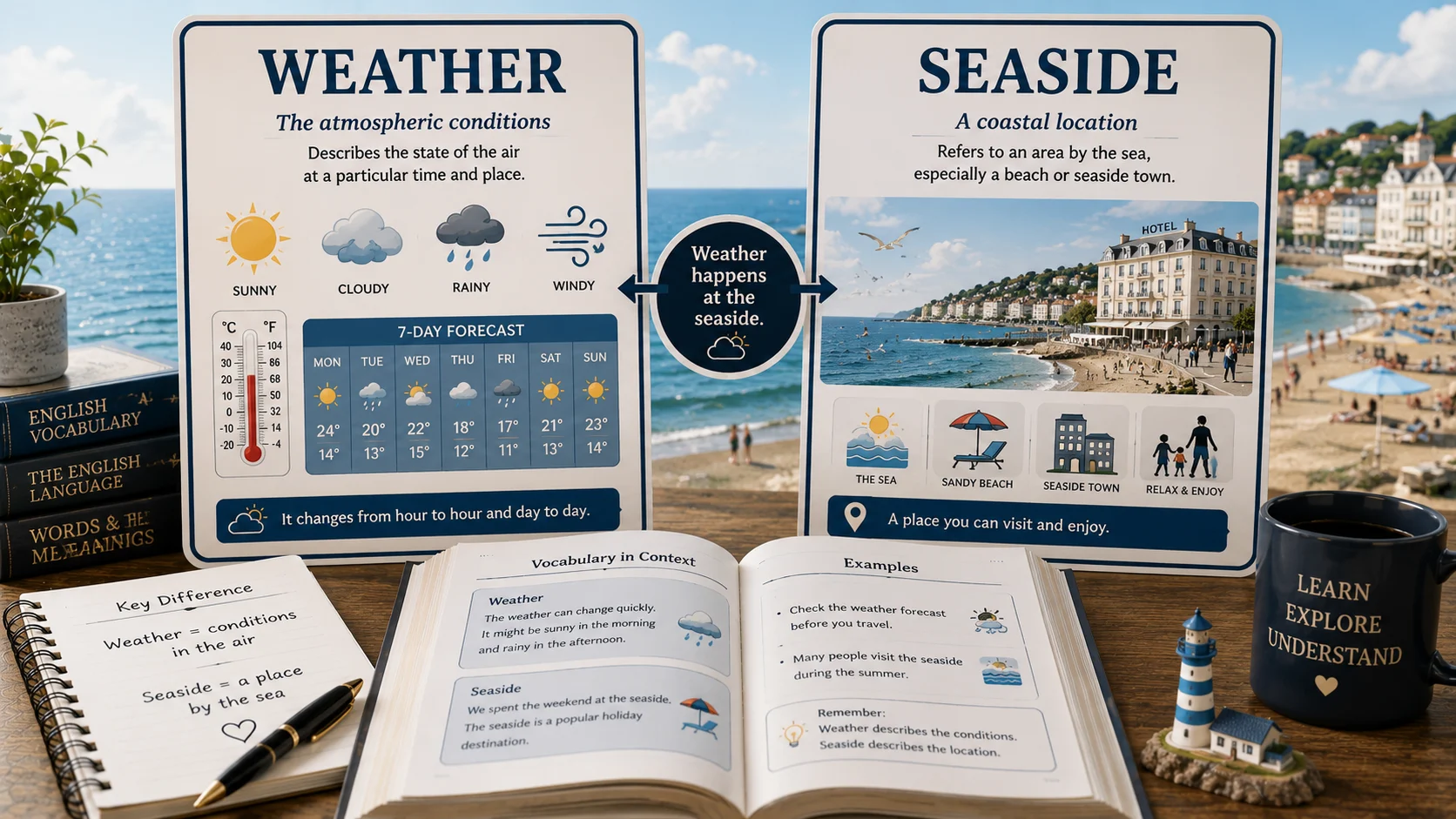
Weather refers to the condition of the atmosphere at a particular time and place, including temperature, rain, wind, clouds, and sunshine. Seaside refers to a place beside the sea or the coastal area itself. Weather or seaside therefore compares two completely different concepts, not two interchangeable English words.
Have you ever seen weather and seaside used in the same sentence and wondered they describe similar things? Although both words can appear when talking about outdoor conditions, travel, or coastal experiences, they have completely different meanings and functions. Weather refers to the condition of the atmosphere at a particular time, such as rain, sunshine, wind, or temperature.
Seaside, on the other hand, refers to an area located beside the sea, often associated with beaches, coastal towns, and ocean views. Understanding this difference can help you choose the right word and avoid confusing meaning with location.
In this guide, we’ll clearly explain weather vs seaside, including their definitions, grammatical roles, common uses, and practical examples. you’re writing an article, describing a vacation, or improving your everyday English, knowing when to use each term will make your writing more accurate, natural, and confident.
Weather vs Seaside | What’s the Difference?
Weather is a noun that describes the condition of the atmosphere in a particular place and at a particular time. It includes conditions such as sunshine, rain, snow, wind, clouds, humidity, and temperature.
For example, you can say, “The weather is warm today,” or “We had terrible weather during our trip.”
Seaside is a noun that refers to an area beside the sea. It commonly describes a coastal place where people may go for a holiday, walk along the beach, swim, relax, or enjoy sea views.
For example, you can say, “We spent the weekend at the seaside,” or “The seaside was crowded during the summer.”
| Word | Part of Speech | Meaning | Example |
|---|---|---|---|
| Weather | Noun | The condition of the atmosphere | The weather is sunny today. |
| Seaside | Noun | A place or area beside the sea | We visited the seaside last weekend. |
| Weather | Noun | Rain, sunshine, wind, temperature, and other atmospheric conditions | The weather changed suddenly. |
| Seaside | Noun | A coastal location used for recreation or living | They rented a house near the seaside. |
Quick recap
Weather tells you what the atmosphere is like.
Seaside tells you where a place is in relation to the sea.
You can experience particular weather at the seaside.
The two words can appear in the same sentence, but they cannot normally replace each other.
Is Weather vs Seaside a Grammar, Vocabulary or Usage Issue?
The difference between weather and seaside is primarily a vocabulary and meaning issue. Both words are nouns, but they refer to entirely different things.
Weather concerns atmospheric conditions. It answers questions such as “What is the temperature?” “Is it raining?” or “Is it windy?”
Seaside concerns location. It answers questions such as “Where are you?” or “What type of place did you visit?”
The words are therefore not interchangeable.
| Question | Correct Word | Example |
|---|---|---|
| What is the atmosphere like? | Weather | The weather is cold today. |
| Where did you go for your holiday? | Seaside | We went to the seaside. |
| Was it raining? | Weather | The weather was rainy. |
| Did you visit the coast? | Seaside | We spent a week at the seaside. |
| Was it sunny during your coastal trip? | Weather | The weather was sunny at the seaside. |
There is no special formal version of one word and informal version of the other. Both are standard English vocabulary. The important issue is choosing the word that expresses the intended meaning.
In academic writing, weather may appear in discussions of climate, geography, agriculture, science, and environmental conditions. Seaside may appear in writing about tourism, geography, travel, coastal communities, and recreation.
In casual conversation, both words are equally natural. A person might say, “The weather was awful,” or “We went to the seaside.”
How to Use Weather Correctly
The word weather is used when discussing atmospheric conditions. It can describe what is happening outside now, what happened previously, or what is expected in the future.
Consider the workplace. An employee might say, “The bad weather delayed my journey to the office.” Here, weather explains the atmospheric conditions that caused the delay.
In an academic context, a student might write, “Weather conditions can affect agricultural production.” The word refers to temperature, rainfall, wind, and other atmospheric factors.
Technology also frequently uses the word weather. Weather applications provide forecasts, temperatures, precipitation information, wind speeds, and warnings. A person might say, “I checked the weather app before leaving home.”
| Context | Correct Example | Meaning |
|---|---|---|
| Workplace | The weather delayed several employees. | Atmospheric conditions affected travel. |
| Academic | Weather can influence crop production. | Atmospheric conditions affect agriculture. |
| Technology | I checked the weather on my phone. | A digital service provided weather information. |
| Travel | We checked the weather before our flight. | The travelers wanted atmospheric information. |
| Daily conversation | The weather is lovely today. | Conditions outside are pleasant. |
Weather usage recap
Use weather for rain, sunshine, wind, temperature, clouds, and similar atmospheric conditions.
It is especially common with verbs and adjectives such as check, forecast, predict, improve, change, warm, cold, sunny, rainy, and stormy.
A useful sentence pattern is:
The weather + is/was + adjective.
For example, “The weather was beautiful.”
How to Use Seaside Correctly
The word seaside describes a location beside the sea. It is especially common in British English and is frequently associated with holidays, beaches, coastal towns, and recreational trips.
In a workplace context, someone might say, “The company organized a retreat at a seaside resort.” Here, seaside describes the location of the resort.
In academic writing, seaside can describe a coastal environment or a place connected with tourism. For example, “The seaside town depends heavily on tourism.”
In technology and travel applications, seaside may appear in descriptions of hotels, resorts, attractions, holiday destinations, and accommodation. A travel website might describe a hotel as a “seaside property.”
| Context | Correct Example | Meaning |
|---|---|---|
| Workplace | The conference was held at a seaside hotel. | The hotel was beside the sea. |
| Academic | The seaside town attracts many visitors. | The coastal town receives tourists. |
| Technology | The travel app listed several seaside resorts. | The resorts were located near the sea. |
| Travel | We stayed at a seaside resort. | The resort was beside the sea. |
| Daily conversation | We spent the afternoon at the seaside. | We visited a coastal area. |
Seaside usage recap
Use seaside when referring to a place beside the sea.
It commonly appears with words such as town, resort, hotel, holiday, trip, cottage, walk, beach, and destination.
A useful sentence pattern is:
at the seaside
For example, “The children played at the seaside.”
When You Should NOT Use Weather or Seaside
Several common mistakes happen when learners confuse the thing being described with the place where it happens.
| Mistake | Why It Is Wrong | Better Choice |
|---|---|---|
| The seaside is rainy today. | Seaside is a place, not atmospheric conditions. | The weather is rainy today. |
| The weather was beautiful, so we visited the weather. | Weather is not a destination. | We visited the seaside. |
| We checked the seaside before leaving. | You check atmospheric conditions before traveling. | We checked the weather. |
| The weather was crowded. | Crowded describes a place, not atmospheric conditions. | The seaside was crowded. |
| The seaside was twenty degrees. | Temperature describes weather conditions. | The weather was twenty degrees. |
| We stayed at the weather. | Weather is not normally accommodation or a destination. | We stayed at the seaside. |
| The weather has many beaches. | Beaches are geographical features, not weather conditions. | The seaside has many beaches. |
| The seaside forecast says it will rain. | The forecast describes weather, not the place itself. | The weather forecast says it will rain. |
The most important point is simple: weather describes conditions, while seaside describes location.
Common Mistakes and Decision Rules
English learners sometimes construct unusual sentences because they understand the general topic but choose the wrong noun.
| Correct Sentence | Incorrect Sentence | Explanation |
|---|---|---|
| The weather was sunny. | The seaside was sunny. | Sunny describes atmospheric conditions. |
| We went to the seaside. | We went to the weather. | The seaside can be a destination. |
| The weather was cold at the seaside. | The seaside was cold at the weather. | Weather describes the conditions at a location. |
| The seaside was crowded. | The weather was crowded. | Crowded describes a place containing many people. |
| We checked the weather forecast. | We checked the seaside forecast. | A forecast normally predicts atmospheric conditions. |
| The seaside was beautiful. | The weather was beautiful because of the beach. | A seaside location can be described as beautiful. |
Decision Rule
If you mean atmospheric conditions, use weather. If you mean a place beside the sea, use seaside.
This rule works in most everyday situations.
Ask yourself one question: Am I talking about conditions or a location?
If you mean rain, sunshine, temperature, wind, clouds, or storms, choose weather.
If you mean a coastal place, beach area, resort, or location beside the sea, choose seaside.
Weather and Seaside in Modern Technology and AI Tools
Modern technology makes both words common, but they appear in different digital contexts.
Weather applications use weather data to display temperatures, forecasts, rainfall, wind conditions, humidity, and severe weather warnings. Search engines and voice assistants can answer questions such as “What is the weather today?”
Seaside usually appears in travel technology. Hotel booking platforms, travel guides, mapping applications, and tourism websites may use the term to describe coastal accommodation and destinations.
Artificial intelligence systems also distinguish these meanings when interpreting natural language. If a user asks, “What is the weather at the seaside?” the system understands that seaside identifies the location while weather identifies the information being requested.
This produces a useful sentence pattern:
Weather at the seaside
Here, weather is the subject of interest and seaside identifies the location.
For example:
“The weather at the seaside was warm and sunny.”
The sentence works because each noun performs a different semantic role.
The Etymology of Weather and Seaside
The history of these words also helps explain why their meanings are so different.
Weather comes from Old English weder, referring to air, sky, or atmospheric conditions. Over time, its meaning developed into the modern idea of atmospheric conditions at a particular time and place.
Seaside is a transparent compound formed from sea and side. Literally, it means the side or area beside the sea. Its modern use developed naturally from this geographical meaning.
This is why seaside is easy to understand once you recognize its two parts. The word describes a location next to the sea.
A useful linguistic principle is:
“Meaning becomes clearer when learners identify the function a word performs in a sentence.”
For this pair, weather identifies a condition, while seaside identifies a location.
Case Study 1: Travel Writing
Imagine an English learner writing about a holiday:
“The weather was excellent, and the seaside was beautiful.”
This sentence successfully uses both words because the writer describes two different aspects of the trip. The weather describes atmospheric conditions, while seaside describes the coastal environment.
Changing either word would make the sentence less accurate.
Case Study 2: Everyday Conversation
Consider a conversation between two friends:
“How was your trip?”
“It was wonderful. The seaside was quiet, and the weather was warm.”
This example demonstrates how native speakers naturally separate location from conditions. The seaside can be quiet, busy, beautiful, or crowded. Weather can be warm, cold, rainy, sunny, windy, or stormy.
These examples give learners a practical way to remember the distinction without memorizing an isolated definition.
Author expertise: This explanation follows standard English lexical and usage principles and is designed from a linguistics focused perspective for English language learners.
Error Prevention Checklist
Always use Weather when
☐ You are talking about rain.
☐ You are describing temperature.
☐ You mean sunshine or clouds.
☐ You are discussing wind or storms.
☐ You are checking a forecast.
☐ You are describing atmospheric conditions.
Always use Seaside when
☐ You mean a place beside the sea.
☐ You are describing a coastal holiday.
☐ You are talking about a seaside town.
☐ You mean a coastal resort.
☐ You are describing accommodation near the sea.
☐ You are discussing a location for recreation.
Never use Seaside when
You are specifically discussing atmospheric conditions.
Never use Weather when
You are naming a coastal destination or location.
Weather or Seaside | How to Remember the Difference
A simple mental image can make the distinction much easier.
Imagine standing beside the sea.
The seaside is the place where you are standing.
The weather is what the atmosphere is doing while you are there.
It could be sunny at the seaside. It could be rainy at the seaside. It could even be stormy at the seaside.
The location remains the seaside, while the weather changes.
This gives learners a powerful memory sentence:
The seaside is where you are. The weather is what the atmosphere is like.
Once you understand that relationship, the two words become much easier to use correctly.
Related Grammar Confusions You Should Master
English learners can strengthen their vocabulary accuracy by studying other commonly confused words and expressions.
| Confusion | Main Difference |
|---|---|
| Weather vs Whether | Atmospheric conditions versus expressing alternatives or uncertainty |
| Beach vs Seaside | A sandy or coastal area versus the broader coastal location |
| Coast vs Coastal | A geographical noun versus an adjective |
| Climate vs Weather | Long term atmospheric patterns versus short term conditions |
| Sea vs Ocean | A large body of salt water versus a larger geographical body |
| Holiday vs Vacation | Common British usage versus common American usage |
| Travel vs Trip | The activity of traveling versus a particular journey |
| Sunny vs Sunshine | An adjective versus a noun |
| Rain vs Rainy | A noun or verb versus an adjective |
| Forecast vs Weather | A prediction of conditions versus the conditions themselves |
Learning these distinctions can help prevent vocabulary errors because many English words are related in meaning without being interchangeable.
FAQs
What is the difference between weather and seaside?
Weather describes atmospheric conditions, while seaside describes a place beside the sea.
Can I say the weather at the seaside?
Yes. “The weather at the seaside” is completely natural because weather describes conditions and seaside identifies the location.
Is seaside a type of weather?
No. Seaside is a place or coastal area, whereas weather refers to atmospheric conditions.
Can seaside be used as a noun?
Yes. Seaside is normally used as a noun when referring to an area beside the sea.
Can weather and seaside be used in one sentence?
Yes. For example, “The weather was beautiful at the seaside.”
Should I say seaside weather or seaside?
Use “seaside weather” when describing weather experienced in a coastal location, but use “seaside” alone when referring to the place.
What word should I use for rain at the seaside?
Use weather when discussing the rain as an atmospheric condition, as in “The weather was rainy at the seaside.”
Is seaside the same as beach?
Not exactly. A beach is a specific coastal feature, while seaside can refer more broadly to an area beside the sea.
Is weather a place?
No. Weather describes atmospheric conditions rather than a physical location.
What is an easy way to remember weather and seaside?
Remember that the seaside is the place, while the weather describes the conditions you experience there.
Conclusion
Weather and seaside are not alternative spellings or interchangeable vocabulary choices. They represent two different ideas. Weather describes atmospheric conditions such as rain, sunshine, wind, temperature, and storms. Seaside describes a place or area beside the sea.
The easiest way to remember the difference is to connect the two concepts: you can experience weather at the seaside. For example, “The weather was sunny at the seaside” is correct because the sentence tells us both what the atmospheric conditions were and where those conditions were experienced.
For English learners, this distinction is valuable because it prevents confusing a location with the conditions found there. Whenever you are unsure, ask yourself you are describing what is happening in the atmosphere or where something is located. Choose weather for the first meaning and seaside for the second.
Discover More Related Articles:
- Grandad or Granddad | Which Word Is Correct & When Should You Use It In 2026
- Fazed or Phased | What Is the Difference & Which Word Should You Use In 2026
- Whiney or Whiny | Which Word Do Dictionaries Recommend In 2026