Blanky or blankie are both informal words used to describe a small, soft blanket, especially one associated with comfort, children, or bedtime. However, blankie is the more established and recognizable spelling in informal English, while blanky is a less common variant. The choice usually depends on personal preference, style, and context.
Ever wondered the cozy word for a favorite blanket is spelled blanky or blankie? You’re not alone. Both forms appear frequently in casual conversations, parenting blogs, social media posts, and children’s language, which makes the difference easy to overlook. While these words may sound almost identical, their spelling, usage, and level of standardization can vary depending on context.
If you’re writing a message, caption, blog post, or simply trying to choose the most natural spelling, knowing how blanky and blankie are used can help you make the right choice.
In this guide, we’ll explore blanky vs. blankie, including their meanings, spelling patterns, common usage, and one form is considered more appropriate than the other. You’ll also learn which version works best in casual and formal writing, so you can use this comforting little word with confidence.
Blanky vs Blankie | What’s the Difference?
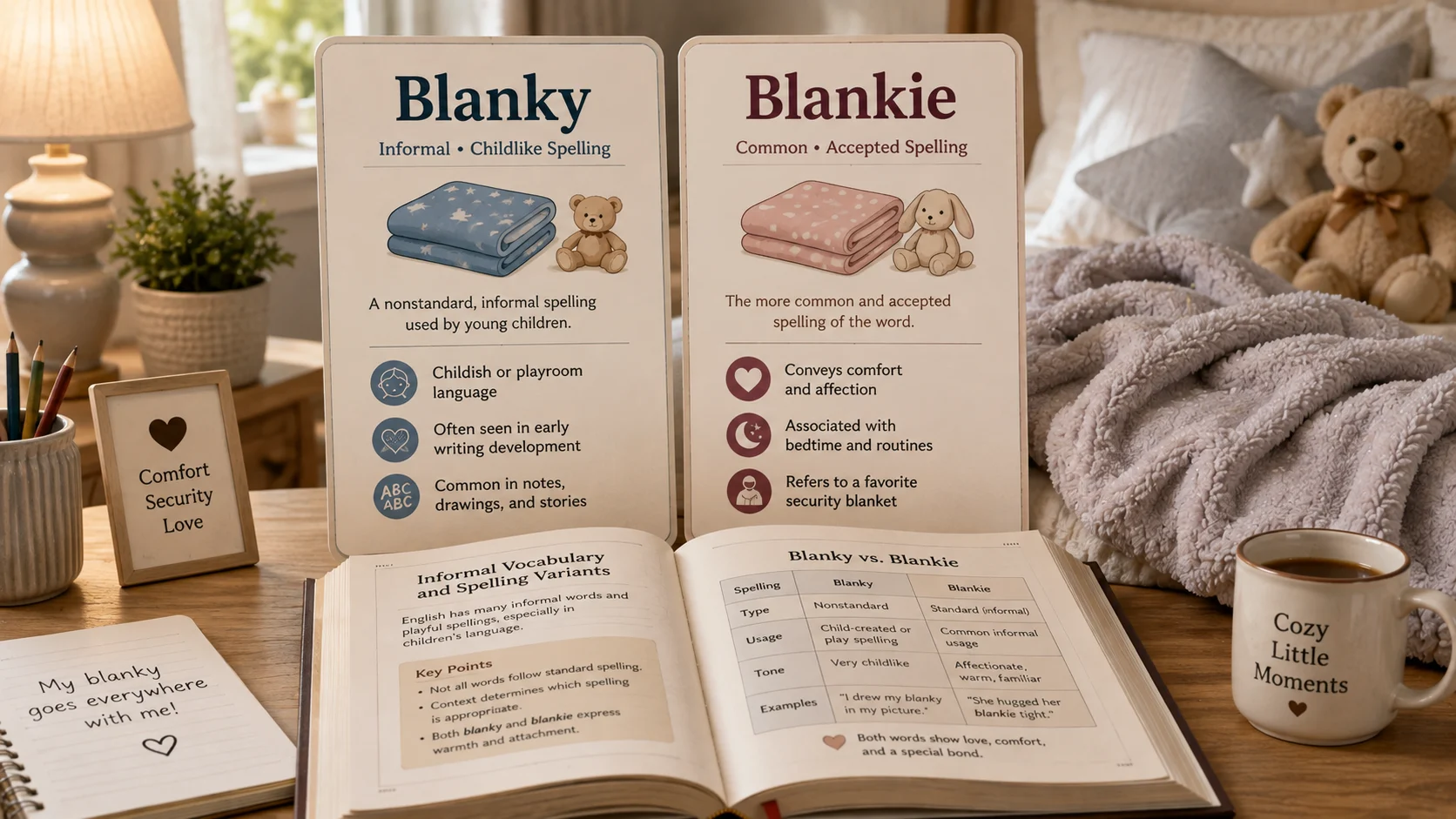
Both blanky and blankie are informal nouns referring to a blanket, especially a soft or comforting blanket used by a child. They are diminutive forms, meaning they give the original word a more affectionate, familiar, or childlike feeling.
The main difference is spelling and usage frequency rather than meaning. Blankie is generally the more recognizable spelling in informal English. Blanky is also understandable and is sometimes used as a variant, particularly in family speech, personalized writing, product names, or online communication.
| Feature | Blanky | Blankie |
|---|---|---|
| Part of speech | Informal noun | Informal noun |
| Basic meaning | A small or comforting blanket | A small or comforting blanket |
| Formality | Very informal | Very informal |
| Common context | Family speech and casual writing | Family speech, children’s language, and casual writing |
| Standard preference | Less common variant | More established informal spelling |
| Suitable for academic writing | Usually no | Usually no |
| Suitable for casual conversation | Yes | Yes |
| Typical emotional meaning | Comfort and affection | Comfort and affection |
The important point is that the two forms usually do not represent two different objects.
Blankie is generally the safer choice when you want the most familiar informal spelling.
Blanky is understandable but less conventional.
Neither word is normally preferred in formal academic or professional writing.
The meaning is determined mainly by context rather than the final letter combination.
Is Blanky vs Blankie a Grammar, Vocabulary or Usage Issue?
The difference between blanky and blankie is primarily a vocabulary and usage issue, not a traditional grammar issue.
Grammar determines how words function within sentences. For example, you need to know a word is being used as a noun, verb, adjective, or another part of speech. Both blanky and blankie function primarily as informal nouns.
The real question is which spelling feels more established and appropriate for the intended audience.
Are Blanky and Blankie Interchangeable?
In ordinary informal conversation, they are largely interchangeable. If someone says, “Where is my blankie?” and another person says, “Where is my blanky?”, the intended meaning is normally identical.
The difference becomes more noticeable in edited writing, product descriptions, children’s literature, and situations where consistent spelling matters.
If you are choosing one spelling for a website, book, product, or brand, blankie is generally the stronger choice because it is immediately recognizable to many readers.
Formal vs Informal Usage
Both terms have a strongly informal character. They are associated with affection, childhood, family speech, and emotional comfort.
A formal report would normally use blanket rather than either informal form.
For example:
| Informal | More Formal |
|---|---|
| The baby is sleeping with her blankie. | The baby is sleeping with her blanket. |
| He brought his blanky to bed. | He brought his blanket to bed. |
| She still keeps her old blankie. | She still keeps her old blanket. |
Academic vs Casual Usage
Academic writing generally favors precise, neutral vocabulary. Unless an academic paper is specifically studying children’s language, family vocabulary, or informal speech, blanket is the better choice.
Casual writing is different. A parent speaking to a child might naturally say, “Where’s your blankie?” The affectionate form adds emotional meaning that the neutral word blanket does not necessarily provide.
How to Use Blankie Correctly
Blankie is useful when the context is affectionate, informal, or connected with childhood. It can describe a child’s favorite blanket or a familiar comfort object.
Workplace Example
In professional communication, blankie would rarely be appropriate. However, it might appear in a workplace conversation involving childcare or a personal anecdote.
For example:
The child would not sleep at daycare without her favorite blankie.
The sentence is grammatically clear, but the word remains informal.
Academic Example
An academic writer discussing childhood comfort objects might use the term when analyzing children’s vocabulary.
For example:
The study examined how children use terms such as blankie when referring to familiar comfort objects.
Here, the informal word is acceptable because the subject itself concerns language and childhood behavior.
Technology Example
The word can also appear in technology related content when developers, marketers, or users give an application, toy, device, or digital character a child friendly personality.
For example:
The children’s sleep app reminds parents to pack a favorite blankie before bedtime.
Blankie Usage Recap
Use blankie when you want a familiar, affectionate, informal term for a blanket. It works especially well in conversations involving children, families, bedtime, comfort, and sentimental memories.
For formal contexts, simply choose blanket.
How to Use Blanky Correctly
Blanky carries essentially the same basic meaning as blankie. It can function as a playful or affectionate name for a blanket.
The spelling is easy to understand because English speakers frequently create informal forms by changing the ending of familiar words. However, blanky is generally less established than blankie.
Workplace Example
Blanky is unlikely to appear in ordinary business writing, but it could occur in an informal story or conversation.
For example:
My daughter insisted that her blanky had to come with us on the business trip.
The word works because the sentence is personal and conversational.
Academic Example
In academic writing, blanky should normally be avoided unless the writer is discussing informal vocabulary, children’s speech, or a specific source that uses the spelling.
For example:
The child repeatedly used the word blanky when referring to her favorite blanket.
In this sentence, the unusual spelling is part of the subject being discussed.
Technology Example
Blanky may appear in product names, applications, children’s games, fictional characters, or online communities.
For example:
The game allows children to choose a virtual blanky for their bedtime character.
This is an intentionally playful use rather than formal English.
Blanky Usage Recap
Use blanky when a playful, personalized, or informal spelling suits the context. It is understandable, but readers are generally more familiar with blankie.
If you need the safest informal choice, blankie is usually preferable.
When You Should NOT Use Blanky or Blankie
There are several situations where neither spelling is the best option.
1. Formal Business Reports
Use blanket instead of blanky or blankie when writing a professional report.
2. Academic Definitions
If you are defining a household textile in an academic context, blanket provides a clearer and more neutral term.
3. Technical Documentation
Instructions, specifications, and technical documents should normally use precise terminology rather than affectionate vocabulary.
4. Medical or Care Documentation
Professional care records generally benefit from neutral wording. Blanket is more suitable than either informal variant.
5. Legal Documents
Legal writing requires precise language. An informal word such as blankie could create an unnecessarily casual tone.
6. Formal Product Specifications
A manufacturer describing the dimensions, material, or construction of a blanket should normally use blanket.
7. Scientific Research
Scientific writing should use terminology that communicates the subject objectively. Informal diminutives are rarely appropriate unless they are being analyzed.
8. Professional Customer Service
A customer service representative should generally use blanket unless the customer has already established a deliberately informal tone.
Common Mistakes and Decision Rules
One common mistake is assuming that blanky and blankie have completely different meanings. In most contexts, they do not.
Another mistake is treating either word as a formal synonym for blanket. Both forms carry a strong informal or affectionate tone.
| Correct Sentence | Incorrect or Less Suitable Sentence | Explanation |
|---|---|---|
| The child brought her blankie to bed. | The research report refers to the object as a blankie. | A formal report would normally use blanket unless the informal term is being studied. |
| She keeps her old blankie in a drawer. | She keeps her old blankie in the laboratory report. | The word fits personal conversation better than formal scientific writing. |
| He calls his favorite blanket a blanky. | Blanky is required whenever someone means blanket. | Blanky is an informal variant, not a mandatory spelling. |
| The baby sleeps with a soft blanket. | The medical record says the patient sleeps with a blankie. | Neutral professional language is generally preferable in formal records. |
| Her favorite blankie is blue. | Her favorite blankie and blanket are two different objects. | In ordinary usage, blankie is an affectionate term for a blanket. |
Decision Rule
If you mean the ordinary household object, use blanket in formal writing. If you mean an affectionate or childlike name for that object, blankie is generally the safest informal choice. Blanky can also be used as an informal variant.
Blanky and Blankie in Modern Technology and AI Tools
Modern digital communication has made informal vocabulary much more visible. Words that once belonged mainly to family conversations can now appear in social media posts, online stores, parenting forums, children’s applications, digital games, and AI generated content.
Both blanky and blankie can therefore appear in search results even when one form is considerably more familiar.
AI tools can also generate either spelling because language models learn from large collections of informal and formal text. This means an AI generated sentence containing blanky is not automatically evidence that blanky is the preferred spelling.
For SEO content, consistency matters. If a page targets users searching for blanky or blankie, it can naturally mention both forms while explaining that blankie is generally the more familiar informal spelling.
The neutral word blanket should remain the preferred choice when clarity and formality are more important than affection.
The Etymology of Blanky and Blankie
Both forms can be understood as affectionate formations based on the word blanket.
English frequently creates informal or diminutive forms by modifying the ending of an existing word. The endings found in forms such as blankie and blanky can make a word sound smaller, friendlier, more personal, or more childlike.
The spelling with ie is especially familiar in affectionate vocabulary. Similar patterns appear in informal words such as doggie and birdie.
The spelling with y can also create a playful tone. Because informal vocabulary does not always follow strict formation rules, more than one spelling can develop naturally.
An Expert Style Explanation
“In informal English, spelling often reflects pronunciation, affection, and community usage rather than a single rigid rule.”
That principle explains why both blankie and blanky can exist without necessarily representing different meanings.
Two Usage Case Studies
Case Study One: Children’s Language
Imagine a children’s story in which a young character refuses to sleep without a favorite blanket. The writer chooses blankie because the story is designed for young readers.
The result is a warmer and more child centered tone than the neutral sentence using blanket.
For example, “Mia hugged her blankie and closed her eyes” immediately suggests affection and familiarity.
The concrete stylistic result is that the informal spelling changes the emotional register of the sentence while leaving its basic meaning unchanged.
Case Study Two: Formal Documentation
Consider a childcare policy that explains what parents should bring for children during overnight care.
A sentence such as “Parents may provide a familiar blanket” is clearer and more professional than “Parents may provide a familiar blankie.”
The concrete result is greater neutrality. The reader receives the same practical information without the childlike emotional tone.
These examples demonstrate an important usage principle: the spelling should reflect the communication setting, not simply personal preference.
Error Prevention Checklist
Always Use Blankie When
You are writing casual dialogue.
You are discussing a child’s favorite comfort object.
You want an affectionate or playful tone.
You are writing children’s content.
You are describing a personal or sentimental memory.
You want the more familiar informal spelling.
Never Use Blankie When
You are writing a formal legal document.
You are preparing technical specifications.
You are writing a scientific report where the informal term is unnecessary.
You are preparing formal business documentation.
You need neutral terminology.
In those situations, blanket is usually the better choice.
Always Use Blanky When
You intentionally want a playful variant.
A character or person specifically uses that spelling.
A product, brand, story, or fictional character has established the spelling.
You are discussing spelling variations.
Never Use Blanky When
You are trying to make formal writing sound neutral.
You are writing technical instructions.
You are using a term in a professional specification.
You want the most familiar informal spelling for a general audience.
Related Grammar Confusions You Should Master
Understanding blanky and blankie is useful, but English contains many other word pairs that cause similar uncertainty.
Advice vs Advise
Advice is a noun, while advise is a verb.
Affect vs Effect
Affect is commonly used as a verb, while effect is commonly used as a noun, although both words have additional meanings.
Compliment vs Complement
A compliment expresses praise, while a complement completes or enhances something.
Stationary vs Stationery
Stationary means remaining still, while stationery refers to writing materials.
Principal vs Principle
Principal commonly refers to a person or something important, while principle refers to a rule or belief.
Your vs You’re
Your shows possession, while you’re is a contraction of you are.
Than vs Then
Than is commonly used for comparisons, while then relates to time, sequence, or consequence.
Lose vs Loose
Lose is a verb meaning to misplace or fail to win, while loose generally describes something that is not firmly attached.
Advice vs Advise
These words differ in both pronunciation and grammatical function, making them a useful comparison for vocabulary learners.
FAQs
Is blankie the correct spelling?
Yes. Blankie is a recognized informal spelling for a small or comforting blanket and is generally the more familiar choice.
Is blanky a correct word?
Blanky can be used as an informal variant of blankie, although it is less established and less familiar to many readers.
What is the difference between blanky and blankie?
There is usually no meaningful difference in what the words refer to. Both can describe an affectionate or childlike name for a blanket.
Should I use blankie or blanket in formal writing?
Use blanket in formal writing because it is the standard neutral term and avoids the strongly informal tone of blankie.
Which is more common, blanky or blankie?
Blankie is generally the more recognizable informal spelling, while blanky appears as a less common playful variant.
Is blankie a slang word?
Blankie is informal vocabulary rather than a formal technical term. It is especially associated with children, families, affection, and comfort.
Can adults use the word blankie?
Yes. Adults can use blankie when speaking affectionately, discussing childhood memories, talking about children, or deliberately using a playful tone.
Can blanky and blankie be used interchangeably?
In most informal contexts, yes. The principal difference is spelling preference and familiarity rather than meaning.
What is the formal word for blankie?
The neutral formal word is blanket.
Conclusion
When deciding between blanky or blankie, the most important point is that both forms generally refer to the same thing: an informal, affectionate name for a blanket.
Blankie is usually the safer informal spelling because it is more familiar and recognizable. Blanky can also work when a playful or personalized spelling is intended.
Neither word should normally replace blanket in formal, academic, technical, scientific, or professional writing. Context is therefore more important than treating one spelling as universally correct.
For casual conversation, children’s stories, family communication, and sentimental writing, blankie is an especially natural choice. If a particular person, character, product, or brand uses blanky, retaining that spelling can also be appropriate.
The simplest rule is easy to remember: use blanket for neutral and formal writing, and use blankie for a familiar and affectionate informal tone.
Discover More Related Articles:
- Outting or Outing | Which Version Belongs in Standard English In 2026
- Argentine or Argentinian | Which Word Is Correct & When Should You Use It In 2026
- Cacoon or Cocoon | The Quick Grammar Guide Every Writer Needs In 2026