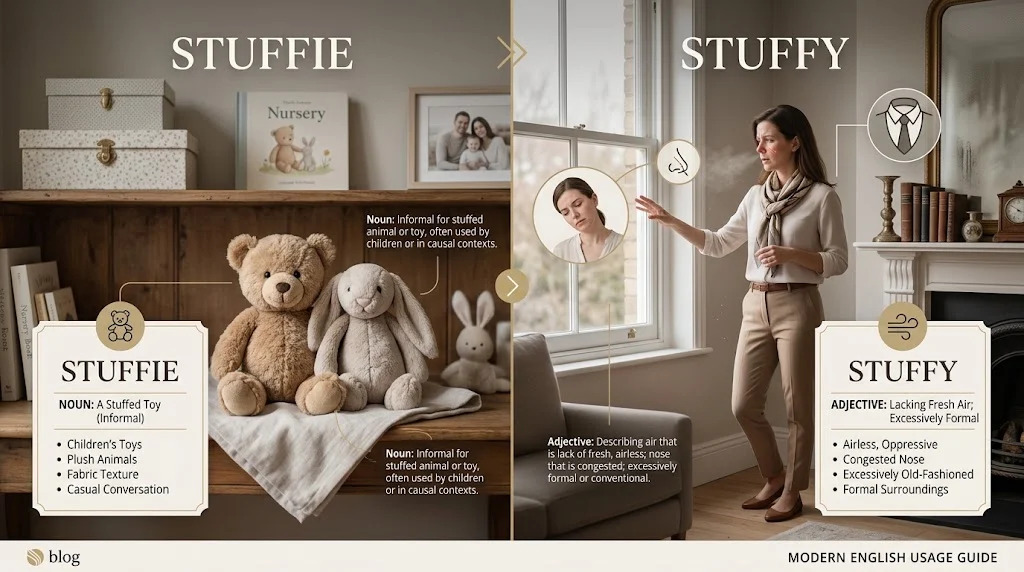
The correct choice depends on meaning. Stuffie is an informal noun for a stuffed animal or soft toy, while stuffy is an adjective describing a poorly ventilated place, a blocked nose, or something overly formal and old fashioned. They sound alike, but they serve different grammatical roles.
Stuffie or Stuffy | What’s the Difference?
The confusion between stuffie or stuffy usually comes from pronunciation. Both words are commonly pronounced /ˈstʌfi/, so they can sound identical when spoken. Their meanings, however, are quite different.
Stuffie is a noun. It is an informal word for a stuffed animal, especially a soft toy made from fabric and filled with a soft material. Cambridge Dictionary identifies it as a shortened form of “stuffed animal,” while Collins also describes it as an informal term for a fabric toy filled with stuffing.
Stuffy is an adjective. It can describe a room or building that lacks fresh air, a nose that is blocked because of congestion, or a person, organization, style, or situation that seems overly formal, dull, conservative, or old fashioned.
| Feature | Stuffie | Stuffy |
|---|---|---|
| Part of speech | Noun | Adjective |
| Basic meaning | A stuffed animal or soft toy | Lacking fresh air, congested, formal, dull, or old fashioned |
| Typical context | Toys, children, pets, bedrooms, casual conversation | Rooms, noses, writing, people, institutions, attitudes |
| Example | My daughter sleeps with her favorite stuffie. | The office feels stuffy today. |
| Style | Informal and affectionate | Standard adjective, with several meanings |
| Plural or comparison | Stuffies | Stuffier and stuffiest |
Quick recap:
Stuffie names a soft toy.
Stuffy describes a condition or quality.
They sound similar but aren’t interchangeable.
The surrounding noun or sentence meaning usually reveals the correct choice.
Is Stuffie or Stuffy a Grammar, Vocabulary, or Usage Issue?
This is primarily a vocabulary and usage issue, although grammar helps you identify the correct word.
The two words are not interchangeable. If you are naming an object such as a teddy bear, plush animal, or soft toy, the noun stuffie is appropriate. If you’re describing a room, nose, writing style, person, or institution, stuffy is the appropriate adjective.
Consider these examples:
“My son has three stuffies.”
Here, the word identifies objects, so it functions as a noun.
“The classroom is stuffy.”
Here, the word describes the classroom, so it functions as an adjective.
This distinction matters in formal and academic writing. Stuffie is an informal term, so a formal report may be better served by “stuffed animal,” “soft toy,” or another precise description. Cambridge and Collins both label the toy meaning as informal.
Stuffy, by contrast, is an established standard adjective. It can be used in professional, academic, and everyday contexts when its meaning fits the sentence. Oxford lists meanings involving poor ventilation, excessive formality, and nasal blockage.
What Does Stuffie Mean?
Stuffie is an informal noun meaning a stuffed animal or soft toy. It commonly refers to a cuddly toy shaped like an animal, such as a teddy bear, rabbit, dog, cat, elephant, or dinosaur.
The word is particularly common in casual speech, family conversations, parenting discussions, children’s contexts, and online communities. Cambridge describes it as a shortened form of “stuffed animal.”
For example:
“My little brother carries his stuffie everywhere.”
“She bought a new stuffie for her niece.”
“The child chose a dinosaur stuffie.”
The plural is stuffies.
It is worth noticing that stuffie does not necessarily refer only to teddy bears. The broader idea is a soft stuffed toy, generally in an animal form. The term can therefore cover many types of plush toys.
Workplace Example
A toy company might use the word in a casual product description:
“Our new stuffie collection is designed for children who love cuddly animal friends.”
In a highly formal business report, however, “stuffed animals” may be more appropriate.
Academic Example
A research paper about childhood attachment might say:
“Children were allowed to bring a familiar stuffed animal from home.”
That phrasing is more formal than “children were allowed to bring a stuffie.”
Technology Example
Online shopping applications may display products using terms such as “plush toy,” “stuffed animal,” or “stuffie,” depending on their audience and branding.
Usage recap: Use stuffie when you mean a soft stuffed toy and the informal tone is appropriate.
What Does Stuffy Mean?
Stuffy has several established meanings, which makes it much more versatile than stuffie.
The first major meaning describes a place that lacks fresh air. A stuffy room may feel hot, uncomfortable, closed in, or poorly ventilated. Cambridge gives examples involving stuffy offices and bedrooms, while Oxford similarly defines the word in relation to unpleasant warmth and insufficient fresh air.
For example:
“The conference room became stuffy after everyone arrived.”
“The bedroom feels stuffy, so let’s open a window.”
The second meaning relates to the nose. A stuffy nose is a blocked or congested nose, often associated with a cold.
The third meaning is figurative. Someone or something can be called stuffy when it is excessively formal, conventional, dull, conservative, or old fashioned.
For example:
“The organization has a reputation for being stuffy.”
“The article sounded too stuffy for its young audience.”
Workplace Example
“The meeting room was stuffy.”
Here, stuffy describes the physical environment.
“The company’s communication style feels stuffy.”
Here, it describes a formal or old fashioned style.
Academic Example
“A stuffy classroom can make students uncomfortable.”
“Some academic writing can become unnecessarily stuffy.”
The first sentence refers to air circulation. The second refers to writing style.
Technology Example
“The laptop room became stuffy after several hours.”
In this sentence, the adjective describes the physical environment rather than the computer itself.
Usage recap: Use stuffy as an adjective when describing air, congestion, excessive formality, dullness, or an old fashioned quality.
When You Should NOT Use Stuffie or Stuffy
There are several situations where choosing the wrong word can change the meaning of your sentence.
- Do not use stuffie when describing air.
Say, “The room is stuffy,” not “The room is stuffie.” - Do not use stuffie for nasal congestion.
Say, “I have a stuffy nose.” - Do not use stuffy when naming a stuffed toy.
In informal language, “stuffie” is the appropriate noun. - Do not use stuffie as a standard adjective.
It normally identifies a toy rather than describing a condition. - Do not use stuffy when referring to a teddy bear.
The sentence “I bought a stuffy” can be confusing because standard English generally interprets stuffy as an adjective. - Do not rely only on pronunciation.
Because the words sound alike, spelling and sentence meaning are essential. - Avoid stuffie in highly formal writing when precision matters.
“Stuffed animal” or “soft toy” may be clearer. - Do not assume every use of stuffy relates to temperature.
It can also describe a blocked nose or an overly formal person, institution, or style.
Common Mistakes and Decision Rules
| Correct sentence | Incorrect sentence | Explanation |
|---|---|---|
| She sleeps with her favorite stuffie. | She sleeps with her favorite stuffy. | The sentence refers to a stuffed toy, so the noun stuffie fits the intended informal meaning. |
| The room is stuffy. | The room is stuffie. | The sentence describes poor ventilation, so the adjective stuffy is required. |
| I have a stuffy nose. | I have a stuffie nose. | Stuffy is the established adjective for nasal congestion. |
| He bought a new stuffie. | He bought a new stuffy. | The object is a soft toy, so stuffie works as the informal noun. |
| The writing sounds stuffy. | The writing sounds stuffie. | The sentence describes a style that feels overly formal or dull. |
| Her child collects stuffies. | Her child collects stuffies as adjectives. | Stuffies is the plural noun referring to multiple stuffed toys. |
Decision Rule: If you mean a stuffed animal or soft toy, use stuffie. If you mean a room without fresh air, a blocked nose, or something overly formal or dull, use stuffy.
Stuffie and Stuffy in Modern Technology and AI Tools
Modern search systems and AI tools increasingly encounter informal vocabulary alongside conventional dictionary English. This makes contextual interpretation particularly important.
A shopping query such as “cute stuffies for children” clearly points toward stuffed animals. A query such as “why is my bedroom stuffy” points toward ventilation. Similarly, “stuffy nose remedies” refers to congestion, not toys.
Search engines can understand these distinctions because the surrounding words provide semantic clues. This is an important lesson for writers: spelling alone isn’t always enough. Context establishes meaning.
For website content, product descriptions, category pages, and conversational copy, stuffie can create a friendly and approachable tone. For educational, medical, professional, or academic writing, stuffy should be used only when its intended adjective meaning is clear.
Etymology and Word History
The relationship between these words becomes easier to understand when their formation is considered.
Stuffy comes from stuff combined with the suffix y, creating an adjective associated with the qualities or effects of stuff. Historical dictionary sources trace the adjective to the early modern period, with Merriam Webster giving a first known use of 1798 for one of its established senses.
Stuffie is a later informal formation associated with stuffed animal. Cambridge explicitly describes it as a shortened form of “stuffed animal,” while Collins gives it as an informal noun for a soft toy.
The shared pronunciation is therefore not evidence that the words have the same meaning. English contains many words that sound alike while performing different grammatical and semantic roles.
Expert Style Explanation
A useful linguistic principle is this: When two words sound alike but belong to different grammatical categories, sentence function becomes a stronger guide than pronunciation.
That principle applies perfectly here. Identify what the word is doing in the sentence first, then choose the spelling.
Case Study 1: Children’s Product Copy
Imagine an online store selling plush animals. A product page titled “Cute Stuffies for Kids” immediately signals an informal, friendly shopping experience. The term communicates the product category while matching the conversational language many shoppers use.
For a formal product specification, however, “stuffed animal” provides greater precision.
Case Study 2: Workplace Communication
Consider an office sentence:
“The training room is stuffy.”
Changing the spelling to stuffie would transform a meaningful environmental description into what appears to be a reference to a toy. The grammatical error therefore affects interpretation, not merely spelling.
This demonstrates why proofreading should consider meaning and context rather than relying exclusively on spell checking.
Author expertise: Written from a professional English usage and SEO perspective, with attention to dictionary definitions, grammatical function, search intent, and practical language clarity.
Error Prevention Checklist
Always Use Stuffie When
You are referring to a stuffed animal.
You mean a plush animal or soft toy.
The context is casual, affectionate, or conversational.
You are discussing a child’s favorite cuddly toy.
You are writing informal product or lifestyle content.
Never Use Stuffy When
You are naming a stuffed animal and want the informal noun.
You are referring specifically to a plush toy.
The sentence requires a noun meaning a soft toy.
At the same time, remember that stuffy is exactly right when describing poor ventilation, nasal congestion, or an overly formal style.
Related Grammar Confusions You Should Master
Understanding this distinction can help you recognize other commonly confused English words.
- Plushie and plushy
These can create similar noun and adjective questions. - Everyday and every day
One is generally an adjective while the other is an adverbial phrase. - Maybe and may be
Their pronunciation can make the distinction easy to miss. - Advice and advise
Their grammatical roles are different despite their similar sounds. - Affect and effect
Context and grammatical function determine the correct choice. - Practice and practise
Regional spelling conventions can affect the correct form. - Loose and lose
Similar spelling often leads writers to confuse them. - Then and than
Their pronunciation can cause mistakes in fast writing. - Your and you’re
One expresses possession while the other is a contraction. - There, their, and they’re
These sound similar but perform completely different grammatical functions.
FAQs
Is stuffie a real English word?
Yes. Major dictionaries including Cambridge and Collins recognize stuffie as an informal noun meaning a stuffed animal or soft toy.
Is stuffy the correct word for a stuffed animal?
Usually no. Stuffy is an adjective, while stuffie is an informal noun for a stuffed animal.
What is the difference between stuffie and stuffy?
Stuffie refers to a stuffed toy, while stuffy describes poor ventilation, nasal congestion, or an overly formal or dull quality.
Is stuffie formal English?
No. It is generally informal, so “stuffed animal” or “soft toy” may be preferable in formal writing.
Is stuffy an adjective or noun?
Stuffy is an adjective. It modifies nouns such as room, nose, writing, attitude, or institution.
Can I say I have a stuffy nose?
Yes. “Stuffy nose” is a standard expression meaning that the nose is blocked or congested.
Why do stuffie and stuffy sound the same?
They commonly have the same pronunciation, but spelling and grammatical function distinguish them.
What is the plural of stuffie? The plural is stuffies.
Can stuffy describe a person?
Yes. It can describe someone who seems excessively formal, conventional, conservative, or old fashioned.
Conclusion
The easiest way to remember stuffie or stuffy is to focus on meaning rather than sound. Stuffie is an informal noun for a stuffed animal or soft toy. Stuffy is an adjective describing a room without fresh air, a blocked nose, or something overly formal, dull, or old fashioned.
When you’re talking about a teddy bear or plush animal, stuffie is the natural informal choice. When you’re describing air, congestion, writing style, or a conservative attitude, choose stuffy. Once you identify the grammatical role and intended meaning, the spelling becomes straightforward.
Discover More Related Articles:
- Comply or Die | Meaning, Usage, Origin & Modern Context In 2026
- Saw or Seen | Which Is Correct & How to Use Each Word In 2026
- Congradulations or Congratulations | Why These Spellings Are Confused In 2026