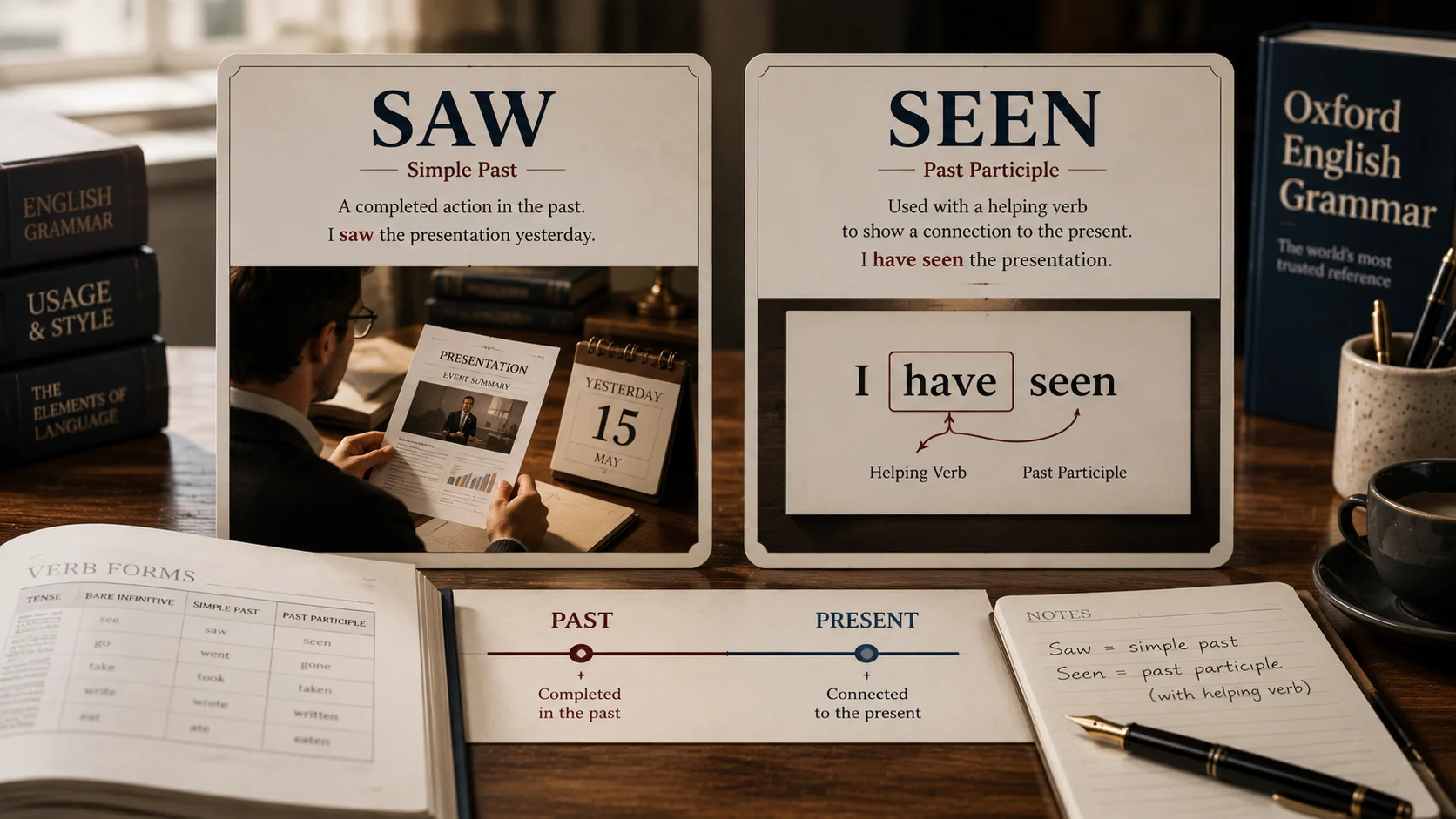
Saw is the simple past tense of “see,” while seen is the past participle and normally needs a helping verb such as “have,” “has,” “had,” or “be.” The choice depends on the verb structure and time being expressed. Understanding this difference prevents common mistakes in everyday speech, academic writing and professional communication.
Have you ever paused while writing a sentence, wondering to use saw or seen? You’re not alone! These two words come from the same verb, see, but using them incorrectly can make even a simple sentence sound grammatically wrong. The key difference lies in verb tense and sentence structure. Saw is the simple past tense, while seen is the past participle, which usually needs a helping verb such as have, has, or had. Understanding this distinction will help you avoid common grammar mistakes and communicate more naturally in everyday conversations and professional writing.
In this guide, we’ll explore saw vs. seen, explain their meanings, and provide clear examples to show when each word is correct. You’ll also learn how to recognize common errors, such as saying “I seen it” instead of “I saw it” or “I have seen it.” you’re improving your English grammar, writing content, or preparing for an exam, this simple comparison will help you use both words with confidence.
Saw or Seen | What’s the Difference?
The words “saw” and “seen” both come from the verb “see,” but they perform different grammatical jobs. The easiest way to distinguish them is to look at the verb tense and the words surrounding them.
“Saw” is the simple past tense of “see.” It describes something that happened and finished in the past.
For example:
I saw your message yesterday.
Here, “saw” stands on its own as the main verb. The action happened yesterday, so the simple past form is appropriate.
“Seen” is the past participle of “see.” It usually cannot function as the main verb by itself in standard English. It normally appears with a helping verb.
For example:
I have seen your message.
The word “have” is the helping verb, while “seen” is the past participle.
| Feature | Saw | Seen |
|---|---|---|
| Part of speech | Verb | Verb |
| Base verb | See | See |
| Verb form | Simple past | Past participle |
| Usually used with a helping verb | No | Yes |
| Example | I saw the movie. | I have seen the movie. |
| Common tense | Simple past | Perfect tenses and passive constructions |
| Correct alone as the main past verb | Yes | Usually no |
The basic distinction is straightforward.
Use saw when you are talking about a completed past event.
Use seen when another verb such as “have,” “has,” “had,” or “was” creates the required grammatical structure.
If you remember only one rule, remember this: “I saw” is correct, but “I have seen” is correct. “I seen” is not standard English.
Is Saw or Seen a Grammar, Vocabulary or Usage Issue?
The difference between these two words is primarily a grammar issue, rather than a vocabulary issue. They come from the same verb, “see,” but represent different forms of that verb.
They are not interchangeable in standard English.
Consider these examples:
I saw Sarah at the library.
I have seen Sarah at the library.
Both sentences can be correct, but they communicate slightly different grammatical relationships with time.
The first sentence uses the simple past. It presents the event as something that happened in the past.
The second sentence uses the present perfect. It connects a past experience or event with the present context.
A common mistake is:
I seen Sarah yesterday.
The standard form is:
I saw Sarah yesterday.
Another common mistake is:
I have saw that movie.
The correct sentence is:
I have seen that movie.
This distinction matters in formal writing because incorrect verb forms can make an otherwise strong sentence appear careless.
In casual speech, especially in some regional dialects, “I seen” may occur naturally. That does not make it standard in formal written English. Writers preparing essays, applications, reports, business correspondence, or professional documents should use the standard grammatical forms.
When to Use Saw
Use “saw” when you are describing a completed event in the past and the verb does not require a perfect construction.
For instance:
I saw the manager this morning.
We saw the results yesterday.
She saw an interesting presentation at the conference.
They saw the problem immediately.
The word “saw” is particularly common with specific past time expressions such as “yesterday,” “last week,” “two days ago,” and “in 2024.”
Workplace Example
Imagine an employee explaining a meeting to a colleague:
I saw the client yesterday and discussed the revised contract.
“Saw” works because the meeting occurred at a definite time in the past.
Another example is:
I saw your email this morning.
The speaker is describing a completed past event.
Academic Example
In academic writing, “saw” can describe observations or events that occurred during a specific study or historical period.
Researchers saw a significant increase in participation during the second phase of the experiment.
However, academic writers should choose the tense based on the intended meaning rather than automatically using the past tense.
Technology Example
Technology creates countless everyday examples:
I saw the notification on my phone.
I saw the error message when I opened the application.
We saw the update appear on the dashboard.
In each case, “saw” describes a completed act of noticing something.
Usage Recap for Saw
Use “saw” when the sentence describes a completed past event. It normally works as the main verb without “have,” “has,” or “had.”
A useful pattern is:
Subject + saw + object + past time reference
For example:
She saw the report yesterday.
When to Use Seen
“Seen” is the past participle of “see.” In standard English, it generally appears with a helping verb.
The most common pattern is the perfect construction:
I have seen that movie.
She has seen the document.
They had seen the warning before the accident.
“Seen” can also appear in passive constructions:
The issue was seen as a major concern.
Here, “was” provides the grammatical support needed for the participle.
Workplace Example
I have seen the latest version of the proposal.
This sentence is useful when the exact time is not important and the experience is relevant to the current situation.
Another example is:
We have seen strong growth in customer demand.
The present perfect connects the past observation with the current situation.
Academic Example
Several studies have seen similar patterns in language acquisition.
More naturally, depending on context, an academic writer might say that studies “have observed” or “have identified” similar patterns. Nevertheless, the grammatical construction with “have seen” is valid when “see” is the intended verb.
A historical example could be:
The region had seen considerable economic growth before the policy changed.
The word “had” places the observation before another past event.
Technology Example
I have seen this error before.
Users have seen similar behavior after recent updates.
The system has seen a sudden increase in traffic.
These sentences use “seen” because “have” or “has” is already providing the auxiliary structure.
Usage Recap for Seen
Use “seen” when the grammar requires a past participle. The word commonly follows “have,” “has,” or “had.”
A useful pattern is:
Subject + have, has, or had + seen + object
For example:
I have seen that notification before.
When You Should NOT Use Saw or Seen
Understanding when not to use each form is just as important as learning when to use it.
- Do not use “seen” alone as the simple past form.
Incorrect:
I seen him yesterday.
Correct:
I saw him yesterday.
- Do not use “saw” after “have.”
Incorrect:
I have saw this before.
Correct:
I have seen this before.
- Do not use “saw” after “has.”
Incorrect:
She has saw the report.
Correct:
She has seen the report.
- Do not use “saw” after “had.”
Incorrect:
They had saw the warning.
Correct:
They had seen the warning.
- Do not automatically choose “seen” because the event happened in the past.
The fact that something happened in the past does not automatically make “seen” correct.
I saw him yesterday.
- Do not use “saw” when a perfect construction requires a participle.
Incorrect:
We have saw the results.
Correct:
We have seen the results.
- Do not treat regional or informal speech as the standard form for formal writing.
Some speakers naturally use “I seen” in conversation. Formal English generally requires “I saw” or “I have seen,” depending on the sentence.
Common Mistakes and Decision Rules
| Correct sentence | Incorrect sentence | Explanation |
|---|---|---|
| I saw him yesterday. | I seen him yesterday. | “Saw” is the simple past form. |
| I have seen him before. | I have saw him before. | “Have” requires the past participle “seen.” |
| She saw the accident. | She seen the accident. | Simple past requires “saw.” |
| She has seen the accident. | She has saw the accident. | “Has” is followed by the participle “seen.” |
| They had seen the warning. | They had saw the warning. | “Had” requires “seen.” |
| We saw the results last week. | We seen the results last week. | A specific completed past event uses “saw.” |
| I have never seen that film. | I have never saw that film. | Present perfect requires “seen.” |
| He saw the notification. | He seen the notification. | “Saw” is the correct simple past form. |
Decision Rule
If you are describing a completed past event by itself, use “saw.” If you already have “have,” “has,” or “had,” use “seen.”
This is more accurate for “saw” and “seen” than a generic rule about an action, person, or tool. The key is the grammatical structure surrounding the verb.
Saw or Seen in Modern Technology and AI Tools
Modern digital communication has created many situations where these verb forms appear naturally.
Consider a support conversation:
I saw the error message after installing the update.
The speaker is describing a completed event.
Now compare:
I have seen this error message before.
Here, the experience is relevant to the present conversation, so the present perfect is appropriate.
AI systems also frequently generate sentences containing these forms. Grammar checking tools can identify many incorrect constructions, but writers should still understand the underlying rule. An automated correction may fix “I have saw” to “I have seen,” but understanding why the correction is necessary makes it easier to avoid similar mistakes with other irregular verbs.
The same principle applies to speech recognition. A transcription system might capture “I seen it” because that is what a speaker said. Transcription accuracy and grammatical correctness are different goals. A transcript may preserve the original speech, while an edited document should follow the grammatical standard required by its audience.
Etymology and Language History
The verb “see” is an old Germanic word with roots reaching back through Old English. Its forms have changed considerably over the history of English, but the modern language still preserves several irregular forms.
The principal forms are:
see
saw
seen
The relationship is similar to other irregular English verbs in which the past tense and past participle are different.
For comparison:
| Base form | Simple past | Past participle |
|---|---|---|
| See | Saw | Seen |
| Go | Went | Gone |
| Take | Took | Taken |
| Write | Wrote | Written |
| Eat | Ate | Eaten |
This pattern explains why memorizing “see, saw, seen” as a three part verb is useful.
Expert Style Explanation
A useful grammatical principle is: The simple past tells us that an event occurred in the past, while the past participle participates in larger verb constructions such as the perfect tenses and passive voice.
That distinction explains most cases involving “saw” and “seen.”
Two Practical Case Studies
Case Study 1: Professional Email
Imagine an employee writes:
I have saw the revised schedule.
The meaning is understandable, but the grammar is incorrect. Because “have” is already present, the sentence requires the past participle.
Correct:
I have seen the revised schedule.
This small correction matters in professional communication because grammatical accuracy contributes to clarity and credibility.
Case Study 2: Academic Writing
Suppose a student writes:
The participants seen an increase in performance.
The intended meaning is that participants observed an increase. The correct simple past construction is:
The participants saw an increase in performance.
The correction changes only one word, but it restores the required past tense form.
These examples show why the distinction is practical rather than merely theoretical.
Error Prevention Checklist
Always use Saw when
• You are describing a completed event in the simple past.
• You mention a specific completed past time.
• The verb is functioning as the main past tense verb.
• You are writing a sentence such as “I saw him yesterday.”
Never use Seen when
• It is standing alone as the simple past verb.
• The sentence says “I seen” without a helping verb.
• You are describing a straightforward completed event that requires simple past.
Always use Seen when
• It follows “have.”
• It follows “has.”
• It follows “had.”
• The sentence requires a past participle.
Related Grammar Confusions You Should Master
Once you understand “saw” and “seen,” several other irregular verb pairs become easier to recognize.
- Did or Done: “Did” is simple past, while “done” is a past participle.
- Went or Gone: “Went” is simple past, while “gone” normally follows a helping verb.
- Ate or Eaten: “Ate” is simple past, while “eaten” is the past participle.
- Wrote or Written: “Wrote” describes simple past, while “written” requires the appropriate auxiliary.
- Took or Taken: “Took” is simple past, while “taken” is the past participle.
- Ran or Run: “Ran” is simple past, while “run” can function as a past participle.
- Broke or Broken: “Broke” is simple past, while “broken” is the past participle.
- Spoke or Spoken: “Spoke” is simple past, while “spoken” is the past participle.
- Drank or Drunk: “Drank” is simple past, while “drunk” is the past participle.
- Began or Begun: “Began” is simple past, while “begun” is the past participle.
Learning these patterns helps you understand English verb forms as a system instead of memorizing isolated corrections.
FAQs
Is “I saw” or “I seen” correct?
“I saw” is correct for the simple past. “I seen” is not standard English when “seen” is used alone as the main past verb.
Is “I have saw” or “I have seen” correct?
“I have seen” is correct because “have” is followed by the past participle of “see.”
What is the past tense of “see”?
The simple past tense of “see” is “saw.” For example, “I saw the movie yesterday.”
What is the past participle of “see”?
The past participle is “seen.” It appears in constructions such as “I have seen the movie.”
Can “seen” be used by itself?
In standard English, “seen” normally requires a helping verb or another grammatical structure. “I seen it” is not standard.
Should I say “I saw it” or “I have seen it”?
Use “I saw it” for a completed past event and “I have seen it” when using the present perfect to connect past experience with the present.
Why do people say “I seen” in conversation?
“I seen” occurs in some regional and nonstandard varieties of English. It may be natural within those speech communities, but standard formal English uses “I saw” or “I have seen.”
Is “saw” a past participle?
No. “Saw” is the simple past form of “see.” “Seen” is the past participle.
Conclusion
The difference between “saw” and “seen” becomes simple once you identify the verb structure. Use saw for the simple past, as in “I saw the movie yesterday.” Use seen when a helping verb creates a perfect or other participial construction, as in “I have seen the movie.”
If you are unsure, look at the words immediately before the verb. “Have,” “has,” and “had” are strong signals that “seen” is required. When no helping verb is needed and you are describing a completed past event, “saw” is usually the correct choice.
Mastering this distinction will improve everyday conversation, academic writing, workplace communication, and professional English because it prevents one of the most noticeable irregular verb errors.
Discover More Related Articles:
- Fiancee or Fiance | Which Spelling Is Correct & When to Use Each In 2026
- Hinge or Bumble | Which Dating App Is Better for Finding a Relationship In 2026
- Weather or Seaside | Meaning & Usage Explained for English Learners In 2026