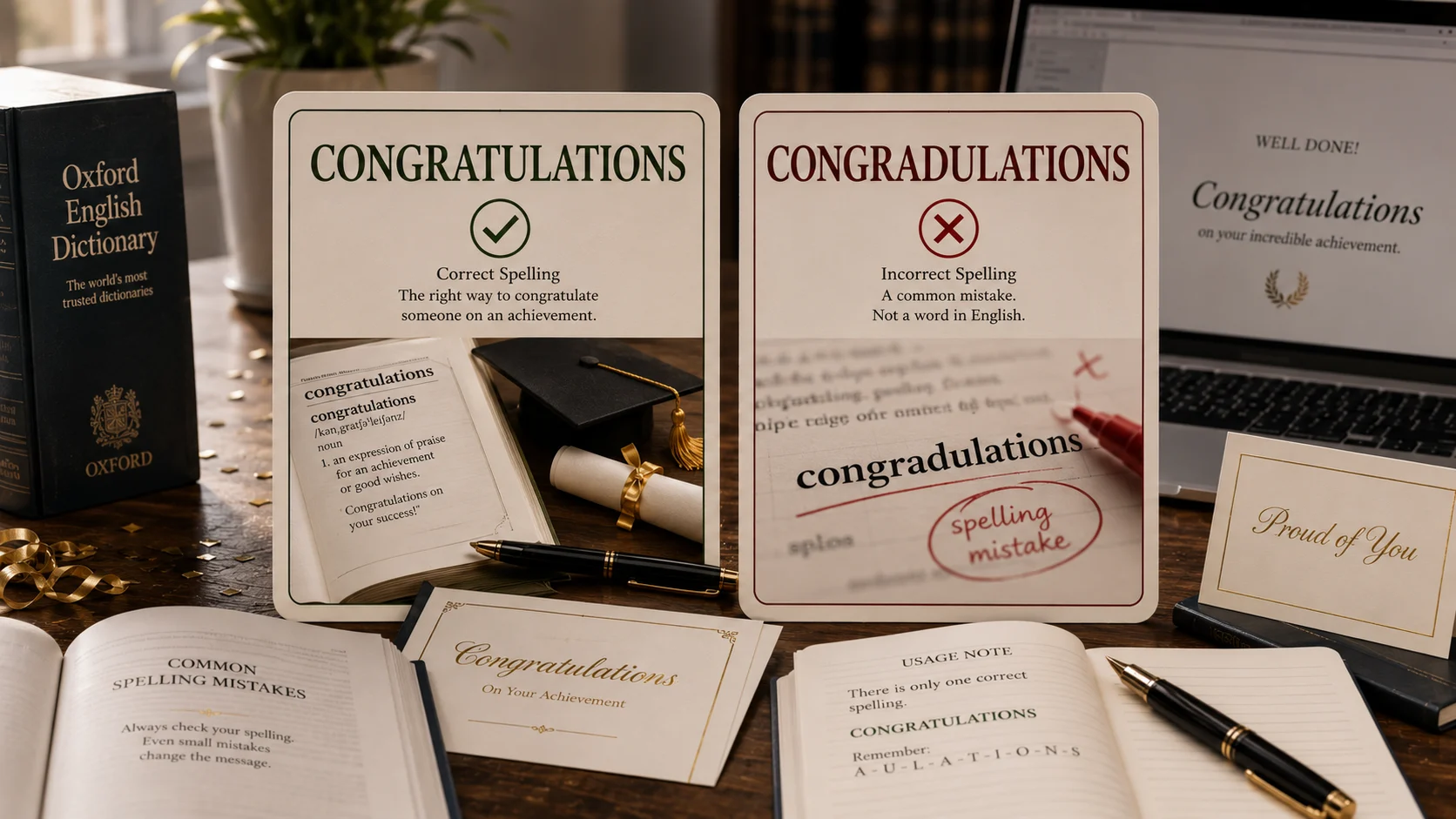
Congratulations is the correct spelling of the word used to express praise, approval, or good wishes after someone achieves something important. Congradulations is a common spelling mistake, not a standard English word. The confusion happens because the correct spelling contains the sound and letters people associate with graduation, which can make the incorrect form feel natural when written quickly.
Have you ever typed congradulations or congratulations and wondered which spelling is correct? A single letter can make the difference between a polished message and a noticeable spelling mistake. you are congratulating someone on a promotion, celebrating a graduation, or sharing the excitement of a personal achievement, choosing the correct spelling helps your message look professional and thoughtful. Although congradulations may seem logical because of its pronunciation, it is a common misspelling of the standard English word.
The correct spelling is congratulations, which is used to express praise, happiness, or good wishes when someone achieves something positive. In contrast, congradulations is not the accepted standard spelling in modern English. In this guide, you’ll discover the meanings of both spellings, explore practical sentence examples, and learn simple ways to remember the correct form. By understanding this common spelling confusion, you can write clearer messages and celebrate other people’s achievements with confidence.
Congradulations or Congratulations | What Is the Difference?
The central question in congradulations or congratulations is actually a spelling question rather than a difference in meaning. Only one form is accepted in standard modern English.
Congratulations is the correct spelling. It is a plural noun that refers to words of praise or good wishes offered to someone who has achieved something, reached an important milestone, or experienced success. It can also function in the familiar expression “Congratulations!” as an interjectional expression of praise.
Congradulations is an incorrect spelling. It does not represent a separate meaning, grammatical form, or alternative variety of standard English. If you write it in a formal email, school assignment, business message, card, or professional document, it will generally be treated as a spelling error.
| Word | Status | Part of speech | Meaning | Example |
|---|---|---|---|---|
| Congratulations | Correct | Plural noun, also used as an expression | Praise or good wishes for an achievement or success | Congratulations on your promotion. |
| Congradulations | Incorrect | Not a standard English word | No accepted independent meaning | Congradulations on your promotion. |
The distinction is simple.
Congratulations is the standard spelling used in dictionaries and formal English.
Congradulations is a misspelling caused partly by the association between congratulations and graduation.
When you want to praise someone for an achievement, write congratulations.
Is Congradulations or Congratulations a Grammar, Vocabulary or Usage Issue?
This is primarily a spelling and vocabulary issue. The two forms are not interchangeable because only congratulations is recognized as the standard English word.
There is no grammatical rule that allows congradulations as an alternative spelling. The mistake usually happens during writing because congratulations has a pronunciation that can make its middle letters difficult to remember.
The word is also closely associated with situations such as graduations, examinations, promotions, weddings, awards, competitions, and major personal achievements. Because graduation contains the sequence “grad,” writers sometimes unconsciously insert that spelling into congratulations.
That association explains the error, but it does not make the spelling acceptable.
In formal writing, academic work, workplace communication, and published content, congratulations should always be preferred. In casual conversation, a listener may understand congradulations immediately, but understanding an error does not turn it into a correct spelling.
Consider these examples:
“Congratulations on completing your degree.”
“Congratulations on your new position.”
“Congratulations to the winning team.”
In each sentence, congratulations expresses praise or good wishes.
The word can also appear without the preposition on:
“Congratulations! You did it.”
This is particularly common in cards, messages, social media posts, and spoken English.
How to Use Congratulations Correctly
The safest way to use congratulations is to connect it directly with the achievement or event being celebrated.
A very common structure is:
Congratulations on + noun or gerund
For example:
“Congratulations on your promotion.”
“Congratulations on winning the competition.”
“Congratulations on graduating from university.”
Another useful structure is:
Congratulations to + person or group
For example:
“Congratulations to all the finalists.”
“Congratulations to Sarah for completing the project.”
The expression can also stand alone:
“Congratulations!”
This short form is completely natural when the situation already makes the achievement clear.
Workplace Example
Imagine that a colleague has been promoted.
“Congratulations on your promotion, Ahmed.”
This sounds professional, warm, and appropriate.
For a more formal business message, you might write:
“Please accept my sincere congratulations on your promotion.”
A common mistake would be to write “congradulations” in an official email. Although the recipient will probably understand the intended meaning, the error can make the message appear careless.
Academic Example
Students frequently use congratulations when discussing academic achievements.
“Congratulations on completing your thesis.”
“Congratulations on earning your degree.”
“Congratulations to the students who achieved the highest results.”
The word is suitable in university announcements, graduation cards, formal letters, certificates, and personal messages.
Technology Example
Digital communication has made congratulations one of the most frequently typed expressions in everyday English. People use it in messaging applications, social media comments, online communities, workplace platforms, and automated notification systems.
For example:
“Congratulations! Your application has been approved.”
“Congratulations on reaching 10,000 followers.”
“Congratulations to the team on completing the release.”
Usage recap: Use congratulations whenever you are expressing praise or good wishes for an achievement. It works in professional, academic, personal, and digital communication.
When You Should NOT Use Congradulations or Congratulations
Although congratulations is highly useful, there are situations where it may not be the most natural expression.
- Do not use congradulations as an alternative spelling. It is simply incorrect.
- Do not use congratulations for an ordinary event that is not normally considered an achievement. Saying “Congratulations on buying groceries” may sound humorous or unusual unless the context gives it a special meaning.
- Do not use congratulations when someone has experienced an unfortunate event. Praise and sympathy serve different communicative purposes.
- Do not automatically write “Congratulations on” before every noun. The expression should relate naturally to an achievement or positive milestone.
- Do not confuse congratulations with appreciation. If you want to thank someone for helping you, “Thank you” is normally more appropriate.
- Do not use congratulations when you actually mean encouragement. Before an examination, for example, “Good luck” is usually more suitable than “Congratulations.”
- Do not use congratulations as a replacement for acknowledgement in every formal situation. Sometimes “We are pleased to announce” or “We commend” better matches the purpose of the message.
- Never assume that congradulations is acceptable simply because people understand it. Frequent online usage does not automatically make a spelling standard.
Common Mistakes and Decision Rules
The most frequent error is inserting the letters associated with grad into the middle of the word.
| Correct sentence | Incorrect sentence | Explanation |
|---|---|---|
| Congratulations on your promotion. | Congradulations on your promotion. | Congratulations is the standard spelling. |
| Congratulations on graduating. | Congradulations on graduating. | The correct word does not contain the extra d after congra. |
| Congratulations to the winners. | Congradulations to the winners. | The incorrect form is a spelling error. |
| Congratulations! You passed. | Congradulations! You passed. | The expression of praise requires the standard spelling. |
| Please accept my congratulations. | Please accept my congradulations. | Formal writing requires congratulations. |
Decision Rule Box
If you mean praise or good wishes for an achievement, use congratulations.
If you see congradulations in your writing, replace it with congratulations.
The action versus person or tool rule sometimes used for word comparisons does not apply to this pair. These are not two words with different grammatical functions. One is correct and the other is a misspelling.
Why Do People Spell Congratulations as Congradulations?
The mistake has a logical psychological explanation.
Congratulations sounds as though it might be connected directly to graduation. The word graduation is strongly associated with major achievements, especially academic success. Because people often say “Congratulations on your graduation,” the brain can connect the two words and transfer the spelling pattern from graduation into congratulations.
There is another reason. The middle portion of congratulations is not always easy to hear clearly in rapid speech. When people write from pronunciation rather than visual memory, they may reconstruct the word incorrectly.
This is an example of a spelling error influenced by word association.
The correct word is related to congratulate, not to graduation.
Congratulate comes from the Latin congratulari, meaning to wish joy or express joy with someone. Graduation and congratulations can appear in the same situation, but their origins and meanings are different.
A useful memory trick is to remember the family:
congratulate → congratulation → congratulations
Do not build the spelling from graduation.
Congratulations in Modern Technology and AI Tools
Modern technology has made spelling mistakes more visible because congratulations appears constantly in digital communication.
Messaging applications, workplace platforms, social networks, email systems, writing assistants, and AI tools all process the word frequently. Spell checking software will generally identify congradulations as an error and recommend congratulations.
AI writing tools can also recognize the intended meaning from context. If a user types “Congradulations on your new job,” an AI assistant may automatically suggest or generate “Congratulations on your new job.”
However, automated correction should not replace language knowledge. A writer should understand why the correction is necessary. This is especially important in professional communication, educational writing, marketing copy, and published material.
Technology can correct a spelling error, but understanding the word family helps prevent the error from returning.
Etymology of Congratulations
The history of congratulations provides an especially useful clue about the spelling.
Congratulations comes from the verb congratulate, which developed from Latin congratulari. The Latin term is associated with sharing joy and expressing happiness with another person.
The modern English word therefore belongs to a family built around congratulate:
congratulate
congratulation
congratulations
The word is not derived from graduation, even though the two words frequently appear together.
This distinction explains why writing “congradulations” is tempting but incorrect. The spelling reflects an imagined connection rather than the actual history of the word.
An expert style explanation would be:
“Correct spelling follows the word’s established lexical family, not the words it happens to resemble in meaning or context.”
That principle applies far beyond congratulations. English contains many words whose spelling becomes confusing because writers associate them with another familiar word.
Two Practical Case Studies
Case Study One: A Graduation Announcement
Consider a university department preparing an announcement for graduates. The draft contains the sentence:
“Congradulations to the graduating class of 2026.”
The intended meaning is obvious, but the spelling error is unsuitable for an official university communication.
After correction, the sentence becomes:
“Congratulations to the graduating class of 2026.”
The change involves only one spelling decision, yet it improves the professionalism of the entire announcement. The concrete result is that the public facing message uses the accepted dictionary form and avoids an easily preventable credibility problem.
Case Study Two: A Workplace Promotion Email
Imagine a manager writing:
“Congradulations on your promotion. We are pleased to have you leading the new department.”
The incorrect spelling appears in the first sentence of an otherwise professional message.
After editing:
“Congratulations on your promotion. We are pleased to have you leading the new department.”
Again, the meaning has not changed. The concrete result is improved linguistic accuracy, which matters because workplace messages often represent both the individual writer and the organization.
These examples are illustrative editing case studies rather than claims about specific organizations.
Error Prevention Checklist
Always use congratulations when
- You are praising someone for an achievement.
- You are offering good wishes after a positive milestone.
- You are writing a graduation message.
- You are recognizing a promotion or award.
- You are congratulating a person, team, or organization.
- You are writing a formal or professional message.
Never use congradulations when
- You are writing an academic assignment.
- You are preparing a business email.
- You are publishing an article.
- You are creating a greeting card.
- You are writing a public announcement.
- You are responding professionally online.
A simple visual memory method is to remember congratulate first. Once you know the correct verb, congratulations becomes much easier to spell.
Related Grammar Confusions You Should Master
Learning congratulations also creates an opportunity to strengthen your broader spelling and usage skills. English learners and native speakers alike frequently encounter confusing word pairs and forms.
Related topics worth mastering include:
- affect or effect
- advice or advise
- accept or except
- compliment or complement
- principal or principle
- stationery or stationary
- definitely or definately
- separate or seperate
- occurrence or occurence
- receive or recieve
These examples demonstrate an important point: many spelling errors are not random. They arise because English spelling does not always match pronunciation perfectly, or because one familiar word influences the spelling of another.
FAQs
Is congradulations a correct spelling?
No. Congratulations is the correct standard English spelling, while congradulations is a misspelling.
Why do people spell congratulations as congradulations?
The error often happens because congratulations is strongly associated with graduation, making the incorrect spelling feel natural.
How do you spell congratulations correctly?
Spell it as congratulations. Remember the related verb congratulate rather than connecting the spelling to graduation.
What is the meaning of congratulations?
Congratulations is an expression of praise or good wishes given to someone after an achievement, success, or positive milestone.
Can I use congratulations in formal writing?
Yes. Congratulations is appropriate in formal letters, business emails, academic announcements, professional messages, and official communications.
Is congratulations a noun or an adjective?
Congratulations is a plural noun, although “Congratulations!” is commonly used as an independent expression of praise.
Is congratulations related to graduation?
The words are closely associated in many situations, but congratulations comes from congratulate and is not simply a form of graduation.
Should I write congratulations on or congratulations for?
“Congratulations on” is the most common construction, as in “Congratulations on your promotion.” “Congratulations to” is also common when identifying the person receiving the praise.
What is an easy way to remember the spelling of congratulations?
Remember the word family congratulate, congratulation, and congratulations. Do not use graduation as a spelling model.
Conclusion
When comparing congradulations or congratulations, there is no genuine choice between two standard English words. Congratulations is the correct spelling and the form you should use in academic, professional, personal, and digital communication. Congradulations is a common misspelling, probably encouraged by the close association between congratulations and graduation.
The easiest way to remember the difference is to focus on the word family congratulate, congratulation, congratulations. If you are praising someone for an achievement, write “Congratulations!” With that simple rule, you can avoid one of the most common spelling mistakes surrounding this useful expression.
Discover More Related Articles:
- Fiancee or Fiance | Which Spelling Is Correct & When to Use Each In 2026
- Hinge or Bumble | Which Dating App Is Better for Finding a Relationship In 2026
- Weather or Seaside | Meaning & Usage Explained for English Learners In 2026