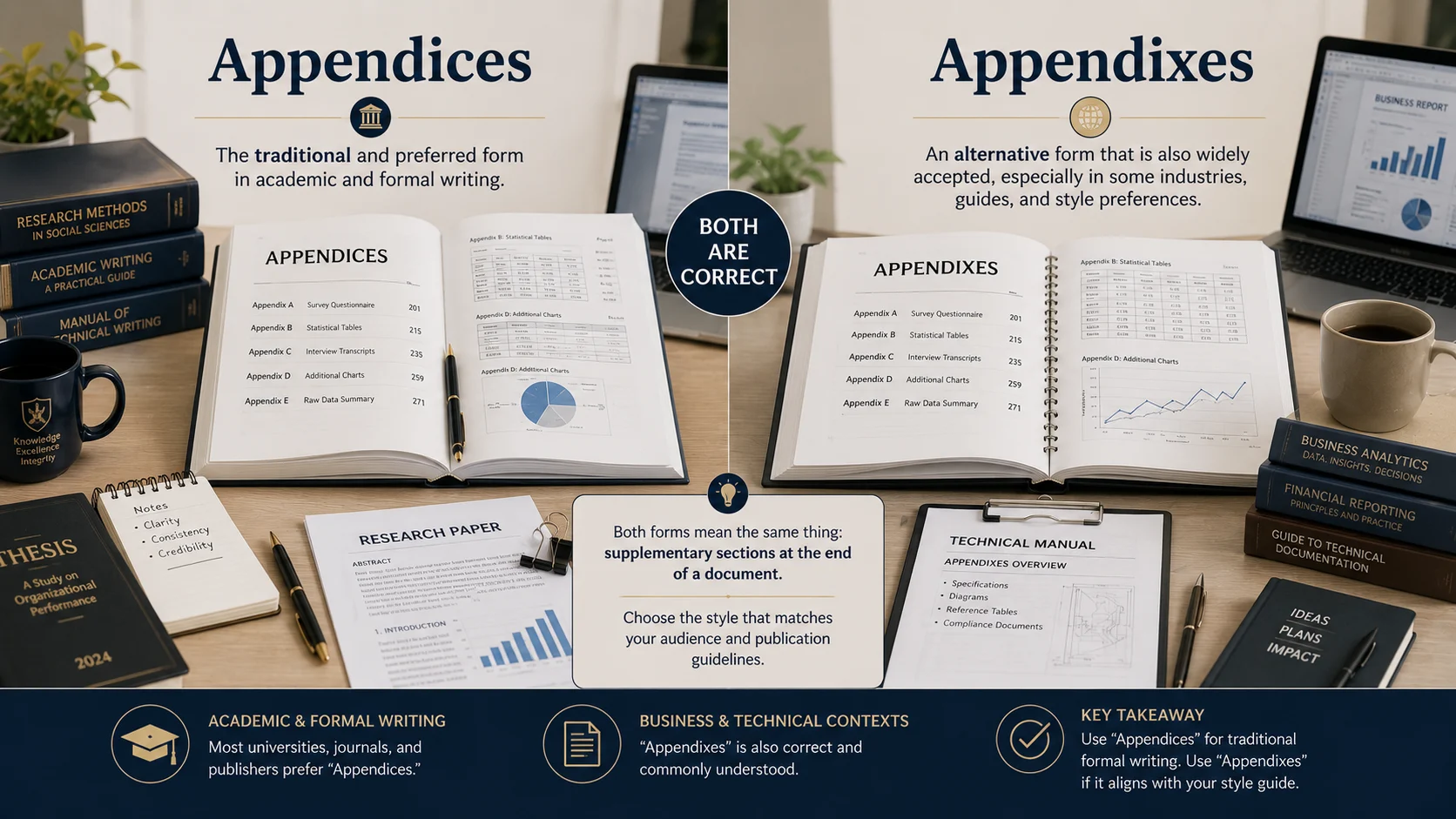
Both appendices or appendixes are correct plural forms of appendix. Appendices is the traditional and more common choice, especially in academic, medical, and formal writing, while appendixes is also accepted and can be useful when referring to supplementary sections in books, reports, or documents.
Appendices vs Appendixes | What’s the Difference?
The words appendices and appendixes are both plural nouns. They refer to more than one appendix, meaning supplementary sections placed at the end of a book, report, thesis, research paper, or other substantial document.
The main difference isn’t meaning. Instead, it comes from plural formation, tradition, style, and context.
Appendices is the older and more widely recognized plural, particularly in formal English. It follows a pattern found in several words derived from Latin. Appendixes is a regular English plural formed by adding es to appendix. Both forms appear in reputable dictionaries and established writing.
For most formal writing, appendices is the safest choice. If you’re writing a university thesis, scientific paper, business report, legal document, or professional publication, appendices will usually sound more conventional.
| Feature | Appendices | Appendixes |
|---|---|---|
| Part of speech | Plural noun | Plural noun |
| Singular form | Appendix | Appendix |
| Meaning | More than one appendix | More than one appendix |
| Pronunciation | Usually pronounced uh PEN dih seez | Usually pronounced uh PEN dih kseez |
| Standard status | Correct | Correct |
| Formal writing | Very common | Acceptable |
| Academic writing | Preferred in many contexts | Acceptable |
| Business writing | Common | Acceptable |
| Technical documents | Common | Acceptable |
| Meaning difference | None | None |
| Best general choice | Yes | Yes, when preferred by style |
Quick recap
Appendices and appendixes have the same basic meaning.
Appendices is more traditional and common in formal writing.
Appendixes is a legitimate regular English plural.
Your choice should usually follow the style guide or convention used by your organization.
What Does Appendix Mean?
Before deciding between the two plural forms, it’s useful to understand the singular noun.
An appendix is a supplementary section attached to the end of a larger document. It usually contains information that supports the main discussion but would interrupt the flow if included in the central text.
For example, a research paper might discuss its findings in the main chapters while placing raw survey questions, detailed calculations, interview transcripts, or supporting statistics in an appendix.
The plural is needed when there is more than one such section.
For example:
The report contains three appendices.
You might also write:
The researcher included several appendixes containing additional documentation.
Both sentences are grammatically acceptable.
The important point is that the choice does not change what the document contains. It changes only the plural form used for appendix.
Is Appendices vs Appendixes a Grammar, Vocabulary or Usage Issue?
This is primarily a vocabulary and usage issue involving plural formation.
There is no grammatical error in choosing either form. The noun appendix has two accepted plural forms, which developed through different linguistic patterns.
Appendices reflects the Latin origin of the word. In traditional Latin usage, nouns ending in ix can develop a plural ending in ices. English retained this pattern in several learned words.
Appendixes, on the other hand, follows a more straightforward English plural pattern. English speakers often make nouns plural by adding s or es, and appendixes fits that familiar pattern.
The two forms are therefore interchangeable in meaning, although they aren’t always equally common in every field.
In academic and scientific contexts, appendices tends to feel more conventional. In general English, appendixes is still perfectly understandable and grammatically valid.
Formal vs casual usage
Formal writing generally favors established conventions. That’s why you’ll frequently see appendices in university guidelines, research publications, professional reports, and scholarly books.
Casual writing gives you more flexibility. If someone writes appendixes, readers generally understand the intended meaning immediately.
Academic vs everyday usage
Academic writers often prefer appendices because it has a long established presence in scholarly publishing.
Everyday writers may use either form without creating confusion. The most important consideration is consistency.
If your document uses appendices in one section, don’t switch to appendixes later unless there is a specific reason.
When Should You Use Appendices?
Use appendices when you’re writing in a context where traditional or formal English is preferred.
This is particularly useful for university assignments, dissertations, research papers, annual reports, technical documentation, medical publications, and formal business documents.
Workplace example
The final report includes two appendices containing financial records and supporting calculations.
Here, appendices sounds natural because the sentence belongs to a formal professional context.
Academic example
The dissertation includes four appendices with interview transcripts and survey data.
This is a particularly common environment for the traditional plural form.
Technology example
The software documentation includes several appendices explaining the API examples and configuration details.
Technical documentation frequently uses formal terminology, so appendices is a natural choice.
Usage recap
Choose appendices when you want the most traditional and widely accepted formal plural.
It’s especially suitable for academic, scientific, professional, and technical writing.
When Should You Use Appendixes?
Use appendixes when you prefer the regular English plural or when a particular publication, organization, or style guide uses that form.
There is nothing inherently incorrect about it.
Workplace example
The contract contains several appendixes covering technical specifications and additional terms.
This sentence is grammatically sound even though many professional writers would choose appendices instead.
Academic example
The study’s appendixes provide additional tables and supporting evidence.
A university may accept this form, although its own style guide could recommend appendices.
Technology example
The developer guide contains two appendixes with configuration examples.
The meaning remains exactly the same as it would with appendices.
Usage recap
Choose appendixes when it matches your preferred English convention or an established house style.
It is a correct plural and should not automatically be treated as an error.
When You Should NOT Use Appendices or Appendixes
Although both plural forms are correct, there are situations where neither should be used.
- When you mean only one supplementary section, use appendix, not either plural form.
- When you’re referring to the main body of a document, don’t call its chapters appendices simply because they appear later.
- When describing supporting material that isn’t formally attached to a document, another term such as supplementary material may be more accurate.
- When referring to a person’s anatomical structure, be careful with the intended meaning. The plural form may be appropriate, but context matters.
- When a publisher provides a required style guide, don’t switch between plural conventions simply because both are grammatically correct.
- When naming a specific section, follow the document’s established numbering system. For example, use Appendix A for one section rather than forcing a plural form.
- When referring to one item among several supplementary sections, use the singular noun.
- When consistency matters, avoid alternating between appendices and appendixes without a clear stylistic reason.
The goal isn’t simply to choose a word that is technically correct. Good writing also depends on consistency, audience expectations, and context.
Common Mistakes and Decision Rules
The most common mistake is assuming that one plural form must be correct while the other must be wrong.
That isn’t the case.
| Correct sentence | Incorrect sentence | Explanation |
|---|---|---|
| The report contains three appendices. | The report contains three appendix. | Appendix is singular, so it cannot follow a plural number here. |
| The thesis includes two appendixes. | The thesis include two appendixes. | The plural subject thesis context requires the singular verb includes. |
| See Appendices A and B. | See Appendix A and B. | Two separate sections require the plural reference Appendices. |
| The appendix contains supporting data. | The appendices contains supporting data. | A plural subject requires contain, not contains. |
| The report has several appendices. | The report has several appendixeses. | Appendixes already functions as a complete plural form. |
| Appendix A contains the survey. | Appendices A contains the survey. | A single labeled section takes the singular form Appendix. |
Decision Rule Box
If you mean one supplementary section, use appendix. If you mean multiple supplementary sections, use either appendices or appendixes. For formal writing, appendices is usually the safer choice.
This rule eliminates most mistakes immediately.
Appendices and Appendixes in Modern Technology and AI Tools
Modern technology has made supplementary information more common rather than less common.
Digital reports, online research papers, software documentation, electronic books, technical manuals, and AI generated documents can all contain supplementary sections.
AI writing tools may produce either appendices or appendixes because both are legitimate English forms. A language model should therefore not automatically mark appendixes as incorrect.
However, automated grammar tools can sometimes favor one form based on their underlying dictionaries or style preferences. That doesn’t necessarily mean the alternative is wrong.
For professional content, human review remains important. A document should follow one consistent style throughout, especially when it is being prepared for publication, academic submission, legal review, or corporate use.
Why Does English Have Two Plurals for Appendix?
The explanation becomes clearer when we look at the history of the word.
Appendix ultimately comes from Latin appendix, meaning something attached or added. The word entered English through scholarly and learned usage.
Traditional learned English retained a Latin influenced plural, appendices. This pattern is also found in words such as index and matrix, although English has developed multiple plural conventions for some of these words as well.
English is particularly comfortable with competing plural forms. Over time, speakers often regularize words according to familiar English patterns. That’s how forms such as appendixes can coexist with the older appendices.
Neither form represents a spelling mistake.
Expert style insight
A useful principle in professional editing is: when two forms are accepted, choose the form that best matches the audience, style guide, and surrounding terminology.
That principle is more useful than treating one accepted form as universally superior.
Two Practical Case Studies
Case Study 1: University Dissertation
Imagine a doctoral dissertation containing survey instruments, interview transcripts, statistical tables, and consent documentation.
The writer labels these sections Appendix A, Appendix B, Appendix C, and Appendix D. When referring to them collectively, the natural formal wording is:
The supporting materials are provided in the appendices.
This choice works particularly well because academic readers are accustomed to seeing appendices in dissertations and research writing.
The practical result is greater stylistic consistency and alignment with conventional academic language.
Case Study 2: Technical Documentation
Consider a software company publishing a developer manual. Its final pages contain configuration references, troubleshooting information, and sample data.
The documentation team may decide to use appendixes because its internal editorial style favors regular English plurals.
That choice is also correct.
The practical result is that the documentation maintains a consistent terminology policy rather than switching between competing forms.
These examples demonstrate an important point: correctness and preference aren’t always the same thing.
Error Prevention Checklist
Always use appendices when
✓ You’re writing a formal academic document.
✓ You’re preparing a dissertation, thesis, or research paper.
✓ You’re writing for an audience accustomed to traditional English terminology.
✓ Your institution or publisher recommends appendices.
✓ You want the most conventional formal option.
✓ You need a plural for multiple supplementary sections.
Never use appendixes when
There is no universal rule saying that appendixes must never be used. It is an accepted plural.
Instead, avoid it when your style guide specifically requires appendices, when consistency with an established document demands appendices, or when your target audience expects the traditional form.
That distinction is important because calling appendixes incorrect would itself be misleading.
Related Grammar Confusions You Should Master
Understanding plural forms like appendices and appendixes can make it easier to recognize other English words with competing or irregular plural patterns.
Here are several useful distinctions to study:
- Indexes or Indices: Both can be correct, with usage influenced by context.
- Formulas or Formulae: Both occur in English, although their distribution differs by field.
- Cactuses or Cacti: English and Latin influenced plural forms coexist.
- Focuses or Foci: Both forms are established, but they may have different stylistic associations.
- Phenomenons or Phenomena: Phenomena is the standard plural of phenomenon.
- Criteria or Criterion: Criterion is singular, while criteria is plural.
- Data or Datum: Traditional and modern usage can treat these forms differently depending on context.
- Media or Medium: The relationship between the singular and plural forms varies across academic and everyday English.
- Syllabus or Syllabi: English allows more than one plural convention.
- Crisis or Crises: The pronunciation and spelling change in the plural.
Learning these patterns helps writers understand why English doesn’t always follow one simple plural rule.
FAQs
Is appendices or appendixes correct?
Both are correct plural forms of appendix, but appendices is more traditional and is generally preferred in formal and academic writing.
What is the plural of appendix?
The plural of appendix can be appendices or appendixes, and both forms are accepted in standard English.
Is appendixes grammatically correct?
Yes, appendixes is a grammatically correct plural form and follows a regular English plural pattern.
Is appendices more correct than appendixes?
No, but appendices is more traditional and more common in many formal, academic, scientific, and professional contexts.
Should I use appendices in academic writing?
In most academic writing, appendices is an excellent choice because it matches the conventional terminology used for multiple supplementary sections.
Can I use appendixes in a research paper?
Yes, unless your university, journal, publisher, or style guide specifically requires appendices.
What is the difference between appendix and appendices?
Appendix refers to one supplementary section, while appendices refers to two or more supplementary sections.
How do you pronounce appendices?
Appendices is commonly pronounced approximately as uh PEN dih seez, with the final syllable sounding like “sees.”
How do you pronounce appendixes?
Appendixes is commonly pronounced approximately as uh PEN dih kseez, with the final ending sounding like “zees.”
How to Choose the Best Form
If you’re unsure which version to use, start with your audience.
For a university thesis, choose appendices. For a scientific publication, appendices is also a strong conventional choice. For a corporate report, either form can work, but following the organization’s style guide is best.
For general writing, both forms are acceptable.
The safest general rule is simple: use appendices when you want the traditional formal option, and use appendixes when you deliberately prefer the regular English plural or when a specific style guide calls for it.
Most importantly, don’t treat the choice as a matter of right versus wrong. The real distinction is one of convention and style.
Conclusion
The choice between appendices or appendixes doesn’t involve a difference in meaning. Both are legitimate plural forms of appendix, and both can describe multiple supplementary sections in books, reports, research papers, and other documents.
For formal and academic writing, appendices is usually the strongest choice because it is traditional, widely recognized, and familiar to professional readers. Appendixes remains correct and can be appropriate when regular English pluralization or a house style favors it.
When accuracy matters, consider three things: the audience, the context, and the applicable style guide. Then choose one form and use it consistently throughout your document.
Discover More Related Articles:
- Offerred or Offered | Which Spelling Is Correct & Why In 2026
- Honda or Toyota | Which Is Better for Reliability, Value & Everyday Driving In 2026
- Draws or Drawers | Meaning, Grammar, Usage & Common Mistakes In 2026