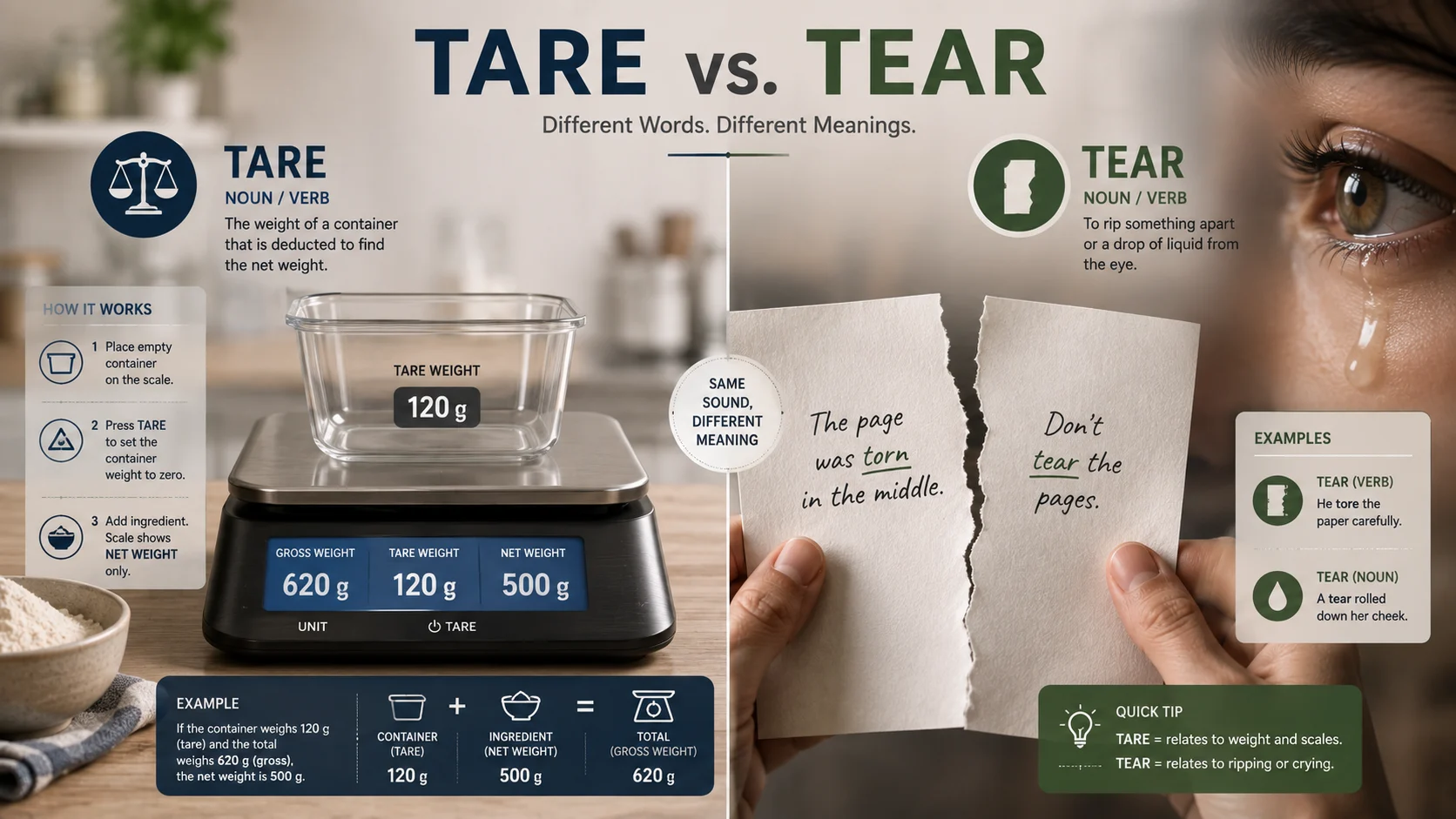
Tare or tear can be confusing because the two words look and sound similar in some contexts, but they have completely different meanings. Tare usually refers to the weight of a container that is deducted from the total weight, while tear can refer to a drop of liquid from the eye or the act of ripping or pulling something apart. The correct choice depends entirely on context.
Tare or Tear: What Is the Difference?
The main difference is meaning and usage. Tare is primarily associated with weight measurement, containers, and weighing scales. Tear has several meanings and can function as both a noun and a verb.
For example, a shopkeeper may use the tare function on a digital scale to remove the weight of an empty container before weighing its contents. In a completely different context, someone might tear a piece of paper or shed a tear while crying.
Although these words can create spelling and pronunciation confusion, they belong to different vocabulary groups and should not be used interchangeably.
| Word | Part of speech | Main meaning | Example |
|---|---|---|---|
| Tare | Noun | Weight of a container or packaging | The tare weight of the box is two kilograms. |
| Tare | Verb | To subtract container weight from total weight | Tare the scale before adding the ingredients. |
| Tear | Noun | A drop of liquid produced by the eye | A tear rolled down her cheek. |
| Tear | Verb | To rip or pull something apart | Be careful not to tear the paper. |
Quick recap
Tare relates mainly to weight measurement and containers.
Tear can refer to tears from the eyes or ripping something apart.
Tare is commonly used with scales, packaging, and measurements.
Tear is commonly used with emotions, paper, fabric, and physical damage.
What Does Tare Mean?
Tare is a noun and verb associated with weighing and measurement.
As a noun, tare means the weight of a container, wrapper, package, or other material that holds a product. When determining the actual weight of the contents, the tare weight is subtracted from the combined weight of the container and its contents.
For example:
The container weighs 500 grams, so its tare weight is 500 grams.
If the container and its contents together weigh 3 kilograms, the contents themselves weigh 2.5 kilograms.
The basic relationship is:
Gross weight = Net weight + Tare weight
Therefore:
Net weight = Gross weight minus Tare weight
This terminology is particularly important in shipping, food production, laboratories, warehouses, retail stores, and industrial weighing.
Tare as a verb
Tare can also function as a verb. On a digital scale, to tare the scale means to reset the displayed weight to zero while the container remains on the weighing surface.
Imagine that you place an empty bowl on a kitchen scale. The bowl weighs 300 grams. If you press the tare button, the scale resets to zero. When you add flour, the displayed number represents the flour rather than the combined weight of the bowl and flour.
For example:
Tare the scale before adding the ingredients.
This usage is extremely common in cooking and food preparation.
Examples of tare
Here are several natural examples:
- The tare weight of the container is 250 grams.
- Check the tare before calculating the net weight.
- The digital scale has an automatic tare function.
- Please tare the scale before weighing the flour.
- The shipping label lists both gross weight and tare weight.
- The technician recorded the tare weight of the empty container.
Tare usage recap
Use tare when you are talking about a container’s weight, weighing equipment, packaging, or removing container weight from a measurement.
If your sentence involves a scale, gross weight, net weight, or an empty container, tare is probably the word you need.
What Does Tear Mean?
Tear has several meanings, and its pronunciation can change depending on how it is being used.
As a noun, tear can mean the small amount of liquid produced by the eyes.
For example:
A tear appeared in her eye.
Here, tear refers to liquid associated with the eye.
As a verb, tear can mean to rip, split, or pull something apart.
For example:
Be careful not to tear the document.
The word can also describe something being damaged by force.
The bag began to tear under the weight.
Tear as a noun
When tear means liquid from the eye, it is pronounced like the word tier.
Examples include:
She wiped away a tear.
Tears filled his eyes.
One tear rolled down her cheek.
Tears can appear because of sadness, happiness, pain, irritation, laughter, or other emotional and physical reactions.
Tear as a verb
When tear means to rip or pull apart, it has a different pronunciation.
Examples include:
Do not tear the paper.
The child tore the wrapping paper.
The fabric has started to tear.
The past tense is tore, and the past participle is torn.
For example:
She tore the letter into pieces.
The page was torn from the notebook.
This makes tear particularly interesting because the same spelling can represent different pronunciations and meanings.
Examples of tear
- A tear fell from her eye.
- He wiped a tear from his cheek.
- Please do not tear the page.
- She tore the envelope open.
- The fabric began to tear.
- The old shirt was completely torn.
- Tears filled her eyes.
- He accidentally tore the document.
Tear usage recap
Use tear when you mean liquid from the eye or when you mean ripping, splitting, or pulling something apart.
The surrounding words usually make the intended meaning clear.
Is Tare or Tear a Grammar, Vocabulary or Usage Issue?
The confusion is mainly a vocabulary and spelling issue, although pronunciation also plays an important role.
Tare and tear are not interchangeable forms of the same word. They have different meanings and different grammatical functions.
Tare is strongly associated with measurement terminology. It is commonly used as a noun and verb in technical, commercial, culinary, and industrial contexts.
Tear is much more common in everyday English. It can be a noun referring to liquid from the eye or a verb meaning to rip or pull something apart.
The two words can therefore appear in completely different sentences.
Compare:
Tare the scale before weighing the product.
with:
Do not tear the package.
The first sentence concerns measurement. The second concerns physical damage.
Tare vs Tear: Pronunciation Explained
Pronunciation makes tear especially tricky because it has two common pronunciations.
When tear means a drop of liquid from the eye, it sounds like tier.
When tear means to rip something, it sounds like tair, which rhymes with words such as care and fair.
Tare is pronounced like the second version of tear, meaning the verb associated with ripping.
So you can remember the distinction this way:
Tare: sounds like the ripping sense of tear and relates to weighing.
Tear: can sound like tier when it means a drop from the eye.
Tear: can sound like tare when it means rip or split.
This pronunciation difference is one reason English learners sometimes find these words difficult.
Tare and Tear in Everyday Sentences
Context is the easiest way to determine which spelling belongs in a sentence.
Consider these examples.
Measurement context
The tare weight of the bottle is 100 grams.
The sentence concerns the weight of an empty container, so tare is correct.
Tare the kitchen scale before adding sugar.
Again, the sentence concerns a weighing scale, so tare is correct.
Emotional context
A tear appeared in her eye.
The sentence describes liquid from the eye, so tear is correct.
He wiped away his tears.
The meaning is emotional or physical liquid from the eyes, so tear is correct.
Damage context
Be careful not to tear the paper.
The meaning is to rip the paper, so tear is correct.
The child tore the page.
The past tense of tear is tore, so tear is the underlying verb.
Common Mistakes
Because the words look similar, writers sometimes substitute one for the other.
| Correct sentence | Incorrect sentence | Explanation |
|---|---|---|
| Tare the scale first. | Tear the scale first. | The sentence refers to a weighing function. |
| The tare weight is 500 grams. | The tear weight is 500 grams. | Tare is the measurement term. |
| A tear fell from her eye. | A tare fell from her eye. | Tear refers to liquid from the eye. |
| Do not tear the paper. | Do not tare the paper. | Tear means rip or damage. |
| Check the tare weight. | Check the tear weight. | Tare belongs to weighing terminology. |
| She began to cry and shed a tear. | She began to cry and shed a tare. | Tear is the correct noun. |
Decision Rule
If you mean the weight of a container or resetting a scale, use tare.
If you mean liquid from the eye, use tear.
If you mean rip, split, or pull apart, use tear.
When Not to Use Tare or Tear
There are several situations where choosing the wrong word can completely change the meaning.
1. Do not use tear for container weight
Incorrect:
The tear weight of the package is 400 grams.
Correct:
The tare weight of the package is 400 grams.
2. Do not use tare for crying
Incorrect:
A tare rolled down her cheek.
Correct:
A tear rolled down her cheek.
3. Do not use tare when you mean rip
Incorrect:
Please do not tare the document.
Correct:
Please do not tear the document.
4. Do not use tear when discussing scale settings
Incorrect:
Tear the digital scale before adding the ingredients.
Correct:
Tare the digital scale before adding the ingredients.
5. Do not confuse tear with torn
If you are describing something that has already been ripped, torn is generally required.
Correct:
The page was torn.
Not:
The page was tear.
6. Do not assume similar pronunciation means similar meaning
English contains many words that sound alike or nearly alike but have unrelated meanings. Pronunciation alone should not determine spelling.
Are Tare and Tear Homophones?
They can be considered homophones in one important pronunciation of tear.
Tare is pronounced like tear when tear means to rip or pull something apart. However, tear has another common pronunciation when it refers to liquid from the eye.
This makes the relationship more complicated than a simple pair of identical sounding words.
English learners should therefore pay attention to both pronunciation and context.
For example:
Tear the paper.
Here, tear has the same pronunciation as tare.
But:
A tear fell from her eye.
Here, tear has the pronunciation associated with tier.
The spelling must be learned alongside the meaning.
Tare Weight, Gross Weight and Net Weight
Understanding the basic weighing terminology makes the meaning of tare much easier to remember.
Gross weight is the total weight of the product together with its container or packaging.
Tare weight is the weight of the container or packaging itself.
Net weight is the weight of the actual product without the container.
For example, suppose a jar and its contents weigh 1,200 grams. The empty jar weighs 200 grams.
The measurements would be:
| Measurement | Weight |
|---|---|
| Gross weight | 1,200 grams |
| Tare weight | 200 grams |
| Net weight | 1,000 grams |
This is why tare is an important term in shipping, manufacturing, retail, food preparation, laboratories, and other areas where accurate measurement matters.
Tare Function on a Digital Scale
The tare function is one of the most useful features on a modern digital scale.
Suppose you want to measure 500 grams of flour in a bowl. If you place the empty bowl on the scale without using tare, the scale displays the bowl’s weight.
Pressing the tare button resets the displayed measurement to zero.
You can then add flour, sugar, rice, spices, or another ingredient. The scale measures only the additional material.
This makes the process faster and reduces the need for manual calculations.
A similar principle applies to professional weighing equipment. The container can remain on the scale while the system removes its weight from the measurement.
Etymology and Word Origins
The word tare comes from historical terms associated with the weight of a container or package. Its development is closely connected with trade and commercial weighing.
The word tear, in its eye related sense, comes from an Old English term associated with the fluid produced by the eye. The verb tear, meaning to rip or pull apart, has a different historical origin.
Although modern English places these words close together alphabetically and one pronunciation of tear sounds like tare, their meanings developed independently.
This is a useful reminder that English spelling does not always provide a straightforward guide to meaning or pronunciation.
How to Remember the Difference
A simple memory technique can make these words easier to distinguish.
Think of tare and scale together.
If you see words such as:
scale, container, package, weight, gross, net, measurement, ingredients
then tare is likely correct.
For tear, think of two ideas:
eyes or ripping.
If you see words such as:
cry, eyes, cheek, sadness, tears
use tear.
If you see:
paper, fabric, rip, split, damage, pull
use tear.
This context based method is more reliable than trying to memorize spelling alone.
Modern Usage of Tare and Tear
Both words remain common in modern English, but they occur in different environments.
Tare appears frequently in technical and commercial contexts. Digital scales, food preparation equipment, shipping systems, laboratory equipment, and industrial weighing systems commonly use the term.
Tear appears much more frequently in general communication. People use it when discussing emotions, crying, damaged objects, clothing, paper, packaging, and physical actions.
Modern digital technology has also made tare more visible to ordinary users. Many kitchen scales now have a clearly marked tare button, meaning people encounter the word even if they have never studied weighing terminology.
Tare or Tear in Academic and Workplace Writing
Correct word choice is particularly important in academic and professional writing because a spelling error can change technical meaning.
In a scientific report, for example:
The tare weight of each container was recorded before the experiment.
is precise and appropriate.
In a workplace document:
Please record the gross weight and tare weight before shipment.
is also correct.
By contrast, emotional or descriptive writing might use:
A tear appeared in her eye as she read the letter.
Creative writing about physical objects might say:
The old fabric began to tear.
The context determines the correct word.
Error Prevention Checklist
Before choosing between these words, ask yourself what you actually mean.
Always use tare when:
- You are talking about the weight of a container.
- You are discussing net and gross weight.
- You are using a weighing scale.
- You need to remove container weight from a measurement.
- You are discussing packaging weight.
- You are using a tare function or tare button.
Always use tear when:
- You mean liquid produced by the eye.
- You are describing crying.
- You mean rip or split.
- You are describing damaged paper or fabric.
- You are using the past tense tore.
- You are describing something that has been torn.
Related English Word Confusions
The confusion between tare and tear belongs to a much larger group of commonly confused English words.
Other useful pairs include:
their and there
your and you’re
its and it’s
affect and effect
than and then
weather and whether
principal and principle
stationary and stationery
Learning these distinctions is valuable because English contains many words that have similar spellings, similar sounds, or completely different meanings despite appearing closely related.
The most effective strategy is to learn each word through context rather than memorizing isolated definitions.
FAQs
What is the difference between tare and tear?
Tare usually relates to the weight of a container or the process of removing container weight from a measurement. Tear can refer to liquid from the eye or the act of ripping something apart.
What does tare mean on a scale?
Tare on a scale means removing the weight of a container from the displayed measurement. Pressing the tare function usually resets the scale to zero while the container remains on it.
Is tare a real word?
Yes. Tare is a standard English word commonly used in weighing and measurement. It can refer to the weight of a container or the action of adjusting a scale to exclude that weight.
Is tear a noun or a verb?
Tear can be both a noun and a verb. As a noun, it can mean liquid from the eye. As a verb, it can mean to rip or pull something apart.
How do you pronounce tare?
Tare is generally pronounced like the word tear when tear means to rip something. It rhymes with words such as care and fair.
Why does tear have two pronunciations?
The word tear has different pronunciations because it represents two words with different meanings and historical origins. The eye related noun has one pronunciation, while the verb meaning rip has another.
Should I use tare or tear for a weighing scale?
Use tare when talking about a weighing scale. For example, you can say, “Tare the scale before adding the ingredients.”
What is tare weight?
Tare weight is the weight of an empty container, package, or other material that holds a product. It is deducted from gross weight to determine net weight.
Is tare a homophone of tear?
Tare and tear are pronounced alike when tear is being used as the verb meaning to rip. However, tear has another pronunciation when it refers to liquid from the eye.
Conclusion
Tare and tear have distinct meanings despite their similar appearance and, in one pronunciation, identical sound. Tare belongs mainly to the language of weighing, measurement, containers, and scales. Tear refers either to liquid from the eye or to the act of ripping, splitting, or pulling something apart.
When you see a scale, container, gross weight, or net weight, think tare. When you see eyes, crying, paper, fabric, ripping, or damage, think tear. Once you connect each spelling with its context, the distinction becomes much easier to remember and use correctly.
Discover More Related Articles:
- Pimple or Herpes | How to Tell the Difference & When to Get Medical Advice In 2026
- Cetaphil or CeraVe | Which Is Better for Your Skin Type In 2026
- Innie or Outie | Meaning, Difference & Usage Explained In 2026