Roll or die can be confusing because the two words refer to completely different things. Roll is usually a verb describing the action of throwing or moving dice, while die is a noun referring to one numbered cube used in games. Understanding the difference helps you use dice related expressions correctly in everyday English.
Roll or Die: What’s the Difference?
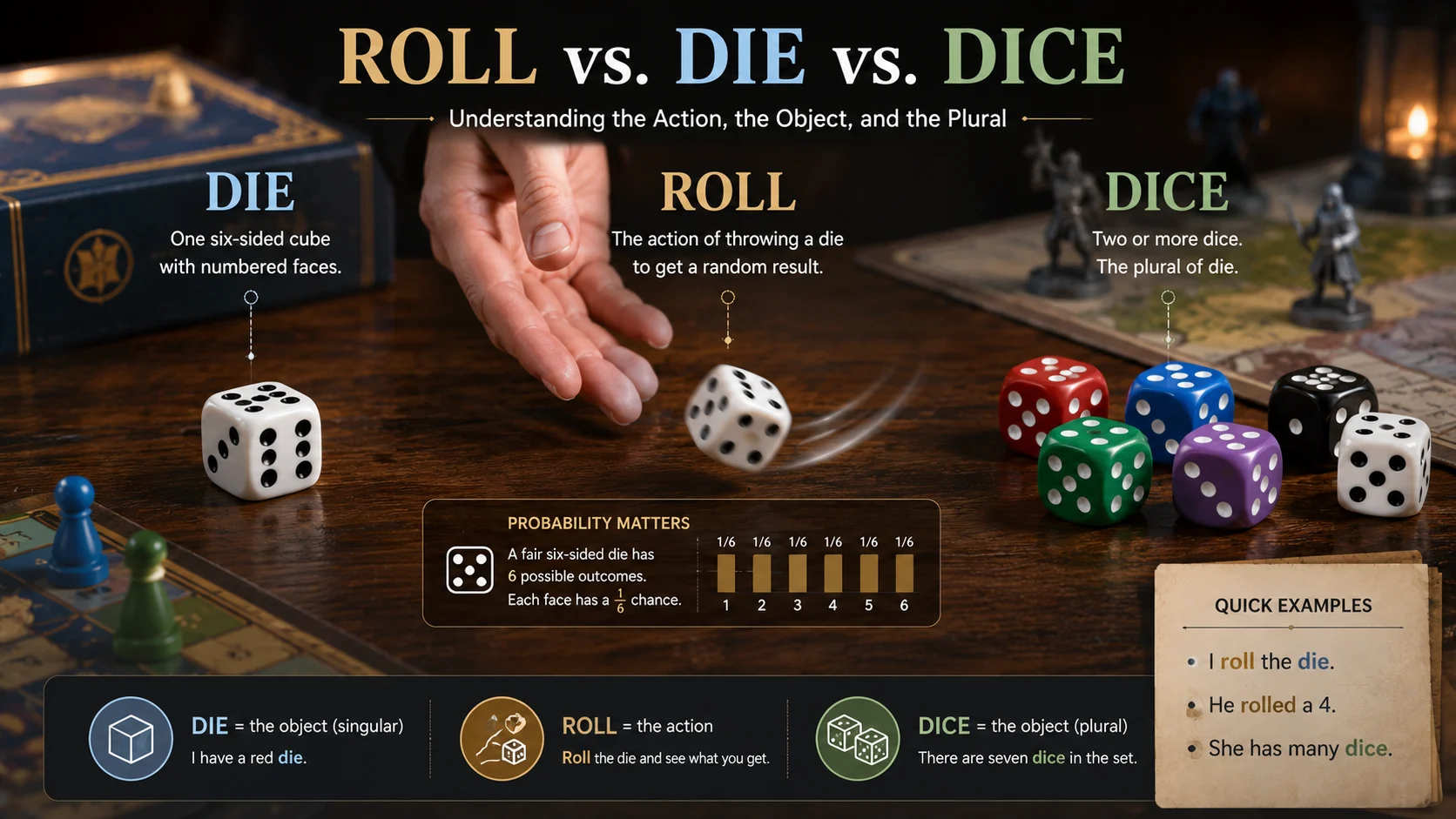
The simplest way to understand these words is to remember that roll describes an action, while die names the object being rolled.
When you play a board game, for example, you might roll a die. Here, roll tells us what you are doing, and die tells us what you are using.
| Term | Part of Speech | Meaning | Example |
|---|---|---|---|
| Roll | Verb or noun | To throw or move something so that it turns | Roll the die and see what number you get. |
| Die | Noun | One small numbered object used in games | I rolled a die and got a six. |
| Dice | Noun | More than one die | She rolled two dice. |
So, if you’re talking about the action, use roll. If you’re talking about one of the numbered gaming objects, use die.
Quick Recap
Roll describes the action of throwing or moving a die or dice.
Die means one individual numbered object.
Dice traditionally refers to two or more such objects.
You can therefore roll a die or roll dice.
What Does Roll Mean?
The word roll has several meanings in English, but in gaming it commonly describes the act of throwing dice and allowing them to land.
For example:
Roll the die to determine who goes first.
In this sentence, roll is a verb. It describes the action performed by the player.
The word can also function as a noun:
That was a lucky roll.
Here, roll refers to the result or event of throwing the die or dice.
Roll as a Verb
When roll is used as a verb, it can describe the physical action of throwing dice.
Examples include:
Roll the die.
Roll the dice again.
I rolled a six.
She rolled two dice.
The past tense is rolled, so you would say, “I rolled the die,” rather than “I roll the die” when describing something that already happened.
Roll as a Noun
Roll can also refer to the throw itself or its outcome.
For example:
That roll gave me the number four.
In gaming terminology, a roll can therefore be associated with both the action and the resulting outcome.
What Does Die Mean?
A die is a noun that refers to a single object with numbered or marked faces that is used in games and other activities involving chance.
A traditional die has six sides, with each side representing a number from one through six.
For example:
I need one die for this game.
The die landed on three.
Roll the die and move your piece.
The important point is that die is singular when referring to one gaming object.
What Is the Plural of Die?
The traditional plural of die is dice.
For example:
I have one die.
I have two dice.
This distinction is especially important when writing about board games, tabletop games, probability, or other activities involving dice.
However, modern informal usage sometimes treats dice as a singular noun, particularly in casual speech. You may hear people say “a dice,” although traditional standard English uses a die for one and dice for more than one.
For formal, academic, and carefully edited writing, it is best to maintain the traditional distinction.
Die vs Dice: What Is the Difference?
The difference between die and dice is primarily one of number.
Die is singular.
Dice is traditionally plural.
Consider these examples:
Roll a die.
Roll two dice.
One die landed on six.
Three dice were used in the game.
The same principle applies regardless of the number of sides on the object. A four sided object can be called a die, while multiple four sided objects are dice.
Is It Roll the Dice or Roll the Die?
Both expressions can be correct, depending on how many objects you are using.
If you are using one, say:
Roll the die.
If you are using more than one, say:
Roll the dice.
For example, a game that requires a single six sided die might instruct players to “roll the die.” A game that requires two dice might say “roll the dice.”
This is one of the easiest ways to remember the distinction.
Is Roll or Die a Grammar, Vocabulary, or Usage Issue?
The confusion is mainly a vocabulary and usage issue, although grammar also matters because die and dice have different number forms.
Roll and die aren’t interchangeable words. They perform different grammatical roles in a sentence.
Roll commonly functions as a verb:
Roll the die.
Die functions as a noun:
The die landed on five.
The words work together rather than competing with each other.
The more relevant comparison is often die vs dice, because those two words refer to the same type of object but differ in number.
How to Use Roll in a Sentence
Here are several natural examples:
Please roll the die.
I rolled the dice twice.
She rolled a five.
We need to roll again.
The player rolled the dice and moved three spaces.
In each example, roll communicates the action associated with the dice.
The word also has many meanings outside gaming. You can roll a ball, roll down a hill, roll out dough, or roll up a piece of paper. Therefore, context determines which meaning applies.
Usage Recap
Use roll when describing the action or a throw involving dice. It can function as either a verb or a noun depending on the sentence.
How to Use Die in a Sentence
Because die is a noun in this context, it names the gaming object.
Examples include:
The die landed on four.
Pick up the die.
We only need one die.
The game uses a six sided die.
I dropped the die on the table.
When there is more than one, use dice:
The dice landed across the table.
We need two dice.
He rolled three dice.
Usage Recap
Use die for one gaming object and traditionally use dice for more than one.
When Not to Use Roll or Die
Several common mistakes can be avoided by considering what you actually mean.
1. Don’t use die when describing the action
Incorrect:
Die the dice.
Correct:
Roll the dice.
The action is roll, while the object is dice.
2. Don’t automatically use dice for one object
Traditional standard English:
Roll the die.
Not:
Roll a dice.
Although “a dice” appears in informal usage, a die remains the conventional singular form.
3. Don’t confuse die with dice
If you’re referring to one object, use die.
If you’re referring to multiple objects, use dice.
4. Don’t treat roll as the name of the object
A roll is an action or event. It isn’t the physical gaming object.
5. Don’t assume roll always refers to gaming
Roll has many meanings. Context is essential.
6. Don’t confuse gaming die with other meanings of die
The word die can also refer to a tool used for cutting or shaping material. In another context, die is the verb associated with death.
The intended meaning depends on the surrounding words.
Common Mistakes and Decision Rules
| Correct Sentence | Incorrect Sentence | Explanation |
|---|---|---|
| Roll the die. | Die the die. | Roll describes the action. |
| Roll the dice. | Roll the dicees. | Dice is the traditional plural form. |
| I rolled one die. | I rolled one dice. | Die is singular. |
| I rolled two dice. | I rolled two die. | Dice is plural. |
| The die landed on six. | The roll landed on six. | Die identifies the object. |
| I made a lucky roll. | I made a lucky die. | Roll can describe the throw or result. |
Decision Rule
If you mean the action, use “roll.”
If you mean one gaming object, use “die.”
If you mean multiple gaming objects, use “dice.”
What Is a Dice Roll?
A dice roll is the act of throwing one or more dice and allowing them to produce a random result.
For example, when a player throws two six sided dice, the possible total results range from two to twelve.
A dice roll is therefore closely connected with concepts such as chance, probability, random outcome, and odds.
In tabletop role playing games, a dice roll can determine a character succeeds at an action. In board games, it may determine how many spaces a player can move.
Roll a Die and Probability
A standard six sided die has six possible outcomes.
If the die is fair, each side has an equal probability of appearing.
The probability of rolling a particular number, such as a four, is:
1 out of 6
or approximately:
16.67 percent
This is why dice are frequently used when teaching basic probability. Each roll represents a random event, assuming the die is fair and the rolls are independent.
Roll the Dice in Games
Dice have been used in games for centuries, and the expression roll the dice has become common in gaming language.
You’ll encounter dice in:
- board games
- tabletop role playing games
- casino games
- educational probability exercises
- strategy games
- party games
Different games can use different types of dice. A standard die has six sides, but gaming systems can also use four sided, eight sided, ten sided, twelve sided, and twenty sided dice.
Roll the Dice as an Expression
Roll the dice can also have a figurative meaning.
When someone says:
I’m willing to roll the dice.
They may mean that they are willing to take a risk despite an uncertain result.
This meaning comes directly from the idea of gambling or making a decision based on chance.
For example:
Starting a new business is a risk, but sometimes you have to roll the dice.
Here, the phrase has nothing to do with physically throwing dice. It means taking a chance.
Modern and Informal Usage
Modern English isn’t always perfectly consistent about die and dice.
In informal conversation, some speakers use dice as both singular and plural. For example, you may hear “a dice” in casual gaming discussions.
Traditional edited English, however, generally maintains the distinction:
one die
two dice
For professional, academic, educational, and SEO content, maintaining this distinction is the safest choice because it follows established dictionary and grammatical usage.
The Etymology of Die and Dice
The words die and dice have a long history in English and other European languages.
Die developed from older terms referring to a gaming cube or similar object. Dice became established as its plural form.
The unusual relationship between the two words is one reason learners sometimes find them confusing. Unlike many regular English nouns, the plural isn’t formed simply by adding s.
This makes die and dice similar to other irregular singular and plural pairs in English.
Two Practical Examples
Example 1: A Board Game
Imagine a board game that requires one six sided object.
The instruction might say:
Roll the die and move your piece according to the number shown.
Here, roll describes the action and die identifies the single object.
Example 2: A Dice Game
Now imagine a game requiring two six sided objects.
The instruction could say:
Roll the dice and add the numbers together.
Here, roll still describes the action, but dice identifies multiple objects.
The basic rule remains unchanged regardless of the game.
Error Prevention Checklist
Remember these simple rules:
Always use “roll” when:
You mean throwing or moving the dice.
You are describing the gaming action.
You are referring to a throw or its result as a noun.
Use “die” when:
You mean one gaming object.
You are describing a single numbered cube.
You are writing in formal or standard English.
Use “dice” when:
You mean two or more gaming objects.
You are talking about multiple dice rolls or objects.
You are following traditional standard English usage.
Related Grammar Confusions
Understanding this topic can also help with other common English distinctions involving singular and plural forms.
Related questions include:
Die vs dice
Mouse vs mice
Child vs children
Person vs people
Man vs men
Foot vs feet
Tooth vs teeth
These examples demonstrate why English learners can’t always create plurals simply by adding s.
FAQs
Is it roll the dice or roll the die?
Both are correct. Use roll the die when referring to one gaming object and roll the dice when referring to multiple objects.
What is the difference between a die and dice?
A die is traditionally the singular form, meaning one gaming object. Dice is traditionally the plural form, meaning two or more.
Is dice singular or plural?
Traditionally, dice is plural and die is singular. Informal modern usage sometimes treats dice as singular, but die remains the standard singular form in careful writing.
Is die singular or plural?
In the gaming context, die is singular. For example, “I rolled one die.”
Do you roll a die or dice?
You can roll either, depending on the number of objects. Say roll a die for one and roll dice for multiple objects.
Can you say “roll a dice”?
You may hear this expression in informal speech, but traditional standard English uses roll a die for one object and roll the dice for multiple objects.
What is the plural of die?
The traditional plural of die is dice.
What do you call one dice?
One gaming object is traditionally called a die.
What does “roll the dice” mean?
Literally, it means throwing dice to produce a random result. Figuratively, roll the dice means to take a chance or accept a risk when the outcome is uncertain.
Conclusion
The distinction is straightforward once you separate the action from the object. Roll describes what you do, while die identifies one gaming object and dice traditionally identifies more than one. When you remember this simple relationship, expressions such as “roll a die,” “roll the dice,” and “dice roll” become much easier to use correctly.
For formal and standard English, remember the core rule: roll is the action, die is singular, and dice is plural. That distinction is useful you’re writing about board games, tabletop gaming, probability, or everyday English usage.
Discover More Related Articles:
- Pimple or Herpes | How to Tell the Difference & When to Get Medical Advice In 2026
- Cetaphil or CeraVe | Which Is Better for Your Skin Type In 2026
- Innie or Outie | Meaning, Difference & Usage Explained In 2026