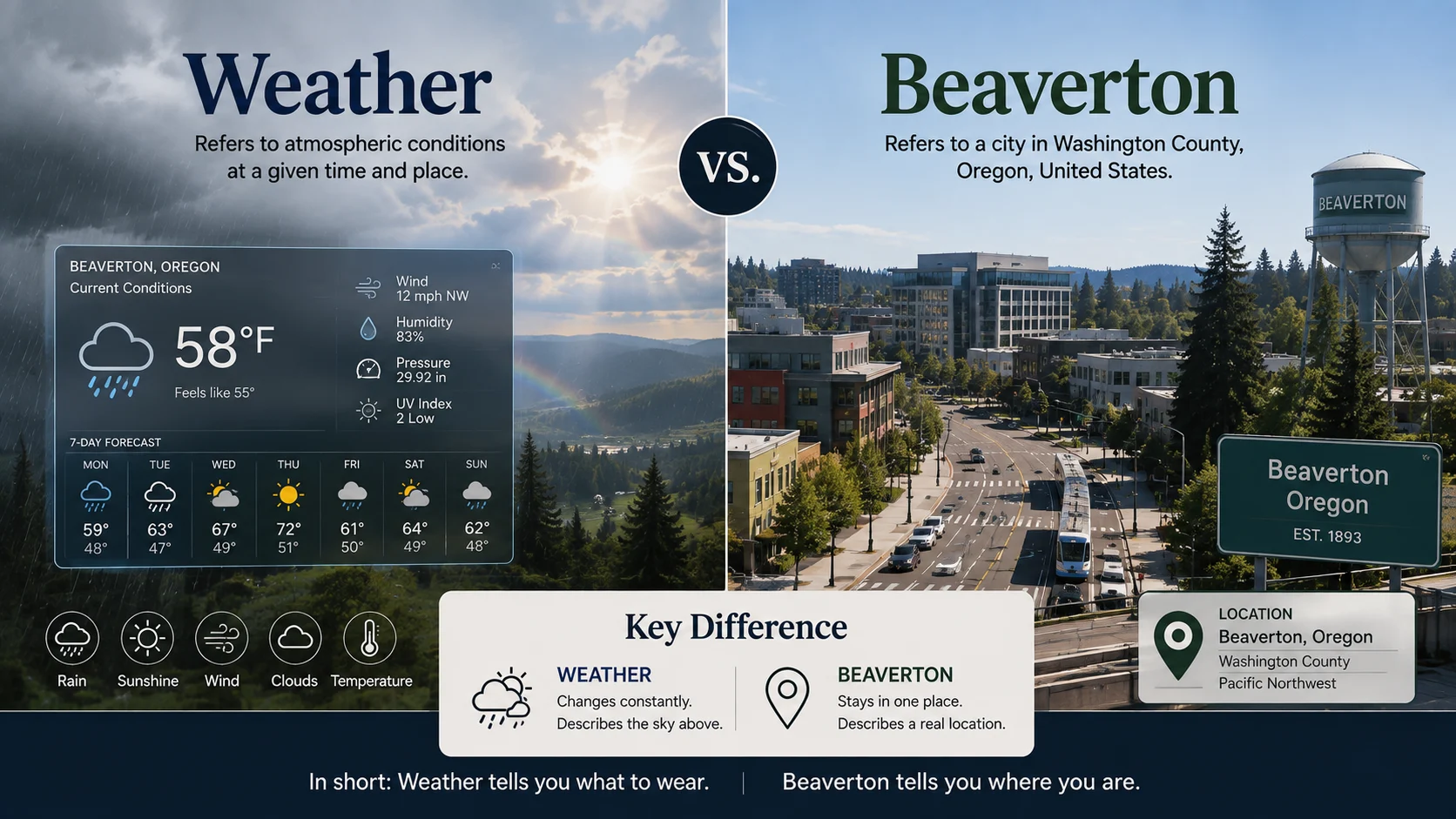
The phrase weather or Beaverton compares two completely different kinds of words. Weather is a common noun describing atmospheric conditions, while Beaverton is a proper noun naming a city. They cannot be used interchangeably, and confusing them can create inaccurate sentences, search queries, addresses, and location based information.
Weather vs Beaverton | What’s the Difference?
The key difference is grammatical category and meaning. Weather is a common noun that describes conditions in the atmosphere, such as temperature, rain, wind, clouds, and sunshine. Beaverton is a proper noun used as the name of a specific city. The City of Beaverton identifies itself as a city in Oregon, located in the Portland metropolitan area.
Because one word describes atmospheric conditions and the other identifies a geographical location, there is no genuine spelling or grammar choice between them. A writer who is asking about conditions in a particular place should normally use both concepts together, as in “the weather in Beaverton.”
| Feature | Weather | Beaverton |
|---|---|---|
| Word type | Common noun | Proper noun |
| Meaning | Atmospheric conditions | Name of a city |
| Capitalization | Usually lowercase | Always capitalized |
| Refers to | Rain, temperature, wind, clouds, and similar conditions | A specific geographical place |
| Example | The weather is cloudy today. | Beaverton is in Oregon. |
| Can they replace each other? | No | No |
Quick recap: Weather describes atmospheric conditions.
Beaverton identifies a particular city.
Neither word is an alternative spelling of the other.
When discussing atmospheric conditions at that location, use both words in the appropriate relationship.
Why Weather and Beaverton Are Sometimes Confused
At first glance, this may appear to be an unusual comparison because the two words have completely different meanings. However, search behavior can create unusual combinations of words.
Someone searching for a forecast might type a location after a weather related term. For example, a person may search for the weather in Beaverton, Beaverton forecast, or Beaverton temperature. Search engines understand that one term represents the subject and the other represents the location.
This distinction matters for content writers, students, businesses, travel websites, local publishers, and anyone creating online information.
Consider these examples:
“What’s the weather in Beaverton?”
This asks about atmospheric conditions in a particular city.
“Where is Beaverton?”
This asks about geographical location.
“Beaverton has rainy weather.”
This combines the place with information about atmospheric conditions.
The words work together, but they do not perform the same grammatical function.
Beaverton is also consistently treated as a city name in official municipal resources. The city’s official materials identify Beaverton as a city in Oregon, while its mapping resources provide administrative boundaries for the city.
Is Weather vs Beaverton a Grammar, Vocabulary or Usage Issue?
This is primarily a vocabulary and usage issue, rather than a conventional grammar dispute.
Grammar determines how words function within sentences. Vocabulary determines what individual words mean. Usage concerns how those words should naturally be selected and combined.
Weather belongs to everyday vocabulary describing atmospheric conditions. It can function as the subject or object of a sentence.
For example:
“The weather changed suddenly.”
“The weather forecast predicts rain.”
“We enjoyed the warm weather.”
Beaverton, by contrast, is a proper noun. It identifies a particular place.
For example:
“She lives in Beaverton.”
“Beaverton is west of Portland.”
“The company has an office in Beaverton.”
The distinction remains the same in formal and informal writing. Academic writing may discuss weather patterns in Beaverton. Casual conversation may simply ask, “What’s the weather like in Beaverton?”
Neither setting makes the words interchangeable.
Formal Usage
Formal writing should use each term according to its established meaning.
A research paper might discuss “seasonal weather patterns in Beaverton.” A business report might mention “weather related disruptions affecting operations in Beaverton.”
Casual Usage
Everyday speech tends to be shorter.
Someone might say, “How’s the weather in Beaverton?”
The sentence is grammatically natural because the weather is the subject of interest and Beaverton specifies the location.
Academic Usage
Academic writing benefits from precision. Instead of treating the two words as alternatives, writers should identify the relationship between them.
For example:
“Researchers examined precipitation patterns in Beaverton.”
Here, precipitation is part of the subject being studied, while Beaverton identifies the geographical area.
How to Use Weather Correctly
Weather is normally used when you are discussing atmospheric conditions at a particular time or over a particular period.
It can refer to temperature, precipitation, wind, humidity, cloud cover, storms, sunshine, or general atmospheric conditions.
Workplace Example
A workplace message might say:
“The weather may affect tomorrow’s outdoor installation.”
Here, weather refers to environmental conditions that could influence work.
If the location matters, the sentence can be expanded:
“The weather in Beaverton may affect tomorrow’s outdoor installation.”
Beaverton provides the location, while weather provides the subject.
Academic Example
An academic sentence might say:
“The study examines long term weather patterns in the region.”
The word weather refers to atmospheric conditions being analyzed.
A more geographically specific sentence could say:
“The study examines weather patterns in Beaverton.”
Technology Example
Weather applications use the word weather to describe forecast information.
A weather application may display temperature, precipitation probability, wind speed, humidity, and forecast conditions. The user may then select Beaverton as the location.
The technology therefore reinforces the same linguistic distinction. The application provides weather information, while Beaverton identifies the location for which the information is requested.
Usage recap: Use weather when discussing atmospheric conditions. Use a place name such as Beaverton when identifying where those conditions occur.
How to Use Beaverton Correctly
Beaverton is a proper noun, so it should normally begin with a capital letter.
The word identifies a specific city rather than a type of atmospheric condition. Official City of Beaverton materials describe the community as a city in Oregon and provide municipal information, services, maps, and city resources.
Workplace Example
“The Beaverton office will open at nine.”
Here, Beaverton identifies the location of the office.
Academic Example
“The research team collected observations from Beaverton.”
The place name identifies where the observations were collected.
Technology Example
“A weather application can provide a forecast for Beaverton.”
This sentence demonstrates the relationship particularly well. The technology provides weather information, and Beaverton specifies the location.
Usage recap: Capitalize Beaverton because it is a proper noun. Use it when identifying the city, not when describing atmospheric conditions.
When You Should NOT Use Weather or Beaverton
Several common situations can lead to incorrect usage.
1. Do not use Beaverton as a synonym for atmospheric conditions
Incorrect:
“Beaverton was rainy yesterday.”
The sentence can be understood, but Beaverton itself does not mean rain or weather. A more precise construction is:
“The weather in Beaverton was rainy yesterday.”
2. Do not use weather when naming a location
Incorrect:
“Our office is located in weather.”
Weather cannot identify a city.
3. Do not lowercase Beaverton
Incorrect:
“I am traveling to beaverton.”
Correct:
“I am traveling to Beaverton.”
4. Do not capitalize ordinary uses of weather
Incorrect:
“The Weather is pleasant today.”
Correct:
“The weather is pleasant today.”
5. Do not treat the words as spelling alternatives
They are not alternative spellings. Weather and Beaverton have unrelated meanings.
6. Do not remove the location relationship from a forecast
Instead of writing an unclear phrase such as “Beaverton weather or,” construct the search or sentence according to the intended meaning.
7. Do not assume a search query reflects grammatical equivalence
Search engines often process combinations of words based on user intent. A search phrase does not necessarily represent a conventional grammatical comparison.
8. Do not confuse a topic with a location
Weather is the information being requested. Beaverton can be the geographical context for that information.
Common Mistakes and Decision Rules
| Correct sentence | Incorrect sentence | Explanation |
|---|---|---|
| The weather in Beaverton is pleasant. | The Beaverton is pleasant. | Weather describes atmospheric conditions, while Beaverton names the city. |
| I checked the weather before traveling. | I checked the Beaverton before traveling. | Weather can be checked as a forecast. A city name is not a forecast. |
| She lives in Beaverton. | She lives in weather. | Beaverton identifies a geographical location. |
| The weather forecast predicts rain. | The Beaverton forecast predicts rain. | Weather is the relevant subject when discussing atmospheric conditions. |
| The company opened a branch in Beaverton. | The company opened a branch in weather. | Beaverton can function as a location in a sentence. |
Decision Rule: If you mean atmospheric conditions, use weather. If you mean the city, use Beaverton. If you are discussing atmospheric conditions at that city, use a construction such as the weather in Beaverton.
Weather and Beaverton in Modern Technology and AI Tools
Modern search engines and artificial intelligence tools make the distinction especially important because they interpret user intent from short queries.
A user may type only a few words into a search box. The system then attempts to determine the user wants a forecast, a location, a map, travel information, climate information, or another type of result.
Weather applications commonly organize information by location. A user chooses a city, and the application returns information such as temperature, precipitation, wind, and forecast conditions.
The National Weather Service also distinguishes weather observations and climate information from geographical identifiers. Its climate resources include temperature, precipitation, snowfall, wind, humidity, and related measurements.
AI systems follow a similar conceptual structure. If someone asks for the weather in Beaverton, the system interprets Beaverton as the location and weather as the requested information.
This distinction is valuable when creating SEO content because search intent often depends on the relationship between a topic and a place.
Etymology and Language Background
The word weather has a long history in English and is related to older Germanic forms associated with atmospheric conditions and wind.
Beaverton has an entirely different linguistic history because it is a geographical name. The City of Beaverton’s official historical material states that the city was incorporated in 1893 and describes its development from an agricultural community into a modern city with a diverse economic base.
The different origins reinforce the central point. These words did not develop as competing forms of the same word.
They belong to different semantic categories.
A useful editorial principle is:
Good writing separates the thing being discussed from the place where it is being discussed.
That principle works far beyond this particular query. It helps writers distinguish subjects, locations, people, products, organizations, and other entities with greater precision.
Case Study 1: Improving a Local Search Query
Consider a hypothetical local content editor preparing a weather page.
The original heading is:
“Beaverton or Weather”
The editor recognizes that the phrase does not clearly communicate the relationship between the two concepts.
The revised heading becomes:
“Weather in Beaverton”
The improvement is substantial because the revised wording establishes both the information type and geographical target.
The result is a clearer search intent statement with only three words. The editor has not changed the subject. The editor has simply placed the words into their natural relationship.
Case Study 2: Correcting a Local Business Sentence
A second illustrative case involves a business website.
Original sentence:
“Our Beaverton may affect outdoor deliveries.”
The sentence is unclear because the city name has been used where atmospheric conditions are intended.
The corrected version is:
“The weather in Beaverton may affect outdoor deliveries.”
The correction changes only the semantic role of the location and the subject. The sentence now communicates exactly what the business needs readers to understand.
These examples demonstrate why precise vocabulary improves clarity, even when the original sentence may appear understandable from context.
Error Prevention Checklist
Always Use Weather When
You are describing rain, snow, sunshine, wind, temperature, clouds, storms, humidity, or general atmospheric conditions.
You are discussing a forecast.
You are describing conditions affecting travel, work, events, agriculture, transportation, or outdoor activities.
You are referring to atmospheric conditions generally rather than a specific location.
Never Use Beaverton When
You mean atmospheric conditions.
You are referring to rain or temperature itself.
You are naming a weather phenomenon.
You need a common noun describing environmental conditions.
Always Use Beaverton When
You mean the specific city in Oregon.
You are identifying a geographical location.
You are discussing a business, residence, institution, service, or event located there.
You need to distinguish that city from another location.
Related Grammar Confusions You Should Master
Understanding this query also provides an opportunity to strengthen broader vocabulary and usage skills.
- Weather vs whether: weather concerns atmospheric conditions, while whether introduces alternatives or uncertainty.
- There vs their: there generally refers to a place or existence, while their indicates possession.
- Your vs you’re: your indicates possession, while you’re is a contraction of you are.
- Its vs it’s: its indicates possession, while it’s means it is or it has.
- Affect vs effect: affect commonly functions as a verb concerning influence, while effect commonly functions as a noun concerning a result.
- Then vs than: then commonly relates to time or sequence, while than is used in comparisons.
- Everyday vs every day: everyday is an adjective, while every day is an expression referring to each day.
- Who vs whom: who commonly functions as a subject, while whom traditionally functions as an object.
- Advice vs advise: advice is a noun, while advise is a verb.
- Place name vs common noun: a proper noun identifies a specific entity, while a common noun identifies a general class or concept.
Learning these distinctions helps writers develop a more reliable sense of English usage rather than memorizing isolated rules.
FAQs
Is weather a place name?
No. Weather is a common noun describing atmospheric conditions, while Beaverton is a proper noun identifying a city.
Is Beaverton a type of weather?
No. Beaverton is a geographical name and does not describe rain, temperature, wind, clouds, or other atmospheric conditions.
Should Beaverton be capitalized?
Yes. Beaverton is a proper noun, so it should begin with a capital letter when referring to the city.
What is the correct phrase for a forecast in Beaverton?
A natural phrase is “the weather in Beaverton,” because weather identifies the subject and Beaverton identifies the location.
Can weather and Beaverton be used interchangeably?
No. They have different meanings and grammatical functions, so replacing one with the other changes the meaning of a sentence.
Why do people search for weather and Beaverton together?
A person may want weather information specifically for Beaverton, making the city name a location modifier for the weather request.
Is weather a noun or an adjective?
Weather is primarily a noun when it refers to atmospheric conditions, although related forms such as weathered and weatherproof can function differently.
Is Beaverton a common noun or proper noun?
Beaverton is a proper noun because it identifies a particular city rather than a general category of places.
How should I write a sentence about conditions in Beaverton?
Write “The weather in Beaverton is…” and then describe the relevant condition, such as sunny, rainy, windy, or cold.
Conclusion
The apparent comparison between weather and Beaverton disappears once their meanings are examined closely. Weather is a common noun for atmospheric conditions, while Beaverton is a proper noun identifying a city in Oregon. They are therefore not alternative spellings, competing grammatical forms, or interchangeable vocabulary.
For clear English, keep the semantic relationship straightforward. Discuss weather when you mean atmospheric conditions. Use Beaverton when you mean the city. When your subject is atmospheric conditions at that location, the natural construction is “the weather in Beaverton.”
This distinction is particularly useful for local SEO, search queries, travel content, weather applications, business communication, academic writing, and AI generated content. Search engines may understand unusual word combinations from context, but human readers benefit from precise language.
The best approach is simple: identify what you are discussing first, then identify where it applies. That small habit prevents ambiguity and produces clearer, more authoritative writing.
Discover More Related Articles:
- Comply or Die | Meaning, Usage, Origin & Modern Context In 2026
- Saw or Seen | Which Is Correct & How to Use Each Word In 2026
- Congradulations or Congratulations | Why These Spellings Are Confused In 2026