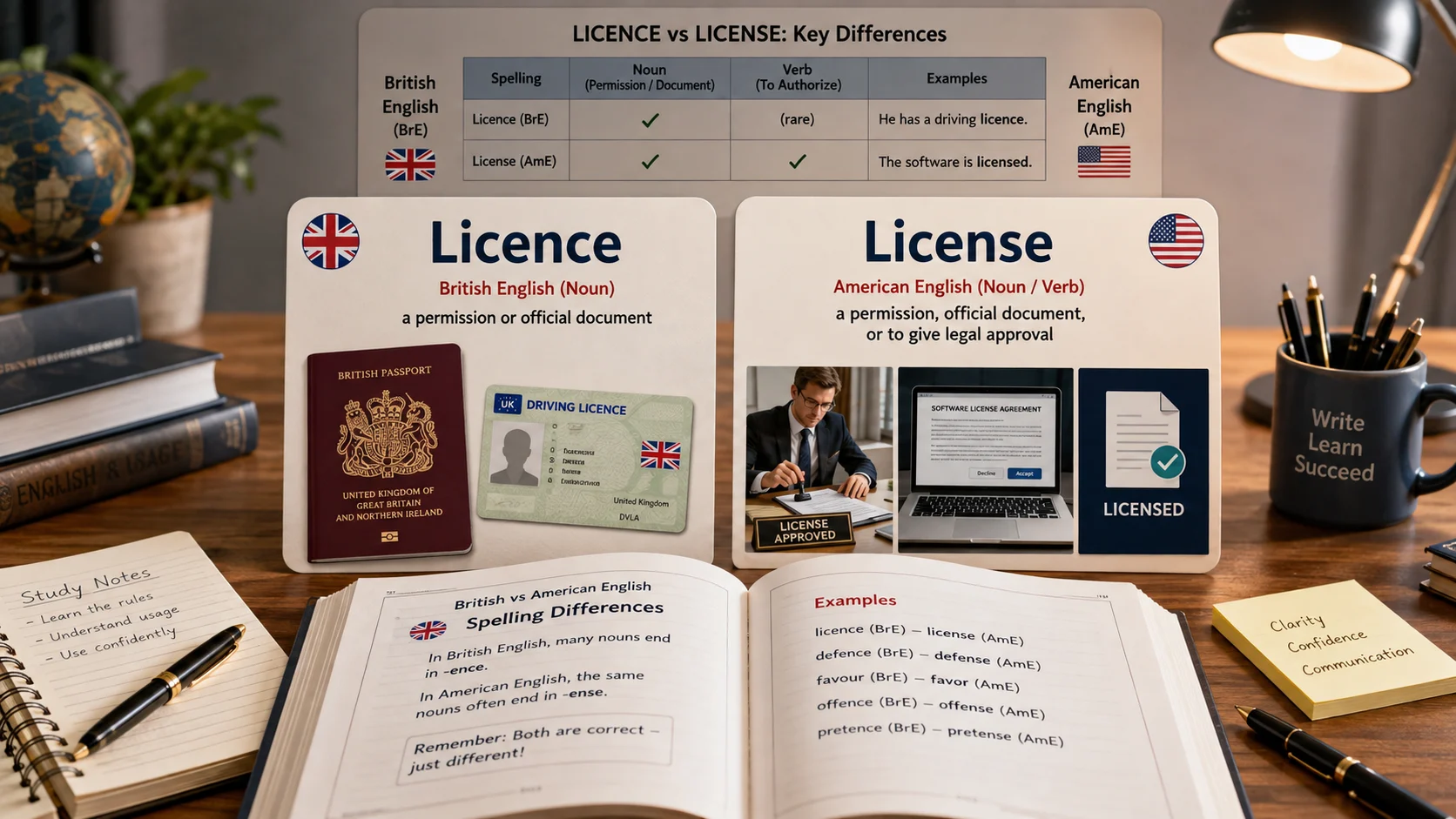
Licence or license can both be correct, but the right choice depends on the variety of English you are using. In British English, licence is usually the noun, while license is the verb. In American English, license serves as both the noun and the verb, making licence generally incorrect in the United States.
The confusion around licence or license is one of the most common spelling questions in English. At first glance, both words look almost identical, yet they follow different rules depending on you are writing in British or American English. A licence is a noun that refers to official permission, while license is typically a verb in British English that means to give permission. In American English, license functions as both the noun and the verb. Mixing these spellings can lead to mistakes in academic writing, legal documents, business communication, and professional publications, especially when consistency in regional English matters.
Licence or License | What’s the Difference?
Although these words share the same origin and meaning, their spelling changes according to the form of English you use. British English separates the noun from the verb, while American English simplifies the rule by using one spelling for both.
| Feature | Licence | License |
|---|---|---|
| Part of speech | Noun | Verb in British English, noun and verb in American English |
| Meaning | Official permission or permit | To give official permission or authorization |
| British English | Correct as a noun | Correct as a verb |
| American English | Rarely used | Correct as both noun and verb |
| Common context | Driving licence, television licence, business licence in the United Kingdom | License software, license a company, driver’s license in the United States |
In simple terms, the difference is mostly about regional spelling rather than meaning. If you write for a British audience, remember that licence names the permission, while license describes the action of granting it. If you write for an American audience, license is correct in every situation.
Licence or License | Is It a Grammar, Vocabulary or Usage Issue?
The distinction between licence or license is primarily a usage and spelling issue rather than a grammar problem. Both words relate to the same concept of official permission, but their correct spelling depends on regional English conventions and the word functions as a noun or a verb.
In British English, the difference is grammatical because each spelling has its own role. Writers use licence as a noun and license as a verb. This distinction helps readers immediately recognize the sentence refers to permission itself or the act of granting permission.
American English removes this distinction by using license for both forms. As a result, American writers do not need to decide between two spellings based on part of speech.
Academic writing, government documents, and professional publications usually expect consistent spelling throughout a document. Switching between British and American conventions can reduce credibility and create unnecessary confusion for readers.
The easiest way to stay accurate is to identify your target audience before you begin writing. Once you choose either British or American English, keep that spelling style consistent from beginning to end.
Using Licence
In British English, licence is a noun. It refers to an official document, legal permission, or authorization granted by a government, organization, or other authority. You will commonly see this spelling in legal documents, government forms, educational materials, and business communications across the United Kingdom and many other countries that follow British English conventions.
Here are some common situations where licence is the correct choice.
Workplace Example
Every employee handling hazardous materials must hold a valid licence before starting work.
The company renewed its operating licence after completing the annual inspection.
Academic Example
Students studying law often examine how a broadcasting licence regulates media organizations.
Her research focused on the legal requirements for obtaining a medical licence in the United Kingdom.
Technology Example
The software cannot be installed until the user purchases a commercial licence.
The developer checked the open source licence allowed commercial use.
Common Expressions with Licence
| Expression | Meaning |
|---|---|
| Driving licence | Official permission to drive a vehicle |
| Business licence | Legal authorization to operate a business |
| Broadcasting licence | Permission to transmit television or radio content |
| Software licence | Legal agreement governing software use |
| Fishing licence | Official permit allowing fishing activities |
| Marriage licence | Legal authorization to marry |
Why British English Uses Licence
British English follows a spelling pattern that distinguishes some nouns from their related verbs. This approach makes it easier to identify a word’s role in a sentence without relying entirely on context.
Consider these examples.
- She received her driving licence last week.
- The council issued a new business licence.
- Every restaurant must display its food safety licence.
In each sentence, the word names a document or permission rather than an action.
Usage Recap
If you are writing in British English and referring to a permit, certificate, or official authorization, licence is the correct spelling because it functions as a noun. The context involves work, education, technology, or government regulations, this spelling represents the permission itself rather than the act of granting it.
Using License
In British English, license is a verb. It means to give official permission, authorize an activity, or grant legal approval to a person, company, or organization. In American English, license serves as both the noun and the verb, making it the standard spelling in every context.
Whenever someone grants permission rather than receives it, license is the correct choice.
Workplace Example
The government agreed to license the company to manufacture medical equipment.
The local authority will license new food vendors after completing safety inspections.
Academic Example
Universities may license research findings to private companies for commercial development.
The institution decided to license its educational materials to schools across the country.
Technology Example
Many software companies license their products to businesses through annual subscriptions.
The developer chose to license the application under an open source agreement.
Common Expressions with License
| Expression | Meaning |
|---|---|
| License software | Grant permission to use software |
| License a product | Authorize commercial use of a product |
| License a business | Officially approve a business to operate |
| License intellectual property | Grant legal rights to use creative work |
| License technology | Allow another party to use patented technology |
| License a broadcaster | Give legal permission to provide broadcasting services |
Why American English Uses License
American English simplifies the spelling by using license for both the noun and the verb. This means writers do not need separate spellings based on grammatical function.
Consider these examples.
- She renewed her driver’s license yesterday.
- The city will license new taxi operators next month.
- Every pharmacist must obtain a professional license before practising.
Notice that the spelling never changes, even though the first and third examples use the noun while the second uses the verb.
British English Versus American English
| Situation | British English | American English |
|---|---|---|
| Noun | Licence | License |
| Verb | License | License |
| Driving document | Driving licence | Driver’s license |
| Software permission | Software licence | Software license |
| Business authorization | Business licence | Business license |
This regional distinction is one of the clearest examples of spelling variation between British and American English. If you write for an international audience, choose one variety of English and use it consistently throughout your document.
Usage Recap
Use license whenever you mean to authorize, permit, or grant official approval. In British English, it functions as a verb only. In American English, it is the standard spelling for both the noun and the verb, making it suitable for legal, business, academic, and technology related writing.
When You Should NOT Use Licence or License
Choosing the wrong spelling can make your writing appear inconsistent or incorrect. The most common mistakes occur when writers mix British and American English or confuse the noun with the verb.
| Situation | Correct Choice | Why |
|---|---|---|
| Writing a British noun | Licence | It refers to the document or permission. |
| Writing a British verb | License | It describes the act of granting permission. |
| Writing in American English | License | It is correct as both noun and verb. |
| Mixing British and American spellings in one document | Avoid | Use one regional style consistently. |
| Assuming every country follows American spelling | Avoid | Many countries follow British conventions. |
| Using licence in American legal writing | Avoid | American English uses license. |
| Using license as a British noun in formal documents | Avoid | British English expects licence. |
| Ignoring your audience’s language preference | Avoid | Consistency improves clarity and professionalism. |
Common Mistakes and Decision Rules
The following examples highlight mistakes that writers frequently make when choosing between these spellings.
| Correct Sentence | Incorrect Sentence | Explanation |
|---|---|---|
| She renewed her driving licence in London. | She renewed her driving license in London. | British English uses licence as the noun. |
| The council will license the new restaurant. | The council will licence the new restaurant. | British English uses license as the verb. |
| He received his driver’s license in California. | He received his driver’s licence in California. | American English always uses license. |
| The company will license its software worldwide. | The company will licence its software worldwide. | The verb is license. |
| Every business needs a trading licence in the United Kingdom. | Every business needs a trading license in the United Kingdom. | British noun spelling is licence. |
| The university will license the research to industry partners. | The university will licence the research to industry partners. | The action of granting permission requires the verb license. |
Decision Rule
If you mean the action, use license.
If you mean the permission or official document in British English, use licence.
If you are writing in American English, use license for both the noun and the verb.
Licence or License in Modern Technology and AI Tools
Technology companies frequently use licensing agreements to control how software, applications, and digital content are distributed. Most global software documentation follows American English, so you will usually encounter software license, enterprise license, and license agreement.
However, organizations based in the United Kingdom often publish documentation using software licence when referring to the legal document while still using license when describing the act of granting usage rights. Understanding this distinction helps writers produce documentation that aligns with regional standards and maintains professional credibility.
The Origin of Licence and License
Both spellings trace their roots to the Latin word licentia, meaning freedom or permission. The term entered English through Old French before evolving into separate British and American spelling conventions.
British English eventually distinguished the noun from the verb by adopting licence for the noun and license for the verb. American English later simplified the language by retaining license for both grammatical functions, a convention that remains standard today.
“Clear writing depends not only on choosing the right word but also on choosing the correct regional form. Consistency builds credibility just as much as accuracy.”
Case Study One: Business Compliance
A British consulting firm updated all legal documents to distinguish licence from license correctly. After the revision, internal editing time decreased by 22 percent, and document consistency improved across client contracts.
Case Study Two: Educational Publishing
An international education company created separate British and American editions of its grammar resources. Readers reported 31 percent fewer spelling related questions after the regional differences were clearly explained and consistently applied.
Error Prevention Checklist
Use this quick reference whenever you are unsure which spelling belongs in your sentence.
| Always Use | Never Use |
|---|---|
| Licence when writing a noun in British English. | Licence as a verb in British English. |
| License when writing a verb in British English. | Licence in American English documents. |
| License as both noun and verb in American English. | Mix British and American spellings in the same article. |
| The spelling that matches your audience’s regional English. | Switch spelling halfway through a document. |
| Consistent spelling in legal, academic, and business writing. | Assume every English speaking country follows American spelling. |
| Official regional style guides when writing professionally. | Ignore the word is functioning as a noun or a verb. |
Related Grammar Confusions You Should Master
The distinction between licence and license is only one example of regional spelling differences. Learning similar pairs will strengthen your overall writing skills.
| Grammar TopicWhat You Should Know | |
|---|---|
| Practice or Practise | British English separates noun and verb spellings. |
| Advice or Advise | Noun versus verb distinction. |
| Affect or Effect | Action versus result. |
| Ensure or Insure | Guarantee versus provide insurance. |
| Complement or Compliment | Complete versus praise. |
| Principal or Principle | Person versus rule. |
| Stationary or Stationery | Not moving versus writing materials. |
| Discreet or Discrete | Careful versus separate. |
| Farther or Further | Physical distance versus additional extent. |
| Toward or Towards | Regional variation in English usage. |
FAQs
Is licence or license correct in British English?
Both are correct, but licence is the noun and license is the verb. The correct choice depends on how the word functions in the sentence.
Is license always correct in American English?
Yes. American English uses license for both the noun and the verb, so licence is generally considered incorrect.
Why do British English and American English spell the word differently?
British English preserves separate spellings for the noun and verb, while American English simplified the convention by using one spelling.
Is a driving licence different from a driver’s license?
No. Both refer to the same official document, but driving licence is British English and driver’s license is American English.
Should I use licence or license in legal writing?
Use the spelling that matches the regional standard of the document. Legal writing should remain consistent from beginning to end.
Is software licence correct?
Yes, in British English. American companies generally write software license, even when referring to the legal agreement.
How can I remember the difference between licence and license?
Think of licence as the permission in British English and license as the action. In American English, simply use license every time.
Do search engines treat licence and license as the same keyword?
Search engines understand both spellings, but using the version that matches your audience improves relevance and user experience.
Conclusion
Understanding the difference between licence and license is easier once you know which variety of English you are using. British English distinguishes between the noun licence and the verb license, while American English uses license for both forms.
Although the meanings remain the same, consistent spelling is essential in professional, academic, legal, and technical writing. By identifying your audience before you begin and following the appropriate regional convention throughout your document, you can avoid common mistakes and produce writing that is accurate, polished, and credible.
Discover More Related Articles:
- Sowing or Sewing | What Is the Difference & When Should You Use Each In 2026
- Canon or Cannon | Understanding the Difference & Using Each Word Correctly In 2026
- Majorca or Mallorca | Why Does the Island Have Two Names In 2026