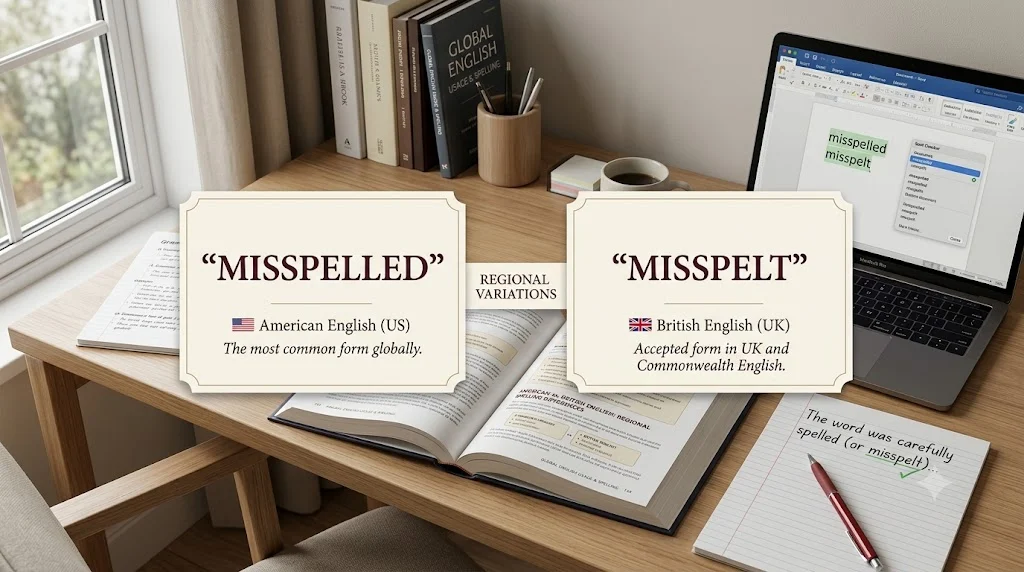
Misspelled and misspelt are both correct forms of the past tense and past participle of misspell, but they reflect different English conventions. Misspelled is standard in American English, while misspelt is especially common in British English and other varieties influenced by British usage. The choice depends mainly on regional spelling preference.
Have you ever wondered misspelled or misspelt is the correct way to describe a word written incorrectly? You’re not alone these two forms often confuse writers because both are accepted in English, but their usage depends largely on the variety of English you are using. Misspelled is the standard form in American English, while misspelt is more commonly used in British English and some other varieties. Understanding this small difference can help you avoid unnecessary spelling mistakes and make your writing more consistent.
In this guide, we’ll explore misspelled vs. misspelt, including their meanings, correct usage, regional preferences, and practical examples. You’re writing an academic paper, professional email, blog post, or everyday message, knowing when to use each form will help you choose the right word with confidence.
Misspelled or Misspelt | What’s the Difference?
The main difference between misspelled and misspelt is not meaning. Both words mean that a word has been written with an incorrect spelling. The distinction comes from regional English usage and verb conjugation patterns.
Misspelled is the more common form in American English. It follows the regular pattern in which the verb spell becomes spelled in the past tense and past participle.
Misspelt is widely used in British English. It follows the pattern found in several British English verbs where a shorter past form ending in t is preferred.
| Word | Part of Speech | Meaning | Main Usage | Example |
|---|---|---|---|---|
| Misspelled | Verb, past tense and past participle | Written a word incorrectly | Common in American English | I misspelled her name. |
| Misspelt | Verb, past tense and past participle | Written a word incorrectly | Common in British English | I misspelt her name. |
The two forms have exactly the same basic meaning.
The difference is primarily regional rather than grammatical.
American English generally prefers misspelled.
British English commonly accepts and prefers misspelt.
Both forms are legitimate English words.
Is Misspelled or Misspelt a Grammar, Vocabulary or Usage Issue?
The choice between misspelled and misspelt is mainly a spelling and usage issue rather than a difference in meaning or grammar.
Both forms come from the verb misspell, which means to spell a word incorrectly. The past tense can therefore describe an action that happened in the past.
For example, an American English speaker might write:
I realized that I had misspelled the company name.
A British English speaker might write:
I realized that I had misspelt the company name.
Neither sentence changes the meaning.
The important distinction is consistency. If your website, school assignment, professional document, or publication follows American English, misspelled is usually the safest choice. If it follows British English, misspelt is often the preferred form.
Formal and Informal Usage
Both forms can appear in formal writing. Neither is inherently informal.
You may encounter misspelled in American academic papers, business documents, software interfaces, dictionaries, and educational resources. Misspelt is similarly acceptable in British academic writing, journalism, professional communication, and educational material.
The key is to follow the spelling system used by the rest of your document.
Academic and Casual Usage
Academic writing should prioritize consistency rather than choosing one form simply because it looks more formal.
A British university assignment can naturally use misspelt, while an American university assignment will normally use misspelled.
In casual communication, either form can be understood internationally, although readers may associate the spelling with a particular variety of English.
When Should You Use Misspelled?
Use misspelled when you are writing in American English or when your publication follows American spelling conventions.
Misspelled is particularly common in American dictionaries, educational materials, workplace documents, websites, and software interfaces.
Workplace Example
The employee accidentally misspelled the customer’s surname on the invoice.
Here, misspelled describes the completed action of writing the surname incorrectly.
Academic Example
The student noticed that she had misspelled an important technical term in her essay.
The form works naturally in American academic writing.
Technology Example
The application highlights words that have been misspelled.
This wording is common in American software, grammar tools, spell checkers, and digital documentation.
Usage Recap
Choose misspelled when your audience primarily uses American English.
It is also a sensible default for international content when your existing style guide follows American conventions.
When Should You Use Misspelt?
Use misspelt when writing in British English or another variety that follows British spelling conventions.
British English commonly uses several verb forms ending in t, and misspelt fits that pattern.
Workplace Example
The assistant noticed that the customer’s address had been misspelt.
This sentence is completely natural in British English.
Academic Example
The researcher found that the author’s surname had been misspelt in the original document.
A British academic publication can use misspelt without any grammatical problem.
Technology Example
The word appears to have been misspelt.
British software documentation and websites may use this form when their editorial style follows British English.
Usage Recap
Choose misspelt when your writing follows British English conventions.
If the surrounding document uses spellings such as colour, organise, centre, and travelling, misspelt will usually fit the same regional style.
When You Should NOT Use Misspelled or Misspelt
Although both words are correct, there are situations where choosing one without considering context can create inconsistency.
| Situation | Better Choice | Reason |
|---|---|---|
| American English article | Misspelled | Matches American spelling conventions |
| British English article | Misspelt | Matches British usage |
| American academic paper | Misspelled | Consistent with American English |
| British academic paper | Misspelt | Consistent with British English |
| Mixed spelling document | Avoid mixing | Regional consistency is clearer |
| Quoting a source | Preserve original form | Do not unnecessarily change the source |
| Following a company style guide | Follow the guide | House style takes priority |
| Writing for a specific national audience | Match the audience | Improves linguistic consistency |
One common mistake is treating misspelt as incorrect simply because American English speakers see misspelled more often. The reverse mistake happens when writers assume misspelled is wrong because they have learned British English.
Neither assumption is accurate.
Common Mistakes and Decision Rules
The easiest way to choose correctly is to identify the English variety you are using.
| Correct Sentence | Incorrect Sentence | Explanation |
|---|---|---|
| I misspelled the word in my email. | I misspelt the word in my American English report. | American English normally prefers misspelled. |
| I misspelt the word in my British English report. | I misspelled the word throughout my British style document. | British English commonly prefers misspelt. |
| She had misspelled his surname. | She had misspelt his surname in an American publication. | Use the regional form required by the publication. |
| The name was misspelt in the British newspaper. | The name was misspelled in the British newspaper. | Misspelt fits the stated British convention. |
| The software detected a misspelled word. | The software detected a misspelt word in an American interface. | Misspelled is generally expected in American interfaces. |
Decision Rule
If your writing follows American English, use misspelled.
If your writing follows British English, use misspelt.
The decision is about regional spelling, not about a difference in meaning.
Misspelled and Misspelt in Modern Technology and AI Tools
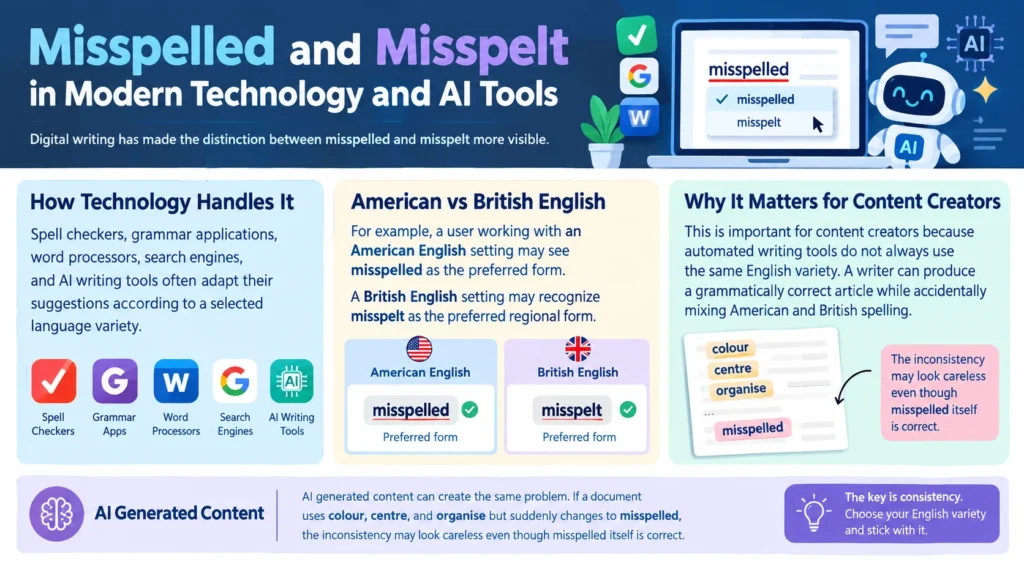
Digital writing has made the distinction between misspelled and misspelt more visible.
Spell checkers, grammar applications, word processors, search engines, and AI writing tools often adapt their suggestions according to a selected language variety.
For example, a user working with an American English setting may see misspelled as the preferred form. A British English setting may recognize misspelt as the preferred regional form.
This is important for content creators because automated writing tools do not always use the same English variety. A writer can produce a grammatically correct article while accidentally mixing American and British spelling.
AI generated content can create the same problem. If a document uses colour, centre, and organise but suddenly changes to misspelled, the inconsistency may look careless even though misspelled itself is correct.
For professional publishing, the best approach is to establish the desired English variety before editing the document.
Why Do Both Misspelled and Misspelt Exist?
The difference comes from the historical development of English verb forms.
The verb spell has traditionally had more than one accepted past form. Spelled became particularly dominant in American English, while spelt remained widely established in British English.
The same regional pattern can be seen with other verbs. British English often retains forms ending in t that American English frequently replaces with forms ending in ed.
This does not mean that British speakers always use the t form or that American speakers never encounter it. English usage is more flexible than a simple national rule.
Modern dictionaries generally recognize both forms, while usage frequency varies according to region.
An important point is that misspelt is not a shortened or careless version of misspelled. It is an established English form with its own history.
An Expert Style Principle
A useful editorial principle is: “Correct spelling depends on the English variety and the style guide governing the text.”
That principle is more reliable than assuming that the spelling you personally encounter most often is the only correct one.
Practical Case Studies | Choosing the Right Form
Case Study 1: An American Educational Website
Imagine an educational website aimed primarily at readers in the United States. Its existing content consistently uses American spellings such as color, behavior, organization, and traveled.
If the site publishes a grammar lesson, using misspelled maintains the site’s established spelling system.
The practical result is greater editorial consistency. Readers encounter one coherent variety of English rather than switching between regional conventions.
Case Study 2: A British Academic Publication
Now consider a British academic publication that uses colour, behaviour, organisation, and travelled throughout its editorial material.
Using misspelt in an article about spelling would align with the publication’s established British English convention.
The practical result is stylistic consistency across the article, headings, examples, and explanatory material.
These examples illustrate an important editorial lesson: the best choice is not simply the word that appears most familiar. It is the word that fits the intended variety of English.
Error Prevention Checklist
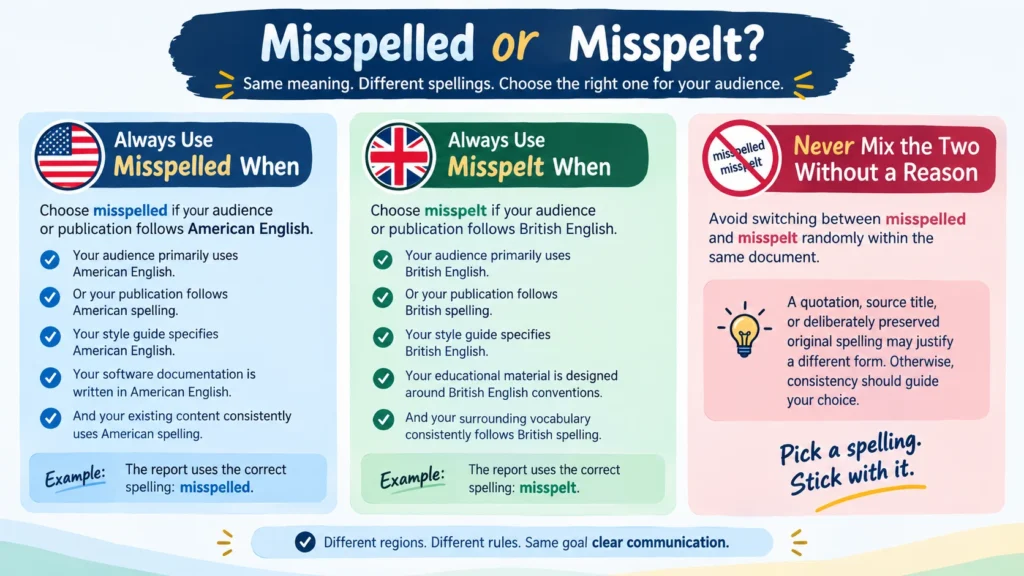
Always Use Misspelled When
Your audience primarily uses American English.
Or your publication follows American spelling.
Your style guide specifies American English.
Your software documentation is written in American English.
And your existing content consistently uses American spelling.
Always Use Misspelt When
Your audience primarily uses British English.
Your publication follows British spelling.
Or your style guide specifies British English.
Your educational material is designed around British English conventions.
And your surrounding vocabulary consistently follows British spelling.
Never Mix the Two Without a Reason
Avoid switching between misspelled and misspelt randomly within the same document.
A quotation, source title, or deliberately preserved original spelling may justify a different form. Otherwise, consistency should guide your choice.
Related Grammar Confusions You Should Master
Understanding misspelled and misspelt is part of a broader lesson about regional English and commonly confused forms.
Here are several useful topics to study next:
Color or Colour: American and British spelling differences.
Traveled or Travelled: Different regional conventions for doubled consonants.
Canceled or Cancelled: Another important American and British spelling distinction.
Organize or Organise: American z spelling versus British s spelling.
Center or Centre: A common difference in word endings.
License or Licence: A distinction involving both regional spelling and grammatical function.
Practice or Practise: A British English distinction between noun and verb forms.
Learned or Learnt: Another pair with regional variation.
Burned or Burnt: Two accepted past forms with different usage patterns.
Spelled or Spelt: The broader spelling distinction behind misspelled and misspelt.
FAQs
Is misspelled or misspelt correct?
Both are correct. Misspelled is more common in American English, while misspelt is widely used in British English.
Is misspelt British or American?
Misspelt is strongly associated with British English. American English generally prefers misspelled.
Is misspelled grammatically correct?
Yes. Misspelled is the standard past tense and past participle form commonly used in American English.
Is misspelt grammatically correct?
Yes. Misspelt is an established past tense and past participle form, especially common in British English.
Should I use misspelled in American English?
Yes. Misspelled is generally the preferred form in American English writing and publishing.
Should I use misspelt in British English?
Yes. Misspelt is a natural and widely accepted choice in British English.
Do misspelled and misspelt mean the same thing?
Yes. Both mean that something has been written with an incorrect spelling.
Why does British English use misspelt?
British English has retained misspelt as an established past form of spell, alongside the form spelled.
Can I use misspelled and misspelt in the same article?
You can, but it is usually better to choose one according to your target English variety and remain consistent.
Conclusion
The choice between misspelled and misspelt is straightforward once you identify your English variety. Both forms describe something that has been spelled incorrectly, and neither is inherently more grammatical than the other.
For American English, misspelled is normally the preferred choice. For British English, misspelt is widely accepted and commonly preferred.
The most important rule is consistency. If your website, publication, classroom, or workplace follows American English, use misspelled throughout. If it follows British English, misspelt will usually be the better fit.
Rather than asking which form is universally correct, ask which English convention your audience expects. That small distinction can make your writing more polished, professional, and linguistically consistent.
Discover More Related Articles:
- Grandad or Granddad | Which Word Is Correct & When Should You Use It In 2026
- Fazed or Phased | What Is the Difference & Which Word Should You Use In 2026
- Whiney or Whiny | Which Word Do Dictionaries Recommend In 2026