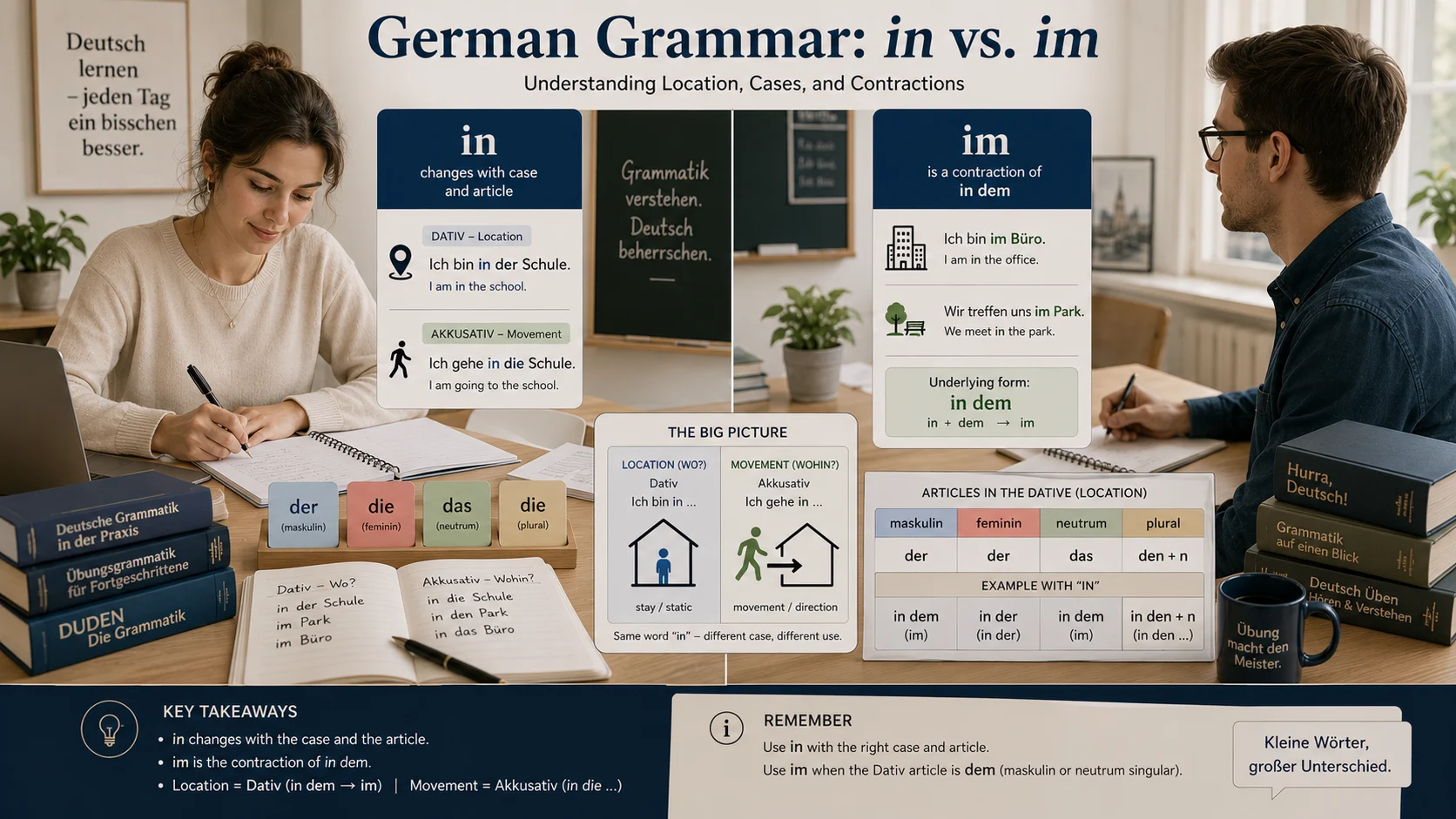
The phrase in or german usually points to confusion about the German prepositions in and im. In German, in is the basic preposition, while im is a contraction of in dem. The correct choice depends on the article, case, and you describe a location or movement.
In vs Im German | What’s the Difference?
The most important point is simple: in and im are not completely separate prepositions. In is a German preposition that can be used with the accusative or dative case. Im is a contracted form of in dem, normally used with masculine or neuter nouns in the dative case.
This distinction matters because German uses grammatical case to show how a noun functions in a sentence. English usually relies more heavily on word order and prepositions, so learners often expect one English preposition to have one fixed German equivalent.
For example, compare these sentences:
Ich bin in der Schule.
This means “I am at school” or “I am in the school.” The preposition in is followed by the dative article der.
Now consider:
Ich bin im Park.
Here, im means in dem. Because Park is masculine and the sentence describes a location, the dative form is required.
The basic pattern can be summarized as follows:
| Form | Full form | Typical use | Example |
|---|---|---|---|
| in | in | Basic preposition | Ich gehe in die Schule. |
| im | in dem | Dative contraction | Ich bin im Park. |
| in der | in der | Feminine dative | Sie ist in der Küche. |
| in den | in den | Plural dative | Wir sind in den Bergen. |
| ins | in das | Accusative contraction | Ich gehe ins Kino. |
Quick Recap
In is the original German preposition.
Im is a contraction of in dem.
Use im when in is followed by masculine or neuter dem in the dative.
Use in with other appropriate articles and cases.
Is In vs Im German a Grammar, Vocabulary, or Usage Issue?
This is primarily a grammar and usage issue, not a vocabulary problem.
The words in and im aren’t interchangeable in every sentence. Their forms are determined by German articles and grammatical case. Understanding the case system makes the distinction much easier.
The preposition in belongs to the group of German two way prepositions. These prepositions can take either the accusative or the dative case.
The central rule is:
Dative usually describes a fixed location.
Accusative usually describes movement toward or into a destination.
Consider:
Ich bin im Haus.
I am in the house.
There is no movement. The speaker is describing a location, so the dative is used. Im is short for in dem.
Now compare:
Ich gehe ins Haus.
I am going into the house.
Here, the sentence describes movement into a destination. The accusative is required, and ins is short for in das.
This gives learners a useful contrast:
| Meaning | Case | Form | Example |
|---|---|---|---|
| Location | Dative | im | Ich bin im Haus. |
| Movement into | Accusative | ins | Ich gehe ins Haus. |
| Location with feminine noun | Dative | in der | Ich bin in der Küche. |
| Movement with feminine noun | Accusative | in die | Ich gehe in die Küche. |
| Location with plural noun | Dative | in den | Ich bin in den Bergen. |
| Movement with plural noun | Accusative | in die | Ich fahre in die Berge. |
This is why simply memorizing translations isn’t enough. German grammar requires you to identify what the sentence actually means.
In German Usage: When Should You Use In?
The preposition in is used when German grammar requires the preposition itself rather than one of its contractions. It can appear with several different articles.
With a feminine noun in the dative, use in der:
Sie ist in der Küche.
With a feminine noun in the accusative, use in die:
Sie geht in die Küche.
With plural nouns, you may see in den in the dative and in die in the accusative:
Wir sind in den Bergen.
Wir fahren in die Berge.
The key is that in remains visible because German does not contract these combinations in the same way as in dem and in das.
Workplace Example
Imagine you’re describing someone’s location at work:
Mein Kollege ist in der Abteilung.
My colleague is in the department.
Because Abteilung is feminine, the dative form is der.
If you’re describing movement:
Mein Kollege geht in die Abteilung.
My colleague is going to the department.
The change from in der to in die is caused by the difference between location and movement.
Academic Example
A student might say:
Ich bin in der Universität.
I am at the university.
Depending on the intended meaning and regional usage, German speakers may also use other constructions, but the grammatical principle remains the same.
For movement, you could say:
Ich gehe in die Universität.
The noun is feminine, so the accusative article is die.
Technology Example
The same grammar appears in modern technology related language:
Die Datei ist in der Cloud.
The file is in the cloud.
Here, Cloud is treated as feminine, so the dative form is der.
For a destination, German may use:
Die Datei wird in die Cloud hochgeladen.
The file is uploaded to the cloud.
The movement or destination idea triggers the accusative.
Usage Recap
Use in with the article form required by the noun and case. Don’t choose between in and im based only on the English translation. First identify the noun’s gender and the sentence describes location or movement.
Im German Usage: When Should You Use Im?
Im is particularly easy to understand once you remember its full form:
im = in dem
The contraction is used when in is followed by dem, which is the dative article for masculine and neuter nouns.
For example:
der Park → im Park
das Haus → im Haus
der Garten → im Garten
das Büro → im Büro
The contraction is extremely common in everyday German.
Workplace Example
Ich bin im Büro.
I am in the office.
The noun Büro is neuter:
das Büro
In the dative, it becomes:
dem Büro
Therefore:
in dem Büro → im Büro
Academic Example
Der Student ist im Klassenzimmer.
The student is in the classroom.
Klassenzimmer is neuter:
das Klassenzimmer
Dative:
dem Klassenzimmer
Therefore:
im Klassenzimmer
Technology Example
Die Daten sind im System gespeichert.
The data are stored in the system.
System is neuter:
das System
Dative:
dem System
Contraction:
im System
This construction is common in technical, business, academic, and everyday German.
Usage Recap
Think of im as a convenient contraction rather than a completely different preposition. Whenever the grammatical structure would produce in dem, German normally contracts it to im.
When You Should NOT Use In or Im
Several common mistakes occur when learners choose the form by translation instead of grammar.
| Mistake | Better form | Why |
|---|---|---|
| Ich bin in dem Park. | Ich bin im Park. | Im is the normal contraction of in dem. |
| Ich gehe im Park. | Ich gehe in den Park. | Movement into the park requires accusative. |
| Ich bin in die Küche. | Ich bin in der Küche. | A fixed location requires dative. |
| Ich gehe im Haus. | Ich gehe ins Haus. | Movement into the house requires accusative. |
| Sie ist im Schule. | Sie ist in der Schule. | Schule is feminine, not neuter. |
| Wir sind im Berge. | Wir sind in den Bergen. | Plural dative requires den. |
| Er geht im Büro. | Er geht ins Büro. | Movement into the office requires accusative. |
| Sie ist ins Büro. | Sie ist im Büro. | A fixed location requires dative. |
Do not use im simply because the English sentence contains “in.” The German noun and the grammatical relationship determine the correct form.
Common Mistakes and Decision Rules
The fastest way to improve is to stop treating in, im, and ins as random forms.
| Correct sentence | Incorrect sentence | Explanation |
|---|---|---|
| Ich bin im Park. | Ich bin in den Park. | The first sentence describes location. |
| Ich gehe in den Park. | Ich gehe im Park. | The second sentence describes movement toward the park. |
| Sie ist im Büro. | Sie ist ins Büro. | Im Büro describes location. |
| Sie geht ins Büro. | Sie geht im Büro. | Ins Büro describes movement into the office. |
| Er ist in der Küche. | Er ist im Küche. | Küche is feminine, so use der. |
| Er geht in die Küche. | Er geht in der Küche. | Movement requires the accusative article die. |
Decision Rule: If you mean a fixed location, check for the dative. If you mean movement into a destination, check for the accusative. Use im specifically when the correct combination is in dem.
This rule is more reliable than trying to memorize dozens of isolated sentences.
In and Im in Modern Technology and AI Tools
Modern German has not abandoned these grammatical distinctions simply because communication now happens through apps, software, cloud platforms, and artificial intelligence.
You may encounter sentences such as:
Die Informationen sind im Chat.
The information is in the chat.
Das Modell arbeitet im Hintergrund.
The model works in the background.
Die Daten werden in das System übertragen.
The data are transferred into the system.
Technology creates new nouns, but German still applies its established grammatical system to them. Words such as System, Programm, Chat, and Server receive grammatical genders, and those genders influence the article used after in.
This is particularly important for German learners working in technology, software, research, or international business.
Why German Uses Contractions Such as Im
German contractions make speech and writing more natural. Im is not an abbreviation in the casual sense. It is an established grammatical contraction.
The same principle appears in:
in dem → im
in das → ins
You can therefore think of the three forms as a small grammatical family:
| Full form | Contracted form | Case |
|---|---|---|
| in dem | im | Dative |
| in das | ins | Accusative |
Knowing these two contractions removes much of the confusion surrounding German prepositions.
Etymology and Grammatical Background
The German preposition in has deep historical roots and is related to comparable forms found across Indo European languages. Its basic meaning concerns position within something or movement into something.
The contraction im developed from the combination of in and the dative article dem. Over time, this combination became a standard grammatical form rather than something speakers consciously construct every time they use it.
A useful expert style principle is:
“German prepositions are best understood through the case they govern and the relationship expressed in the sentence.”
In practical terms, don’t memorize im as meaning one particular English word. Learn that im represents in dem, and then determine why the dative form is required.
Two Practical Learning Case Studies
Case Study 1: Learning Through Location and Movement
A learner repeatedly writes:
Ich gehe im Supermarkt.
The intended meaning is “I go into the supermarket.”
The correction is:
Ich gehe in den Supermarkt.
The improvement comes from recognizing movement toward a destination. Once the learner identifies the accusative requirement, the article becomes den.
For a location, the sentence changes:
Ich bin im Supermarkt.
This contrast teaches the grammar more effectively than memorizing the two sentences independently.
Case Study 2: Learning Through Noun Gender
Another learner knows that im means in dem but incorrectly writes:
Ich bin im Schule.
The problem isn’t the preposition. The problem is noun gender.
Schule is feminine:
die Schule
Its dative form is:
der Schule
Therefore:
Ich bin in der Schule.
This demonstrates why article knowledge is essential. Learning noun gender and case together makes German prepositions substantially easier.
Error Prevention Checklist
Always Use In When
You need the basic preposition with an article such as der, die, or den.
The noun is feminine and the dative form is in der.
The noun is feminine in the accusative and the form is in die.
The noun is plural and the required form is in den or in die.
The grammatical structure does not produce in dem or in das.
Never Use Im When
The noun is feminine and requires der or die.
The noun is plural and requires den or die.
You are describing movement into a destination that requires in das, which becomes ins.
You are using im simply because the English translation contains “in.”
The noun’s gender does not allow the dative article dem.
Related Grammar Confusions You Should Master
Understanding this topic becomes easier when you also study other German grammar contrasts.
- in and ins
- an and am
- auf and auf dem
- zu and zum
- zu and zur
- der, die, and das
- dative and accusative
- location and movement
- den and dem
- ein and einen
These distinctions are connected. A learner who understands German articles and cases will usually find preposition choices much easier.
FAQs
Is im short for in dem in German?
Yes. Im is the standard contraction of in dem and is normally used with masculine or neuter nouns in the dative case.
What is the difference between in and im in German?
In is the preposition, while im combines in with the dative article dem. The choice depends on grammar.
When do you use im instead of in German?
Use im when the grammatical construction is in dem, such as im Park, im Büro, or im Haus.
Is im accusative or dative in German?
Im is dative because it comes from in dem. The accusative counterpart is usually ins, from in das.
What does im mean in English?
Depending on context, im can mean “in the,” “inside the,” or another phrase involving a location.
Is in a two way preposition in German?
Yes. In can govern either the dative or accusative, depending on the sentence expresses location or movement.
What is the difference between im and ins in German?
Im means in dem and normally expresses a location, while ins means in das and commonly expresses movement into something.
Why can’t I always translate in directly into German?
German grammatical case changes the article after in, so the correct form depends on the noun, gender, number, and meaning of the sentence.
Conclusion
The best way to understand in or german is to focus on German case rather than direct English translation. In is the core preposition, while im is the contraction of in dem. Once you recognize dative location, accusative movement, noun gender, and article forms, choosing between in, im, and ins becomes much more predictable.
For practical German, remember one central principle: im means in dem. If the sentence doesn’t require in dem, don’t force im into it. Check the noun’s gender, identify you’re describing location or movement, and then select the correct article.
Discover More Related Articles:
- Pimple or Herpes | How to Tell the Difference & When to Get Medical Advice In 2026
- Cetaphil or CeraVe | Which Is Better for Your Skin Type In 2026
- Innie or Outie | Meaning, Difference & Usage Explained In 2026