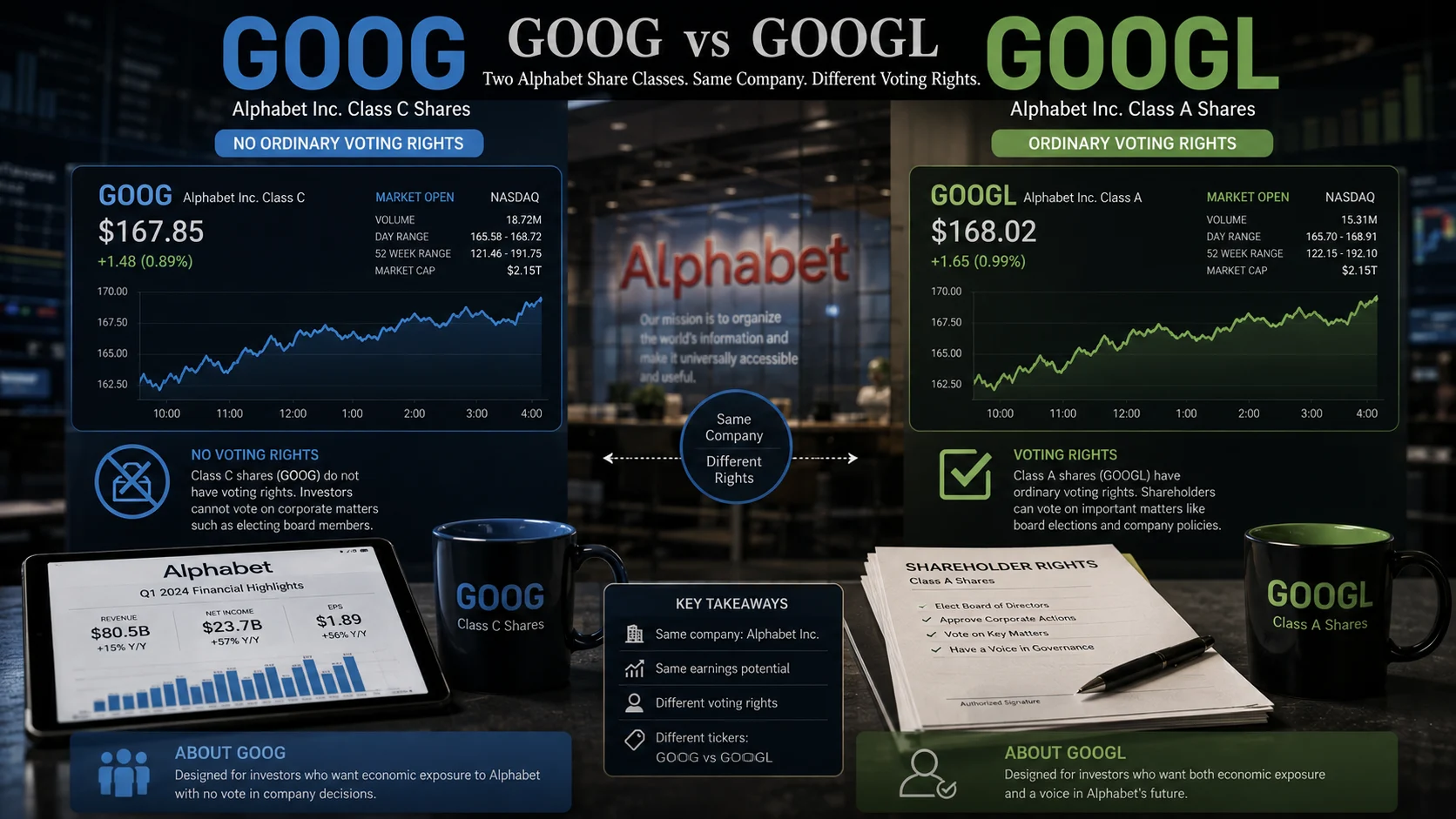
GOOG and GOOGL are two stock ticker symbols for Alphabet Inc., the parent company of Google. GOOG represents Alphabet Class C shares, while GOOGL represents Class A shares with voting rights. The confusion matters because choosing between them can affect an investor’s voting rights and the way a stock position is identified in financial markets.
Goog or Googl: What’s the Difference?
The biggest point to understand is that GOOG and GOOGL are not two spellings of Google. They are market symbols used to identify different classes of Alphabet shares on Nasdaq.
GOOG identifies Alphabet’s Class C common stock. GOOGL identifies Alphabet’s Class A common stock. Class A shares carry voting rights, while Class C shares generally do not carry voting rights. Alphabet also has Class B shares, which are not publicly traded and have greater voting power.
The distinction became especially important after Google reorganized under Alphabet in 2015. Alphabet became the publicly traded parent company, while Google became a wholly owned subsidiary. Both classes continued to trade under the symbols GOOG and GOOGL.
| Feature | GOOG | GOOGL |
|---|---|---|
| Company | Alphabet Inc. | Alphabet Inc. |
| Share class | Class C | Class A |
| Voting rights | No regular voting rights | One vote per share |
| Exchange | Nasdaq | Nasdaq |
| Publicly traded | Yes | Yes |
| Relationship to Google | Alphabet ownership | Alphabet ownership |
| Main distinction | Non voting common stock | Voting common stock |
Quick Recap
GOOG and GOOGL both represent ownership in Alphabet Inc.
GOOG is associated with Class C shares and normally has no voting rights.
GOOGL represents Class A shares and provides one vote per share.
The companies financial performance is not divided into two separate businesses simply because two ticker symbols exist.
Is Goog vs Googl a Grammar, Vocabulary or Usage Issue?
This is primarily a financial terminology and usage issue, rather than a grammar problem.
People sometimes search for GOOG and GOOGL as though they were spelling variations. They are not. In ordinary English, neither ticker should replace the word Google when referring to the search engine, Google Maps, Gmail, Google Cloud, or another Google product.
The distinction becomes relevant when discussing stocks, investing, financial markets, portfolio construction, market prices, or shareholder rights.
For formal financial writing, the symbols should normally appear in uppercase as GOOG and GOOGL. In casual conversations, people may pronounce them as words, but the underlying symbols remain identifiers used by the financial market.
Academic writing about corporate governance should also distinguish the share classes accurately. A paper discussing voting control, corporate ownership, or shareholder rights should not simply call GOOG and GOOGL two versions of Google stock.
The same principle applies to financial websites, investment apps, spreadsheets, stock screeners, and portfolio reports. The ticker tells the system exactly which security is being referenced.
How to Use GOOG Correctly
GOOG is the Nasdaq ticker associated with Alphabet’s Class C common shares. The Class C structure was created to allow Alphabet to raise capital while limiting the dilution of voting control among existing controlling shareholders.
This makes GOOG especially relevant when an investor wants exposure to Alphabet without placing importance on ordinary shareholder voting rights.
Workplace Example
A financial analyst might write:
“Our portfolio holds GOOG because the investment strategy does not require ordinary shareholder voting rights.”
This sentence correctly uses GOOG as a security identifier.
Academic Example
A researcher studying corporate governance might write:
“GOOG provides an example of publicly traded common stock without ordinary voting rights.”
Here, the ticker is being used in a formal discussion of share structure.
Technology Example
An investment application may display GOOG alongside its current market price, daily movement, trading volume, and historical performance. The application uses the ticker to distinguish the security from GOOGL.
Usage Recap
Use GOOG when you specifically mean Alphabet Class C shares.
Do not use GOOG as an alternative spelling for Google.
In financial contexts, capitalization matters because the ticker functions as a precise market identifier.
How to Use GOOGL Correctly
GOOGL is the Nasdaq ticker associated with Alphabet’s Class A common shares. These shares carry one vote per share. The voting right is the central structural difference between GOOGL and GOOG.
For many everyday investors, the practical financial exposure of the two securities can appear very similar because both represent ownership in Alphabet. However, the voting structure makes them legally distinct classes of stock.
Workplace Example
An investment report might state:
“The fund purchased GOOGL to maintain exposure to Alphabet while holding shares that carry voting rights.”
That is an appropriate use of the ticker.
Academic Example
A corporate governance study could state:
“GOOGL shareholders have voting rights that distinguish Class A shares from Alphabet’s Class C shares.”
The sentence focuses on the actual legal structure rather than treating the symbols as spelling choices.
Technology Example
A stock tracking application may allow users to search for GOOGL and GOOG separately. Selecting GOOGL retrieves market information for Alphabet Class A shares.
Usage Recap
Use GOOGL when you mean Alphabet Class A shares.
Remember that GOOGL is a stock ticker, not the spelling of the Google brand.
The additional letter does not mean a different company. It identifies a different class of Alphabet common stock.
When You Should NOT Use GOOG or GOOGL
There are several situations where using either ticker would create confusion.
1. When Referring to the Google Search Engine
Write Google Search, not GOOG or GOOGL. The ticker symbols identify securities, not the search engine.
2. When Referring to Gmail
Gmail is a Google service. Calling it a GOOG service would introduce unnecessary financial terminology.
3. When Discussing Google Maps
Google Maps is a product. Neither stock symbol is an appropriate substitute for the product name.
4. When Writing About Alphabet as a Company
If your sentence discusses Alphabet’s corporate structure as a whole, simply writing Alphabet may be clearer than using either ticker.
5. When Describing a Google Product
Google Cloud, Google Chrome, YouTube, and other products should be identified by their proper names rather than by a stock symbol.
6. When Discussing Stock Ownership Without Identifying the Share Class
If the share class is irrelevant, writing “Alphabet shares” may be more useful than forcing a GOOG or GOOGL distinction into the sentence.
7. When Discussing the Original Google Corporate Structure
Historical descriptions require careful dates and terminology because Alphabet became the publicly traded parent company in 2015. Google subsequently operated as a wholly owned subsidiary.
8. When Searching for the Meaning of Google
The word Google has its own history and linguistic development. It should not be confused with the financial abbreviations GOOG and GOOGL.
Common Mistakes and Decision Rules
The most common mistake is assuming that the extra L in GOOGL is simply an abbreviation or spelling variation. It is actually part of the ticker symbol identifying a particular class of Alphabet shares.
| Correct sentence | Incorrect sentence | Explanation |
|---|---|---|
| GOOGL represents Alphabet Class A shares. | GOOGL is another spelling of Google. | GOOGL is a financial ticker, not a spelling variation. |
| GOOG represents Alphabet Class C shares. | GOOG is the name of the Google search engine. | GOOG identifies a publicly traded share class. |
| GOOGL carries voting rights for ordinary Class A shareholders. | GOOG and GOOGL have exactly the same shareholder rights. | The share classes have different voting structures. |
| Google is a subsidiary of Alphabet. | GOOGL is the parent company of Google. | Alphabet is the parent company, while GOOGL is a ticker symbol. |
| An investor can compare GOOG and GOOGL prices. | An investor can use GOOG as the spelling of Google. | Financial symbols and brand names serve different purposes. |
Decision Rule
If you mean Alphabet Class C stock, use GOOG.
If you mean Alphabet Class A stock, use GOOGL.
If you mean the technology company or its products, use Google or Alphabet according to the context.
GOOG and GOOGL in Modern Technology and AI Tools
The difference between GOOG and GOOGL becomes even more important as financial information increasingly appears inside digital tools.
Modern investment platforms, financial dashboards, stock screeners, spreadsheet applications, market APIs, and AI assistants rely on ticker symbols to identify securities. A request for GOOG stock data is therefore different from a request for GOOGL stock data.
AI tools can also introduce confusion if a user asks a broad question such as “What is Google stock?” A useful answer should clarify the user means GOOG, GOOGL, or Alphabet generally.
This is an important example of why precise terminology matters in automated systems. A ticker symbol is not simply text. It acts as a structured identifier that can determine which market data an application retrieves.
For financial analysis, the distinction should therefore be preserved when importing prices, calculating returns, comparing valuations, or building investment reports.
The History Behind GOOG and GOOGL
The story becomes clearer when the corporate history is considered.
Google was originally the publicly traded company. In 2015, Google underwent a corporate restructuring that created Alphabet Inc. as the parent company. Google became one of Alphabet’s wholly owned subsidiaries. Alphabet continued to have two publicly traded classes represented by GOOG and GOOGL.
Alphabet’s filings identify Class A stock with the symbol GOOGL and Class C stock with the symbol GOOG. The Class B shares are not publicly traded.
The structure was designed around a central corporate governance issue: allowing the company to raise capital while maintaining substantial control among its founders and other holders of high voting power.
This explains why the difference between the two symbols is more than a cosmetic change.
Etymology and Naming
The word Google itself has a different origin from the financial symbols.
Google’s name is associated with the mathematical term googol, which represents the number 1 followed by 100 zeros. The founders selected the Google name because it suggested an enormous quantity of information and suited the idea behind a large scale search engine.
GOOG and GOOGL are later financial abbreviations associated with the company and its share classes.
That distinction creates an important linguistic point: the brand name, the corporate name, and the stock tickers are related, but they do not perform the same function.
Expert Style Explanation
A useful way to remember the structure is this:
“GOOG and GOOGL identify securities, while Google identifies a technology brand and Alphabet identifies the parent corporation.”
That simple distinction eliminates most terminology errors.
Two Practical Case Studies
Case Study 1: Comparing Share Classes
Imagine an investor researching Alphabet for a long term portfolio. The investor finds two securities, GOOG and GOOGL, and assumes one must be an outdated symbol.
That assumption would be incorrect.
The investor should first identify the share classes. GOOG represents Class C shares, while GOOGL represents Class A shares. The key difference is ordinary voting rights.
The practical lesson is simple: never select a ticker solely because the price looks slightly more attractive. Understand what security the ticker actually represents.
Case Study 2: Building an Investment Dashboard
Consider a financial analyst creating a dashboard that tracks Alphabet.
If the analyst enters only the company name, an application may need to determine which security should be displayed. If the dashboard requires the exact market instrument, the analyst must specify GOOG or GOOGL.
The result is a cleaner dataset because each ticker corresponds to a specific share class.
The practical lesson is that ticker precision improves financial data quality. This matters for price tracking, historical analysis, portfolio reporting, and automated financial workflows.
Error Prevention Checklist
Always Use GOOG When
You are referring specifically to Alphabet Class C shares.
You are discussing the non voting publicly traded class.
A financial platform specifically identifies the security as GOOG.
Always Use GOOGL When
You are referring specifically to Alphabet Class A shares.
You are discussing ordinary voting rights associated with Class A stock.
A financial platform specifically identifies the security as GOOGL.
Never Use Either Ticker When
You are naming the Google search engine.
You are referring to Gmail, Google Maps, Chrome, or another Google product.
You are simply discussing the Google brand.
You are discussing Alphabet generally and the specific share class does not matter.
Related Grammar and Usage Confusions You Should Master
Understanding GOOG and GOOGL also highlights a broader lesson about precise language. Similar confusion occurs when people mix terms that look alike but perform different functions.
- Google vs Alphabet
- Company name vs stock ticker
- Brand name vs corporate entity
- Stock symbol vs company abbreviation
- Class A shares vs Class C shares
- Voting shares vs non voting shares
- Market price vs company value
- Revenue vs profit
- Share price vs market capitalization
- Investor ownership vs voting control
These distinctions are useful beyond Alphabet. Financial writing depends heavily on exact terminology because small wording differences can change the meaning of an entire statement.
FAQs
What is the difference between GOOG and GOOGL?
GOOG represents Alphabet Class C shares, while GOOGL represents Class A shares with ordinary voting rights.
Is GOOG the same as Google?
No. GOOG is a stock ticker for Alphabet Class C shares, while Google is the technology brand and subsidiary.
Is GOOGL the correct spelling of Google?
No. GOOGL is a Nasdaq ticker symbol for Alphabet Class A shares.
Which stock is GOOG?
GOOG is Alphabet’s Class C publicly traded common stock, generally without ordinary voting rights.
Which stock is GOOGL?
GOOGL is Alphabet’s Class A publicly traded common stock, which carries one vote per share.
Why does Alphabet have GOOG and GOOGL?
Alphabet has multiple publicly traded share classes with different voting structures, allowing investors to own shares while preserving a particular corporate governance structure.
Are GOOG and GOOGL different companies?
No. Both are securities issued by Alphabet Inc. They represent different classes of the same parent company.
Should I write Google or GOOGL?
Write Google when discussing the brand or its products. Use GOOGL only when specifically discussing Alphabet Class A stock.
Does GOOG have voting rights?
Alphabet’s Class C shares represented by GOOG generally do not carry ordinary voting rights.
Conclusion
The difference between GOOG and GOOGL is straightforward once the corporate structure is understood. GOOG identifies Alphabet Class C shares, while GOOGL identifies Class A shares with voting rights. Neither ticker is an alternative spelling of Google.
For everyday technology writing, use Google when discussing the brand, search engine, or products. For financial writing, use GOOG or GOOGL only when you mean the specific Alphabet share class.
This distinction may look small, but accurate terminology matters in investing, financial research, academic writing, data analysis, and AI driven financial tools. Knowing exactly what each symbol represents helps prevent misleading statements and makes financial content considerably more precise.
Discover More Related Articles:
- Maui or Kauai | Which Hawaiian Island Is Right for You In 2026
- Play or Draw | What Happens When a Game Ends Even In 2026
- Dinner or Diner | One Means a Meal, the Other Is a Restaurant In 2026