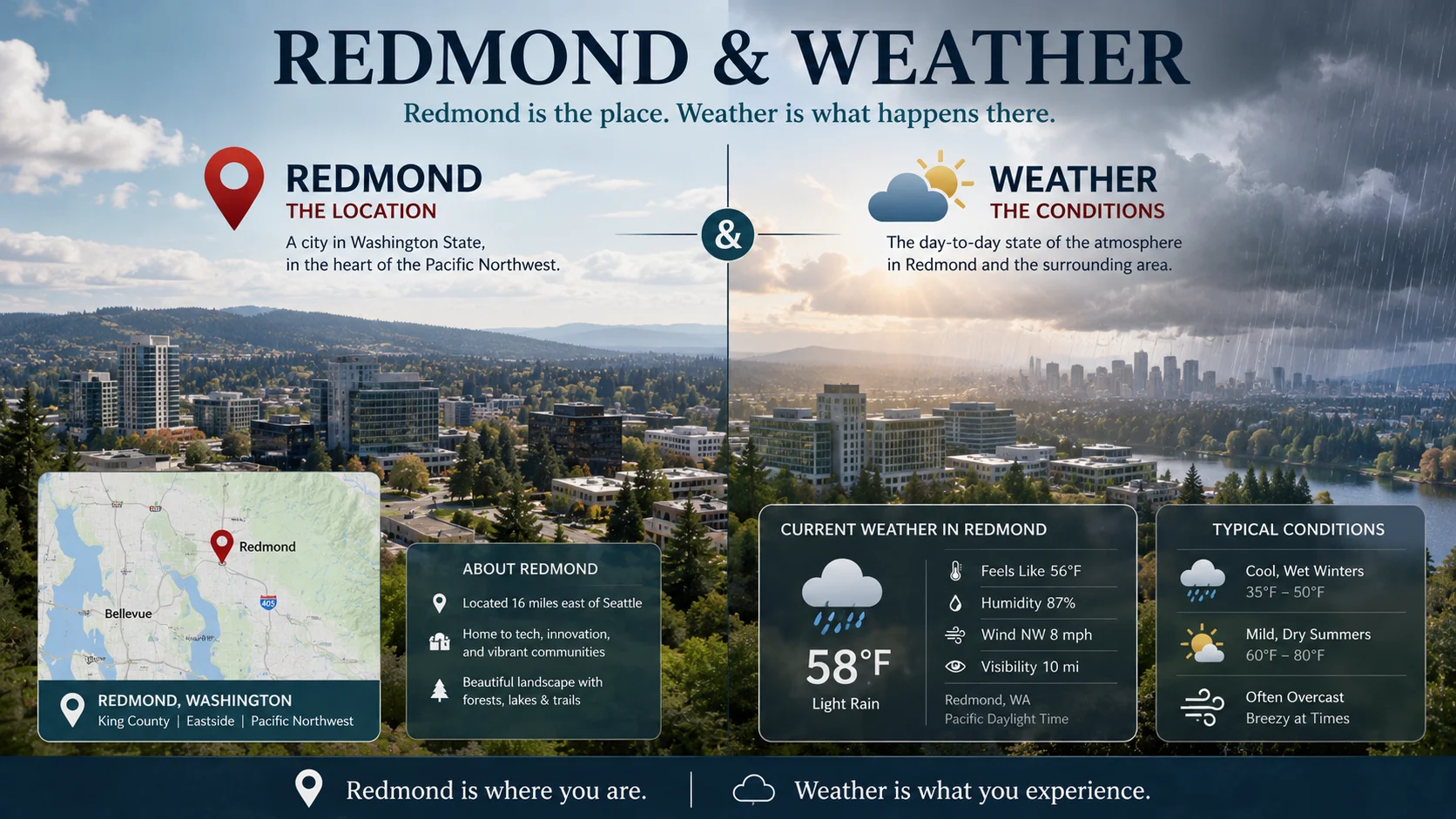
Redmond or weather usually reflects a location based search rather than a true word choice comparison. Redmond is a proper noun used for a place or name, while weather is a common noun describing atmospheric conditions. If you are searching for conditions in Redmond, the natural phrase is Redmond weather, especially when looking for temperature, rain, forecasts, or seasonal climate information.
Redmond or weather | What Does the Search Mean?
At first glance, redmond or weather looks like a comparison between two words. It is not. The two terms belong to completely different categories and perform different jobs in a sentence.
Redmond is normally a proper noun. In a location based search, it commonly refers to Redmond, Washington, a city in King County located east of Seattle. The city is known for its technology economy, parks, trails, and residential communities. The City of Redmond describes the community as being less than 20 miles east of downtown Seattle and at the north end of Lake Sammamish.
Weather, by contrast, is a common noun. It describes the condition of the atmosphere at a particular time or over a particular period. Temperature, rainfall, cloud cover, wind, humidity, and precipitation are all parts of weather.
The important distinction is simple. Redmond identifies where you are talking about. Weather identifies what atmospheric conditions you are talking about.
| Term | Part of speech | Basic meaning | Typical use |
|---|---|---|---|
| Redmond | Proper noun | A name, often referring to a city | Redmond is east of Seattle. |
| Weather | Common noun | Atmospheric conditions | The weather is warm today. |
| Redmond weather | Noun phrase | The atmospheric conditions in Redmond | What is the Redmond weather today? |
Quick recap
Redmond is a place name, not a type of weather.
Weather describes atmospheric conditions.
Redmond weather combines the location with the thing being searched for.
For a forecast, climate information, or current conditions, Redmond weather is the clearer search phrase.
What Is Redmond?
Redmond is a proper noun because it identifies a particular place or entity. In the context of weather searches, the most prominent interpretation is Redmond, Washington.
The City of Redmond reports an area of more than 17 square miles and describes the city as being positioned at the northern end of Lake Sammamish. Its official statistics list an annual mean temperature of 52.8 degrees Fahrenheit and average annual precipitation of 35.50 inches.
Redmond is also a growing community. The United States Census Bureau estimated the city’s population at 82,506 in July 2025, compared with a 2020 census population of 73,256.
That geographical identity matters when someone searches for weather information. A forecast cannot be meaningful without a location. The word Redmond supplies that location, while weather identifies the information being requested.
Workplace example
A workplace message might say:
The team meeting in Redmond may need to move indoors because of the weather.
Here, Redmond tells readers where the meeting is taking place. Weather explains the environmental reason for changing the plan.
Academic example
A geography assignment could say:
Redmond has a mild climate compared with many locations at similar latitudes.
In this sentence, Redmond functions as the geographical subject. Climate describes the long term pattern of atmospheric conditions.
Technology example
A weather application may display:
Redmond weather: 62 degrees with a chance of rain.
The application uses the location name as the search parameter and weather as the information category.
Usage recap
Use Redmond when identifying the place.
Use weather when discussing atmospheric conditions.
Use Redmond weather when you want information about atmospheric conditions in Redmond.
What Is Weather?
Weather is the state of the atmosphere at a particular time and place. It can change from hour to hour and from one day to another.
Common weather elements include temperature, precipitation, wind speed, wind direction, cloud cover, humidity, visibility, and atmospheric pressure.
Weather is different from climate. Weather concerns relatively short term conditions, while climate describes patterns observed over much longer periods.
This distinction is especially important when discussing Redmond. A particular summer afternoon may be unusually hot even though the city’s overall climate remains comparatively mild. Similarly, a rainy winter day does not by itself define the climate of the entire region.
The City of Redmond describes its climate as Mediterranean, with warm to hot summers and cool winters. Its climate information also notes that summers tend to be warm and dry, while winters tend to be cool and wet.
Workplace example
Check the weather before scheduling the outdoor inspection.
The word weather refers to conditions that could affect the work.
Academic example
Researchers recorded weather conditions during the field study.
Here, weather refers to measurable atmospheric conditions.
Technology example
A forecasting service can provide temperature, precipitation probability, wind, humidity, and other weather measurements for a selected location. The National Weather Service provides point forecasts for Redmond, Washington using location specific forecast data.
Usage recap
Weather is a common noun.
It describes atmospheric conditions.
It can refer to current conditions or short term changes.
For a particular city, combine the location with weather, such as Redmond weather.
Is Redmond or weather a Grammar, Vocabulary, or Usage Issue?
The phrase redmond or weather is primarily a usage and search intent issue, not a traditional grammar confusion such as affect and effect.
Redmond and weather cannot normally replace each other. They are not synonyms, homophones, spelling variants, or alternative grammatical forms.
Redmond is a proper noun and should generally begin with a capital letter when it refers to a specific place. Weather is a common noun and normally appears in lowercase unless it begins a sentence or appears in a title that follows a particular capitalization style.
The terms can appear together naturally:
The weather in Redmond is changing.
Redmond weather is expected to become cooler.
We checked the weather before traveling to Redmond.
They can also appear separately:
Redmond has many parks.
The weather is unpredictable.
The key is that each word contributes different information.
Formal versus informal usage
In formal writing, clarity is more important than forcing the exact search phrase into a sentence. A report might say:
Atmospheric conditions in Redmond vary considerably by season.
An informal search might simply say:
Redmond weather today.
Both expressions communicate useful information, but they serve different purposes.
Academic versus casual usage
Academic writing generally prefers complete and precise expressions. Search queries are often shorter because users want information quickly.
For example:
What is the climate of Redmond, Washington?
is more formal than:
Redmond weather.
Neither is wrong. They simply reflect different communication contexts.
Redmond or weather in Everyday Search Queries
Search engines interpret combinations of place names and information categories differently from ordinary sentences.
Someone searching for redmond or weather may actually be trying to find:
- Redmond weather today
- Redmond weather this week
- Weather in Redmond Washington
- Redmond temperature
- Redmond rain forecast
- Redmond climate
- Redmond seasonal weather
- Redmond weather conditions
This explains why the phrase can look awkward while still having a recognizable search intent.
A search engine understands that Redmond can represent a geographical entity and that weather represents a topic connected with that entity. The useful relationship is therefore not Redmond versus weather. It is Redmond plus weather.
When You Should NOT Use Redmond or Weather
There are several situations where treating these terms as alternatives creates confusion.
1. Do not use weather as the name of a city
Weather does not identify Redmond or any other location. It describes atmospheric conditions.
2. Do not use Redmond as a synonym for climate
Redmond is a location. Climate is the long term atmospheric pattern associated with a location.
3. Do not capitalize weather simply because it appears beside Redmond
The correct expression is generally:
Redmond weather
not:
Redmond Weather
unless a particular title style requires title capitalization.
4. Do not describe a forecast as the climate
A forecast predicts relatively short term conditions. Climate describes long term patterns.
5. Do not assume every Redmond has identical weather
Redmond can refer to more than one place. Redmond, Washington and Redmond, Oregon have different geographical settings and therefore different weather patterns. The Census Bureau separately identifies Redmond city in Washington and Redmond city in Oregon.
6. Do not omit the location when accuracy matters
If an application or article simply says weather, readers may not know which place is being discussed.
7. Do not treat a search query as a complete sentence
Search engines often receive short fragments. Natural prose normally requires more context.
Common Mistakes and Decision Rules
| Correct sentence | Incorrect sentence | Explanation |
|---|---|---|
| What is the weather in Redmond today? | What is the Redmond in weather today? | Redmond identifies the location, while weather identifies the atmospheric conditions. |
| Redmond weather is expected to change. | Weather Redmond is expected to change. | The natural noun phrase places the location before the information category. |
| Redmond has a mild climate. | Weather has a mild climate. | Redmond is the geographical subject. |
| The weather in Redmond was rainy. | The Redmond in weather was rainy. | The prepositional phrase clearly identifies where the weather occurred. |
| Check the Redmond forecast before leaving. | Check the weather Redmond before leaving. | The location functions naturally as a modifier of the forecast. |
Decision rule
If you mean the place, use Redmond.
If you mean atmospheric conditions, use weather.
If you mean atmospheric conditions in the place, use Redmond weather.
Redmond Weather and Seasonal Climate
Understanding the difference between weather and climate makes searches for Redmond much more useful.
According to the City of Redmond’s climate information, summers are generally warm and dry, while winters are cooler and wetter. November is identified as the rainiest month, and August is the warmest month on average. Snowfall occurs but is not the dominant feature of the city’s climate.
The city’s official statistics report an annual mean temperature of 52.8 degrees Fahrenheit and average annual precipitation of 35.50 inches.
| Season | Typical pattern | What travelers should consider |
|---|---|---|
| Spring | Milder temperatures with changing conditions | Layered clothing and rain protection can be useful. |
| Summer | Generally warm and relatively dry | Outdoor activities are often more comfortable during this period. |
| Autumn | Increasing rainfall and cooler conditions | Rain protection becomes increasingly useful. |
| Winter | Cooler and wetter conditions | Expect more precipitation and occasional snow. |
These are climate patterns, not guarantees for a particular day. Actual weather can vary considerably.
Redmond or weather in Modern Technology and AI Tools
Modern search engines, weather applications, mapping services, and AI assistants increasingly understand relationships between entities and attributes.
If a user enters a phrase such as Redmond weather, a system can interpret Redmond as a location entity and weather as the requested information type. That is more useful than treating the two words as competing alternatives.
AI systems can also distinguish between questions such as:
What is Redmond?
and:
What is the weather in Redmond?
The first asks for information about a place. The second asks for atmospheric information associated with that place.
This distinction matters for search engine optimization because users frequently enter incomplete phrases. High quality content should satisfy the underlying intent rather than merely repeat the exact query.
Why Redmond Weather Searches Need Location Accuracy
Location accuracy is one of the most important details in weather searches.
Redmond, Washington is not the same location as Redmond, Oregon. A search engine or weather service must identify the intended place before giving a useful forecast.
For Redmond, Washington, the National Weather Service provides location specific forecast information including temperature, precipitation probability, humidity, wind, and sky conditions.
This also explains why adding the state can improve clarity:
Redmond, Washington weather
is more specific than:
Redmond weather
when several places with the same name are possible.
Etymology and Language Authority
The word Redmond functions as a proper name rather than a descriptive weather term. Its capitalization signals that it identifies a particular entity.
The word weather has a much older linguistic history and is related to words describing atmospheric conditions. In modern English, it functions mainly as a noun, although related forms can appear in broader expressions.
A useful linguistic principle is:
A place name identifies the setting, while a weather term describes the atmospheric condition within that setting.
This principle applies far beyond Redmond. Consider New York weather, London weather, Seattle weather, or Tokyo weather. The first element identifies the location. The second identifies the information being requested.
Two Practical Case Studies
Case study one: Travel planning
Imagine a traveler planning an outdoor activity in Redmond, Washington.
Searching only for Redmond may return information about parks, businesses, transportation, demographics, and local attractions. Searching for weather in Redmond narrows the intent toward temperature, rainfall, wind, and other atmospheric conditions.
The practical result is better decision making. The traveler can decide what clothing to bring, an outdoor activity is suitable, and weather protection is necessary.
Case study two: Search interpretation
Consider two searches:
Redmond
and:
Redmond weather
The first has broad local intent. The second has a specific information need.
The second query therefore provides a much stronger signal about the user’s desired content. This is why a well optimized article should explain the relationship between the location and the information category rather than incorrectly presenting them as competing words.
Error Prevention Checklist
Always use Redmond when
You are identifying the city or another proper entity named Redmond.
You are discussing the location, residents, geography, businesses, parks, or local services.
You need to specify where an event or activity takes place.
Never use weather when
You mean the name of the city.
You are identifying a geographical location.
You are referring to the city’s population or physical area.
Always use weather when
You mean temperature, rain, wind, humidity, cloud cover, or other atmospheric conditions.
You are discussing current conditions or a short term forecast.
Use Redmond weather when
You want atmospheric information specifically connected with Redmond.
Related Grammar Confusions You Should Master
Understanding redmond or weather also highlights a broader lesson about word relationships. Not every confusing search phrase involves synonyms or grammar.
- Affect and effect
- Weather and whether
- Climate and weather
- Then and than
- Its and it’s
- Your and you’re
- There, their, and they’re
- Principal and principle
- Advice and advise
- Practice and practise
One especially important comparison is weather and whether. These words sound alike in many varieties of English but have completely different meanings. Weather concerns atmospheric conditions, while whether introduces alternatives or uncertainty.
FAQs
What does redmond or weather mean?
It usually represents a location based search where Redmond identifies the place and weather identifies the requested atmospheric information.
Is Redmond a type of weather?
No. Redmond is normally a proper noun referring to a place or name, while weather describes atmospheric conditions.
What is the correct phrase, Redmond weather or weather Redmond?
Redmond weather is the more natural noun phrase, while weather in Redmond is also clear and grammatically natural.
What is the weather in Redmond Washington?
Weather changes continuously, so current conditions should be checked through a current forecasting service such as the National Weather Service.
Is Redmond weather the same as Redmond climate?
No. Weather describes current or short term conditions, while climate describes long term atmospheric patterns.
Does Redmond get snow?
Redmond, Washington can receive snow, although the city’s climate information describes snowfall as uncommon compared with many colder locations.
Is Redmond in Washington or Oregon?
Both Washington and Oregon have cities named Redmond, so specifying the state can prevent location confusion.
Why do people search for Redmond weather?
They may want the current temperature, precipitation forecast, wind conditions, seasonal information, or travel planning guidance.
What is the difference between weather and climate in Redmond?
Weather can change from one hour or day to another, while climate describes the broader pattern of conditions over many years.
Conclusion
The phrase redmond or weather is best understood as a search intent question rather than a genuine vocabulary comparison. Redmond is a proper noun that identifies a place, while weather is a common noun describing atmospheric conditions.
When the intended meaning is atmospheric conditions in Redmond, the clearest expressions are Redmond weather and weather in Redmond. For greater geographical precision, especially because Redmond is also the name of a city in Oregon, use Redmond, Washington weather when that is the intended location.
For readers, writers, students, travelers, and search users, the decision is straightforward. Redmond tells you where. Weather tells you what atmospheric conditions are happening there.
Discover More Related Articles:
- Maui or Kauai | Which Hawaiian Island Is Right for You In 2026
- Play or Draw | What Happens When a Game Ends Even In 2026
- Dinner or Diner | One Means a Meal, the Other Is a Restaurant In 2026