Guns or butter describes the economic choice between spending limited resources on military defense or civilian goods and services. The phrase represents opportunity cost: when a government devotes more resources to defense, fewer may remain available for food, healthcare, education, infrastructure and other civilian needs.
The phrase guns or butter sounds simple, but it represents one of the most important ideas in economics: every society has limited resources and unlimited wants. Governments must decide how those resources should be allocated, especially when national security competes with living standards and public investment.
At first glance, the expression may seem to describe a literal choice between weapons and food. In economics, however, it is a broader model of resource allocation. Guns represent military spending and national defense, while butter represents civilian consumption and domestic welfare.
Understanding this distinction matters because the phrase appears frequently in economics textbooks, political discussions, history courses, government budgets, and debates about public priorities. It is also closely connected to opportunity cost, scarcity, the production possibilities frontier, economic growth, and government spending.
Guns or Butter | What’s the Difference?
Guns is a noun representing military goods, defense capabilities, weapons, armed forces, and national security spending.
Butter is a noun representing civilian goods, consumer welfare, public services, and resources directed toward improving everyday living standards.
The expression does not mean that governments literally choose between purchasing weapons and purchasing butter. Instead, these two words symbolize competing categories of economic priorities.
| Term | Part of speech | Economic meaning | Typical examples |
|---|---|---|---|
| Guns | Noun | Military and defense priorities | Weapons, soldiers, defense equipment, military infrastructure |
| Butter | Noun | Civilian and consumer priorities | Food, healthcare, education, housing, infrastructure |
| Guns or butter | Economic expression | A resource allocation tradeoff | Defense spending versus domestic spending |
| Opportunity cost | Noun | Value of the next best alternative sacrificed | Civilian investment forgone because of higher defense spending |
| Production possibilities frontier | Noun phrase | Model showing possible combinations of two outputs | Maximum feasible combinations of defense and civilian goods |
The central idea is scarcity.
A country has only so much labor, capital, land, technology, energy, and government revenue. If more of those resources are directed toward defense production, fewer resources may be available for civilian production.
That does not mean every increase in military spending automatically reduces civilian welfare. An economy can grow, productivity can improve, taxes can change, and governments can borrow. The model simply highlights the tradeoff that exists when resources are limited.
Quick recap
Guns symbolize defense and military priorities.
Butter symbolizes civilian consumption and public welfare.
The phrase describes an economic tradeoff rather than a literal shopping decision.
Its deeper concept is opportunity cost.
Is Guns or Butter a Grammar, Vocabulary or Usage Issue?
The expression guns or butter is primarily a vocabulary and economics issue, not a grammar problem.
The individual words are ordinary nouns, but together they form an established economic expression. Their meaning becomes figurative when they are used to describe government resource allocation.
The phrase is generally not interchangeable with expressions such as government spending, taxation, or public expenditure. Those concepts can be related, but they are not identical.
For example, a government can increase military spending while also increasing total government expenditure. In that situation, the economy may experience growth rather than a simple reduction in civilian spending. The guns or butter framework asks a more specific question: how are scarce productive resources being allocated between competing priorities?
Formal and informal usage
In academic writing, the expression is appropriate when discussing economic tradeoffs, fiscal priorities, military expenditure, or the production possibilities frontier.
In casual conversation, people may use it more broadly to mean choosing between security and quality of life.
For example:
The budget debate has become a classic guns or butter problem.
In an economics essay, however, the writer should explain what each category represents rather than assuming every reader understands the metaphor.
Academic versus casual usage
Academic use tends to focus on scarcity, opportunity cost, production capacity, and resource allocation.
Casual use often emphasizes political priorities.
Both uses are legitimate, but context determines how much explanation is necessary.
What Do Guns Represent in Economics?
In the guns or butter model, guns represent resources committed to national defense.
That can include military personnel, weapons systems, defense research, military bases, cybersecurity capabilities, logistics, aircraft, naval vessels, and other defense related activities.
The term is deliberately broad. It does not require an economy to manufacture literal guns.
Workplace example
Imagine a company that produces specialized technology for both government defense contracts and civilian infrastructure projects. If the company shifts more engineers and factory capacity toward defense contracts, it may have less capacity available for civilian projects.
The decision has an opportunity cost.
The company may earn more from defense contracts, but it could also lose opportunities in civilian markets.
Academic example
An economics student might write:
An increase in defense production can illustrate the opportunity cost of allocating scarce productive resources toward military output rather than civilian goods.
This is stronger than simply saying that military spending is bad or civilian spending is good. Economic analysis focuses on the cost of the alternative that is sacrificed.
Technology example
Technology provides an especially interesting modern example.
A government may fund advanced computing, satellite systems, cybersecurity, artificial intelligence research, or communications technology for national security purposes. Some of these investments can later create civilian applications.
Therefore, the guns category is not always economically separate from civilian progress. Defense research can sometimes produce technologies that spread into civilian markets.
Usage recap
Guns represent defense priorities rather than weapons alone.
The category includes labor, technology, infrastructure, and capital devoted to national security.
Its opportunity cost depends on what those resources could have produced elsewhere.
What Does Butter Represent in Economics?
Butter represents civilian consumption and domestic welfare.
The metaphor comes from the idea of ordinary consumer goods, with butter serving as a simple symbol of everyday material well being. In modern economic discussions, the category can extend far beyond food.
Butter can represent healthcare, education, housing, transportation, consumer products, infrastructure, environmental programs, and other civilian priorities.
Workplace example
A business may face a comparable choice when deciding to spend its available capital on security systems or customer facing improvements.
A company that invests heavily in cybersecurity may have fewer funds available for new offices, employee facilities, product development, or marketing.
The comparison is not perfect, but it demonstrates the underlying principle of competing uses for scarce resources.
Academic example
A student discussing public finance might explain that spending on schools, hospitals, roads, and social programs can represent the civilian side of the guns or butter tradeoff.
The important point is not one category is morally superior. The economic question is what society gives up when it chooses one allocation over another.
Technology example
A government could direct public funds toward civilian broadband, digital education, public health technology, or transportation systems instead of directing the same productive resources toward defense technology.
Again, the real world is more complicated than the metaphor because some technologies can serve both military and civilian purposes.
Usage recap
Butter symbolizes civilian welfare and consumption.
It includes much more than food.
The concept is useful for understanding competing government priorities.
Civilian spending can also create long term productivity and economic growth.
When You Should NOT Use Guns or Butter
The expression is powerful, but it should not be used as a universal description of every budget decision.
- Do not use it for every government spending debate. Not every budget decision involves a meaningful defense versus civilian tradeoff.
- Do not treat guns and butter as literal products. The phrase is an economic metaphor.
- Do not assume that higher defense spending always reduces civilian consumption. Economic growth and productivity can change the available resource base.
- Do not assume the choice is always either military spending or social spending. Governments can finance both through taxation, borrowing, economic growth, and changes in other expenditures.
- Do not use the phrase to make a moral conclusion automatically. Economics can describe tradeoffs without deciding which priority is ethically preferable.
- Do not confuse it with the concept of inflation. Inflation can affect government purchasing power, but it is not what the expression means.
- Do not use it as a synonym for opportunity cost. Opportunity cost is the broader economic principle behind the expression.
- Do not ignore productive capacity. A growing economy may be able to produce more defense and civilian goods simultaneously.
Common Mistakes and Decision Rules
| Correct sentence | Incorrect sentence | Explanation |
|---|---|---|
| The government faces a guns or butter tradeoff. | The government must literally choose guns instead of butter. | The expression is metaphorical. |
| Defense spending can create an opportunity cost for civilian production. | Defense spending always destroys civilian production. | The actual effect depends on economic conditions. |
| Guns represent military priorities. | Guns only mean firearms. | The economic meaning is broader. |
| Butter represents civilian welfare. | Butter means only food spending. | The term represents civilian goods and services more broadly. |
| The production possibilities frontier can illustrate the tradeoff. | The production possibilities frontier proves that defense spending is harmful. | The model demonstrates scarcity and opportunity cost, not a moral judgment. |
Decision Rule
If you mean military or defense priorities, think of guns.
If you mean civilian consumption, welfare, and domestic priorities, think of butter.
If you mean the value of the alternative that was sacrificed, use the term opportunity cost.
This distinction prevents one of the most common misunderstandings of the concept.
Guns or Butter in Modern Technology and AI Tools
Modern technology makes the traditional guns or butter model more complicated.
Artificial intelligence, advanced computing, robotics, satellites, telecommunications, and cybersecurity can have both military and civilian applications. A single research program may support national security while also creating technologies that eventually benefit businesses and consumers.
AI is an especially clear example.
Government funding for advanced computing could support defense intelligence, cybersecurity, autonomous systems, or military logistics. Similar technologies can also contribute to medical research, education, transportation, scientific discovery, and commercial innovation.
This creates what economists sometimes describe as dual use technology.
As a result, the boundary between guns and butter is not always clean. A resource devoted to one objective can generate benefits in another area.
The Economics Behind Guns or Butter
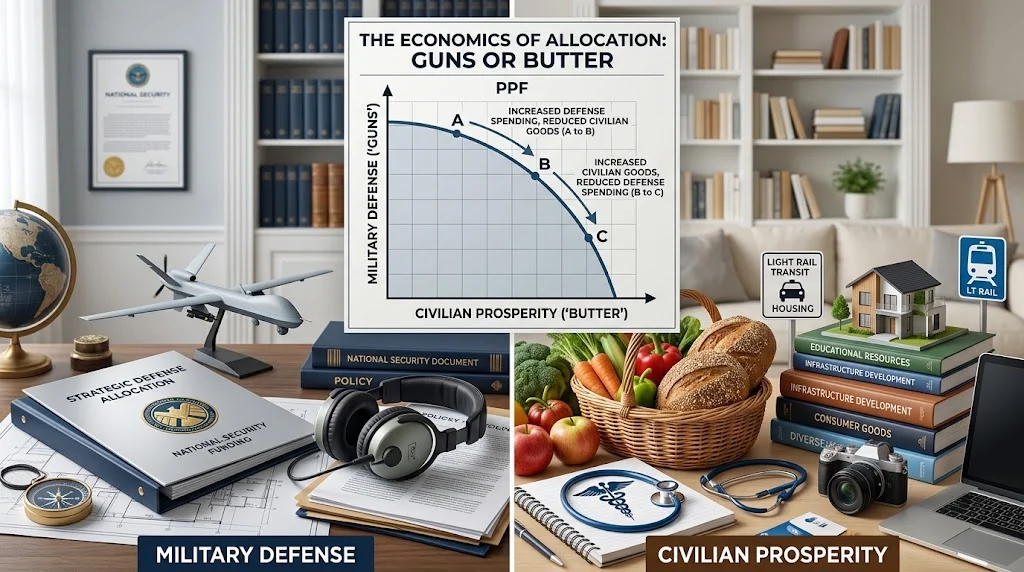
The simplest way to understand the concept is through the production possibilities frontier.
Imagine an economy capable of producing two broad categories of output: defense goods and civilian goods.
If all productive resources were directed toward defense, the economy could produce a large amount of military output but relatively little civilian output.
If resources were directed almost entirely toward civilian production, civilian output could rise while defense production falls.
The production possibilities frontier shows the maximum combinations the economy can produce with its existing resources and technology.
Moving along the frontier demonstrates opportunity cost.
Suppose an economy moves from point A to point B and produces more defense equipment. If civilian production falls as a result, the lost civilian output represents an opportunity cost.
The model also explains why economic growth matters.
If an economy becomes more productive because of better technology, education, infrastructure, or capital investment, its production possibilities frontier can expand. The country may then be able to produce more defense goods and more civilian goods than before.
That is why the guns or butter model should not be interpreted as a permanent fixed quantity of wealth.
Why Opportunity Cost Matters
Opportunity cost is arguably the most important concept behind guns or butter.
Every decision involving scarce resources has alternatives.
If a government spends a billion dollars on a defense project, economists ask what the resources used for that project could have produced elsewhere.
Perhaps they could have supported hospitals. Perhaps they could have improved transportation infrastructure. Perhaps they could have reduced taxes or funded scientific research.
The opportunity cost is not necessarily the dollar amount of the defense project.
It is the value of the next best alternative that society gives up.
This distinction makes the guns or butter model much more useful than a simple comparison of budget numbers.
Etymology and Historical Meaning
The phrase became especially prominent in discussions of wartime economies and public resource allocation during the twentieth century.
The word guns became a convenient symbol for military production, while butter represented civilian consumption and everyday prosperity.
The expression gained lasting importance because wartime mobilization demonstrated how dramatically governments could redirect factories, workers, raw materials, and investment toward national defense.
The metaphor eventually became a standard teaching device in economics because it provides an intuitive way to introduce scarcity and opportunity cost.
An expert perspective
A useful economic interpretation is:
Every allocation decision has a cost because resources used for one purpose cannot simultaneously be used for another purpose.
That principle captures the analytical heart of the guns or butter framework.
Two Real World Case Studies
Case study one: Wartime production
During major wars, governments have historically redirected factories and workers toward military production.
Factories that might otherwise produce consumer automobiles, appliances, or other civilian products can be converted to produce military equipment.
The economic consequence is not simply that governments spend more money. Productive capacity itself is redirected.
This demonstrates the guns side of the model particularly clearly.
The concrete result is a change in the composition of national output. Military production rises, while some civilian production becomes unavailable or restricted.
Case study two: Defense research and civilian innovation
Defense research provides a more complicated example because military investment can generate civilian benefits.
Technologies associated with government funded research have sometimes contributed to later civilian applications in computing, communications, navigation, materials science, and other fields.
The result demonstrates an important limitation of a simplistic guns versus butter interpretation.
The initial allocation may favor national security, but technological spillovers can later benefit civilian industries. In other words, the economic effects of resource allocation can extend beyond the original spending category.
Error Prevention Checklist
Always use guns when
You are discussing military production.
You are analyzing national defense priorities.
You are comparing defense resources with civilian resources.
You are explaining military expenditure within an economic model.
Never use butter when
You mean military production.
You are referring specifically to weapons or defense capabilities.
You are describing the opportunity cost itself.
You are using the word as though it were a technical synonym for all government spending.
Why the Guns or Butter Model Still Matters
The model remains useful because it teaches a principle that applies far beyond defense budgets.
Businesses allocate capital.
Households allocate income.
Governments allocate public resources.
Students allocate study time.
Every decision involves alternatives.
Even when an economy becomes wealthier, scarcity does not disappear. People still have competing objectives, and resources still have alternative uses.
The guns or butter framework therefore works as a simple introduction to a much larger economic idea: choices have consequences because resources are limited.
It also encourages better questions.
Instead of asking only defense spending is high or low, economists can ask what resources are being used, what alternatives are being sacrificed, productive capacity is expanding, and the spending creates future benefits.
That makes the concept useful for understanding fiscal policy, public finance, economic growth, national security, and government decision making.
Related Economic Confusions You Should Master
Understanding guns or butter becomes easier when you also understand several related concepts:
- Opportunity cost: The value of the next best alternative given up.
- Scarcity: The condition that resources are limited relative to human wants.
- Production possibilities frontier: A model showing possible combinations of two types of output.
- Tradeoff: A situation in which gaining more of one thing requires sacrificing something else.
- Economic growth: An increase in an economy’s productive capacity.
- Fiscal policy: Government decisions involving taxation and spending.
- Government expenditure: Money spent by public authorities on goods, services, transfers, and other activities.
- Resource allocation: The process of deciding how scarce resources should be used.
- Marginal cost: The additional cost associated with producing one additional unit.
- Efficiency: Using resources in a way that avoids unnecessary waste while considering the relevant economic objective.
FAQs
What does guns or butter mean in economics?
Guns or butter describes the choice between allocating scarce resources toward military defense or civilian goods and services, illustrating scarcity and opportunity cost.
Why are guns and butter used as an economic example?
Guns symbolize national defense while butter symbolizes civilian consumption, making an otherwise complex resource allocation problem easier to visualize.
What is the opportunity cost in guns or butter?
The opportunity cost is the value of the next best alternative sacrificed when resources are directed toward either military or civilian production.
What does butter represent in the guns or butter model?
Butter represents civilian consumption, domestic welfare, public services, and other uses of resources that are not primarily devoted to military purposes.
What does guns represent in economics?
Guns represent military goods, defense services, national security investment, and other resources devoted to defense.
Is guns or butter a real economic choice?
It is a simplified economic model rather than a literal choice, because governments can finance different priorities through growth, taxation, borrowing, and changes in other spending.
How does the production possibilities frontier explain guns or butter?
It shows how an economy’s limited resources can produce different combinations of military and civilian output and illustrates the opportunity cost of moving between those combinations.
Can a country increase both guns and butter?
Yes. Economic growth, technological improvements, productivity gains, and expanded resources can increase the economy’s capacity to produce both military and civilian output.
Conclusion
The phrase guns or butter is a simple expression for a sophisticated economic idea. Guns represent defense and military priorities, while butter represents civilian consumption and domestic welfare. The important lesson is not that one category is automatically better than the other, but that scarce resources have competing uses.
Understanding the concept helps explain opportunity cost, production possibilities, government spending, economic growth, and resource allocation. It also prevents a common mistake: treating the phrase as a literal either or choice.
In modern economies, the relationship is even more nuanced because technology, research, and economic growth can connect military and civilian production. Nevertheless, the central question remains timeless: when resources are limited, what should society produce, and what does it give up by choosing one priority over another?
Discover More Related Articles:
- Cant or Can’t | How One Apostrophe Changes Everything In 2026
- Sew or Sow | Meaning, Difference & Correct Usage In 2026
- Short or Tall | Understanding Height Terms & Correct Usage In 2026