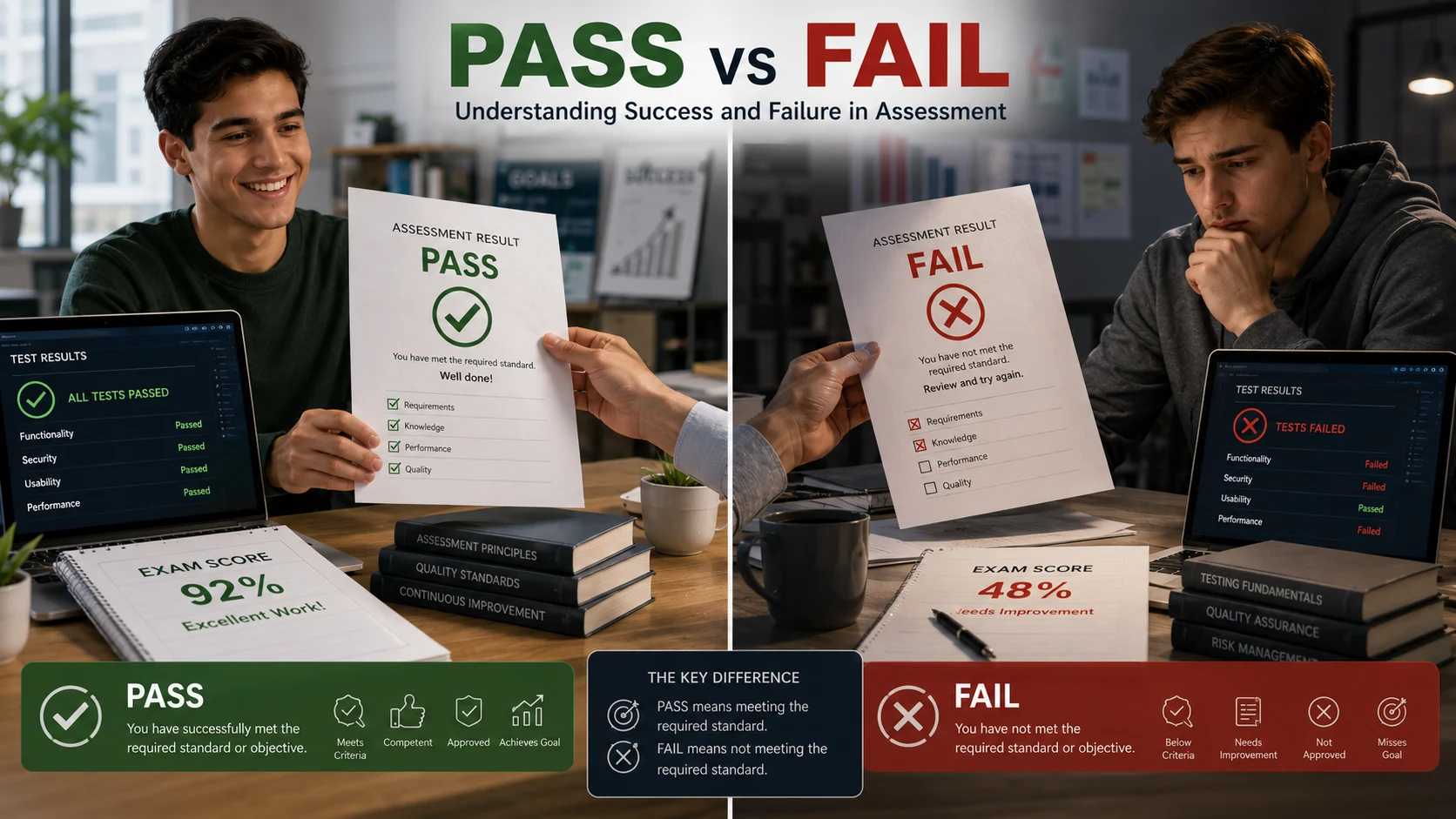
Pass or fail describes a simple result in which a person either meets the required standard or does not meet it. Pass means the required level has been achieved, while fail means the required level has not been achieved. The terms are common in exams, assessments, applications, workplace evaluations, software testing, and everyday decisions.
Understanding pass or fail is important because these words can describe an outcome, a decision, a grading method, or a testing result. Although they look simple, confusion can occur when writers use pass as a noun, verb, or adjective, or when fail is used in a sentence where failure is actually intended as a noun.
Pass vs Fail | What’s the Difference?
Pass is primarily a verb meaning to successfully meet a requirement, standard, test, examination, or condition. It can also function as a noun, especially when referring to permission, a successful result, or a ticket that allows entry.
Fail is primarily a verb meaning to be unsuccessful in meeting a required standard or condition. It can also function as a noun, particularly when referring to an unsuccessful result or an instance of failure.
The simplest distinction is based on the outcome. If the required standard has been achieved, the result is a pass. If the standard has not been achieved, the result is a fail.
| Term | Part of Speech | Core Meaning | Common Context | Example |
|---|---|---|---|---|
| Pass | Verb | Successfully meet a requirement | Exams, tests, assessments | She passed the exam. |
| Pass | Noun | A successful result or permission | Exams, entry, travel | He received a pass. |
| Fail | Verb | Not meet a required standard | Exams, tests, inspections | He failed the test. |
| Fail | Noun | An unsuccessful result | Assessments, testing | The project was a fail. |
| Passing | Adjective or participle | Meeting the required standard | Grades and assessments | She earned a passing grade. |
| Failing | Adjective or participle | Not meeting the required standard | Grades and assessments | He received a failing grade. |
The distinction is straightforward.
A person passes when the required standard is met.
A person fails when the required standard is not met.
The words are opposites when they describe an assessment result, but they are not interchangeable.
Is Pass vs Fail a Grammar, Vocabulary or Usage Issue?
The difference is mainly a vocabulary and usage issue, although grammar determines how each word should appear in a sentence.
For example, “She passed the exam” uses passed as a verb. “She received a pass” uses pass as a noun. Likewise, “He failed the exam” uses failed as a verb, while “The inspection was a fail” uses fail as a noun.
The two words are not interchangeable because they express opposite outcomes.
Consider these examples:
“Maria passed her driving test.”
“Maria failed her driving test.”
The grammatical structure is almost identical, but the meaning changes completely because pass indicates success and fail indicates unsuccessful performance.
In formal and academic English, both words are perfectly acceptable. However, the noun fail can sound informal in some contexts. In a formal report, writers may prefer failure, unsuccessful result, or did not meet the required standard.
For example, a casual statement might say:
“The first attempt was a fail.”
A formal report might say:
“The first attempt did not meet the required standard.”
This difference matters in professional communication because word choice can affect tone even when the underlying meaning remains clear.
How to Use Pass Correctly
The verb pass is commonly used when someone successfully completes an examination, assessment, inspection, test, or requirement.
“She passed the mathematics examination.”
“They passed the safety inspection.”
“I passed my driving test.”
The word can also describe successfully meeting a particular standard.
“The product passed the quality check.”
“The application passed the initial review.”
Pass in the Workplace
In professional settings, pass often appears in evaluations, quality control, compliance procedures, interviews, and certification processes.
For example:
“The candidate passed the technical assessment.”
“The equipment passed the safety inspection.”
“The document passed the compliance review.”
These sentences clearly indicate that a required condition was satisfied.
Pass in Academic Writing
Academic environments use pass extensively when discussing examinations, courses, assignments, and degree requirements.
For example:
“Students must pass all required examinations.”
“She passed the final assessment with a strong result.”
“The student passed the course after completing the required work.”
Notice that pass does not necessarily mean excellent performance. A person can pass by meeting the minimum required standard without achieving the highest grade.
Pass in Technology
Technology frequently uses pass to describe successful tests, validation procedures, automated checks, and system conditions.
For example:
“The software passed all validation tests.”
“The application passed the security check.”
“The automated test passed successfully.”
In software testing, a pass normally means that the observed result matched the expected result under the specified conditions.
Usage Recap for Pass
Use pass when someone or something successfully meets a required condition.
Use passed for a completed successful action in the past.
Use passing when describing something that meets the required standard.
Use pass as a noun when referring to a successful result or permission, depending on context.
How to Use Fail Correctly
The verb fail means that someone or something did not achieve a required standard, condition, or result.
“He failed the examination.”
“The machine failed the inspection.”
“The software failed the test.”
The word can describe both human performance and the performance of objects, systems, processes, or plans.
Fail in the Workplace
In professional communication, fail is useful when describing an unsuccessful assessment or process.
“The applicant failed to meet the stated requirements.”
“The product failed the quality inspection.”
“The system failed the diagnostic test.”
The construction fail to is especially common in formal English.
For example:
“The company failed to provide the required documents.”
This means the company did not provide them as required.
Fail in Academic Writing
In education, fail commonly describes a student who does not achieve the minimum passing standard.
“He failed the final examination.”
“She failed to meet the course requirements.”
“The assignment received a failing grade.”
The noun failure is often more appropriate than fail in formal academic writing.
For example:
“The examination resulted in a failure to meet the minimum standard.”
Fail in Technology
Fail is extremely common in technology because systems are frequently evaluated through automated tests and validation procedures.
“The test failed because the expected output did not match the actual output.”
“The server failed the health check.”
“The authentication process failed.”
In these contexts, fail is not necessarily a judgment about quality in a broad sense. It usually means that a particular requirement or expected condition was not satisfied.
Usage Recap for Fail
Use fail when a required standard has not been achieved.
Use failed for an unsuccessful completed action.
Use failing to describe something that is currently not meeting the required standard.
Use failure when a formal noun is needed.
When You Should NOT Use Pass or Fail
Knowing when not to use these words can prevent subtle errors in professional and academic writing.
1. Do not use pass when the meaning is simply physical movement
“Walk through the door” may describe movement, while “pass the test” describes successful completion. Although pass can have a movement meaning, context determines which sense is intended.
2. Do not use fail when you mean deliberate refusal
“He failed the invitation” is incorrect if the intended meaning is that he declined an invitation.
Use:
“He declined the invitation.”
3. Do not use pass when you mean receive a grade
If you mean the specific grade or score, use the appropriate grading term.
“She received an A.”
“She passed the course.”
These statements communicate different levels of detail.
4. Do not use fail as a formal noun without considering tone
“The project was a fail” may work in casual conversation, but “The project was unsuccessful” is usually better for formal reports.
5. Do not confuse fail with failure
“Failure” is the standard noun in formal English.
“The system experienced a failure.”
“The system failed the test.”
6. Do not assume passing means excellent performance
Passing generally means meeting the minimum required standard. It does not automatically indicate exceptional achievement.
7. Do not use fail when a requirement was never applicable
If a person was not required to complete an assessment, saying they failed it can create a misleading impression.
8. Do not treat pass and fail as universal judgments
A system can pass one test and fail another. The result applies to the specific requirement being assessed.
Common Mistakes and Decision Rules
Many mistakes happen because writers focus on the general idea of success or failure instead of the grammatical role of the word.
| Correct Sentence | Incorrect Sentence | Explanation |
|---|---|---|
| She passed the exam. | She pass the exam yesterday. | A completed past action requires passed. |
| He failed the test. | He fail the test yesterday. | Failed is the correct past tense. |
| She passed the course. | She failed the course successfully. | Pass and fail express opposite outcomes. |
| The system passed the check. | The system passed failure. | Pass must match the intended assessment meaning. |
| He failed to submit the form. | He failed submitting the form. | Fail to is the standard construction for an action not completed. |
| The inspection was successful. | The inspection was a pass in every formal report. | Pass as a noun can sound less formal depending on context. |
| The system experienced a failure. | The system experienced a fail. | Failure is generally preferred as the formal noun. |
Decision Rule
If you mean successful completion or achievement of a required standard, use pass. If you mean unsuccessful completion or failure to meet that standard, use fail.
A useful test is to ask one question: Was the required standard achieved?
If the answer is yes, choose pass.
If the answer is no, choose fail.
Pass and Fail in Modern Technology and AI Tools
Modern technology relies heavily on pass and fail language because digital systems constantly evaluate conditions.
Automated testing systems may label an individual test as passed or failed. Security tools may report a scan passed its required checks. Data validation systems can determine information meets predefined rules.
Artificial intelligence systems can also use pass and fail concepts during evaluation. For example, an AI model might be tested against a benchmark where each response is assessed according to defined criteria.
However, human language requires more nuance than a simple binary result. A system might pass one evaluation while performing poorly in another. Therefore, pass or fail should always be connected to the particular criterion being measured.
This is especially important in technical documentation. Saying “the system passed” without explaining what it passed can be vague. A clearer statement is:
“The system passed the authentication test but failed the performance test.”
That sentence gives the reader useful information instead of presenting an overly broad conclusion.
Etymology and Language History of Pass and Fail
Pass entered English through Old French and ultimately traces back to Latin roots associated with movement and going through. Over time, its meanings expanded from physical movement to successfully getting through a barrier, examination, or requirement.
Fail came into English through Old French and is related to Latin fallere, meaning to deceive, disappoint, or fail. Its modern meaning developed around not succeeding or not achieving an expected result.
The historical development of both words helps explain why they now appear in many contexts. Pass can describe movement, permission, transmission, and successful completion, while fail has developed into a broad term for unsuccessful performance.
An expert style rule worth remembering is:
“Choose pass when the required standard has been met, and choose fail when that standard has not been met.”
This principle works across education, employment, testing, technology, and everyday communication.
Two Practical Case Studies
Case Study One: Academic Assessment
Imagine a university course requiring students to achieve at least 50 percent on a final examination.
Student A earns 67 percent. The student passes because the score exceeds the required threshold.
Student B earns 43 percent. The student fails because the score is below the required threshold.
The important point is that pass and fail describe the relationship between the result and the established standard. They do not describe a person’s overall intelligence or ability.
Case Study Two: Software Testing
Suppose a software application must return a correct result for 100 predefined test cases.
If all required cases produce the expected result, the test suite can be described as having passed.
If one or more mandatory tests produce an unacceptable result, the relevant test or test suite may be marked as failed, depending on the testing rules.
This example shows why pass and fail should be connected to defined criteria. A software application may pass one evaluation while failing another without contradiction.
Error Prevention Checklist
Use this checklist before publishing or submitting your writing.
Always use Pass when
The required standard has been achieved.
Someone successfully completes an examination.
A product successfully meets an inspection requirement.
A system successfully completes a defined test.
A candidate successfully meets a stated condition.
You are describing a successful assessment result.
Never use Fail when
The required standard has clearly been achieved.
You actually mean decline or refuse.
You need the formal noun and failure would be more appropriate.
The person was never required to complete the assessment.
The sentence suggests that passing and failing could occur simultaneously under the same criterion.
Pass or Fail in Formal and Informal English
Context can determine which form sounds most natural.
In everyday conversation, people often say:
“I passed.”
“I failed.”
“The test was a fail.”
The first two are completely natural in both spoken and written English. The third is more conversational.
In formal writing, precision is usually preferred:
“The candidate passed the assessment.”
“The candidate did not meet the required standard.”
“The assessment resulted in a failure.”
This distinction is useful for reports, applications, academic papers, business documents, and official correspondence.
Related Grammar Confusions You Should Master
Learning pass and fail becomes even easier when you understand other commonly confused English terms. Important examples include:
- Accept vs Except: accept means receive or agree, while except means exclude.
- Affect vs Effect: affect is commonly a verb, while effect is commonly a noun.
- Compliment vs Complement: compliment expresses praise, while complement means something that completes or enhances another thing.
- Practice vs Practise: practice is the standard noun in British English, while practise is the corresponding verb.
- Principal vs Principle: principal refers to a person or something primary, while principle means a rule or belief.
- Stationary vs Stationery: stationary means not moving, while stationery refers to writing materials.
- Licence vs License: British English generally uses licence as the noun and license as the verb, while American English normally uses license for both.
- Lose vs Loss: lose is a verb, while loss is a noun.
- Advice vs Advise: advice is a noun, while advise is a verb.
- Then vs Than: then usually relates to time or sequence, while than is used for comparison.
These distinctions matter because accurate vocabulary improves clarity, credibility, and search quality across virtually every form of professional writing.
FAQs
What does pass or fail mean?
Pass or fail describes a person, product, process, or system has met a required standard or condition.
Is pass the opposite of fail?
Yes. When discussing an assessment or required standard, pass indicates success and fail indicates that the required standard was not achieved.
Should I say passed or pass?
Use passed when describing a completed past action, such as “She passed the exam.” Use pass for present tense or after appropriate helping verbs.
What is the noun form of fail?
The standard formal noun is failure. Fail can also function as an informal noun in expressions such as “That was a fail.”
Does passing mean getting a high grade?
No. Passing normally means meeting the minimum required standard, not necessarily achieving an excellent result.
Is pass or fail formal English?
Yes. Both words are standard English, although fail as a noun can sound informal, so failure may be preferable in formal writing.
What is the difference between pass and passing?
Pass is commonly used as a verb or noun, while passing can describe something that meets the required standard or the act of moving through something.
What is the difference between fail and failure?
Fail is commonly used as a verb, while failure is the standard noun used to describe an unsuccessful result or event.
Can a system pass one test and fail another?
Yes. A system can pass one evaluation while failing another because each test may measure a different requirement.
Conclusion
The difference between pass or fail is ultimately a question of outcome and context. Use pass when a person, product, process, or system meets the required standard. Use fail when the required standard is not met.
For everyday, academic, workplace, and technical writing, the most reliable decision is simple: identify the requirement first, then determine it was achieved. This approach prevents grammatical mistakes while also producing clearer and more precise English.
Discover More Related Articles:
- Maui or Kauai | Which Hawaiian Island Is Right for You In 2026
- Play or Draw | What Happens When a Game Ends Even In 2026
- Dinner or Diner | One Means a Meal, the Other Is a Restaurant In 2026