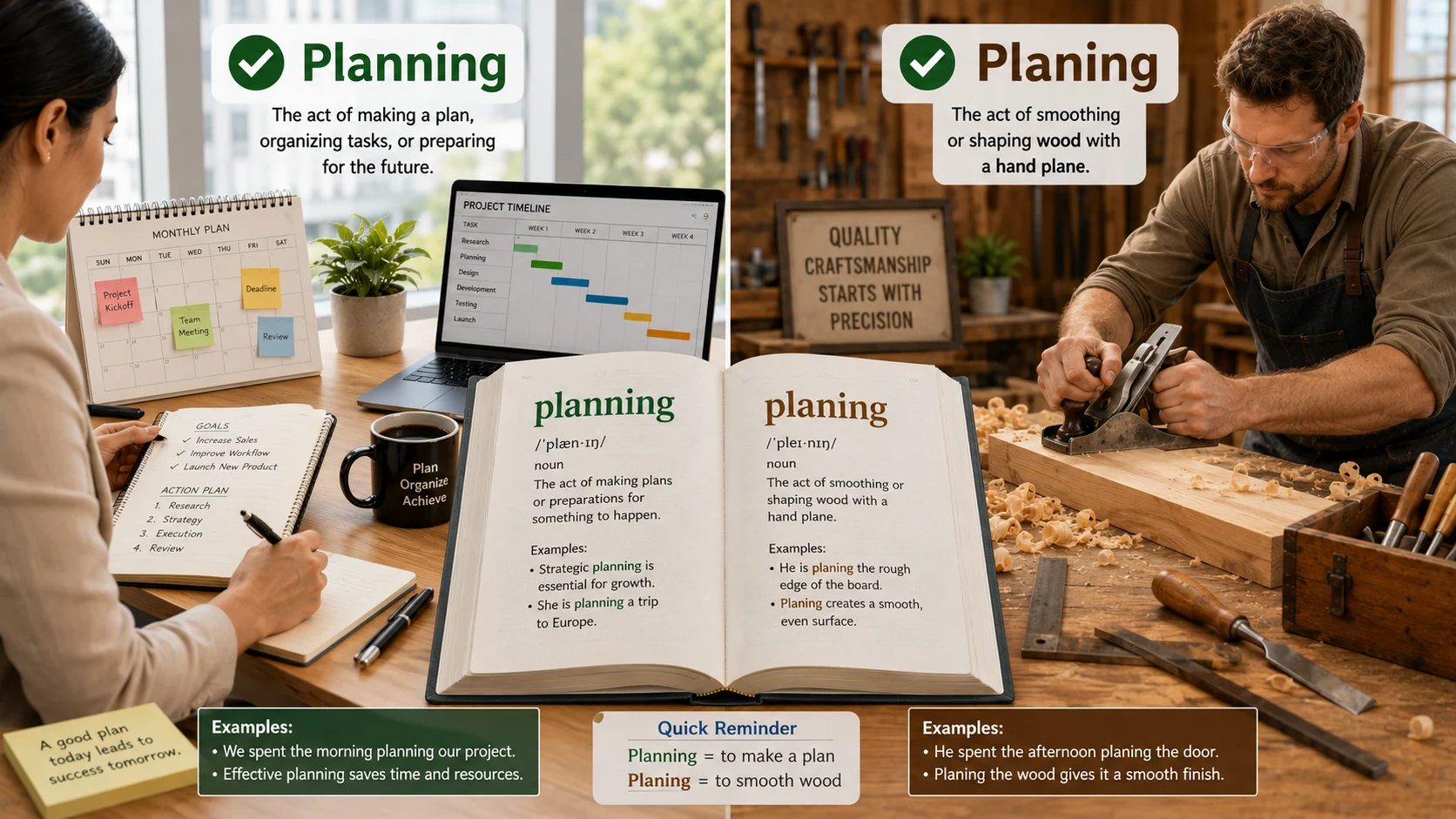
Planning or planing often causes confusion because the two words look almost identical but have very different meanings. Planning is the correct spelling for the process of making plans or organizing future actions. Planing refers to smoothing or shaping a surface with a plane, usually in woodworking or manufacturing. Choosing the wrong word can completely change the meaning of a sentence.
The question planning or planing is one of the most common spelling and usage dilemmas in English. At first glance, the words appear nearly identical, yet they belong to different contexts and carry separate meanings. Planning is the present participle and gerund form of the verb plan, meaning to prepare or organize something before it happens. Planing, on the other hand, is the present participle of the verb plane, which means to smooth or level a surface with a tool or machine.
This confusion often leads to embarrassing mistakes in business emails, academic assignments, project proposals, and even online content. Understanding when to use each word will improve your writing, make your communication more professional, and help you avoid costly misunderstandings.
Planning vs Planing | What Is the Difference?
The simplest way to remember the difference is to focus on the meaning rather than the spelling.
| Word | Part of Speech | Meaning | Common Context |
|---|---|---|---|
| Planning | Noun or Verb | The process of preparing, organizing, or arranging future actions | Business, education, personal goals, project management |
| Planing | Verb | Smoothing or shaping wood, metal, or another material with a plane | Woodworking, carpentry, engineering, manufacturing |
Although both words come from similar looking base words, they describe completely different activities. One relates to organizing ideas and future events, while the other describes a physical process used to shape materials.
If you are discussing schedules, projects, meetings, vacations, or goals, the correct word is planning. If you are talking about woodworking tools or creating smooth surfaces, planing is the correct choice.
Is Planning vs Planing a Grammar, Vocabulary or Usage Issue?
This confusion is mainly a spelling and vocabulary issue rather than a grammar problem.
The two words are not interchangeable because they represent different verbs with unrelated meanings.
In formal writing, using the wrong word can reduce your credibility. Imagine writing, We are planing our marketing campaign. Readers may interpret the sentence as a typo or assume you are talking about woodworking instead of strategy.
In casual conversations, people usually understand your intended meaning through context. However, professional documents, academic papers, and business communications require accurate spelling to maintain clarity.
Modern spell checkers sometimes miss this error because both words are correctly spelled English words. That makes it especially important to understand the difference yourself rather than relying entirely on software.
You are writing for work, school, or online publishing, choosing the correct word reflects careful attention to detail.
Understanding Planning
Planning refers to thinking ahead and organizing actions before carrying them out. It involves identifying goals, setting priorities, allocating resources, and deciding the steps needed to achieve success.
Good planning helps individuals and organizations avoid unnecessary problems and improve efficiency.
Workplace Example
Our team is planning the product launch for next month to ensure every department is prepared.
In this sentence, planning describes organizing tasks before the launch takes place.
Academic Example
The students spent several weeks planning their science exhibition before presenting their projects.
The word highlights preparation and careful organization.
Technology Example
Software developers are planning the next application update based on customer feedback.
Again, the word relates to organizing future work rather than performing a physical action.
Additional Examples
She is planning a family vacation during the summer holidays.
Careful planning reduced the company’s operating costs.
Financial planning helps people achieve long term security.
The event planning committee finalized the schedule yesterday.
Strategic planning plays an important role in business growth.
Why Planning Matters
Planning improves productivity because it reduces uncertainty and provides a clear direction. You are managing a construction project, preparing for an examination, launching a business, or organizing a community event, effective planning increases the likelihood of success.
Many successful organizations dedicate significant time to planning because thoughtful preparation often prevents expensive mistakes later.
Usage Recap
Use planning whenever you are talking about preparation, organization, scheduling, strategy, or future actions. It is the correct choice in business, education, technology, finance, healthcare, and everyday communication.
Understanding Planing
Planing has a completely different meaning. It comes from the verb plane, which means to smooth, flatten, or shape the surface of a material by removing thin layers.
The process is commonly performed with a hand plane, electric planer, or industrial machine.
Workplace Example
The carpenter spent the afternoon planing wooden boards before assembling the cabinets.
Here, the word describes shaping wood with a specialized tool.
Academic Example
Students in the woodworking class learned proper techniques for planing timber safely.
The activity involves practical craftsmanship rather than organization.
Technology Example
Modern factories use automated machines for planing large metal surfaces with remarkable precision.
In engineering and manufacturing, planing improves surface quality before further processing.
Additional Examples
The craftsman carefully finished planing the tabletop.
Workers completed the planing process before painting the wooden panels.
Accurate planing creates smooth surfaces suitable for furniture making.
Machine planing saves time in large manufacturing facilities.
Proper planing improves the appearance of finished wood products.
Why Planing Is Less Common
Outside woodworking, carpentry, engineering, and manufacturing, most people rarely encounter this word. That is why writers often type planing when they actually mean planning.
Because the spelling differs by only one letter, this mistake appears frequently in emails, blogs, business reports, and social media posts.
Usage Recap
Use planing only when referring to smoothing, shaping, or leveling materials with a plane or planer. It should never replace planning when discussing goals, schedules, meetings, projects, or future preparation.
When You Should NOT Use Planning or Planing
Even experienced writers occasionally confuse these words because they differ by only one letter. The easiest way to avoid mistakes is to think about the context before you write.
Do not use planning when you are describing the process of smoothing wood, metal, or another material.
Do not use planing when discussing business strategies, project management, meetings, or future goals.
Do not write planing in resumes, cover letters, or professional emails unless you actually work in carpentry or manufacturing.
Do not replace planning with planing in academic essays because the sentence will become incorrect even though the spelling checker may not flag it.
Do not assume spell checking software will catch the mistake. Since both words are valid English words, many grammar tools accept either spelling.
Do not choose a word based only on pronunciation. Instead, think about the meaning you want to express.
Do not forget that planning is far more common in everyday English, while planing appears mainly in technical fields.
Common Mistakes and Decision Rules
| Correct Sentence | Incorrect Sentence | Explanation |
|---|---|---|
| We are planning a company conference. | We are planing a company conference. | Organizing an event requires planning. |
| She is planning her university applications. | She is planing her university applications. | The sentence is about preparation, not woodworking. |
| The carpenter is planing the wooden table. | The carpenter is planning the wooden table. | The action involves smoothing wood, so planing is correct. |
| Workers finished planing the boards before painting them. | Workers finished planning the boards before painting them. | The material is being shaped with a plane, making planing the correct choice. |
| Careful planning improves business success. | Careful planing improves business success. | Strategic preparation always uses planning. |
| The machine is planing the metal surface. | The machine is planning the metal surface. | The machine is smoothing a surface, which requires planing. |
Decision Rule Box
If you mean the action of preparing, organizing, scheduling, or thinking ahead, use planning.
If you mean smoothing or shaping a surface with a plane or planer, use planing.
A simple memory trick is to remember that planning contains a double n, just as successful preparation often requires more than one step. Planing has a single n because it comes directly from the word plane.
Planning and Planing in Modern Technology and AI Tools
Modern writing assistants and artificial intelligence tools have become much better at identifying spelling errors, but they can still miss mistakes involving correctly spelled words.
For example, if you write, Our team is planing a new marketing strategy, many spelling checkers may not highlight the error because planing is a legitimate English word.
Context aware AI writing tools are improving at recognizing the intended meaning, but human proofreading remains essential. Understanding the difference yourself is still the most reliable way to avoid errors in professional writing.
The Origin of Both Words
The word plan comes from the Latin word planum, meaning a drawing or a flat surface. Over time, it developed the modern meaning of preparing or designing something before it happens.
The word plane comes from the Latin word planus, meaning flat or level. It later became the name of the woodworking tool used to smooth surfaces.
Although the words share historical roots, their meanings have evolved in completely different directions.
Expert Insight
“Strong writing depends not only on good ideas but also on choosing words that communicate those ideas accurately. Small spelling differences can create entirely different meanings.”
This principle is especially true when comparing planning and planing.
Case Study One
A software company published a product announcement stating that it was planing its next software release.
Customers noticed the mistake immediately, and several comments on social media questioned the company’s professionalism.
After correcting the spelling to planning, the announcement appeared more polished and credible.
Result
The company improved its professional image and prevented further confusion among readers.
Case Study Two
A woodworking magazine published an article explaining techniques for planing hardwood boards.
An editor unfamiliar with woodworking mistakenly replaced every instance of planing with planning.
Professional carpenters quickly pointed out the error because the article no longer described the correct woodworking process.
Result
The publication restored the original wording, ensuring technical accuracy for its audience.
Error Prevention Checklist
Always use planning when you are discussing preparation, organization, goals, schedules, strategies, meetings, projects, or future actions.
Always use planning in business writing, academic papers, marketing content, and everyday communication.
Never use planing unless you are referring to smoothing or shaping a material with a plane or planer.
Never replace planning with planing simply because the words sound similar.
Always read the sentence in context before deciding which spelling is correct.
Remember that spell checkers may not detect this particular mistake.
Related Grammar Confusions You Should Master
Understanding similar word pairs can improve both your writing accuracy and confidence.
Planning or planningly
Advice or advise
Practice or practise
Affect or effect
Complement or compliment
Principal or principle
Stationary or stationery
Breath or breathe
Loose or lose
FAQs
Is planning or planing the correct spelling for organizing future activities?
The correct spelling is planning. It refers to preparing, organizing, or arranging future actions. You are discussing business, education, travel, or personal goals, planning is the appropriate word.
What does planing mean in English?
Planing means smoothing or shaping a surface with a plane or planer. It is commonly used in woodworking, carpentry, engineering, and manufacturing.
Why do people confuse planning and planing?
The words differ by only one letter and are pronounced similarly. Since both are correctly spelled English words, many writers accidentally choose the wrong one without noticing.
Can grammar checkers detect the difference between planning and planing?
Not always. Many grammar and spell checking tools accept both spellings because each is a valid English word. Context is what determines which one is correct.
Is planing ever correct in business writing?
Only if the document is specifically discussing woodworking, manufacturing, or engineering processes. Otherwise, business writing almost always requires planning.
Why does planning have two letter n characters?
When the verb plan becomes planning, the final consonant is doubled before adding ing according to standard English spelling rules.
How can I remember the difference between planning and planing?
Think about the meaning. If you are preparing for the future, choose planning. If you are smoothing wood or another material with a tool, choose planing.
Which spelling is more common in everyday English?
Planning is far more common because people frequently discuss goals, schedules, meetings, and projects. Planing is mainly used in technical professions such as carpentry and manufacturing.
Conclusion
Understanding the difference between planning and planing is easier once you focus on meaning instead of spelling. Planning relates to preparation, organization, and future actions, making it the correct choice for everyday communication, business writing, and academic work.
Planing refers only to smoothing or shaping materials with a plane, making it a specialized term used mainly in woodworking and manufacturing.
Whenever you are unsure, ask yourself a simple question. Are you organizing something for the future, or are you shaping a physical surface? The answer will almost always lead you to the correct word.
Discover More Related Articles:
- Input or Imput | One Letter Can Cost You Credibility In 2026
- Latter or Ladder | Why This Pair Confuses So Many Writers In 2026
- Niece or Neice | Never Get This Spelling Wrong Again In 2026